
Last summer, my sister and I escaped to NYC for 36 hours. We packed in a show, some good shopping , and a lot of good eating including breakfast at Eataly and dinner at Momofuku.
I’m pretty sure I’ve mentioned this getaway before — sorry, I don’t get out much — but after discovering that Danish pastry dough can be made in the food processor and, as a result, that cheese danishes can be whipped up in just a few hours, I found myself dreaming about other danish-like pastries, croissants in particular, ones brimming with prosciutto à la Eataly specifically.
The breakfast pastries we ate at Eataly were served at room temperature and were filled with slices of meat sandwich-style. They inspired me to make the pain au jambon I had read about in the Tartine cookbook, in which smoked ham and cheese are rolled and baked with the dough.
Guided by Tartine , I layered thin slices of prosciutto and batons of gruyère over my faux croissant dough, and before too long, a half dozen crackly golden pastries emerged from my oven, cheese oozing from the ridges, salty meat entwined with each flaky layer.
If you read this post about the cheese danishes , you know I am in awe of this dough. Without any labor-intensive butter-laminating process, this pastry dough bakes into a puff of feather-light layer upon feather-light layer. It’s astonishing.
Perhaps more astonishing, however, is how the finished croissants — how so many good croissants — feel and taste about as light as rice cakes, as if very little butter went into their creation at all. How do they do that? What a sham.
In any case, the possibilities with this dough seem endless — croissants aux amandes , pain au chocolat , morning buns, plain croissants perhaps made for the sole purpose of making croissant bread pudding or French toast the following day?
If you are hosting a holiday brunch, know that the rolled croissants can be prepared a day in advance, stored in the fridge for up to 18 hours, and after a three-hour rise the following morning, baked to golden perfection.
As with the cheese danishes, too, they reheat incredibly well on subsequent mornings, and when halved and toasted and filled with a fried egg, they make just about the best breakfast sandwich you could ever imagine.









These are two rolled croissants that spent 12 hours in the fridge. The following morning, after letting them rise for 3 hours…

…they baked off beautifully. This is nice to know if you want to shape the croissants the night before you plan on serving them.

Toasted, halved, and topped with a fried egg. Yum.
Description
If you want to make cheese danishes, view this post . Day-old pastries reheat nicely at 350ºF for 10 minutes or so.
processor danish pastry:
- 1/4 cup ( 60 ml) warm water
- 1/2 cup ( 125 ml) milk at room temperature
- 1 large egg at room temperature
- 2 1/4 cups ( 286 g ) all-purpose flour
- 1 package (2.25 tsp. | 7 g) instant yeast
- 1 teaspoon kosher salt
- 1 tablespoon ( 25g ) sugar
- 1 cup ( 250 g ) unsalted butter, cold, cut into thin slices
pain au jambon:
- 8 to 16 thin slices prosciutto di Parma or smoked ham (depending on how many croissants you are making)
- Gruyère or similar cheese, about 1/2 oz per croissant (I used 4 oz. total), cut into matchstick-sized pieces
- egg wash: 1 egg beaten with 2 tablespoons of milk
- Make the pastry: If you are using instant yeast or fresh yeast and have planned ahead such that you know you will be refrigerating the dough over night: Pour the water and milk into a measuring cup and add the egg, beating with a fork to mix. Set aside. If you need to speed up your dough-making process or want to make sure your yeast is alive and well: Sprinkle yeast over the warm water and milk with a little bit of the sugar (I take 1/2 teaspoon from the 1 tablespoon) and let stand until the mixture starts to foam a little bit. Then, beat egg with a fork until broken up and add to milk-yeast mixture. Beat mixture with fork again until just combined. Set aside.
- Place a large bowl near your food processor. Then put the flour, yeast (if you haven’t mixed it with the milk), salt and sugar in the processor, and give it one quick whizz just to mix. Add the cold slices of butter and process briefly so that the butter is cut up a little. You still want visible chunks of butter about least 1/2 inch in size — about 10 to 15 short pulses.
- Empty the contents of the food processor into the large bowl, then add in the milk-egg mixture. Use your hands or a rubber spatula to mix the ingredients together, but don’t overdo it: expect to have a gooey mess with some butter lumps pebbling it. Cover the bowl with plastic wrap, put in the refrigerator, and leave overnight or up to 4 days. (Note: If you have “bloomed” your yeast as noted in step 1, you can get away with two hours in the fridge at this step.)
- To turn the dough into pastry, take it (or half of it — I find it easier to work with half the amount of dough at this step) out of the refrigerator, let it get to room temperature (or don’t if you are pressed for time) and roll the dough out into a 20-inch square. (Note: Don’t worry too much about inches here — just try to roll the dough out into a large square that is relatively thin. Also, you will need to lightly dust your work surface with flour and add more flour as needed to your rolling pin and board.) Fold the dough square into thirds, like a business letter, turning it afterward so that the closed fold is on your left, like the spine of a book. Roll the dough out again into a large square (mine always looks more like a rectangle), repeating the steps above 3 times.
- Wrap the dough in plastic wrap, and put it in the refrigerator for 30 minutes (you can keep it in the refrigerator for up to 4 days, if you haven’t already done so at the earlier stage), or refrigerate half to use now and put the other half in the freezer to use later. (Note: If you are pressed for time, skip this 30 minute chill time.)
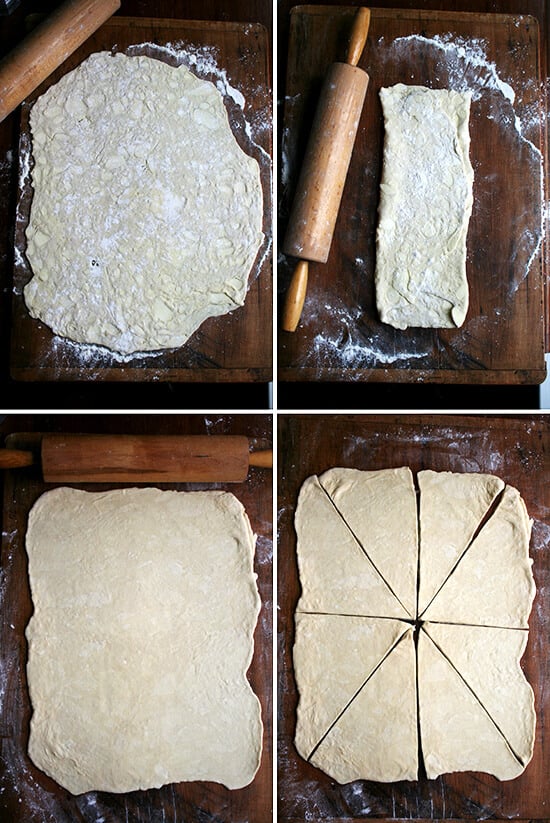
- Roll the croissants: Roll the dough out again into a large square or rectangle. Cut the dough in half lengthwise and crosswise. Then cut each each of the four pieces created in half diagonally. (See pictures for guidance.)
- Lay a piece of prosciutto or smoked ham over two-thirds (or more) of each triangle, leaving the pointed tip uncovered. Scatter the batons of Gruyère over top. Starting with the wide base of each triangle, carefully roll up each croissant, encasing the ham and cheese as you go.
- Place the rolled croissants on a baking sheet lined with parchment paper and brush with the egg wash. Leave them to rise until they double in size, about 1 1/2 hours; they should then feel like marshmallow. (Note: With both the cheese danishes and these croissants, it never looks as though the pastries have doubled nor does the texture of the dough feel as fluffy marshmallow. I just stick them in the oven after 1.5 hours regardless of how they look.)
- Meanwhile, about 30 minutes before they’re ready to be cooked, preheat the oven to 350°F. Place in the oven and bake for 15 to 20 minutes or until puffy and golden brown.
- Prep Time: 12 hours
- Cook Time: 20 minutes
- Category: Breakfast
- Method: Baked
- Cuisine: French
Last summer, my sister and I escaped to NYC for 36 hours. We packed in a show, some good shopping , and a lot of good eating including breakfast at Eataly and dinner at Momofuku.
I’m pretty sure I’ve mentioned this getaway before — sorry, I don’t get out much — but after discovering that Danish pastry dough can be made in the food processor and, as a result, that cheese danishes can be whipped up in just a few hours, I found myself dreaming about other danish-like pastries, croissants in particular, ones brimming with prosciutto à la Eataly specifically.
The breakfast pastries we ate at Eataly were served at room temperature and were filled with slices of meat sandwich-style. They inspired me to make the pain au jambon I had read about in the Tartine cookbook, in which smoked ham and cheese are rolled and baked with the dough.
Guided by Tartine , I layered thin slices of prosciutto and batons of gruyère over my faux croissant dough, and before too long, a half dozen crackly golden pastries emerged from my oven, cheese oozing from the ridges, salty meat entwined with each flaky layer.
If you read this post about the cheese danishes , you know I am in awe of this dough. Without any labor-intensive butter-laminating process, this pastry dough bakes into a puff of feather-light layer upon feather-light layer. It’s astonishing.
Perhaps more astonishing, however, is how the finished croissants — how so many good croissants — feel and taste about as light as rice cakes, as if very little butter went into their creation at all. How do they do that? What a sham.
In any case, the possibilities with this dough seem endless — croissants aux amandes , pain au chocolat , morning buns, plain croissants perhaps made for the sole purpose of making croissant bread pudding or French toast the following day?
If you are hosting a holiday brunch, know that the rolled croissants can be prepared a day in advance, stored in the fridge for up to 18 hours, and after a three-hour rise the following morning, baked to golden perfection.
As with the cheese danishes, too, they reheat incredibly well on subsequent mornings, and when halved and toasted and filled with a fried egg, they make just about the best breakfast sandwich you could ever imagine.
These are two rolled croissants that spent 12 hours in the fridge. The following morning, after letting them rise for 3 hours…
…they baked off beautifully. This is nice to know if you want to shape the croissants the night before you plan on serving them.
Toasted, halved, and topped with a fried egg. Yum.
Description
If you want to make cheese danishes, view this post . Day-old pastries reheat nicely at 350ºF for 10 minutes or so.
processor danish pastry:
- 1/4 cup ( 60 ml) warm water
- 1/2 cup ( 125 ml) milk at room temperature
- 1 large egg at room temperature
- 2 1/4 cups ( 286 g ) all-purpose flour
- 1 package (2.25 tsp. | 7 g) instant yeast
- 1 teaspoon kosher salt
- 1 tablespoon ( 25g ) sugar
- 1 cup ( 250 g ) unsalted butter, cold, cut into thin slices
pain au jambon:
- 8 to 16 thin slices prosciutto di Parma or smoked ham (depending on how many croissants you are making)
- Gruyère or similar cheese, about 1/2 oz per croissant (I used 4 oz. total), cut into matchstick-sized pieces
- egg wash: 1 egg beaten with 2 tablespoons of milk
- Make the pastry: If you are using instant yeast or fresh yeast and have planned ahead such that you know you will be refrigerating the dough over night: Pour the water and milk into a measuring cup and add the egg, beating with a fork to mix. Set aside. If you need to speed up your dough-making process or want to make sure your yeast is alive and well: Sprinkle yeast over the warm water and milk with a little bit of the sugar (I take 1/2 teaspoon from the 1 tablespoon) and let stand until the mixture starts to foam a little bit. Then, beat egg with a fork until broken up and add to milk-yeast mixture. Beat mixture with fork again until just combined. Set aside.
- Place a large bowl near your food processor. Then put the flour, yeast (if you haven’t mixed it with the milk), salt and sugar in the processor, and give it one quick whizz just to mix. Add the cold slices of butter and process briefly so that the butter is cut up a little. You still want visible chunks of butter about least 1/2 inch in size — about 10 to 15 short pulses.
- Empty the contents of the food processor into the large bowl, then add in the milk-egg mixture. Use your hands or a rubber spatula to mix the ingredients together, but don’t overdo it: expect to have a gooey mess with some butter lumps pebbling it. Cover the bowl with plastic wrap, put in the refrigerator, and leave overnight or up to 4 days. (Note: If you have “bloomed” your yeast as noted in step 1, you can get away with two hours in the fridge at this step.)
- To turn the dough into pastry, take it (or half of it — I find it easier to work with half the amount of dough at this step) out of the refrigerator, let it get to room temperature (or don’t if you are pressed for time) and roll the dough out into a 20-inch square. (Note: Don’t worry too much about inches here — just try to roll the dough out into a large square that is relatively thin. Also, you will need to lightly dust your work surface with flour and add more flour as needed to your rolling pin and board.) Fold the dough square into thirds, like a business letter, turning it afterward so that the closed fold is on your left, like the spine of a book. Roll the dough out again into a large square (mine always looks more like a rectangle), repeating the steps above 3 times.
- Wrap the dough in plastic wrap, and put it in the refrigerator for 30 minutes (you can keep it in the refrigerator for up to 4 days, if you haven’t already done so at the earlier stage), or refrigerate half to use now and put the other half in the freezer to use later. (Note: If you are pressed for time, skip this 30 minute chill time.)
- Roll the croissants: Roll the dough out again into a large square or rectangle. Cut the dough in half lengthwise and crosswise. Then cut each each of the four pieces created in half diagonally. (See pictures for guidance.)
- Lay a piece of prosciutto or smoked ham over two-thirds (or more) of each triangle, leaving the pointed tip uncovered. Scatter the batons of Gruyère over top. Starting with the wide base of each triangle, carefully roll up each croissant, encasing the ham and cheese as you go.
- Place the rolled croissants on a baking sheet lined with parchment paper and brush with the egg wash. Leave them to rise until they double in size, about 1 1/2 hours; they should then feel like marshmallow. (Note: With both the cheese danishes and these croissants, it never looks as though the pastries have doubled nor does the texture of the dough feel as fluffy marshmallow. I just stick them in the oven after 1.5 hours regardless of how they look.)
- Meanwhile, about 30 minutes before they’re ready to be cooked, preheat the oven to 350°F. Place in the oven and bake for 15 to 20 minutes or until puffy and golden brown.
- Prep Time: 12 hours
- Cook Time: 20 minutes
- Category: Breakfast
- Method: Baked
- Cuisine: French
Last summer, my sister and I escaped to NYC for 36 hours. We packed in a show, some good shopping , and a lot of good eating including breakfast at Eataly and dinner at Momofuku.
I’m pretty sure I’ve mentioned this getaway before — sorry, I don’t get out much — but after discovering that Danish pastry dough can be made in the food processor and, as a result, that cheese danishes can be whipped up in just a few hours, I found myself dreaming about other danish-like pastries, croissants in particular, ones brimming with prosciutto à la Eataly specifically.
The breakfast pastries we ate at Eataly were served at room temperature and were filled with slices of meat sandwich-style. They inspired me to make the pain au jambon I had read about in the Tartine cookbook, in which smoked ham and cheese are rolled and baked with the dough.
Guided by Tartine , I layered thin slices of prosciutto and batons of gruyère over my faux croissant dough, and before too long, a half dozen crackly golden pastries emerged from my oven, cheese oozing from the ridges, salty meat entwined with each flaky layer.
If you read this post about the cheese danishes , you know I am in awe of this dough. Without any labor-intensive butter-laminating process, this pastry dough bakes into a puff of feather-light layer upon feather-light layer. It’s astonishing.
Perhaps more astonishing, however, is how the finished croissants — how so many good croissants — feel and taste about as light as rice cakes, as if very little butter went into their creation at all. How do they do that? What a sham.
In any case, the possibilities with this dough seem endless — croissants aux amandes , pain au chocolat , morning buns, plain croissants perhaps made for the sole purpose of making croissant bread pudding or French toast the following day?
If you are hosting a holiday brunch, know that the rolled croissants can be prepared a day in advance, stored in the fridge for up to 18 hours, and after a three-hour rise the following morning, baked to golden perfection.
As with the cheese danishes, too, they reheat incredibly well on subsequent mornings, and when halved and toasted and filled with a fried egg, they make just about the best breakfast sandwich you could ever imagine.
These are two rolled croissants that spent 12 hours in the fridge. The following morning, after letting them rise for 3 hours…
…they baked off beautifully. This is nice to know if you want to shape the croissants the night before you plan on serving them.
Toasted, halved, and topped with a fried egg. Yum.
Description
If you want to make cheese danishes, view this post . Day-old pastries reheat nicely at 350ºF for 10 minutes or so.
processor danish pastry:
- 1/4 cup ( 60 ml) warm water
- 1/2 cup ( 125 ml) milk at room temperature
- 1 large egg at room temperature
- 2 1/4 cups ( 286 g ) all-purpose flour
- 1 package (2.25 tsp. | 7 g) instant yeast
- 1 teaspoon kosher salt
- 1 tablespoon ( 25g ) sugar
- 1 cup ( 250 g ) unsalted butter, cold, cut into thin slices
pain au jambon:
- 8 to 16 thin slices prosciutto di Parma or smoked ham (depending on how many croissants you are making)
- Gruyère or similar cheese, about 1/2 oz per croissant (I used 4 oz. total), cut into matchstick-sized pieces
- egg wash: 1 egg beaten with 2 tablespoons of milk
- Make the pastry: If you are using instant yeast or fresh yeast and have planned ahead such that you know you will be refrigerating the dough over night: Pour the water and milk into a measuring cup and add the egg, beating with a fork to mix. Set aside. If you need to speed up your dough-making process or want to make sure your yeast is alive and well: Sprinkle yeast over the warm water and milk with a little bit of the sugar (I take 1/2 teaspoon from the 1 tablespoon) and let stand until the mixture starts to foam a little bit. Then, beat egg with a fork until broken up and add to milk-yeast mixture. Beat mixture with fork again until just combined. Set aside.
- Place a large bowl near your food processor. Then put the flour, yeast (if you haven’t mixed it with the milk), salt and sugar in the processor, and give it one quick whizz just to mix. Add the cold slices of butter and process briefly so that the butter is cut up a little. You still want visible chunks of butter about least 1/2 inch in size — about 10 to 15 short pulses.
- Empty the contents of the food processor into the large bowl, then add in the milk-egg mixture. Use your hands or a rubber spatula to mix the ingredients together, but don’t overdo it: expect to have a gooey mess with some butter lumps pebbling it. Cover the bowl with plastic wrap, put in the refrigerator, and leave overnight or up to 4 days. (Note: If you have “bloomed” your yeast as noted in step 1, you can get away with two hours in the fridge at this step.)
- To turn the dough into pastry, take it (or half of it — I find it easier to work with half the amount of dough at this step) out of the refrigerator, let it get to room temperature (or don’t if you are pressed for time) and roll the dough out into a 20-inch square. (Note: Don’t worry too much about inches here — just try to roll the dough out into a large square that is relatively thin. Also, you will need to lightly dust your work surface with flour and add more flour as needed to your rolling pin and board.) Fold the dough square into thirds, like a business letter, turning it afterward so that the closed fold is on your left, like the spine of a book. Roll the dough out again into a large square (mine always looks more like a rectangle), repeating the steps above 3 times.
- Wrap the dough in plastic wrap, and put it in the refrigerator for 30 minutes (you can keep it in the refrigerator for up to 4 days, if you haven’t already done so at the earlier stage), or refrigerate half to use now and put the other half in the freezer to use later. (Note: If you are pressed for time, skip this 30 minute chill time.)
- Roll the croissants: Roll the dough out again into a large square or rectangle. Cut the dough in half lengthwise and crosswise. Then cut each each of the four pieces created in half diagonally. (See pictures for guidance.)
- Lay a piece of prosciutto or smoked ham over two-thirds (or more) of each triangle, leaving the pointed tip uncovered. Scatter the batons of Gruyère over top. Starting with the wide base of each triangle, carefully roll up each croissant, encasing the ham and cheese as you go.
- Place the rolled croissants on a baking sheet lined with parchment paper and brush with the egg wash. Leave them to rise until they double in size, about 1 1/2 hours; they should then feel like marshmallow. (Note: With both the cheese danishes and these croissants, it never looks as though the pastries have doubled nor does the texture of the dough feel as fluffy marshmallow. I just stick them in the oven after 1.5 hours regardless of how they look.)
- Meanwhile, about 30 minutes before they’re ready to be cooked, preheat the oven to 350°F. Place in the oven and bake for 15 to 20 minutes or until puffy and golden brown.
- Prep Time: 12 hours
- Cook Time: 20 minutes
- Category: Breakfast
- Method: Baked
- Cuisine: French
Description
If you want to make cheese danishes, view this post . Day-old pastries reheat nicely at 350ºF for 10 minutes or so.
processor danish pastry:
- 1/4 cup ( 60 ml) warm water
- 1/2 cup ( 125 ml) milk at room temperature
- 1 large egg at room temperature
- 2 1/4 cups ( 286 g ) all-purpose flour
- 1 package (2.25 tsp. | 7 g) instant yeast
- 1 teaspoon kosher salt
- 1 tablespoon ( 25g ) sugar
- 1 cup ( 250 g ) unsalted butter, cold, cut into thin slices
pain au jambon:
- 8 to 16 thin slices prosciutto di Parma or smoked ham (depending on how many croissants you are making)
- Gruyère or similar cheese, about 1/2 oz per croissant (I used 4 oz. total), cut into matchstick-sized pieces
- egg wash: 1 egg beaten with 2 tablespoons of milk
- Make the pastry: If you are using instant yeast or fresh yeast and have planned ahead such that you know you will be refrigerating the dough over night: Pour the water and milk into a measuring cup and add the egg, beating with a fork to mix. Set aside. If you need to speed up your dough-making process or want to make sure your yeast is alive and well: Sprinkle yeast over the warm water and milk with a little bit of the sugar (I take 1/2 teaspoon from the 1 tablespoon) and let stand until the mixture starts to foam a little bit. Then, beat egg with a fork until broken up and add to milk-yeast mixture. Beat mixture with fork again until just combined. Set aside.
- Place a large bowl near your food processor. Then put the flour, yeast (if you haven’t mixed it with the milk), salt and sugar in the processor, and give it one quick whizz just to mix. Add the cold slices of butter and process briefly so that the butter is cut up a little. You still want visible chunks of butter about least 1/2 inch in size — about 10 to 15 short pulses.
- Empty the contents of the food processor into the large bowl, then add in the milk-egg mixture. Use your hands or a rubber spatula to mix the ingredients together, but don’t overdo it: expect to have a gooey mess with some butter lumps pebbling it. Cover the bowl with plastic wrap, put in the refrigerator, and leave overnight or up to 4 days. (Note: If you have “bloomed” your yeast as noted in step 1, you can get away with two hours in the fridge at this step.)
- To turn the dough into pastry, take it (or half of it — I find it easier to work with half the amount of dough at this step) out of the refrigerator, let it get to room temperature (or don’t if you are pressed for time) and roll the dough out into a 20-inch square. (Note: Don’t worry too much about inches here — just try to roll the dough out into a large square that is relatively thin. Also, you will need to lightly dust your work surface with flour and add more flour as needed to your rolling pin and board.) Fold the dough square into thirds, like a business letter, turning it afterward so that the closed fold is on your left, like the spine of a book. Roll the dough out again into a large square (mine always looks more like a rectangle), repeating the steps above 3 times.
- Wrap the dough in plastic wrap, and put it in the refrigerator for 30 minutes (you can keep it in the refrigerator for up to 4 days, if you haven’t already done so at the earlier stage), or refrigerate half to use now and put the other half in the freezer to use later. (Note: If you are pressed for time, skip this 30 minute chill time.)
- Roll the croissants: Roll the dough out again into a large square or rectangle. Cut the dough in half lengthwise and crosswise. Then cut each each of the four pieces created in half diagonally. (See pictures for guidance.)
- Lay a piece of prosciutto or smoked ham over two-thirds (or more) of each triangle, leaving the pointed tip uncovered. Scatter the batons of Gruyère over top. Starting with the wide base of each triangle, carefully roll up each croissant, encasing the ham and cheese as you go.
- Place the rolled croissants on a baking sheet lined with parchment paper and brush with the egg wash. Leave them to rise until they double in size, about 1 1/2 hours; they should then feel like marshmallow. (Note: With both the cheese danishes and these croissants, it never looks as though the pastries have doubled nor does the texture of the dough feel as fluffy marshmallow. I just stick them in the oven after 1.5 hours regardless of how they look.)
- Meanwhile, about 30 minutes before they’re ready to be cooked, preheat the oven to 350°F. Place in the oven and bake for 15 to 20 minutes or until puffy and golden brown.
- Prep Time: 12 hours
- Cook Time: 20 minutes
- Category: Breakfast
- Method: Baked
- Cuisine: French
Find it online : https://alexandracooks.com/2013/03/26/prosciutto-gruyere-croissants/




On Easter Sunday 2003, my sister made Nigella Lawson’s Easter Egg Nest cake, a cake that had been featured in The New York Times the Wednesday prior. Studded with flecked pastel eggs, this cake could only suit my sister better if a flock of Peeps and a colony of white chocolate bunnies were nestled among the eggs.
I’m not sure anyone in the family including my sister has made the cake since, but upon finding an old photo of Lindsey presenting her creation at the dinner table, I felt I had to make it. At the very least, I knew it would look festive on the table, the kids would find it enchanting, and my few guests would welcome a sliver of anything chocolaty.
Dense with a mousse-like texture, this cake is definitely for chocolate lovers — intense chocolate lovers. If you have made the torta caprese and are into making comparison charts, this cake has the same amount of chocolate and the same number of eggs for half the amount of butter (one sticks versus two) and no almonds or almond flour (two cups of ground almonds go into the the torta caprese).
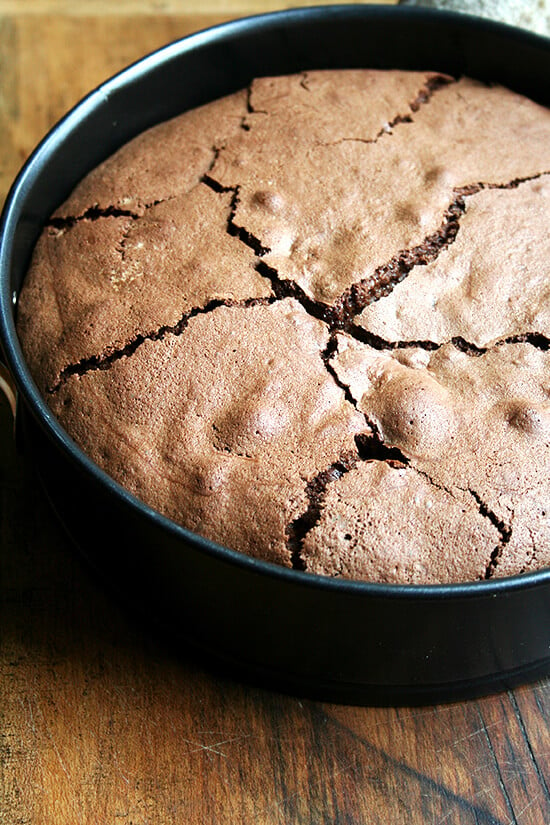
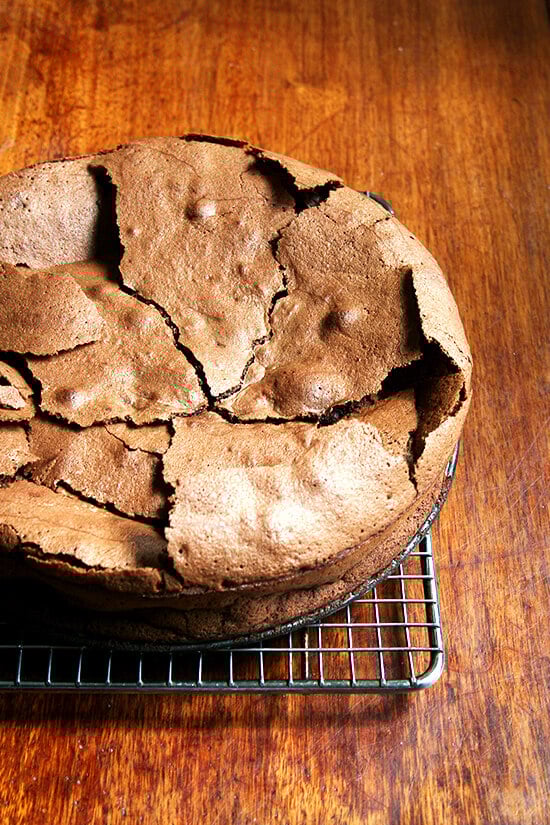
For me, this cake is festive and fun more than anything. It puffs way up when it bakes and sinks when it cools, a crackly meringue-like layer forming a perfect base to house dozens of colorful candy eggs. If you love a rich chocolate cake, this one’s for you.
Have a wonderful holiday and weekend, Everyone. I’ll leave you with my favorite holiday reminder: If you’re making a ham, don’t forget the ham sauce ! Seriously, so good.
A Few More Ideas for Easter can be found here
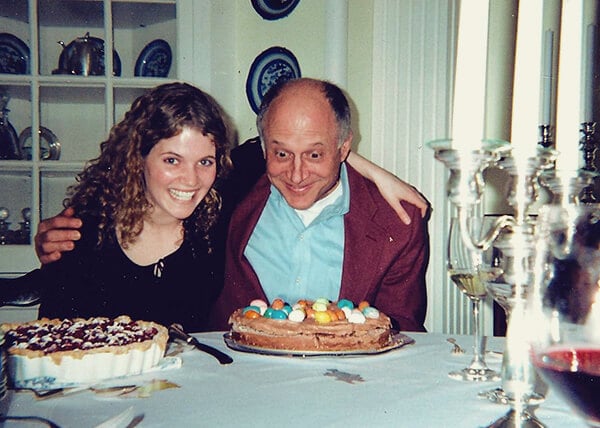
Easter 2003: My sister presenting her Easter Egg Nest Cake with Mr. Ford, a favorite high school teacher and close family friend:

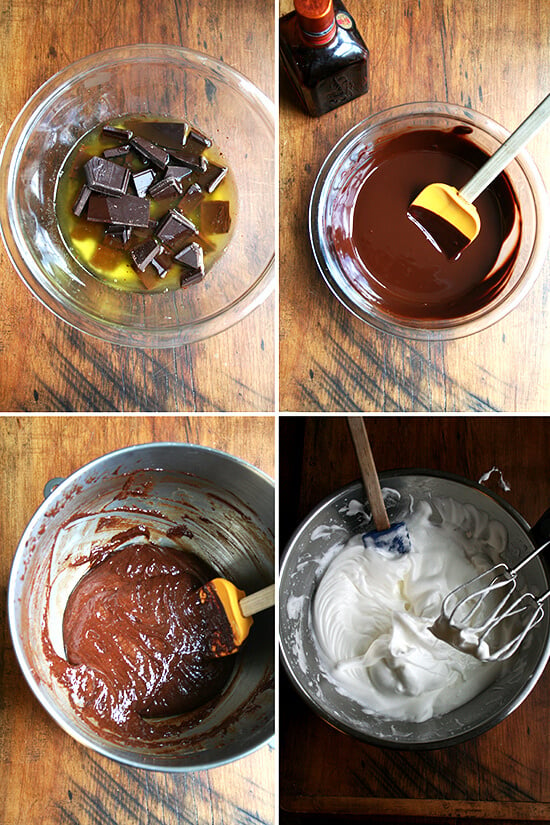
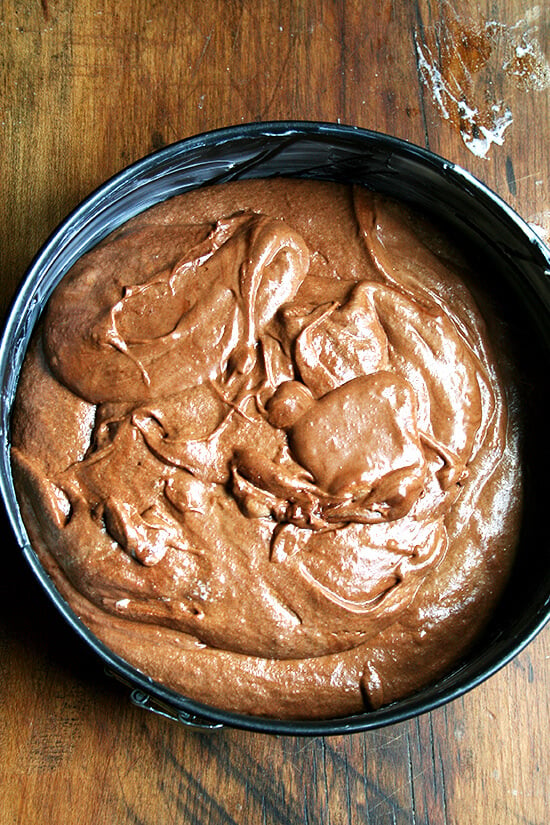
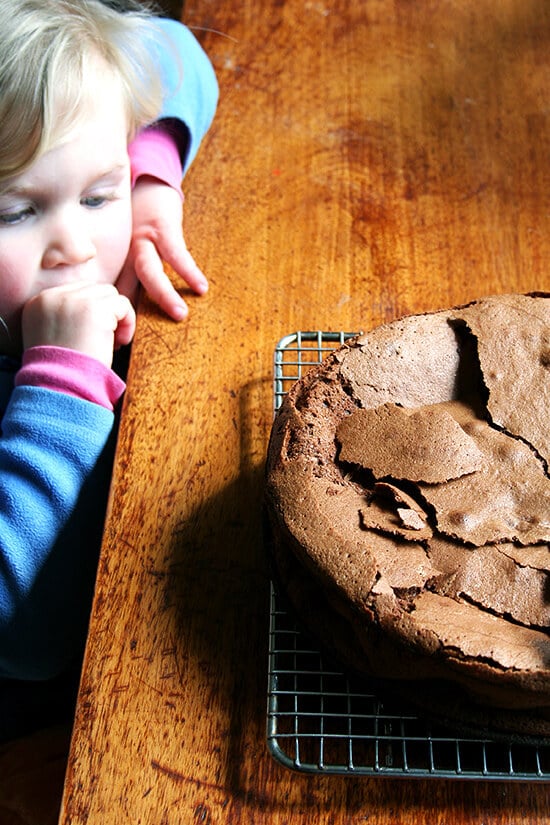
Making the Easter Egg Nest Cake:
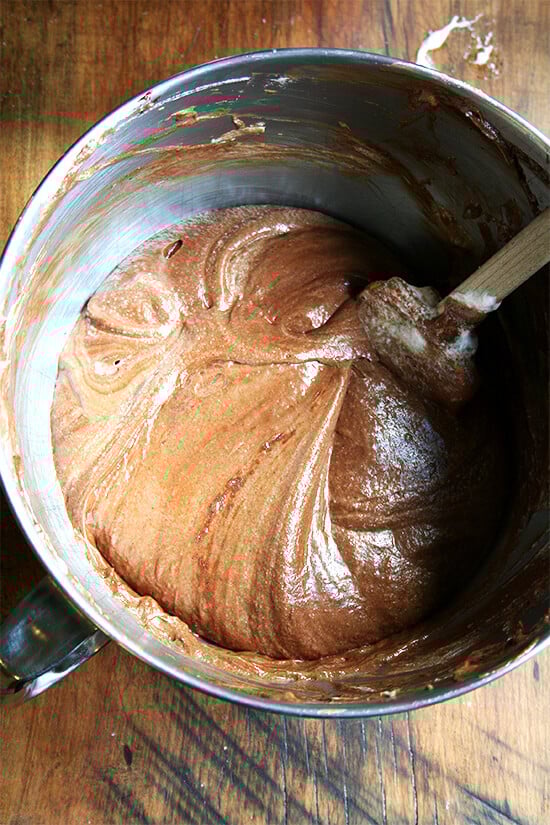

Description
Notes: If you would like to follow the original recipe, find it here . I’ve made two changes: salt has been added as have a couple of tablespoons of booze.
I think this cake really needs a dollop of lightly sweetened (or not) whipped cream or something like a crème anglaise, if you are up for it.
- 8 tablespoons unsalted butter
- 8 ounces bittersweet chocolate, melted
- 6 large eggs: 2 whole; 4 separated
- 1/2 cup plus 1/3 cup superfine sugar
- 1 teaspoon vanilla extract (I omit because I added booze.)
- 1/2 teaspoon nice sea salt (such as Maldon) or kosher salt
- 1 – 2 tablespoons Grand Marnier or Cointreau (optional)
- powdered sugar for garnish
- mini malted eggs or Cadbury cream eggs or whatever you like
- slightly sweetened whipped cream for serving
- Heat oven to 350 degrees. Line the bottom of a 9-inch springform cake pan with parchment paper.
- For the cake: Stir butter into chocolate and let cool. (Note: You can melt the chocolate in a bowl over simmering water or in the top of a double boiler or in the microwave.) Whisk 4 egg whites until foamy. Gradually add 1/2 cup sugar and whisk until whites hold their shape but are not too stiff. Reserve.
- Whisk 2 whole eggs and 4 egg yolks with 1/3 cup of sugar and vanilla until combined. Stir in chocolate to mix. Add the vanilla (if using), the salt, and the booze, if using, and stir to combine.
- In three additions, fold whites into chocolate mixture. Pour into prepared pan and bake for 35 to 40 minutes, or until cake rises, cracks and center is no longer wobbly.
- Cool cake on a wire rack; middle will sink and the sides will crack. Carefully remove cake from pan and place it on serving plate. Once completely cook, arrange Easter eggs on top. Serve with whipped cream.
- Prep Time: 15 minutes
- Cook Time: 45 minutes
- Category: Dessert
- Method: oven
- Cuisine: American, British
