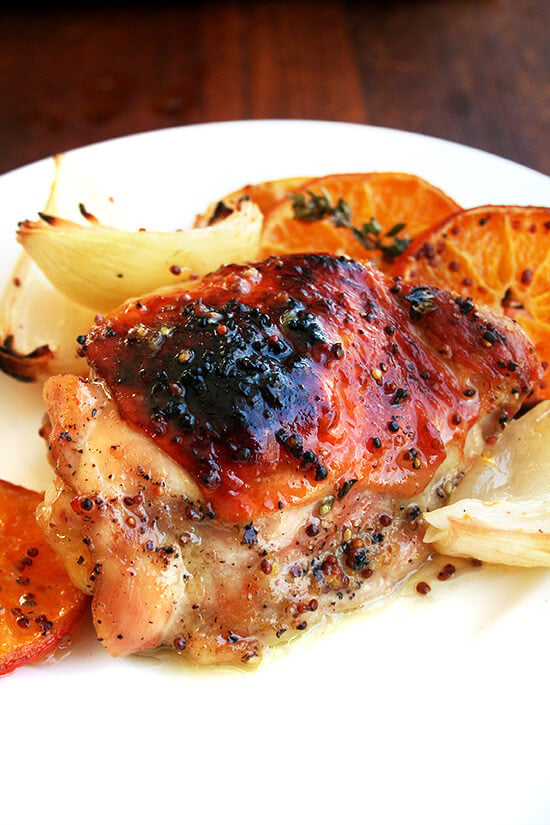
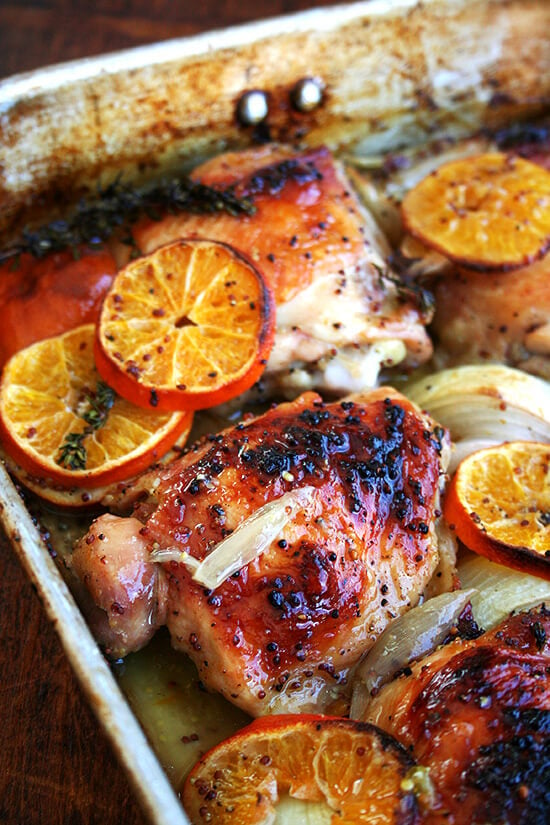
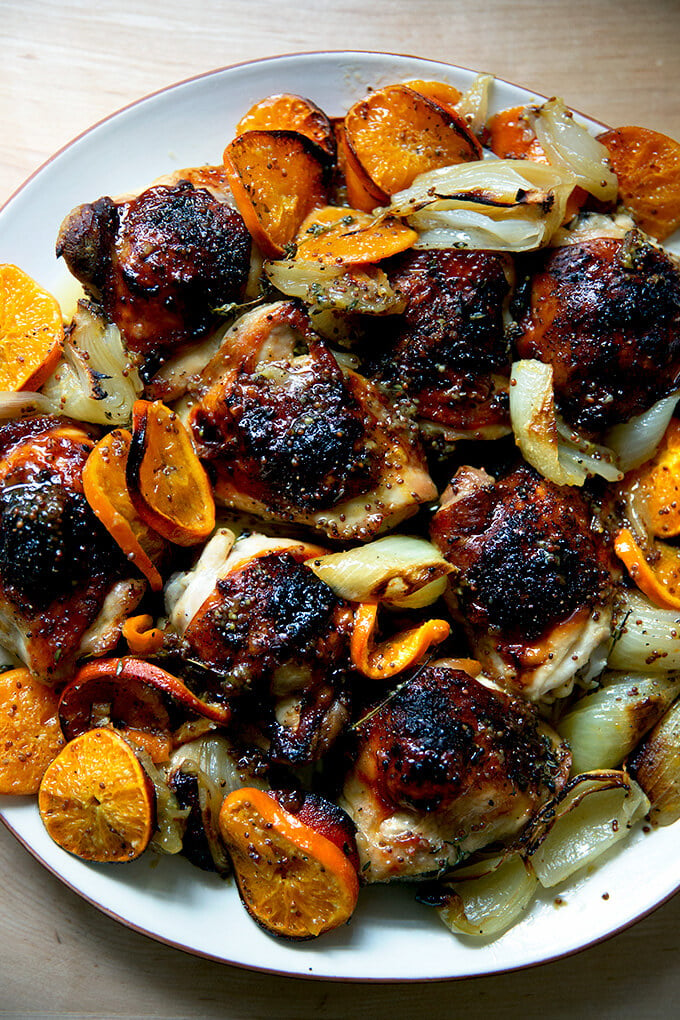
Here’s a low-effort, big-reward chicken recipe: roasted chicken thighs with clementines. It requires about 15 minutes (or less) to throw together, and it bakes for about an hour. The result? A stunning, festive, incredibly delicious assembly of caramelized onions, burnished oranges, and crispy-skinned fall-off-the-bone tender chicken.
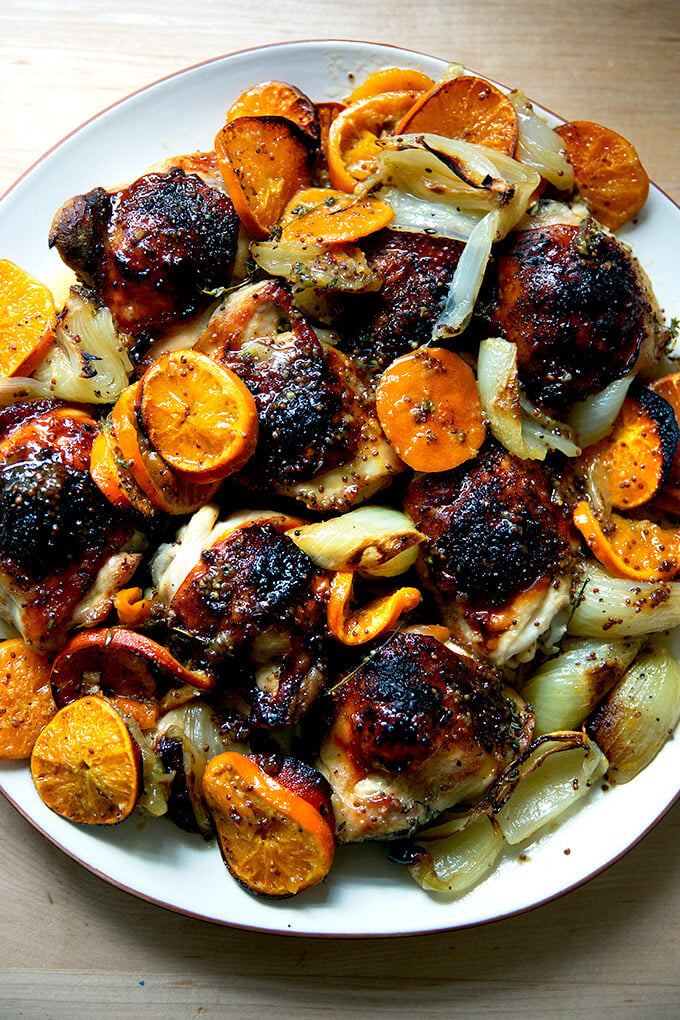
Upon receiving Jerusalem early last summer, I poured through it cover to cover, reading about hummus wars and baba ghanoush, feeling inspired to start burning eggplants and preserving lemons with every turn of the page.
Six months later I’m only just enjoying my first taste of the cookbook: roast chicken with clementines, a recipe my mother has been urging me to make since the start of citrus season.
This recipe calls for high heat — 475ºF — for a long time — just under an hour — which allows the chicken skin to brown and the vegetables to caramelize beautifully. The liquid, a mixture of freshly squeezed citrus juice and some sort of anise-flavored liqueur (Arak, Ouzo or Pernod), keeps the chicken meat incredibly juicy below its crispy skin. (Update: I always use white wine for simplicity.)
Ottolenghi and Tamimi, the authors, note in the preface to the recipe, this is a “sweetly comforting dish you will always want to come back to” and suggest serving it with plain rice or bulgur. For me, the volume of slightly sweet, mustard-seed laced juices pooling below the chicken demands lots of crusty bread .
This dish is festive and colorful, and with clementine season in full swing, there couldn’t be a better time to get it on your table. Hope you love it as much as I do.
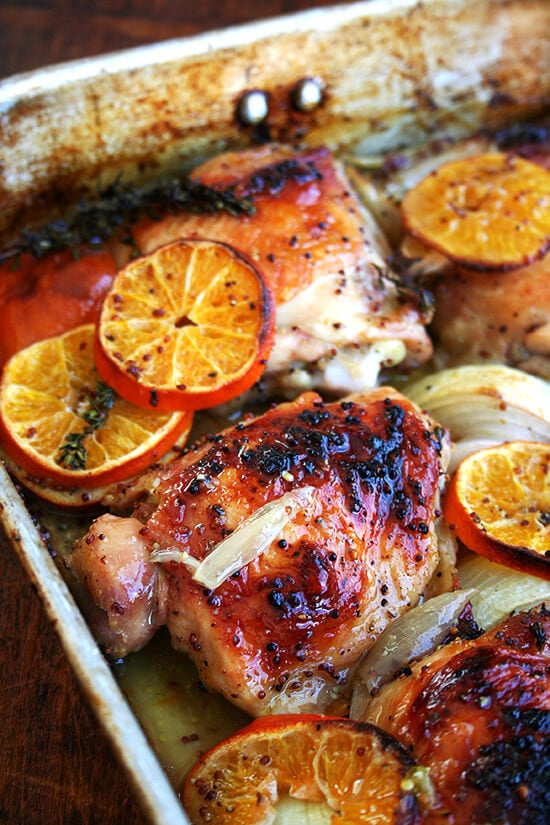
How to Make Roast Chicken and Clementines
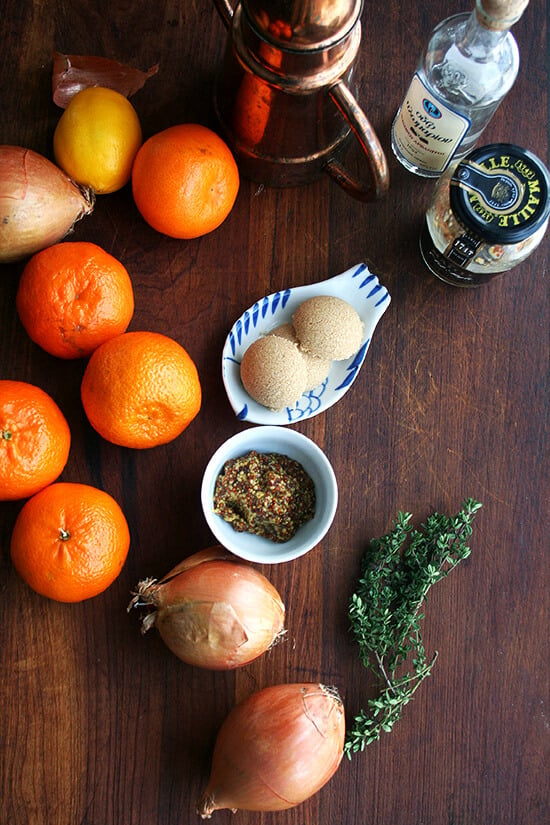
Gather your ingredients:
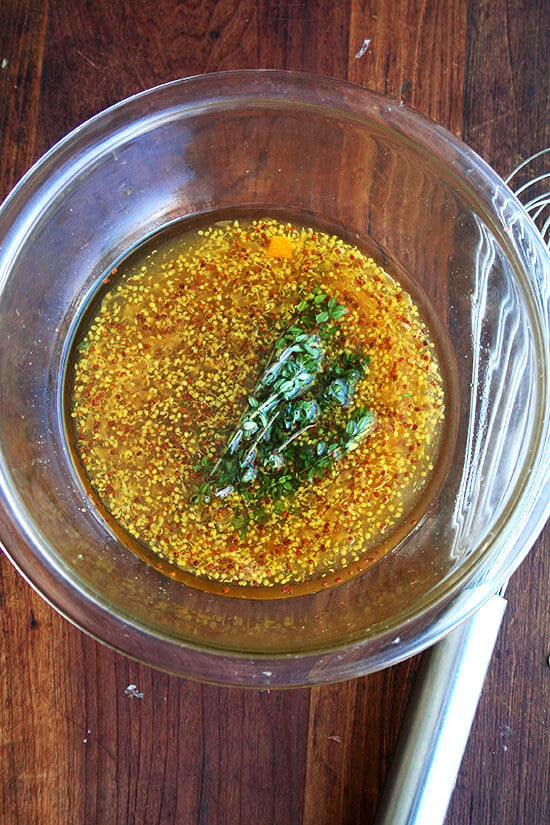
Stir together a simple sauce:
Combine everything in a large roasting pan:
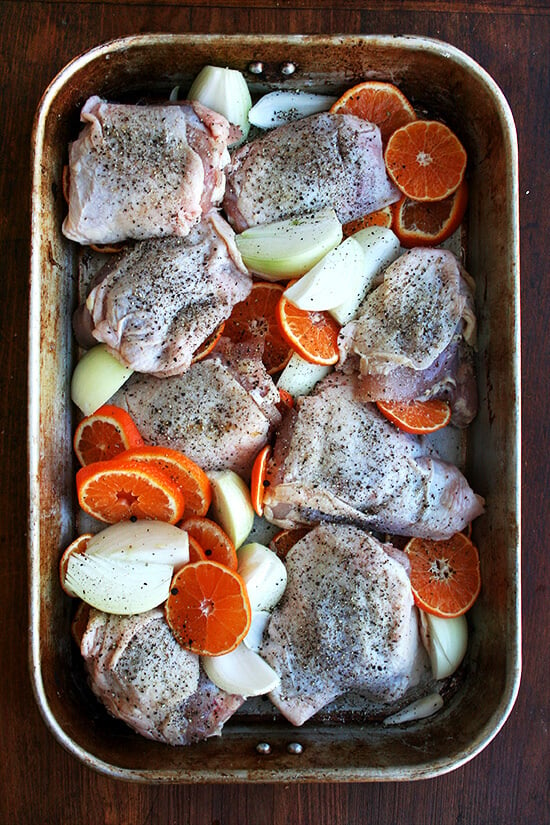
Transfer to the oven for about an hour.
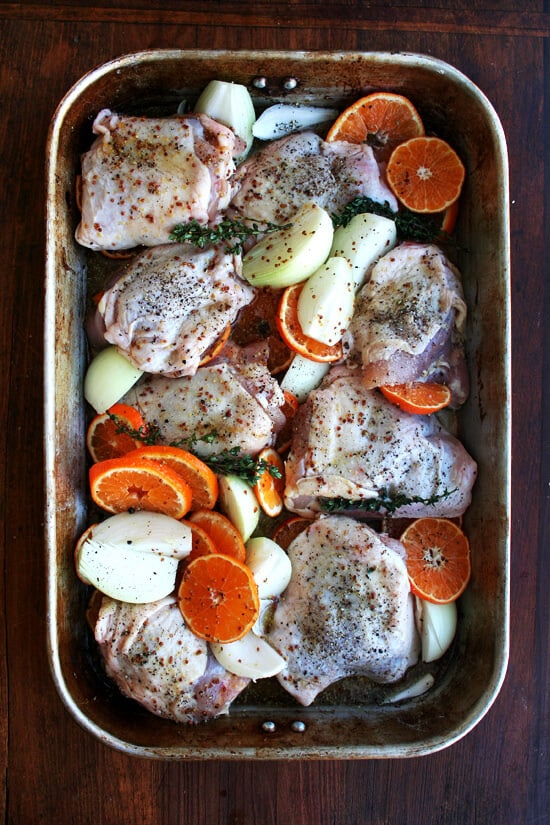
It’s done when the skin is crisp and caramelized, and the meat is nearly falling off the bone:
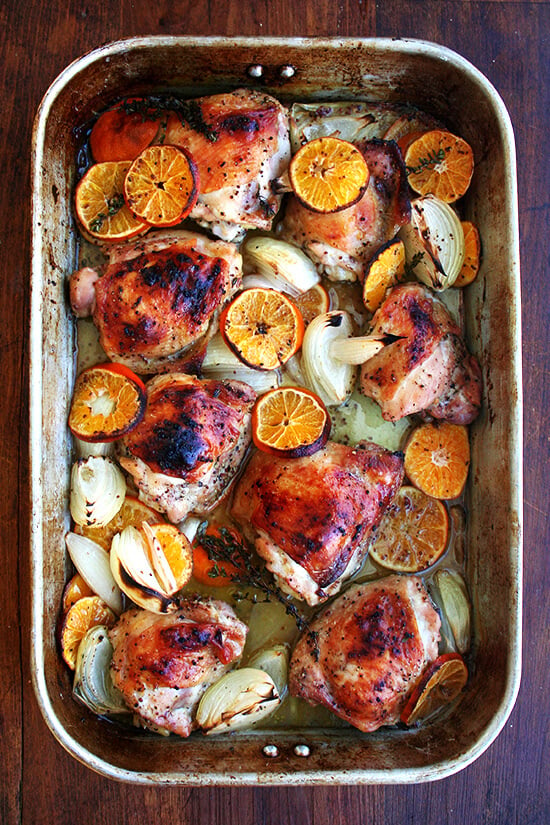
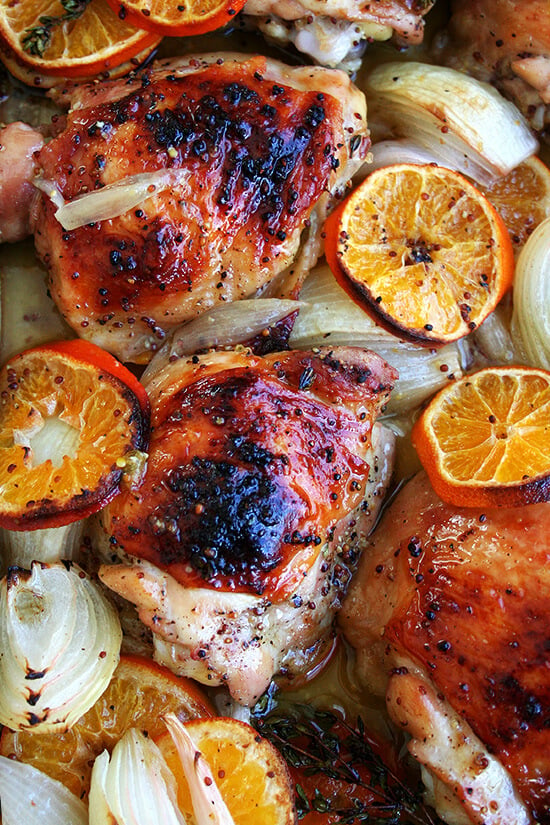
Description
Adapted from Jerusalem by Yotam Ottolenghi and Sami Tamimi
Feel free to take liberties with the ingredients here. I now make this with 1/3 cup clementine juice (versus 3 tablespoons orange juice and 3 tablespoons lemon juice), which works just fine. The original recipe called for fennel bulbs but I prefer onions, and I have also used leeks in place of the onions. The original recipe also called for fennel seed, which I omit, and anise-flavored liqueur, but I now use white wine. So, essentially (and unintentionally!) I’ve removed all three of the anise-flavored components to this dish.
The key is to use a large enough roasting pan that allows space between each piece of chicken. If the chicken is crowded together it won’t brown properly. Marinating overnight is not necessary though it’s nice to know that you can assemble this dish ahead of time.
Also, the clementine pieces are edible! Some of them are tastier than others — the ones that are exposed (above the juices during the roasting) crisp up and can taste a little bitter; the ones that remain under the juices during the entire cooking process, however, are soft and delicious. You can be strategic and place more of the orange slices beneath the chicken so that they are protected, but I would leave some of them exposed, because they look so pretty when they get a bit caramelized. (I also don’t mind when the oranges are a bit bitter/crisp.)
- 1/3 cup white wine (or Arak, Ouzo, or Pernod, see notes above)
- 1/4 cup olive oil
- 1/3 cup freshly squeezed orange (or clementine) juice
- 2 tablespoons grainy mustard
- 3 tablespoons light brown sugar or honey
- 2 teaspoons kosher salt
- freshly ground pepper
- 8 bone-in, skin-on chicken pieces (a mix of thighs and drumsticks is nice)
- 4 clementines, unpeeled, sliced thin
- a few sprigs of thyme
- 2 to 3 medium onions (or fennel bulbs) cut lengthwise and then into quarters
- In a large mixing bowl, whisk together alcohol of choice, oil, orange juice, mustard, brown sugar, and salt. Season with pepper, to taste. If you are roasting immediately: Place chicken skin side up in a large roasting pan with clementine slices, thyme sprigs, and onion pieces. Pour sauce over top and gently toss everything together with your hands. If you are marinating: Place chicken with clementine slices, thyme sprigs, and onion pieces in a large mixing bowl or ziplock bag. Turn several times to coat. Marinate chicken for several hours or overnight.
- Preheat oven to 475ºF degrees. Transfer pan to the oven. After 30 minutes, check on the chicken. If the skin is browning too quickly, turn the oven down to 400ºF and continue roasting until the skin is brown and crisp, 20 to 25 minutes longer. I roast the chicken at 475ºF for 45 minutes and at 400ºF for 10 minutes, but every oven is different, so just keep an eye on it. Remove pan from the oven.
- Transfer chicken and clementines and onion pieces with juices to a serving platter. Let rest 5 to 10 minutes before serving.
- Prep Time: 10 minutes
- Cook Time: 55 minutes
- Category: Chicken
- Method: Roasting
Here’s a low-effort, big-reward chicken recipe: roasted chicken thighs with clementines. It requires about 15 minutes (or less) to throw together, and it bakes for about an hour. The result? A stunning, festive, incredibly delicious assembly of caramelized onions, burnished oranges, and crispy-skinned fall-off-the-bone tender chicken.
Upon receiving Jerusalem early last summer, I poured through it cover to cover, reading about hummus wars and baba ghanoush, feeling inspired to start burning eggplants and preserving lemons with every turn of the page.
Six months later I’m only just enjoying my first taste of the cookbook: roast chicken with clementines, a recipe my mother has been urging me to make since the start of citrus season.
This recipe calls for high heat — 475ºF — for a long time — just under an hour — which allows the chicken skin to brown and the vegetables to caramelize beautifully. The liquid, a mixture of freshly squeezed citrus juice and some sort of anise-flavored liqueur (Arak, Ouzo or Pernod), keeps the chicken meat incredibly juicy below its crispy skin. (Update: I always use white wine for simplicity.)
Ottolenghi and Tamimi, the authors, note in the preface to the recipe, this is a “sweetly comforting dish you will always want to come back to” and suggest serving it with plain rice or bulgur. For me, the volume of slightly sweet, mustard-seed laced juices pooling below the chicken demands lots of crusty bread .
This dish is festive and colorful, and with clementine season in full swing, there couldn’t be a better time to get it on your table. Hope you love it as much as I do.
How to Make Roast Chicken and Clementines
Gather your ingredients:
Stir together a simple sauce:
Combine everything in a large roasting pan:
Transfer to the oven for about an hour.
It’s done when the skin is crisp and caramelized, and the meat is nearly falling off the bone:
Description
Adapted from Jerusalem by Yotam Ottolenghi and Sami Tamimi
Feel free to take liberties with the ingredients here. I now make this with 1/3 cup clementine juice (versus 3 tablespoons orange juice and 3 tablespoons lemon juice), which works just fine. The original recipe called for fennel bulbs but I prefer onions, and I have also used leeks in place of the onions. The original recipe also called for fennel seed, which I omit, and anise-flavored liqueur, but I now use white wine. So, essentially (and unintentionally!) I’ve removed all three of the anise-flavored components to this dish.
The key is to use a large enough roasting pan that allows space between each piece of chicken. If the chicken is crowded together it won’t brown properly. Marinating overnight is not necessary though it’s nice to know that you can assemble this dish ahead of time.
Also, the clementine pieces are edible! Some of them are tastier than others — the ones that are exposed (above the juices during the roasting) crisp up and can taste a little bitter; the ones that remain under the juices during the entire cooking process, however, are soft and delicious. You can be strategic and place more of the orange slices beneath the chicken so that they are protected, but I would leave some of them exposed, because they look so pretty when they get a bit caramelized. (I also don’t mind when the oranges are a bit bitter/crisp.)
- 1/3 cup white wine (or Arak, Ouzo, or Pernod, see notes above)
- 1/4 cup olive oil
- 1/3 cup freshly squeezed orange (or clementine) juice
- 2 tablespoons grainy mustard
- 3 tablespoons light brown sugar or honey
- 2 teaspoons kosher salt
- freshly ground pepper
- 8 bone-in, skin-on chicken pieces (a mix of thighs and drumsticks is nice)
- 4 clementines, unpeeled, sliced thin
- a few sprigs of thyme
- 2 to 3 medium onions (or fennel bulbs) cut lengthwise and then into quarters
- In a large mixing bowl, whisk together alcohol of choice, oil, orange juice, mustard, brown sugar, and salt. Season with pepper, to taste. If you are roasting immediately: Place chicken skin side up in a large roasting pan with clementine slices, thyme sprigs, and onion pieces. Pour sauce over top and gently toss everything together with your hands. If you are marinating: Place chicken with clementine slices, thyme sprigs, and onion pieces in a large mixing bowl or ziplock bag. Turn several times to coat. Marinate chicken for several hours or overnight.
- Preheat oven to 475ºF degrees. Transfer pan to the oven. After 30 minutes, check on the chicken. If the skin is browning too quickly, turn the oven down to 400ºF and continue roasting until the skin is brown and crisp, 20 to 25 minutes longer. I roast the chicken at 475ºF for 45 minutes and at 400ºF for 10 minutes, but every oven is different, so just keep an eye on it. Remove pan from the oven.
- Transfer chicken and clementines and onion pieces with juices to a serving platter. Let rest 5 to 10 minutes before serving.
- Prep Time: 10 minutes
- Cook Time: 55 minutes
- Category: Chicken
- Method: Roasting
Here’s a low-effort, big-reward chicken recipe: roasted chicken thighs with clementines. It requires about 15 minutes (or less) to throw together, and it bakes for about an hour. The result? A stunning, festive, incredibly delicious assembly of caramelized onions, burnished oranges, and crispy-skinned fall-off-the-bone tender chicken.
Upon receiving Jerusalem early last summer, I poured through it cover to cover, reading about hummus wars and baba ghanoush, feeling inspired to start burning eggplants and preserving lemons with every turn of the page.
Six months later I’m only just enjoying my first taste of the cookbook: roast chicken with clementines, a recipe my mother has been urging me to make since the start of citrus season.
This recipe calls for high heat — 475ºF — for a long time — just under an hour — which allows the chicken skin to brown and the vegetables to caramelize beautifully. The liquid, a mixture of freshly squeezed citrus juice and some sort of anise-flavored liqueur (Arak, Ouzo or Pernod), keeps the chicken meat incredibly juicy below its crispy skin. (Update: I always use white wine for simplicity.)
Ottolenghi and Tamimi, the authors, note in the preface to the recipe, this is a “sweetly comforting dish you will always want to come back to” and suggest serving it with plain rice or bulgur. For me, the volume of slightly sweet, mustard-seed laced juices pooling below the chicken demands lots of crusty bread .
This dish is festive and colorful, and with clementine season in full swing, there couldn’t be a better time to get it on your table. Hope you love it as much as I do.
How to Make Roast Chicken and Clementines
Gather your ingredients:
Stir together a simple sauce:
Combine everything in a large roasting pan:
Transfer to the oven for about an hour.
It’s done when the skin is crisp and caramelized, and the meat is nearly falling off the bone:
Description
Adapted from Jerusalem by Yotam Ottolenghi and Sami Tamimi
Feel free to take liberties with the ingredients here. I now make this with 1/3 cup clementine juice (versus 3 tablespoons orange juice and 3 tablespoons lemon juice), which works just fine. The original recipe called for fennel bulbs but I prefer onions, and I have also used leeks in place of the onions. The original recipe also called for fennel seed, which I omit, and anise-flavored liqueur, but I now use white wine. So, essentially (and unintentionally!) I’ve removed all three of the anise-flavored components to this dish.
The key is to use a large enough roasting pan that allows space between each piece of chicken. If the chicken is crowded together it won’t brown properly. Marinating overnight is not necessary though it’s nice to know that you can assemble this dish ahead of time.
Also, the clementine pieces are edible! Some of them are tastier than others — the ones that are exposed (above the juices during the roasting) crisp up and can taste a little bitter; the ones that remain under the juices during the entire cooking process, however, are soft and delicious. You can be strategic and place more of the orange slices beneath the chicken so that they are protected, but I would leave some of them exposed, because they look so pretty when they get a bit caramelized. (I also don’t mind when the oranges are a bit bitter/crisp.)
- 1/3 cup white wine (or Arak, Ouzo, or Pernod, see notes above)
- 1/4 cup olive oil
- 1/3 cup freshly squeezed orange (or clementine) juice
- 2 tablespoons grainy mustard
- 3 tablespoons light brown sugar or honey
- 2 teaspoons kosher salt
- freshly ground pepper
- 8 bone-in, skin-on chicken pieces (a mix of thighs and drumsticks is nice)
- 4 clementines, unpeeled, sliced thin
- a few sprigs of thyme
- 2 to 3 medium onions (or fennel bulbs) cut lengthwise and then into quarters
- In a large mixing bowl, whisk together alcohol of choice, oil, orange juice, mustard, brown sugar, and salt. Season with pepper, to taste. If you are roasting immediately: Place chicken skin side up in a large roasting pan with clementine slices, thyme sprigs, and onion pieces. Pour sauce over top and gently toss everything together with your hands. If you are marinating: Place chicken with clementine slices, thyme sprigs, and onion pieces in a large mixing bowl or ziplock bag. Turn several times to coat. Marinate chicken for several hours or overnight.
- Preheat oven to 475ºF degrees. Transfer pan to the oven. After 30 minutes, check on the chicken. If the skin is browning too quickly, turn the oven down to 400ºF and continue roasting until the skin is brown and crisp, 20 to 25 minutes longer. I roast the chicken at 475ºF for 45 minutes and at 400ºF for 10 minutes, but every oven is different, so just keep an eye on it. Remove pan from the oven.
- Transfer chicken and clementines and onion pieces with juices to a serving platter. Let rest 5 to 10 minutes before serving.
- Prep Time: 10 minutes
- Cook Time: 55 minutes
- Category: Chicken
- Method: Roasting
Description
Adapted from Jerusalem by Yotam Ottolenghi and Sami Tamimi
Feel free to take liberties with the ingredients here. I now make this with 1/3 cup clementine juice (versus 3 tablespoons orange juice and 3 tablespoons lemon juice), which works just fine. The original recipe called for fennel bulbs but I prefer onions, and I have also used leeks in place of the onions. The original recipe also called for fennel seed, which I omit, and anise-flavored liqueur, but I now use white wine. So, essentially (and unintentionally!) I’ve removed all three of the anise-flavored components to this dish.
The key is to use a large enough roasting pan that allows space between each piece of chicken. If the chicken is crowded together it won’t brown properly. Marinating overnight is not necessary though it’s nice to know that you can assemble this dish ahead of time.
Also, the clementine pieces are edible! Some of them are tastier than others — the ones that are exposed (above the juices during the roasting) crisp up and can taste a little bitter; the ones that remain under the juices during the entire cooking process, however, are soft and delicious. You can be strategic and place more of the orange slices beneath the chicken so that they are protected, but I would leave some of them exposed, because they look so pretty when they get a bit caramelized. (I also don’t mind when the oranges are a bit bitter/crisp.)
- 1/3 cup white wine (or Arak, Ouzo, or Pernod, see notes above)
- 1/4 cup olive oil
- 1/3 cup freshly squeezed orange (or clementine) juice
- 2 tablespoons grainy mustard
- 3 tablespoons light brown sugar or honey
- 2 teaspoons kosher salt
- freshly ground pepper
- 8 bone-in, skin-on chicken pieces (a mix of thighs and drumsticks is nice)
- 4 clementines, unpeeled, sliced thin
- a few sprigs of thyme
- 2 to 3 medium onions (or fennel bulbs) cut lengthwise and then into quarters
- In a large mixing bowl, whisk together alcohol of choice, oil, orange juice, mustard, brown sugar, and salt. Season with pepper, to taste. If you are roasting immediately: Place chicken skin side up in a large roasting pan with clementine slices, thyme sprigs, and onion pieces. Pour sauce over top and gently toss everything together with your hands. If you are marinating: Place chicken with clementine slices, thyme sprigs, and onion pieces in a large mixing bowl or ziplock bag. Turn several times to coat. Marinate chicken for several hours or overnight.
- Preheat oven to 475ºF degrees. Transfer pan to the oven. After 30 minutes, check on the chicken. If the skin is browning too quickly, turn the oven down to 400ºF and continue roasting until the skin is brown and crisp, 20 to 25 minutes longer. I roast the chicken at 475ºF for 45 minutes and at 400ºF for 10 minutes, but every oven is different, so just keep an eye on it. Remove pan from the oven.
- Transfer chicken and clementines and onion pieces with juices to a serving platter. Let rest 5 to 10 minutes before serving.
- Prep Time: 10 minutes
- Cook Time: 55 minutes
- Category: Chicken
- Method: Roasting
Find it online : https://alexandracooks.com/2013/12/31/roasted-chicken-with-clementines/



It doesn’t get much better than croque monsieur: layers of good, toasty bread, creamy béchamel, smoky ham, and nutty Gruyère. Top it with a perfectly poached egg, and it becomes croque madame. It’s what brunch (and dinner!) dreams are made of.
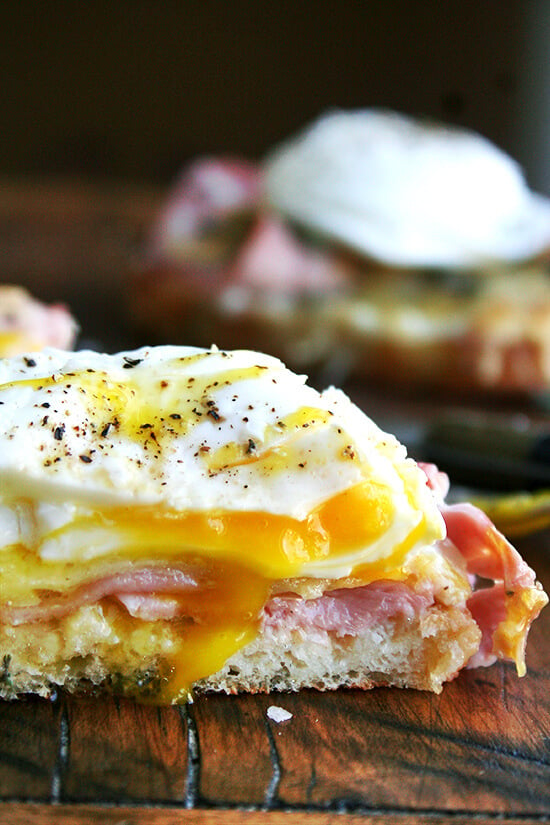
Croque monsieur is an iconic French dish, a simple sandwich at its core, but gussied up with a rich, creamy sauce, also known as béchamel. This one, prepared open-faced, is one of those assemblies where the product is so much more than the sum of its parts: a tablespoon of béchamel, a slice of ham, a handful of cheese. Sprinkled with fresh thyme out of the oven, and topped with a poached egg, which makes it croque madame, this classic French dish is heaven, a perfect breakfast or, with a salad by its side, a simple dinner.
Note: You could easily make this vegetarian by swapping in sautéed greens or mushrooms or roasted asparagus or fresh tomatoes for the ham.
How to Make Croque Monsieur/ Croque Madame, Step by Step
First, make the bechamel by melting the butter, sautéeing the onion, adding the flour and milk, and cooking until the mixture coats the back of a spoon.
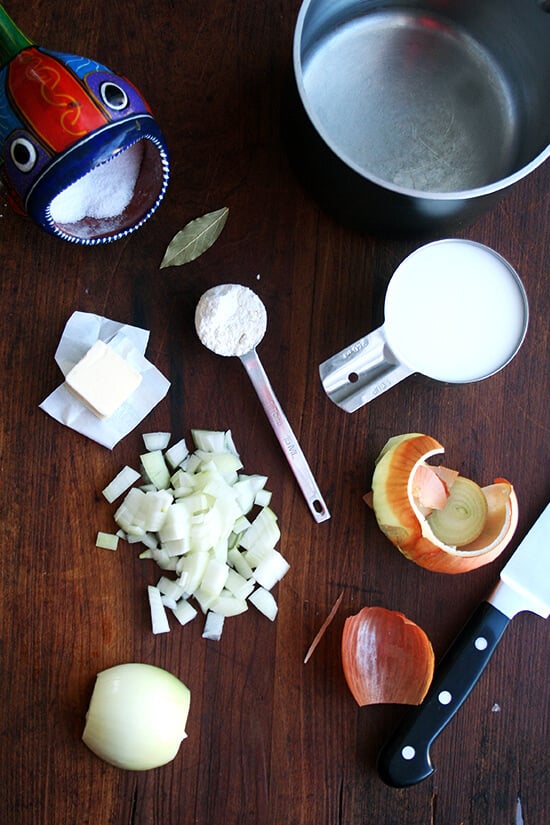
Next, gather your remaining ingredients: ham, cheese, thyme, and some good bread .
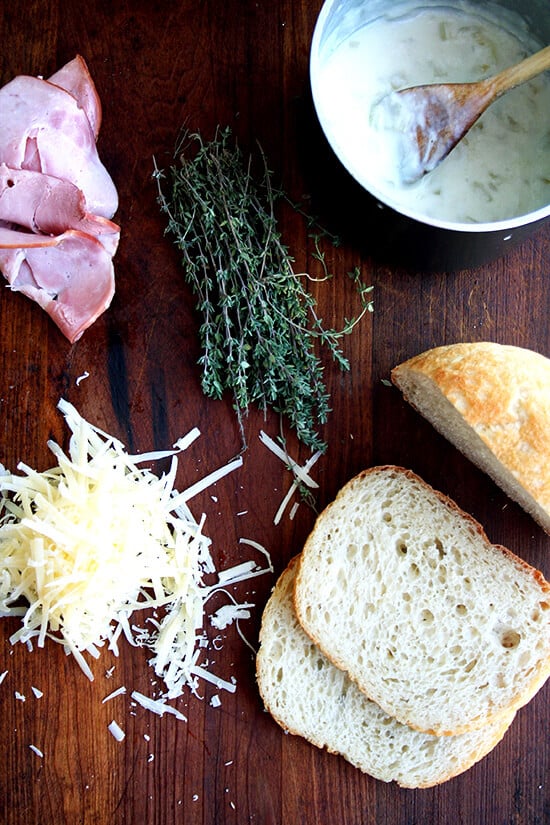
Make an open-faced sandwich as follows: broil however many slices of bread you wish for 1 minute on each side, then place the slices on a rack set atop a sheet pan. Spread bechamel over the slices, then top with sliced ham and grated cheese.
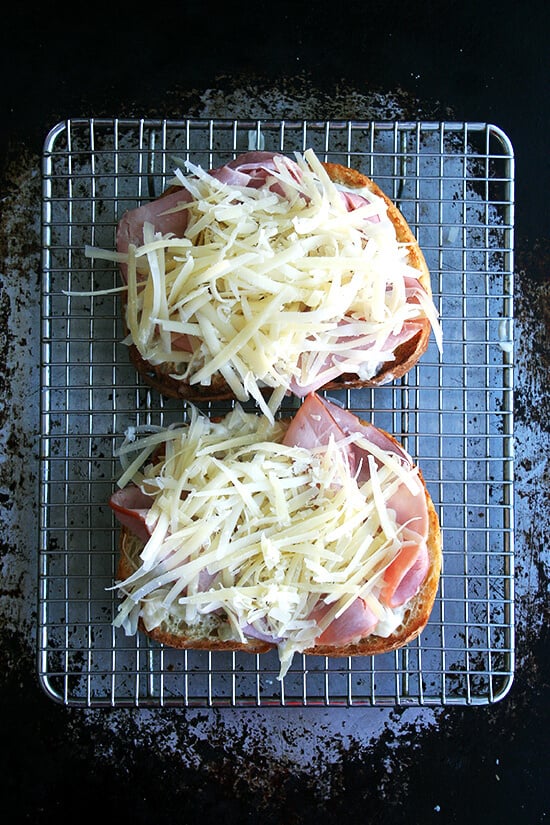
Broil until bubbly, then sprinkle with fresh thyme.

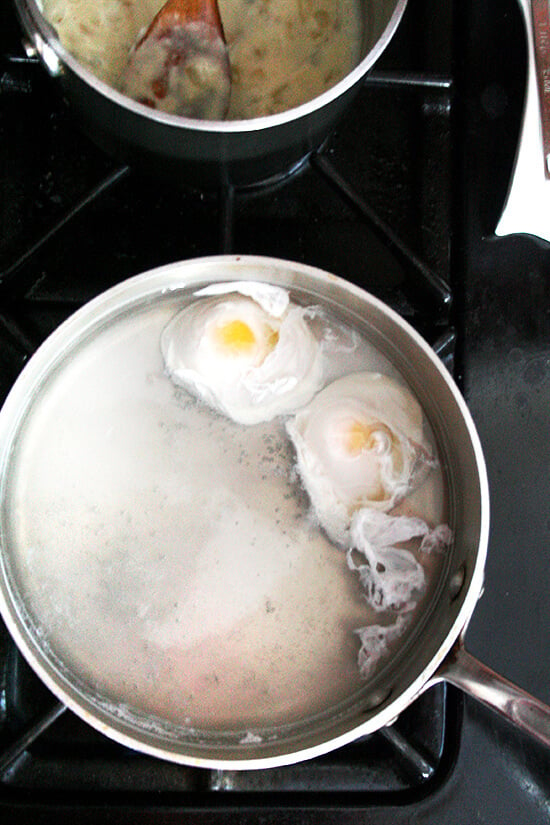
To make a croque madame, you’ll top the sandwich with a poached egg :

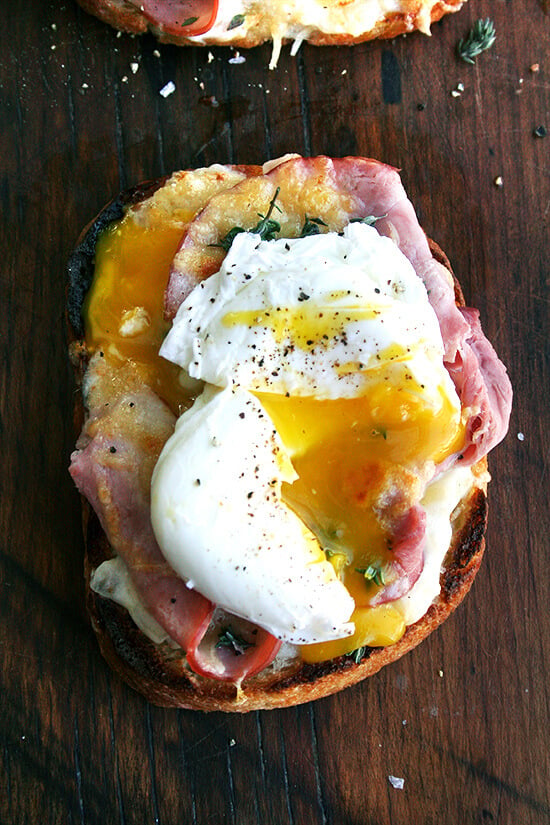
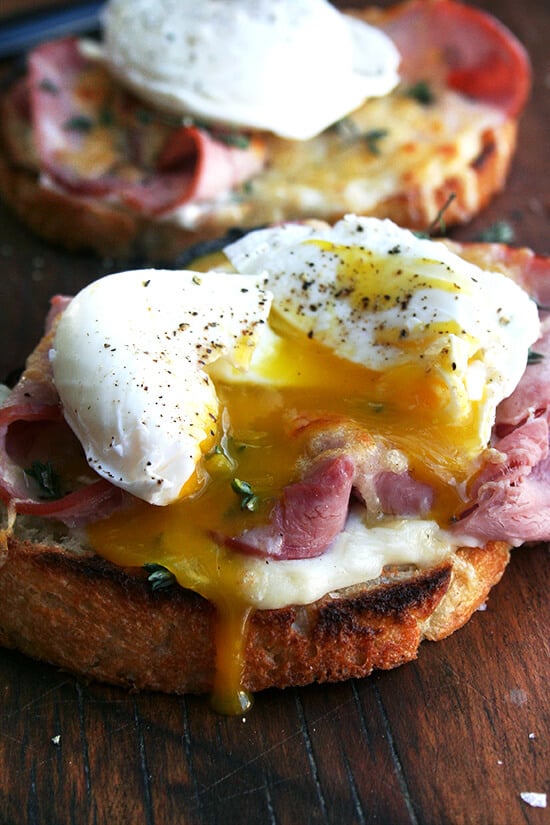
For a simple dinner, serve the Croque Monsieur/Madame with a simple salad.
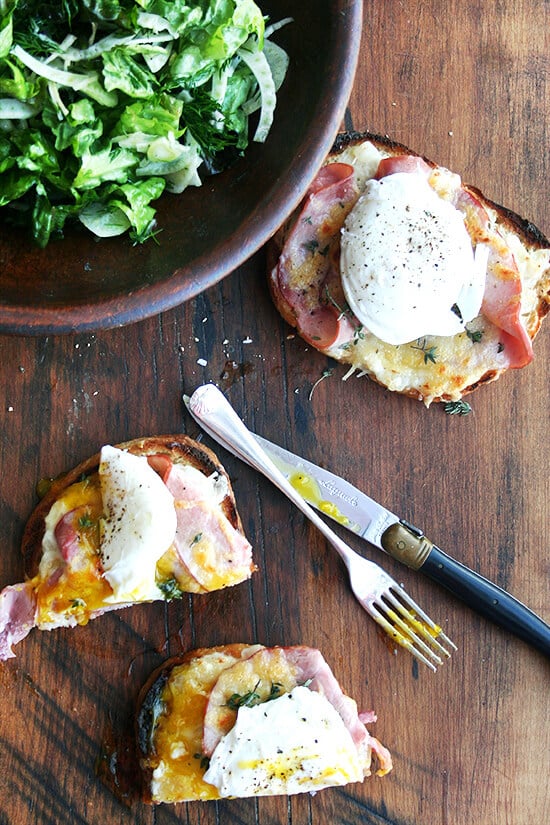
Description
It doesn’t get much better than croque monsieur: layers of good, toasty bread, creamy béchamel, smoky ham, and nutty Gruyère. Top it with a perfectly poached egg, and it becomes croque madame. It’s what brunch (and dinner!) dreams are made of.
Notes:
Bechamel recipe adapted from Nancy Silverton’s Sandwich Book
For the croque monsieur:
- good bread , cut into thick slices
- béchamel (recipe below)
- 3 to 4 slices good ham (figure 1 to 2 per sandwich)
- grated Gruyère, Comté or Swiss cheese
- fresh thyme leaves
For the béchamel:
- 1 tablespoon butter
- 1/4 cup finely chopped onion
- kosher salt
- 1 tablespoon flour
- 1 cup whole milk
- 1 bayleaf
For the poached eggs:
- 2 eggs (count on 1 egg per sandwich)
- splash of white vinegar
- Prepare pot for eggs: Fill a shallow saucepan with two to three inches water and bring to a simmer.
- Prepare the béchamel : In a medium saucepan over medium heat, melt the butter. Add the onion and a pinch of salt and cook about 5 to 7 minutes or until the onion is soft but has not begun to color. Turn the heat to very low, add the flour, and stir to combine it with the onion and butter. Continue to cook over low heat until the flour is absorbed, stirring constantly so that it doesn’t brown, about 2 minutes or so. Slowly stir in the milk. Drop in the bay leaf.
- Over medium to medium-high heat, bring the mixture to a boil then reduce the heat to its lowest setting and cook for about 15 minutes, stirring occasionally to prevent the sauce from burning on the bottom of the pan. Taste and cook longer if the taste of raw flour is still detectable. The mixture should be thick, but if it’s too thick and becoming difficult to stir, you’ll need to whisk in a little more milk. Remove the bay leaf and discard.
- Meanwhile, preheat the broiler. Place the slices of bread on a rack on a sheet pan (or a broiling pan) and broil them about a minute on each side. Remove pan from the oven.
- Spread about 1 tablespoon of béchamel over each slice of bread. Top with 1 to 2 slices of ham. Top with grated cheese to taste. Set aside.
- Crack each egg into a small bowl or ramekin. Sprinkle about a tablespoon of vinegar into the pot of simmering shallow water. Adjust the heat so that the water is barely simmering — get the water to a simmer, then turn it down so you don’t see any bubbles. Use the handle of a wooden spoon to make a whirlpool in the water, then drop one egg into the center of the whirlpool. Repeat with other egg. Adjust the heat to keep the water just below a simmer. Set the timer for 3 minutes.
- When the eggs have cooked for 3 minutes, place the toasts under the broiler and cook until the cheese is bubbling and starting to brown. Remove from the oven. Sprinkle with the fresh thyme.
- Meanwhile, using a slotted spoon, lift one egg up from the water and shake it. The yolk should jiggle a little bit, but shouldn’t look too loose. You might have to cook the eggs for a minute longer. Note: Knowing when poached eggs are done is just a matter of practice and preference — personally I don’t like the yolk to taste raw, but I still like it runny, and for this consistency, I usually have to cook the eggs for about 4 to 5 minutes. When the eggs look cooked to your liking, remove them with a slotted spoon and transfer to a paper towel-lined plate.
- Top each sandwich with a poached egg. Sprinkle with a pinch of salt and freshly cracked pepper to taste.
- Prep Time: 10 minutes
- Cook Time: 30 minutes
- Category: Breakfast
- Method: Stovetop, Oven
- Cuisine: French, American
