
The weather this week called for soup. Wanting something new, I turned to Sally Schneider’s A New Way to Cook and found a recipe for roasted pumpkin and garlic soup described as “utterly simple” and “exceptionally creamy,” all of which sounded perfect.
The recipe called for roasting sugar pumpkins or any winter squash and a head of garlic together, then puréeing the flesh of the two together with stock.
It sounded too simple to be good, but Sally has never steered me wrong, so I made it and was astonished by its flavor. After puréeing the soup, Sally suggests stirring in a few tablespoons of heavy cream or crème fraîche, which I did, but I wouldn’t have missed this final enrichment had I not.
What was going on here? Why was it so good? For two reasons, I think. Time, for one: during the 40 to 60 minutes in the oven, the flavors of both the squash and the garlic intensify. As they roast, they sweeten and soften, emerging meltingly tender with caramelized edges.
And second, the stock. Sally suggests using chicken stock, but I used vegetable stock , which, if you have never made, I can’t recommend enough: it takes no time to throw together, simmers for only 45 minutes, and tastes complex and rich upon completion. I made the stock while the squash and garlic roasted.
Upon being blended, the roasted vegetables transform into the silkiest purée, needing nothing more than a pinch of salt, a few twists of pepper, and, of course, a loaf of bread for dunking.
How to Make Roasted Butternut Squash and Garlic Soup, Step by Step
Gather your ingredients: garlic and butternut squash.
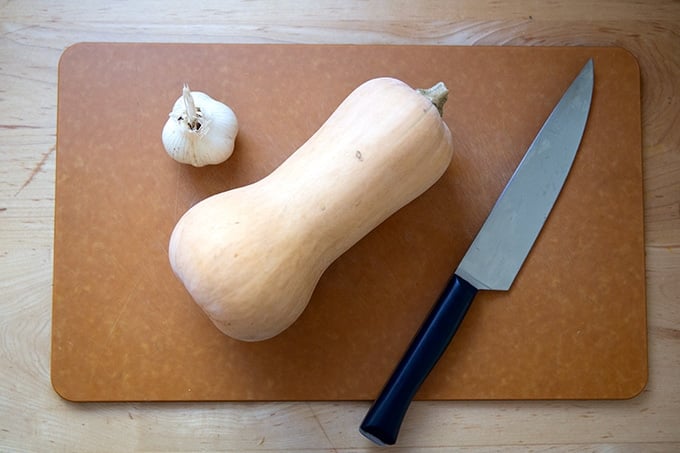
To prep the squash, halve it, and scoop out the seeds. To prep the garlic, cut the head in half crosswise (through the equator).

Rub the squash with a drizzle of olive oil. For the garlic, drizzle a small amount of oil on the sheet pan, and rub the halved head of garlic in it, cut side down. You only need one head of garlic for this recipe, but I recommend roasting more so that you have those buttery soft cloves on hand to spread over olive oil-toasted slices of bread.
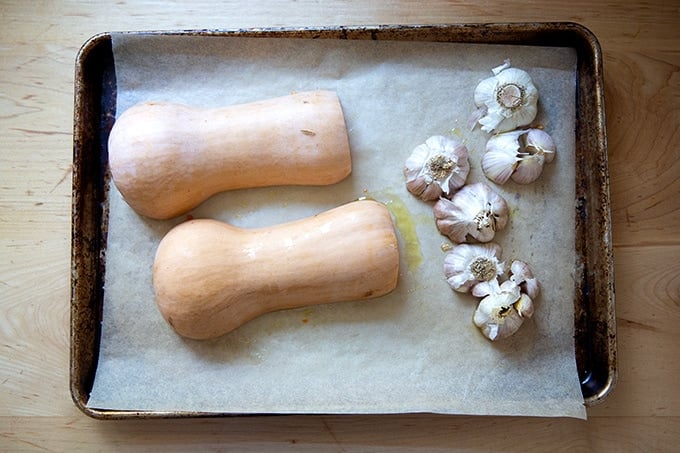
Roast for 1 hour, checking after 40 minutes — you’ll want to remove the garlic at the 40-minute mark if it’s looking caramelized and delicious.
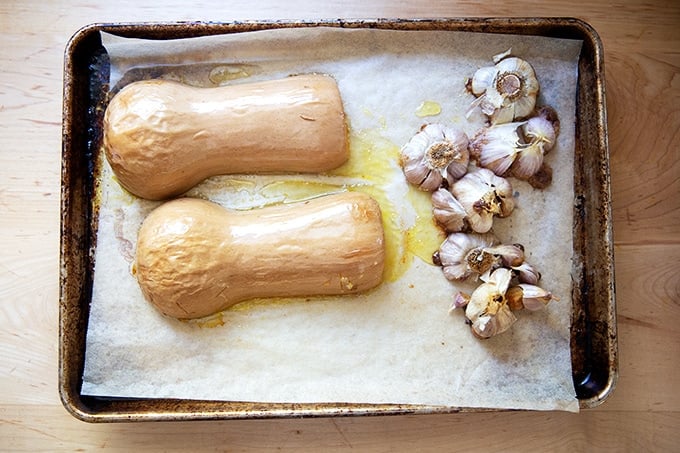
The squash, at the solid end (not the hollowed-out end), should be very knife-tender.
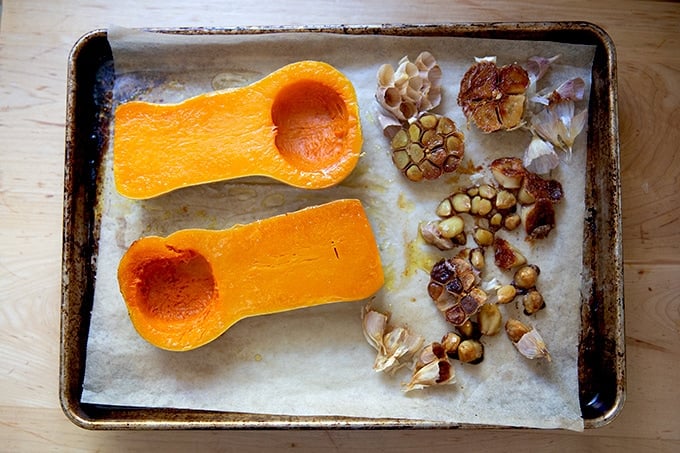
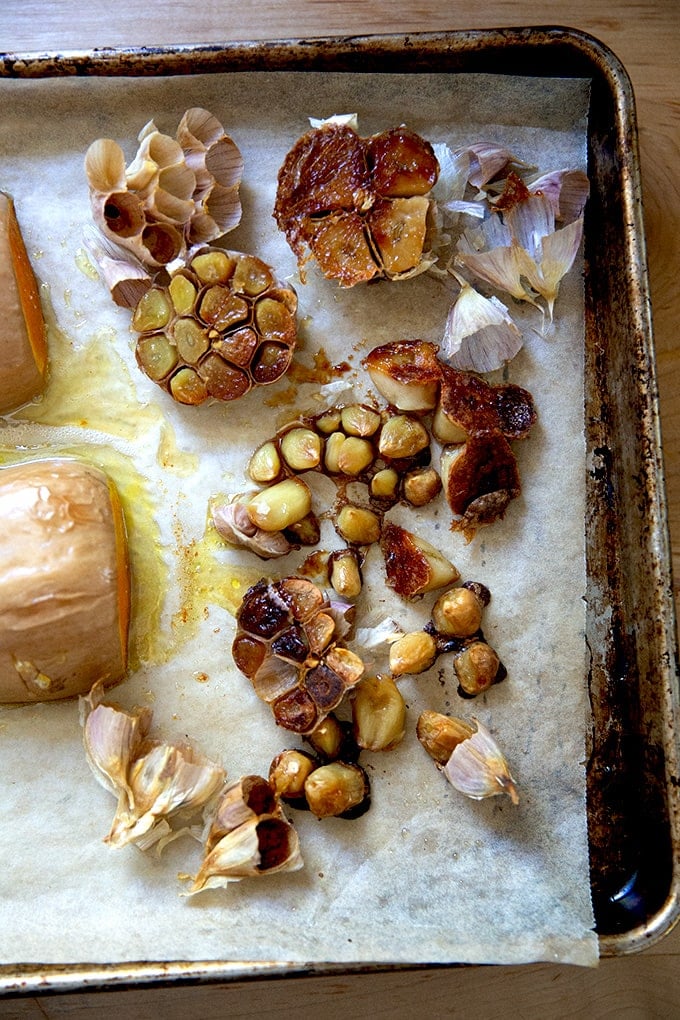
The garlic should be caramelized at the edges and knife-tender as well… some of these are overdone.
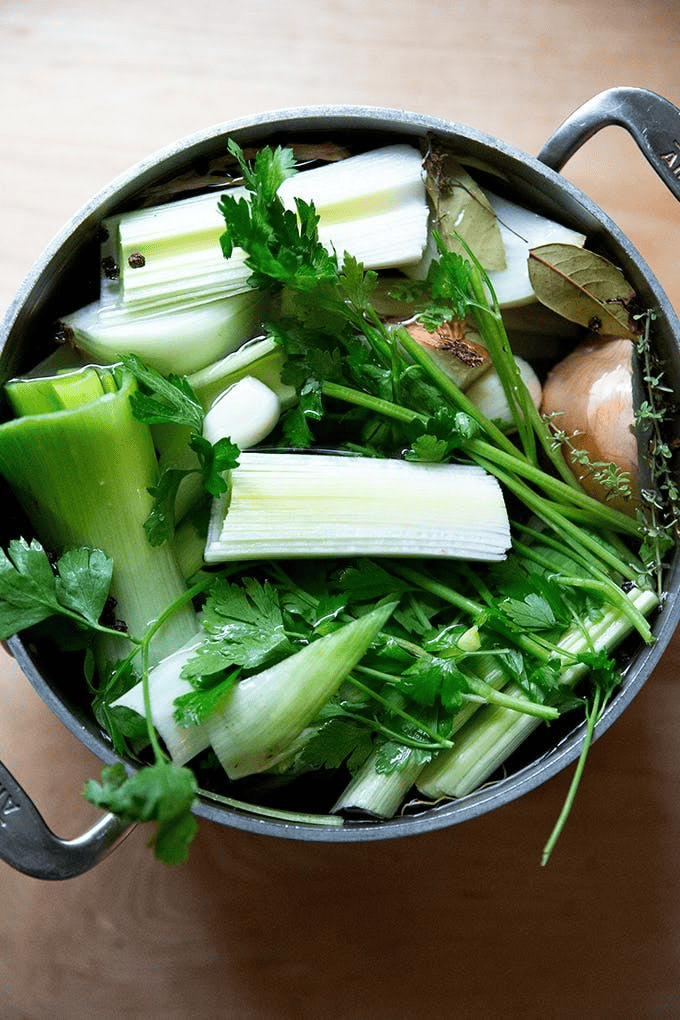
You also need stock. This vegetable stock will materialize in the time your squash and garlic roast away in the oven, and if you haven’t yet made it, you will be blown away by its flavor. Promise.
After 45 minutes of simmering, drain the stock…
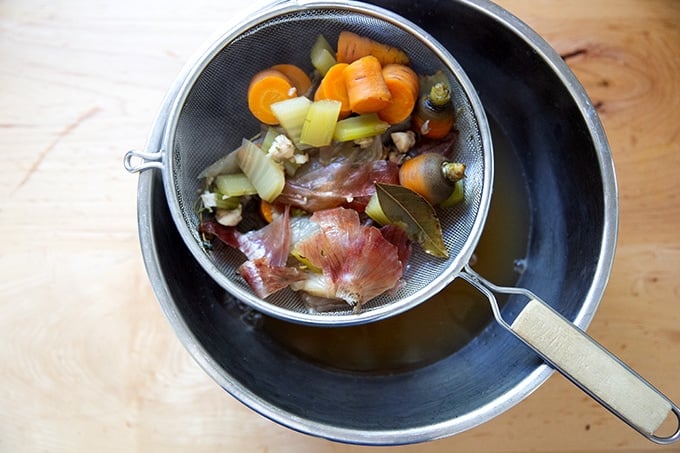
… and transfer it to storage containers. (I love these deli quart containers ). You will have two quarts of stock.

Scoop out the flesh of the squash and the cloves from 1 head of garlic and place them in a pot. Add 1 quart of stock.
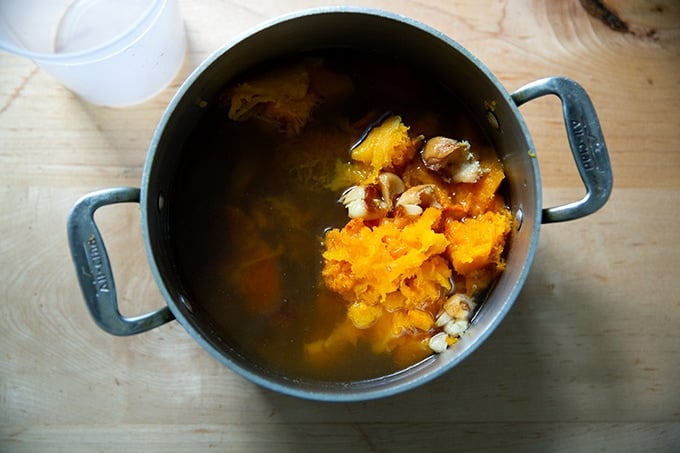
Bring to a simmer, the purée until smooth.
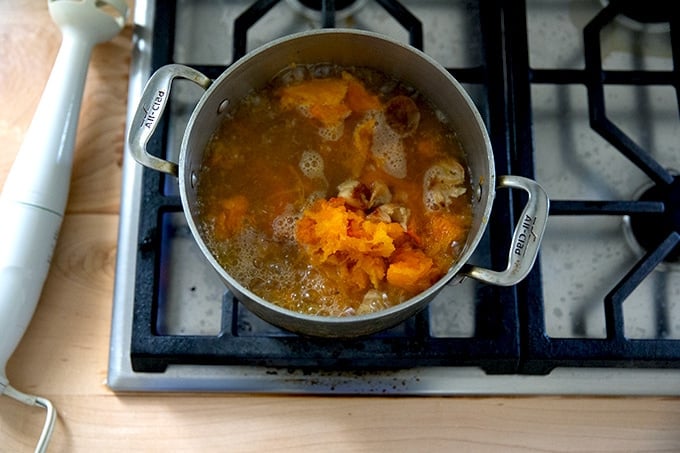
At this point, taste for salt and pepper. I consistently add 1 to 1.5 teaspoons of Diamond Crystal kosher salt, but, of course, you should add salt to taste. I am astonished by how tasty it is at this point, but even so, I do add the recommended 3 tablespoons of heavy cream or crème fraîche.

Whisk or stir to incorporate, then taste and adjust as needed with more salt and pepper to taste.
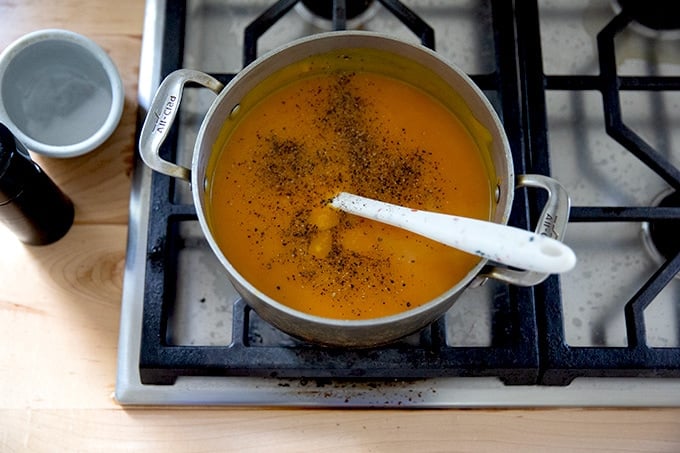
Serve as you wish…

If you’re feeling up for it, you could top the soup with frizzled sage leaves and olive oil-toasted bread…
… but, real talk: bread of some sort is all you need. Peasant bread is never a bad idea…

… neither is olive oil-toasted croutons: to make these, simply heat up some extra-virgin olive oil in a skillet stovetop, add torn bread cubes, season with salt, and cook for about 2 minutes or until the cubes are golden at the edges.

Description
Adapted from Sally Schneider’s A New Way to Cook .
Notes:
You need 1 whole head/bulb of garlic for this recipe — not a single clove.
- 1 whole butternut squash, 2.25 to 2.75 lbs
- 1 whole head/bulb of garlic, see notes above
- extra-virgin olive oil
- 1 quart of stock of choice, such as vegetable or chicken
- kosher salt
- 3 tablespoons of crème fraîche or heavy cream, optional
- Fresh cracked pepper to taste
- bread for serving, such as peasant bread or focaccia or no-knead thyme dinner rolls
- Preheat the oven to 350ºF. Line a sheet pan with parchment paper (for easier cleanup).
- Halve the butternut squash: slice off the bottom of the bulbous end, stand the squash upright, then carefully cut straight down through the center. Use a spoon to scoop out the seeds and discard. Rub the halved sides with a drizzle of olive oil then place them halved side down on the prepared sheet pan. Cut the head of garlic in half through the equator. Rub a small amount of olive oil on the sheet pan and place the garlic, cut side down, in the olive oil. Transfer to the oven.
- After 40 minutes, check on the garlic. If it is knife-tender and caramelized at the surface, remove it, otherwise, let it continue roasting with the squash until done. Cook the squash for roughly 1 hour or until knife tender at the solid end.
- Let the squash and garlic cool for 20 minutes or until cool to the touch. Scoop the squash flesh into a pot. Squeeze the roasted cloves of garlic into the pot as well. Add the quart of stock. Bring to a simmer.
- Use an immersion blender to purée the mixture — alternatively, transfer the mixture to a blender or food processor and purée until smooth. If you transferred the mixture to puree it, return it to the pot and bring it to a simmer. Taste. Adjust to taste with salt and pepper to taste. I consistently add 1 to 1.5 teaspoons of Diamond Crystal kosher salt.
- If you wish, add the heavy cream or crème fraîche and whisk to incorporate. Depending on the size of the squash, you may need to add more stock to thin it to the right consistency.
- Ladle into bowls and serve with bread on the side.
- Store the soup in the fridge for up to a week or freeze for up to 3 months. When reheating day- or days-old soup, you may need to add water or more stock to thin — it thickens as it sits.
- Prep Time: 10 minutes
- Cook Time: 1 hour
- Category: Soup
- Method: oven, stovetop
- Cuisine: Amerian
The weather this week called for soup. Wanting something new, I turned to Sally Schneider’s A New Way to Cook and found a recipe for roasted pumpkin and garlic soup described as “utterly simple” and “exceptionally creamy,” all of which sounded perfect.
The recipe called for roasting sugar pumpkins or any winter squash and a head of garlic together, then puréeing the flesh of the two together with stock.
It sounded too simple to be good, but Sally has never steered me wrong, so I made it and was astonished by its flavor. After puréeing the soup, Sally suggests stirring in a few tablespoons of heavy cream or crème fraîche, which I did, but I wouldn’t have missed this final enrichment had I not.
What was going on here? Why was it so good? For two reasons, I think. Time, for one: during the 40 to 60 minutes in the oven, the flavors of both the squash and the garlic intensify. As they roast, they sweeten and soften, emerging meltingly tender with caramelized edges.
And second, the stock. Sally suggests using chicken stock, but I used vegetable stock , which, if you have never made, I can’t recommend enough: it takes no time to throw together, simmers for only 45 minutes, and tastes complex and rich upon completion. I made the stock while the squash and garlic roasted.
Upon being blended, the roasted vegetables transform into the silkiest purée, needing nothing more than a pinch of salt, a few twists of pepper, and, of course, a loaf of bread for dunking.
How to Make Roasted Butternut Squash and Garlic Soup, Step by Step
Gather your ingredients: garlic and butternut squash.
To prep the squash, halve it, and scoop out the seeds. To prep the garlic, cut the head in half crosswise (through the equator).
Rub the squash with a drizzle of olive oil. For the garlic, drizzle a small amount of oil on the sheet pan, and rub the halved head of garlic in it, cut side down. You only need one head of garlic for this recipe, but I recommend roasting more so that you have those buttery soft cloves on hand to spread over olive oil-toasted slices of bread.
Roast for 1 hour, checking after 40 minutes — you’ll want to remove the garlic at the 40-minute mark if it’s looking caramelized and delicious.
The squash, at the solid end (not the hollowed-out end), should be very knife-tender.
The garlic should be caramelized at the edges and knife-tender as well… some of these are overdone.
You also need stock. This vegetable stock will materialize in the time your squash and garlic roast away in the oven, and if you haven’t yet made it, you will be blown away by its flavor. Promise.
After 45 minutes of simmering, drain the stock…
… and transfer it to storage containers. (I love these deli quart containers ). You will have two quarts of stock.
Scoop out the flesh of the squash and the cloves from 1 head of garlic and place them in a pot. Add 1 quart of stock.
Bring to a simmer, the purée until smooth.
At this point, taste for salt and pepper. I consistently add 1 to 1.5 teaspoons of Diamond Crystal kosher salt, but, of course, you should add salt to taste. I am astonished by how tasty it is at this point, but even so, I do add the recommended 3 tablespoons of heavy cream or crème fraîche.
Whisk or stir to incorporate, then taste and adjust as needed with more salt and pepper to taste.
Serve as you wish…
If you’re feeling up for it, you could top the soup with frizzled sage leaves and olive oil-toasted bread…
… but, real talk: bread of some sort is all you need. Peasant bread is never a bad idea…
… neither is olive oil-toasted croutons: to make these, simply heat up some extra-virgin olive oil in a skillet stovetop, add torn bread cubes, season with salt, and cook for about 2 minutes or until the cubes are golden at the edges.
Description
Adapted from Sally Schneider’s A New Way to Cook .
Notes:
You need 1 whole head/bulb of garlic for this recipe — not a single clove.
- 1 whole butternut squash, 2.25 to 2.75 lbs
- 1 whole head/bulb of garlic, see notes above
- extra-virgin olive oil
- 1 quart of stock of choice, such as vegetable or chicken
- kosher salt
- 3 tablespoons of crème fraîche or heavy cream, optional
- Fresh cracked pepper to taste
- bread for serving, such as peasant bread or focaccia or no-knead thyme dinner rolls
- Preheat the oven to 350ºF. Line a sheet pan with parchment paper (for easier cleanup).
- Halve the butternut squash: slice off the bottom of the bulbous end, stand the squash upright, then carefully cut straight down through the center. Use a spoon to scoop out the seeds and discard. Rub the halved sides with a drizzle of olive oil then place them halved side down on the prepared sheet pan. Cut the head of garlic in half through the equator. Rub a small amount of olive oil on the sheet pan and place the garlic, cut side down, in the olive oil. Transfer to the oven.
- After 40 minutes, check on the garlic. If it is knife-tender and caramelized at the surface, remove it, otherwise, let it continue roasting with the squash until done. Cook the squash for roughly 1 hour or until knife tender at the solid end.
- Let the squash and garlic cool for 20 minutes or until cool to the touch. Scoop the squash flesh into a pot. Squeeze the roasted cloves of garlic into the pot as well. Add the quart of stock. Bring to a simmer.
- Use an immersion blender to purée the mixture — alternatively, transfer the mixture to a blender or food processor and purée until smooth. If you transferred the mixture to puree it, return it to the pot and bring it to a simmer. Taste. Adjust to taste with salt and pepper to taste. I consistently add 1 to 1.5 teaspoons of Diamond Crystal kosher salt.
- If you wish, add the heavy cream or crème fraîche and whisk to incorporate. Depending on the size of the squash, you may need to add more stock to thin it to the right consistency.
- Ladle into bowls and serve with bread on the side.
- Store the soup in the fridge for up to a week or freeze for up to 3 months. When reheating day- or days-old soup, you may need to add water or more stock to thin — it thickens as it sits.
- Prep Time: 10 minutes
- Cook Time: 1 hour
- Category: Soup
- Method: Stovetop, Oven
- Cuisine: Amerian
Description
Adapted from Sally Schneider’s A New Way to Cook .
Notes:
You need 1 whole head/bulb of garlic for this recipe — not a single clove.
- 1 whole butternut squash, 2.25 to 2.75 lbs
- 1 whole head/bulb of garlic, see notes above
- extra-virgin olive oil
- 1 quart of stock of choice, such as vegetable or chicken
- kosher salt
- 3 tablespoons of crème fraîche or heavy cream, optional
- Fresh cracked pepper to taste
- bread for serving, such as peasant bread or focaccia or no-knead thyme dinner rolls
- Preheat the oven to 350ºF. Line a sheet pan with parchment paper (for easier cleanup).
- Halve the butternut squash: slice off the bottom of the bulbous end, stand the squash upright, then carefully cut straight down through the center. Use a spoon to scoop out the seeds and discard. Rub the halved sides with a drizzle of olive oil then place them halved side down on the prepared sheet pan. Cut the head of garlic in half through the equator. Rub a small amount of olive oil on the sheet pan and place the garlic, cut side down, in the olive oil. Transfer to the oven.
- After 40 minutes, check on the garlic. If it is knife-tender and caramelized at the surface, remove it, otherwise, let it continue roasting with the squash until done. Cook the squash for roughly 1 hour or until knife tender at the solid end.
- Let the squash and garlic cool for 20 minutes or until cool to the touch. Scoop the squash flesh into a pot. Squeeze the roasted cloves of garlic into the pot as well. Add the quart of stock. Bring to a simmer.
- Use an immersion blender to purée the mixture — alternatively, transfer the mixture to a blender or food processor and purée until smooth. If you transferred the mixture to puree it, return it to the pot and bring it to a simmer. Taste. Adjust to taste with salt and pepper to taste. I consistently add 1 to 1.5 teaspoons of Diamond Crystal kosher salt.
- If you wish, add the heavy cream or crème fraîche and whisk to incorporate. Depending on the size of the squash, you may need to add more stock to thin it to the right consistency.
- Ladle into bowls and serve with bread on the side.
- Store the soup in the fridge for up to a week or freeze for up to 3 months. When reheating day- or days-old soup, you may need to add water or more stock to thin — it thickens as it sits.
- Prep Time: 10 minutes
- Cook Time: 1 hour
- Category: Soup
- Method: Stovetop, Oven
- Cuisine: Amerian
Find it online : https://alexandracooks.com/2023/10/15/roasted-butternut-squash-and-garlic-soup/
Making popovers couldn’t be simpler: the 5-ingredient batter comes together in seconds, and 30 minutes later, they’re done! Read on to learn the tips for making foolproof popovers every time.
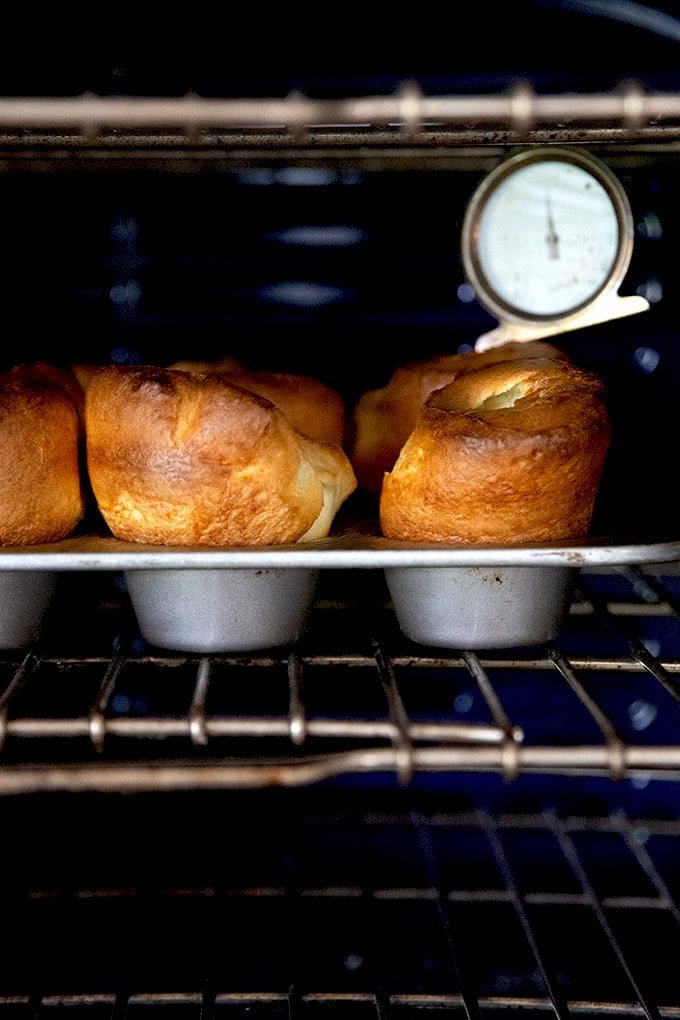
There is nothing more festive than pulling a pan of lofty popovers (also known as Yorkshire pudding*) from the oven just as everyone is gathering around the table to eat. Piping hot and light as air with custardy centers begging for pats of butter, popovers are a treat to behold.
Having made many batches of popovers over the years, I’ve learned how to achieve lofty popovers every time: room temperature ingredients + a hot oven = popover success. This is because popovers rely on steam — as opposed to baking powder, baking soda, or yeast — to rise. This King Arthur Flour article says it best: “The warmer your batter going into the oven, the more quickly it’ll produce steam: simple as that.”
Final tip? Use the right flour. For especially lofty popovers, bread flour is your gal! I achieve great loft with all-purpose flour as well, but I achieve the greatest heights when I use bread flour.
How to Make Lofty Popovers, Step by Step
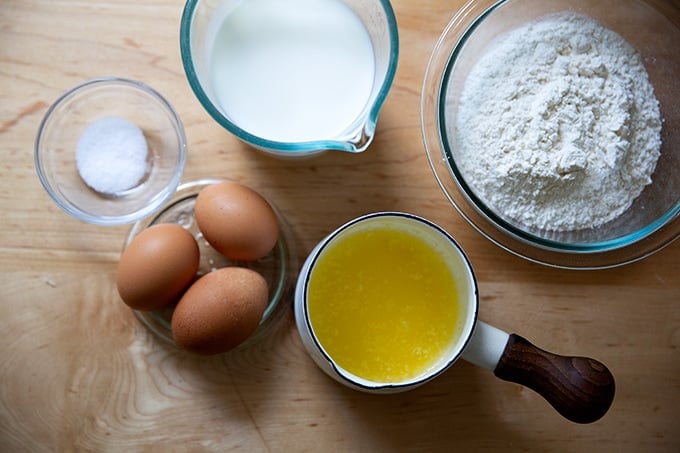
Gather your ingredients: eggs, milk, melted butter, flour, and salt. You want your eggs and milk at room temperature — see the recipe box for tips if you forget to leave them out before getting started.
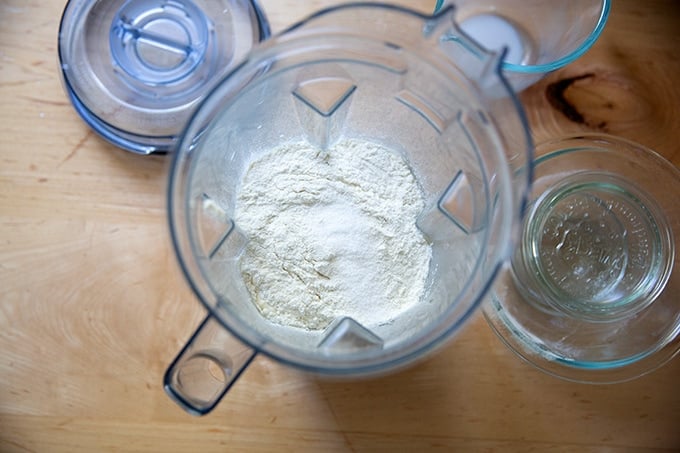
Combine the eggs (room temperature), milk (room temperature or slightly warmed), salt, and flour in a blender. Blend for 30 seconds until combined. Alternatively, whisk the ingredients together by hand. I find using the blender ensures a smooth batter, which is what you want here.
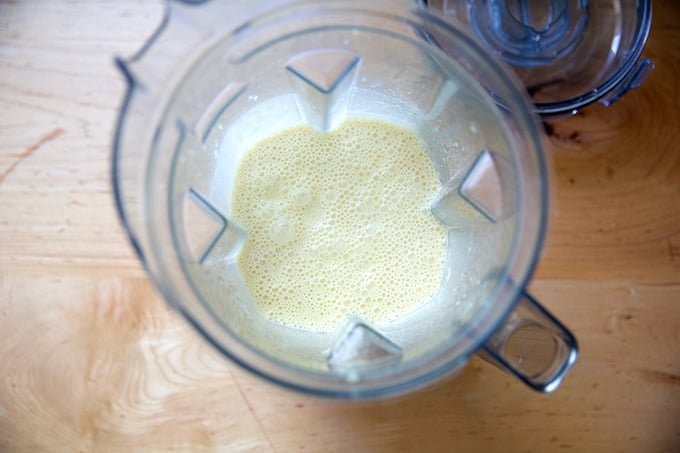
Add the melted butter and blend again for 15 to 20 seconds.

The batter should be smooth:
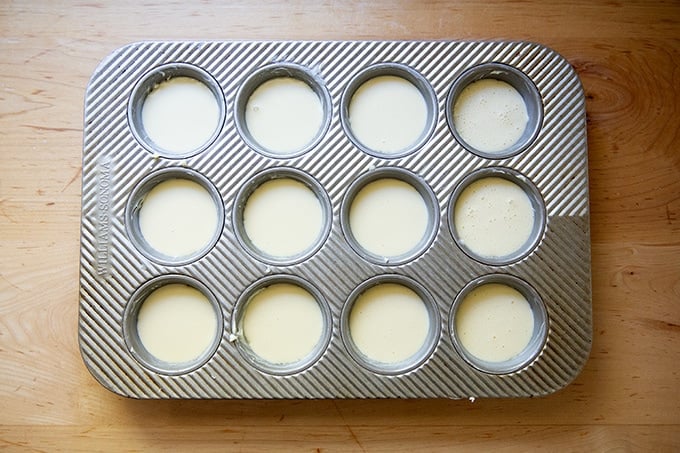
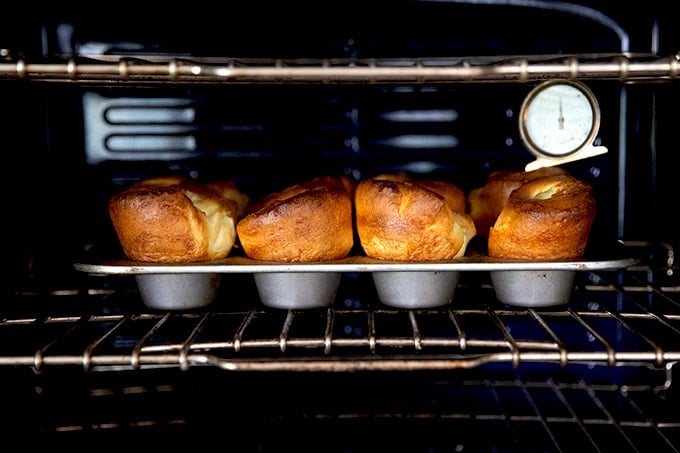
Transfer the batter to a buttered muffin tin, then place in the oven and bake at 425ºF for 20 minutes and 350ºF for 10 minutes:
Ta-da! How fun are they?
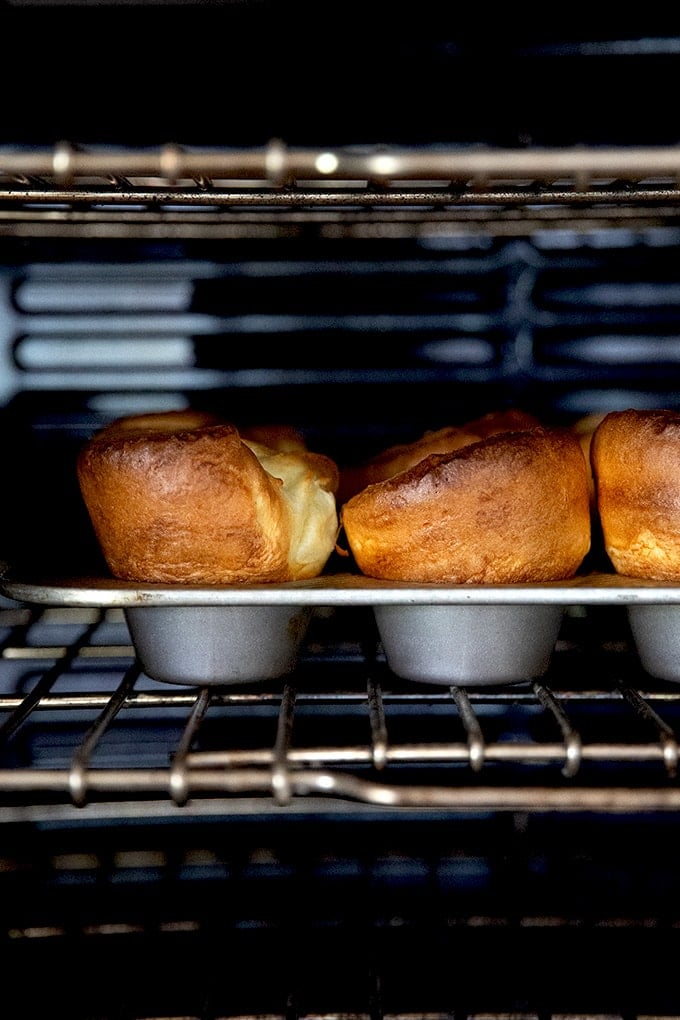
Remove from the oven and admire your work…
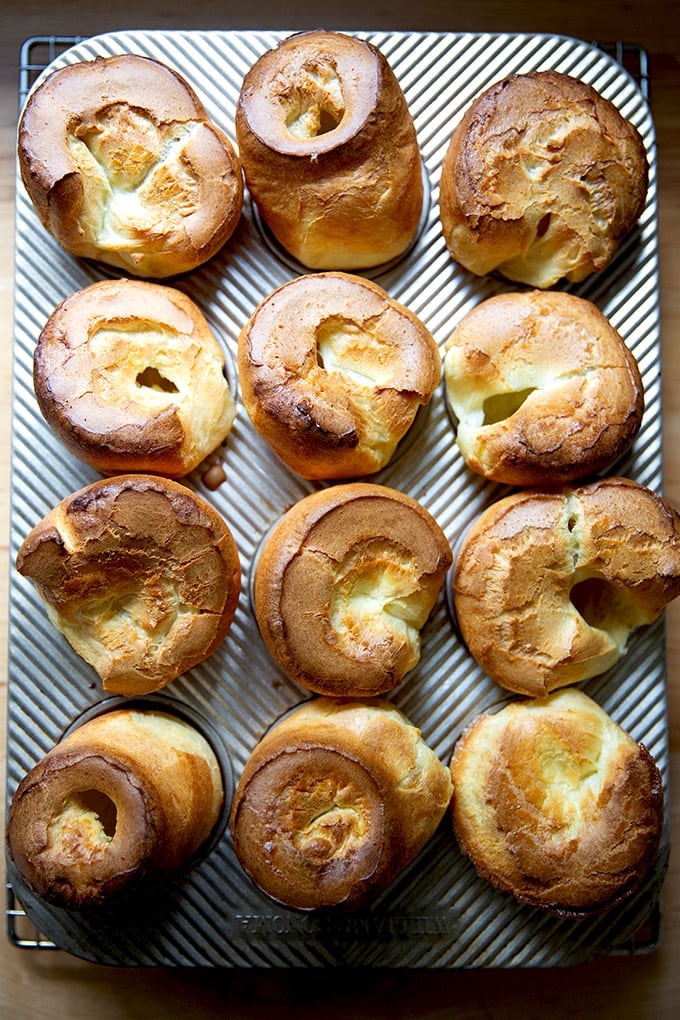
… briefly! I’m not even sure why I turned these out onto a cooling rack because…

… the one rule of popovers is: Eat Immediately! Transfer them to a bowl and pass around the table.


Serve with butter on the side.
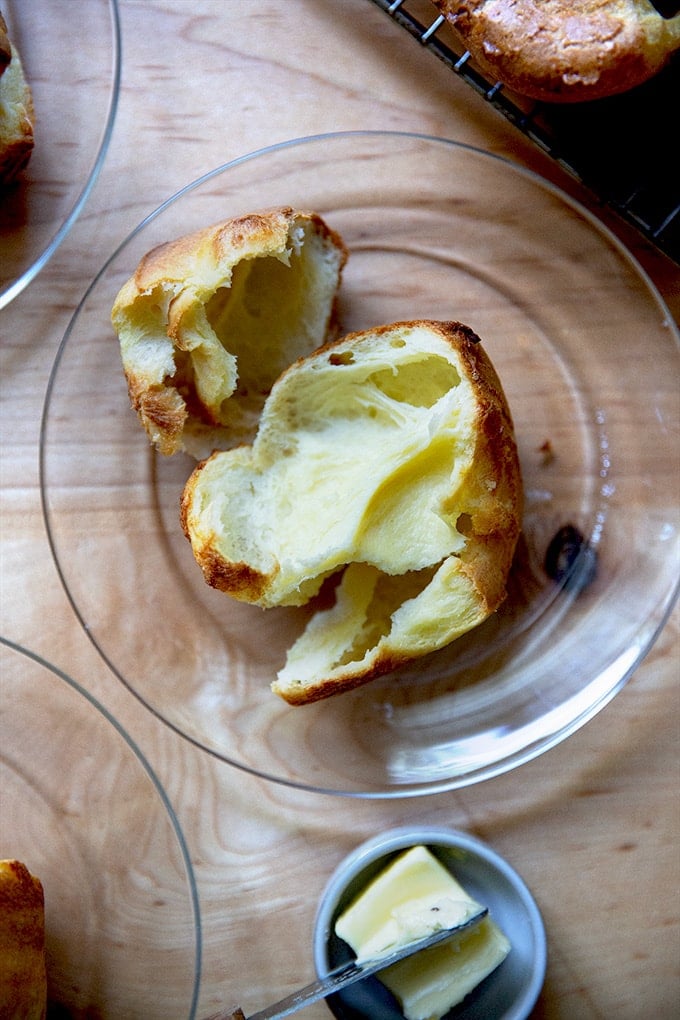
Heaven.

Description
Making popovers couldn’t be simpler: the 5-ingredient batter comes together in seconds, and 30 minutes later, they’re done! Read on to learn the tips for making foolproof popovers every time.
Notes:
Most popover recipes are basically the same — if you compare recipes, you’ll find they differ slightly in the number of eggs and quantities of milk and flour, but you’ll also see that the basic ratio of flour to milk to eggs is roughly the same.
*Another name for popovers is Yorkshire pudding, the only difference being the baking method. Yorkshire pudding calls for preheating the pan with meat drippings before pouring the batter over the top.
This is essentially 1.5 times my mother’s recipe, with influences from both King Arthur Flour and America’s Test Kitchen , both of which emphasize using room-temperature or slightly warmed ingredients. In sum, the keys to success here are:
- Use a scale to measure — it’s the only way to measure accurately.
- Use room-temperature eggs . If you forget to bring your eggs to room temperature, you can plunge them into a bowl of hot tap water for 10 minutes. Truly: I don’t think I’ve ever used room-temperature eggs when a recipe has called for it, and I’ve never noticed a difference. With popovers, I have.
- Use room-temperature milk . If you forget to bring your milk to room temperature, you can heat it briefly in the microwave or on the stovetop — just until it’s warm to the touch, 75ºF or so.
- Hot oven . You’ll want to start with your oven at 425ºF at a minimum. Some recipes call for 450ºF, but I find in my oven that temperature browns the popovers a little too much for my liking. Every oven is different, however, so you may find 450ºF works better for you.
- Bread flour : for especially loft popovers, bread flour is your gal! I have achieved great loft with all-purpose flour as well, but I did achieve the greatest heights when I used bread flour.
A note on salt: If you are using Morton kosher salt or fine sea salt use 1/2 teaspoon.
The pan: I love this USA muffin pan . You can use a traditional 6-well popover pan, too, but I prefer the results when the batter is spread among 12 wells. My batter stuck in my popover pan, too, which made for mangled popovers upon removing them. I highly recommend simply using a metal muffin pan for best results here.
- softened butter, for greasing, plus more for serving
- 3 large eggs, room temperature (see recipe if you forget to take your eggs out ahead of time)
- 1 1/2 cups ( 375 grams ) room-temperature milk — I’ve been using 2% (see recipe if you forget to leave your milk out ahead of time)
- 1 1/2 cups ( 192 grams ) bread flour or all-purpose flour
- 1 teaspoon ( 3 grams ) kosher salt, I use Diamond Crystal brand, see notes above
- 3 tablespoons ( 43 grams ) melted butter — I use salted, but unsalted is fine
- Preheat the oven to 425ºF with a rack in the center. Grease a 12-cup muffin tin with the softened butter.
- If your eggs are not at room temperature, place them in a bowl and cover with hot tap water. Let stand for 10 minutes, then remove.
- Place your milk in the microwave for 1 minute. Remove. It should be roughly 75ºF, but slightly warmer is fine, too. I have also used milk that I’ve left at room temperature for several hours, and that has worked great, but I think you’ll find you’ll get even more loft if you warm the milk slightly. You can do this on the stovetop, too — just heat it until it is warm to the touch.
- Place the eggs, milk, flour, and salt in a blender and blend to combine, roughly 30 seconds. I use my Vitamix, and I blend at speed 5. You want a smooth batter here, and using a blender ensures your batter will be smooth.
- Add the melted butter and blend for another 15 to 20 seconds. (Alternatively, whisk by hand: whisk together the eggs, milk, and salt first; add the flour and whisk until combined and smooth; add the butter and whisk again until smooth.)
- Pour the batter into the prepared muffin tin, aiming to fill each well halfway with the batter. Once you’ve filled each well, divide any remaining batter as evenly as possible among the wells.
- Transfer to the oven immediately and bake for 20 minutes. Lower the heat to 350ºF and bake for 10 minutes more.
- Remove, transfer to a serving bowl, and eat immediately! Serve with softened butter on the side.
- Prep Time: 15 minutes
- Cook Time: 30 minutes
- Category: Bread
- Method: Oven
- Cuisine: Amerian
