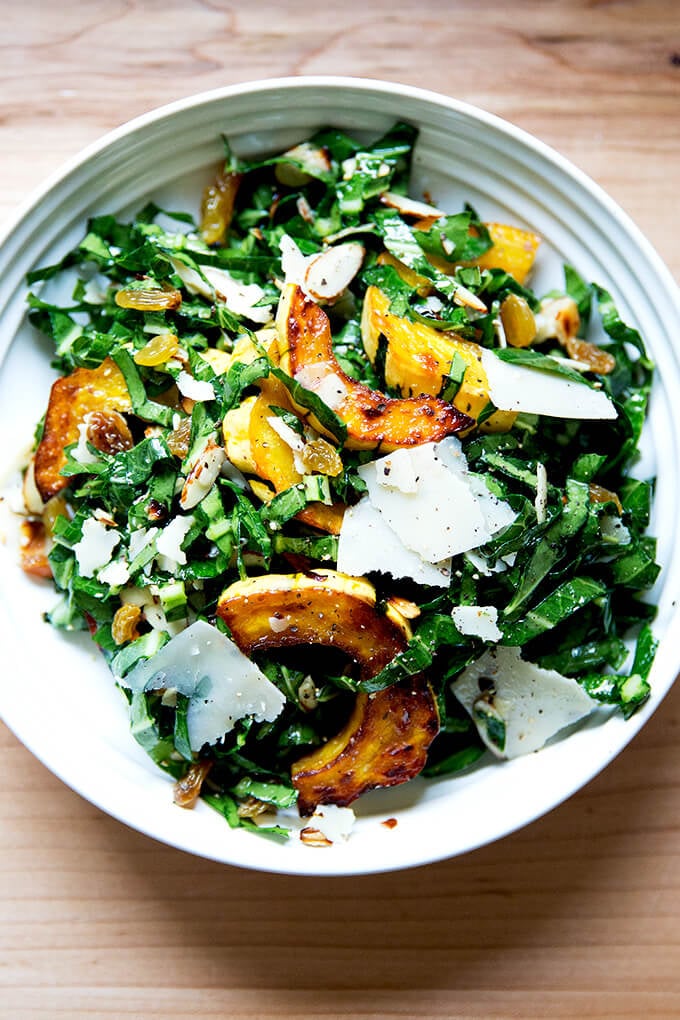
Last week, my friend Deb sent me a recipe for a kale salad she had made for Rosh Hashanah. Everyone, she wrote, raved.
I made it promptly and was reminded:
Roasted garlic = complete goodness. Delicata squash = so pretty, so tasty, so low maintenance.
In some ways, it’s no surprise the salad was so delicious: it’s got toasted almonds, shaved parmesan, and golden raisins, that dried fruit-nut-and-cheese trifecta that wins every time.
Plus: there’s thinly shaved kale and roasted delicata squash. As Ina says: How bad can that be?
But what was surprising was the dressing, a mix of vinegar and fresh lemon juice, honey, olive oil, and a whole head of smashed roasted garlic cloves. It’s equal parts acid to fat, which means it’s very sharp, which is partly why, I think, it works so well here.
A few days after making it, I found myself craving it again, but didn’t have an hour to roast a head of garlic, so I didn’t — rebel! — and guess what? It was still delicious. Without the roasted garlic, this salad comes together in just about 30 minutes, and thanks to the squash mostly but also the nuts, dried fruit, and cheese, it feels very substantial.
We’ve been treating it as the main course with — you guessed it! — a nice hunk of bread on the side.
Ready for a plot twist?
I first made the salad with kale, but I’ve since been using thinly shaved collard greens and a technique I learned from Ronna Welsh’s The Nimble Cook . Instead of massaging the greens, Ronna has you toss the thinly shaved leaves with a little bit of salt AND sugar, then let them stand for 15 minutes before tossing with the dressing.
“I use a pinch of sugar with collards, because they tend to lean a bit bitter. Other greens, like kale, can be bitter, too, but because collards are thicker (and more to chew), the bitterness hangs around longer in your mouth.”
This technique serves another purpose, too, however. Whereas massaged raw greens soften as they would under heat, “a light toss,” Ronna says, “leaves them crisp.”
It’s true. I actually tried massaging the collards — rebel! — and I did not like the extra-wilted texture at all.
Ronna suggests dressing the greens with a sharp vinaigrette to ensure the salad will not taste at all sweet. The lemony dressing here is a perfect match for collards.
I always associate collard greens with braising — with hours and hours of cooking — so this salt-sugar toss followed by a brief rest followed by a sharp dressing has been a revelation. Collard greens in 15 minutes? Sign me up!
Note: I rarely see collard greens at the store, but I can always count on getting them in my farmshare a few times a year, so I’m always on the lookout for new ways to prepare them. But since learning Ronna’s technique, I seek them out. Depending where you live, you may have more or less trouble finding them, but you very likely will be able to find Tuscan kale, which works beautifully in this salad as well.
Here’s the play-by-play: Find yourself a nice bundle of collard greens or Tuscan kale.
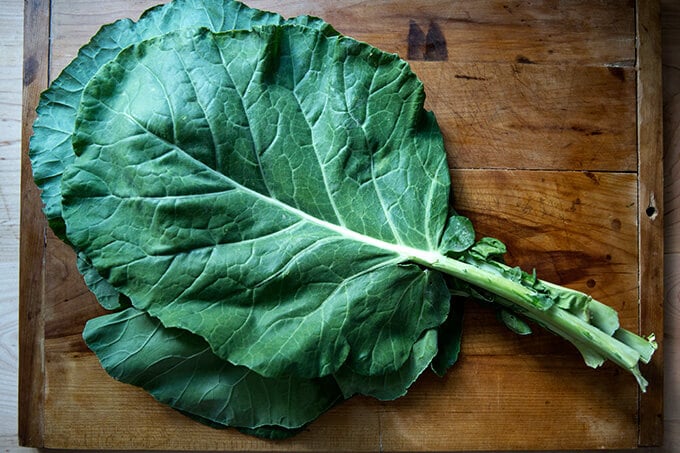
Remove the stems.
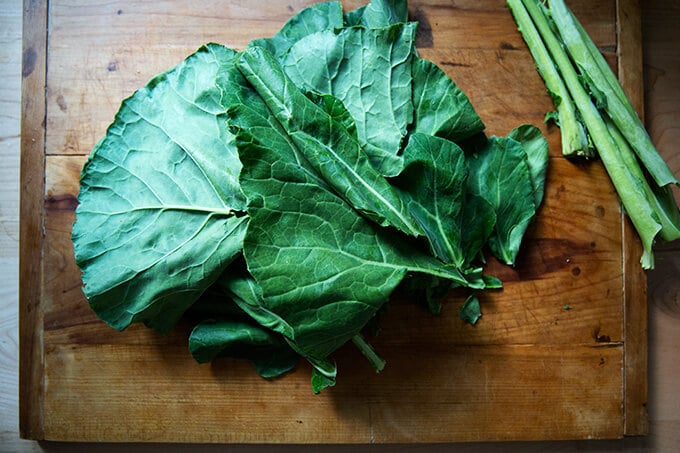
Slice the leaves very finely.
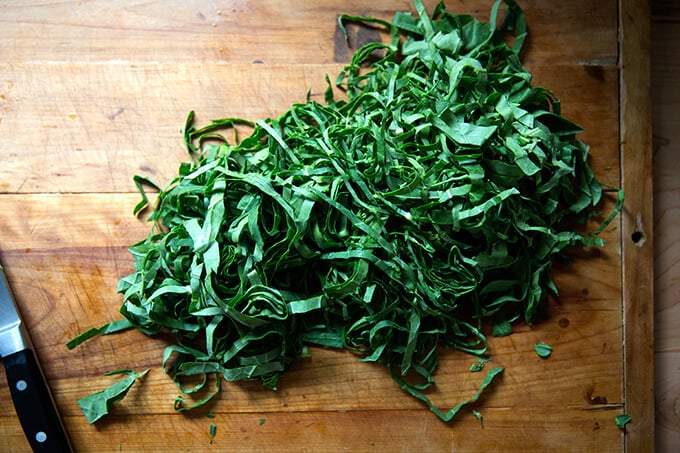
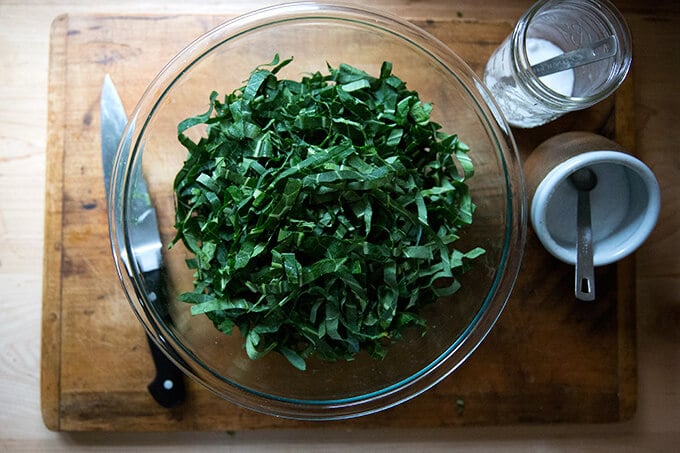
Toss the greens with a little bit of salt and sugar (if using collards), and let them stand 15 minutes.
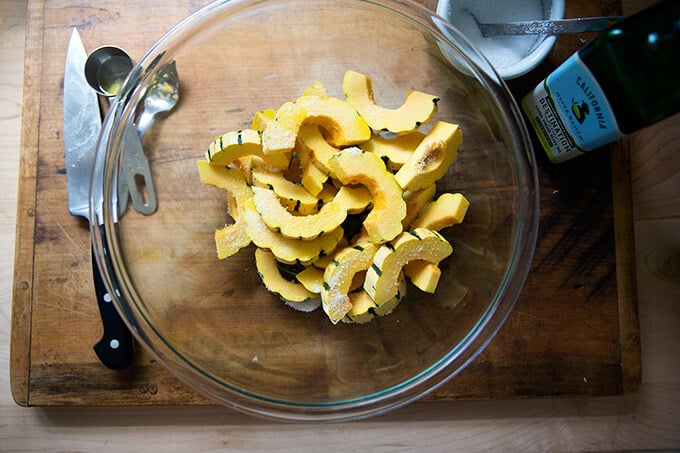
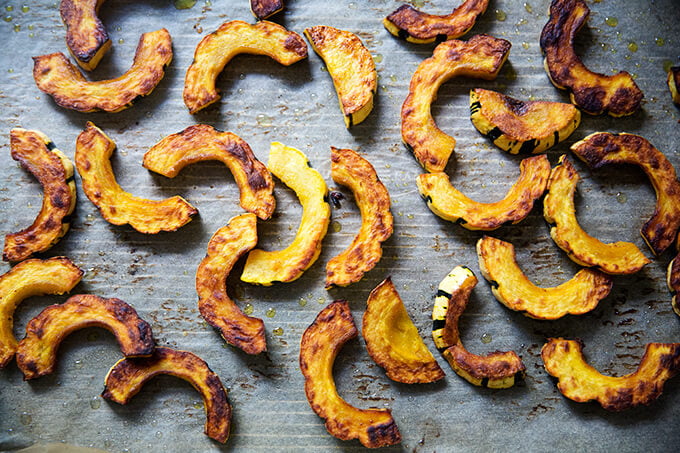
Meanwhile, roast slices of delicata squash with olive oil and salt.
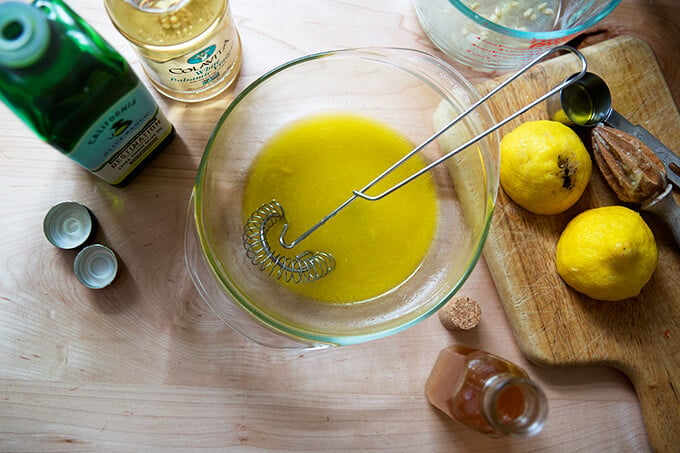
Meanwhile, whisk up a sharp dressing of vinegar, lemon, honey, and olive oil.
Toss the greens with shaved parmesan, toasted almonds, golden raisins, and the dressing.
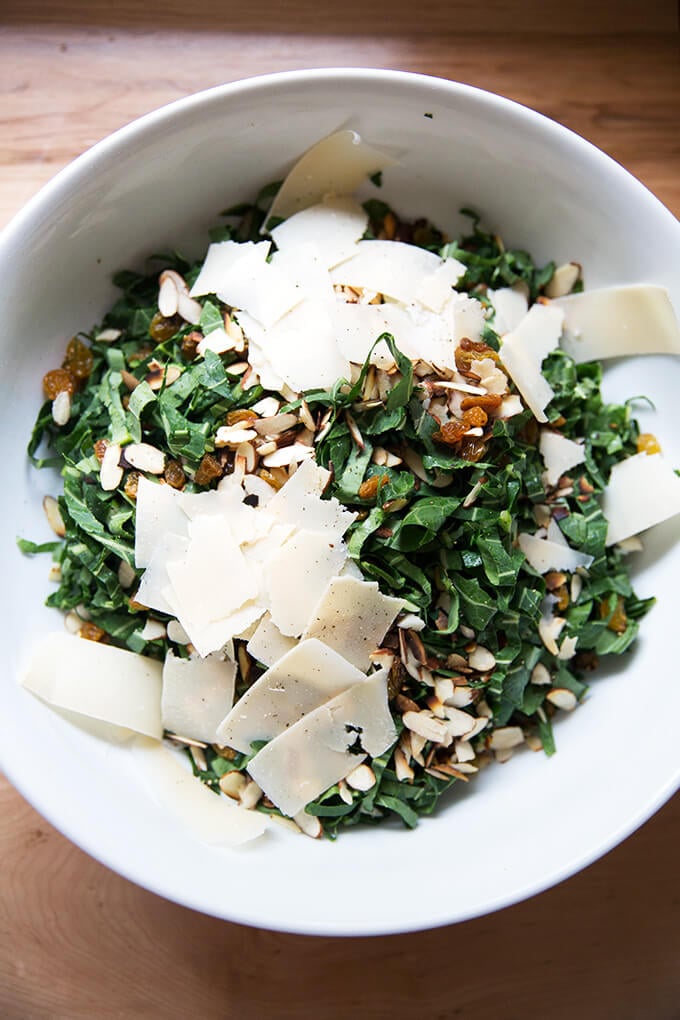
Add the squash and toss again.
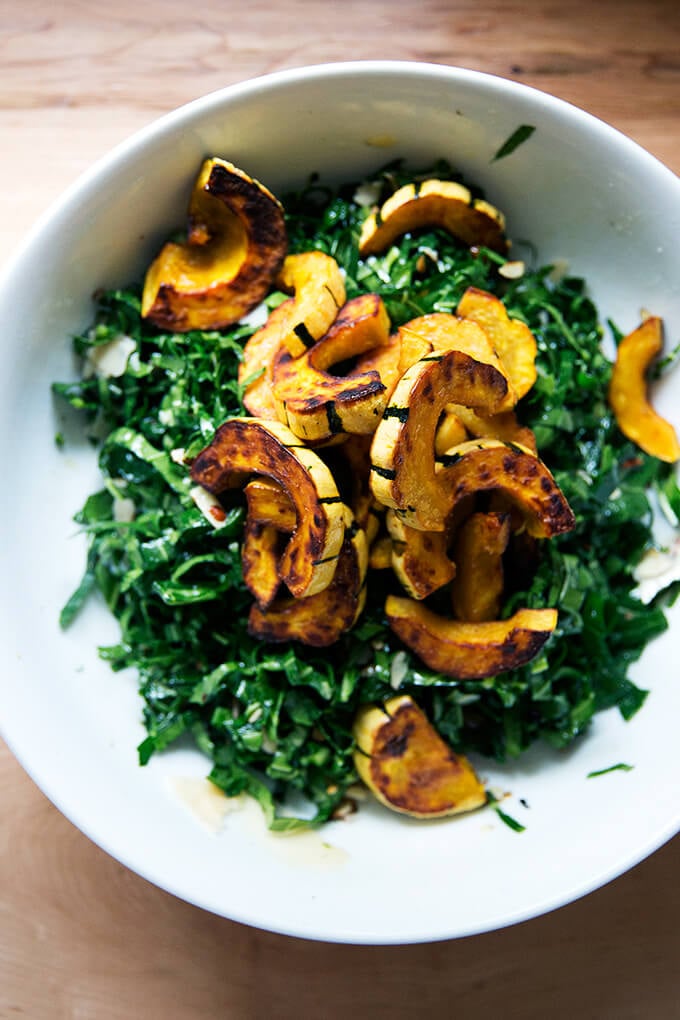
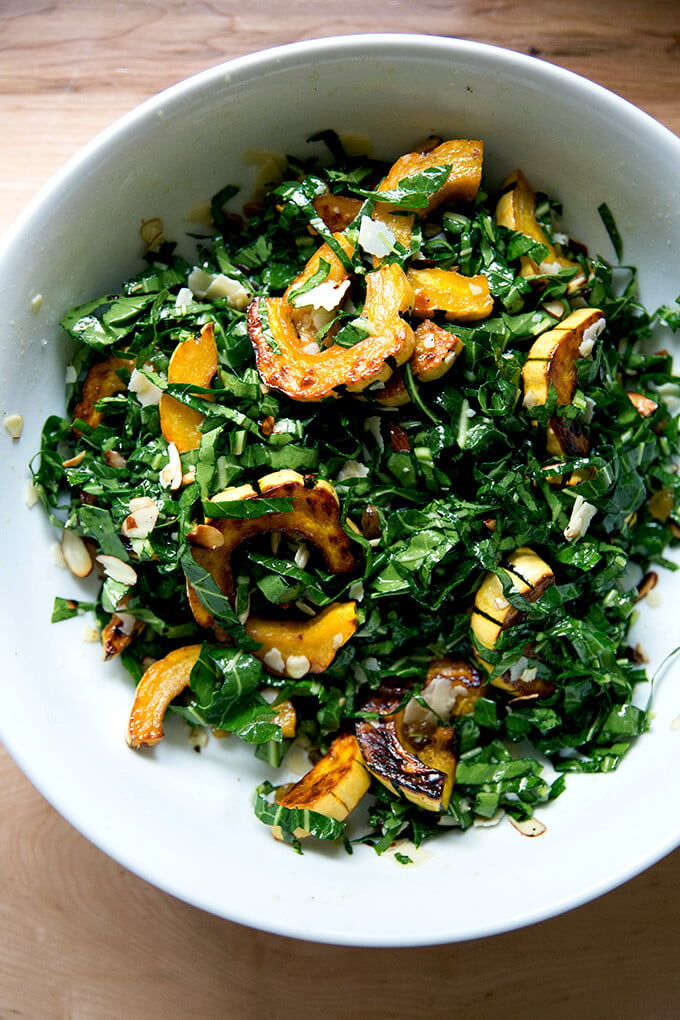
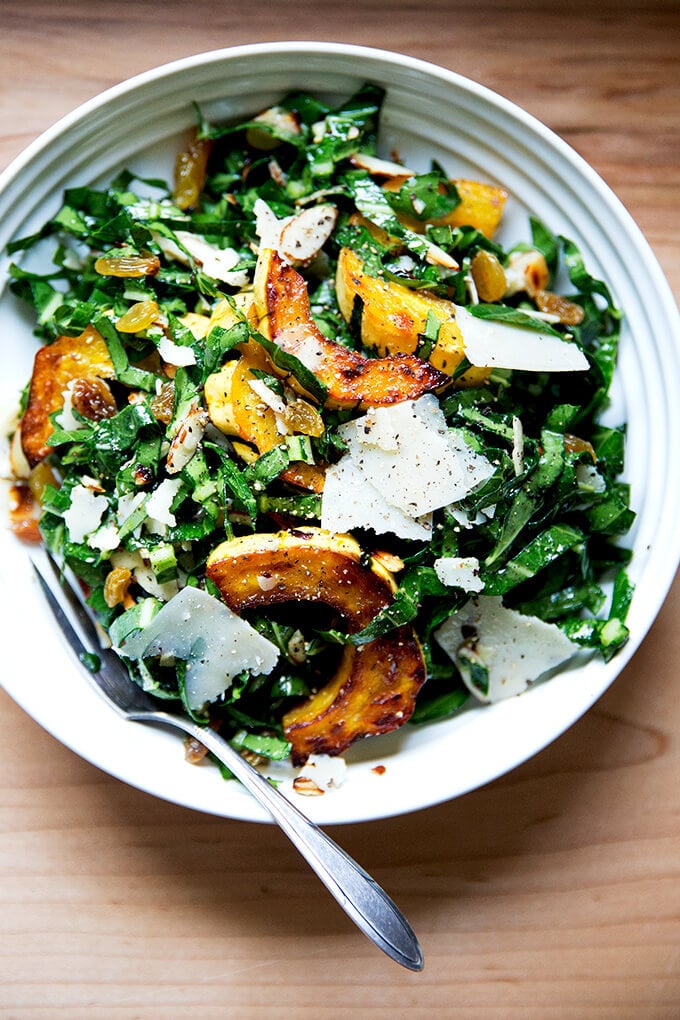
Shave more parmesan over top and serve.
Description
Salad recipe adapted from Epicurious . Original recipe calls for roasting a head of garlic, smashing the cloves, and whisking them into the dressing. It’s delicious. To save time, I’ve omitted that step.
Salt: I always use Diamond Crystal kosher salt. If you are using Morton’s kosher salt, you may want to cut back a teensy bit on the quantities listed below. Morton’s is saltier.
This is such a festive, pretty, hearty fall salad. When the pomegranates begin arriving, I think I’ll add those here, too.
- 6 tablespoons extra-virgin olive oil
- 1 large or 2 small delicata squash, halved, seeds removed, and sliced into 1/2 -inch thick pieces
- 1 large head (roughly 10 ounces ) collard greens or lacinato kale, thickest ribs removed to yield about 8 ounces
- kosher salt
- 1/4 teaspoon sugar
- 2 tablespoons white balsamic (or cider or other white) vinegar
- 2 tablespoons fresh lemon juice
- 1 teaspoon honey
- 1/2 cup sliced almonds
- 1/2 cup golden raisins or dried fruit of choice
- shaved Parmigiano Reggiano or Manchego, to taste
- freshly ground black pepper, to taste
- Heat the oven to 400ºF. Place the squash pieces in a large bowl and coat with 2 tablespoons of the oil and 1 teaspoon kosher salt. Spread out the squash, reserving the bowl, on a large baking sheet and roast for 15 minutes. Flip, and roast for another 10 to 15 minutes. Check. Continue to roast if necessary until slices are golden on both sides. Set aside to cool to room temperature.
- Thinly slice the greens the way you would chiffonade basil: stack a few leaves on top of one another, roll into a tight coil, then cut straight down to create thin ribbons. Place the greens (you should have about 8 ounces) in the reserved bowl and toss with a scant 1/2 teaspoon kosher salt and 1/4 teaspoon sugar (if using collards). Toss gently — no need to massage. Set aside for 15 minutes.
- In a small bowl, stir together 2 tablespoons oil, vinegar, lemon juice, honey, and 1/4 teaspoon kosher salt. Taste. Add the remaining 2 tablespoons oil, if it tastes too sharp for your liking. (Note: Dressing should taste sharp. You can also always add 2 more tablespoons of oil to the salad once it’s all tossed together if you think it still tastes too sharp.)
- Set a small skillet on the stove over low heat. Add the almonds and toast until golden, checking often.
- Add the raisins, toasted nuts, and some shaved parmesan to the bowl of greens. Toss with the dressing. Add the squash pieces and toss again. Shave more parmesan over top and crack fresh pepper over top to taste, as well.
- Serve the salad at room temperature.
- Prep Time: 15 minutes
- Cook Time: 25 minutes
- Category: Salad
- Method: Toss
- Cuisine: American
Description
Salad recipe adapted from Epicurious . Original recipe calls for roasting a head of garlic, smashing the cloves, and whisking them into the dressing. It’s delicious. To save time, I’ve omitted that step.
Salt: I always use Diamond Crystal kosher salt. If you are using Morton’s kosher salt, you may want to cut back a teensy bit on the quantities listed below. Morton’s is saltier.
This is such a festive, pretty, hearty fall salad. When the pomegranates begin arriving, I think I’ll add those here, too.
- 6 tablespoons extra-virgin olive oil
- 1 large or 2 small delicata squash, halved, seeds removed, and sliced into 1/2 -inch thick pieces
- 1 large head (roughly 10 ounces ) collard greens or lacinato kale, thickest ribs removed to yield about 8 ounces
- kosher salt
- 1/4 teaspoon sugar
- 2 tablespoons white balsamic (or cider or other white) vinegar
- 2 tablespoons fresh lemon juice
- 1 teaspoon honey
- 1/2 cup sliced almonds
- 1/2 cup golden raisins or dried fruit of choice
- shaved Parmigiano Reggiano or Manchego, to taste
- freshly ground black pepper, to taste
- Heat the oven to 400ºF. Place the squash pieces in a large bowl and coat with 2 tablespoons of the oil and 1 teaspoon kosher salt. Spread out the squash, reserving the bowl, on a large baking sheet and roast for 15 minutes. Flip, and roast for another 10 to 15 minutes. Check. Continue to roast if necessary until slices are golden on both sides. Set aside to cool to room temperature.
- Thinly slice the greens the way you would chiffonade basil: stack a few leaves on top of one another, roll into a tight coil, then cut straight down to create thin ribbons. Place the greens (you should have about 8 ounces) in the reserved bowl and toss with a scant 1/2 teaspoon kosher salt and 1/4 teaspoon sugar (if using collards). Toss gently — no need to massage. Set aside for 15 minutes.
- In a small bowl, stir together 2 tablespoons oil, vinegar, lemon juice, honey, and 1/4 teaspoon kosher salt. Taste. Add the remaining 2 tablespoons oil, if it tastes too sharp for your liking. (Note: Dressing should taste sharp. You can also always add 2 more tablespoons of oil to the salad once it’s all tossed together if you think it still tastes too sharp.)
- Set a small skillet on the stove over low heat. Add the almonds and toast until golden, checking often.
- Add the raisins, toasted nuts, and some shaved parmesan to the bowl of greens. Toss with the dressing. Add the squash pieces and toss again. Shave more parmesan over top and crack fresh pepper over top to taste, as well.
- Serve the salad at room temperature.
- Prep Time: 15 minutes
- Cook Time: 25 minutes
- Category: Salad
- Method: Toss
- Cuisine: American
Find it online : https://alexandracooks.com/2019/10/09/raw-collard-green-salad-with-roasted-delicata-squash-almonds-parmesan/
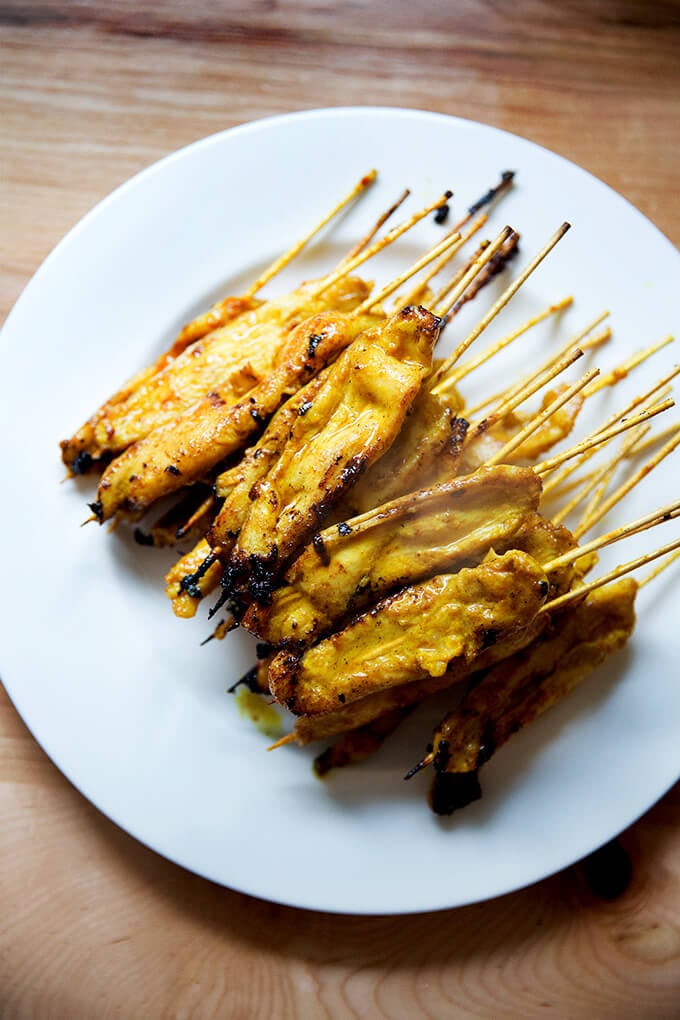
This easy Thai chicken satay has become my family’s most requested meal. The 6-ingredient chicken marinade, which requires no chopping, comes together in a snap. The chicken can be sliced and marinated 48 hours or more in advance, so don’t be afraid to make it ahead of time. I always serve it with coconut rice, which my children devour.
A few months ago, I discovered my children love Thai food. If you are wondering: How could children not love Thai food? Chicken on a stick ! Dumplings! Rice! Noodles! Peanut sauce! What’s not to love?
I hear you.
But if I know anything it’s that you never know with these fickle little beings, and this recent discovery is a welcomed one. Dining out with four little ones is about as much fun as it sounds, but knowing the food will not be a challenge — knowing I can relish a spicy green papaya salad while the children jump from one platter to the next — changes everything.
A night at Celadon , newly opened just down the road, leaves us all incredibly happy.
Celadon’s Thai chicken satay in particular is what my children devour about as quickly as it arrives on the table. After a few visits, I set out to recreate the satay at home, consulting a few recipes, which ran the gamut from including Thai red curry paste and coconut milk in the marinade to excluding both, opting for dried spices and aromatics instead.
The recipe below is the result of several experiments, and it has become one of my children’s most-requested meals. Here are the details:
Easy Thai Chicken Satay
Thought process:
- To keep the marinade simple, I omitted aromatics. There’s no garlic, ginger, lemongrass, etc. here . Mentally knowing I don’t need to chop anything for the marinade makes it feel doable any night of the week.
- To keep it geared toward children, I omitted spicy pastes and sauces .
What I included:
- Brown sugar, fish sauce, soy sauce, coconut milk, turmeric, and curry powder . It’s a little sweet, a little salty, and it’s got warm spice without heat. It comes together in a snap.
- Coconut rice goes nicely with satay, and I now always make the two together to make the most of that one can of unsweetened coconut milk: 3/4 cup of it goes into the rice; the remainder goes into the marinade.
A few tips:
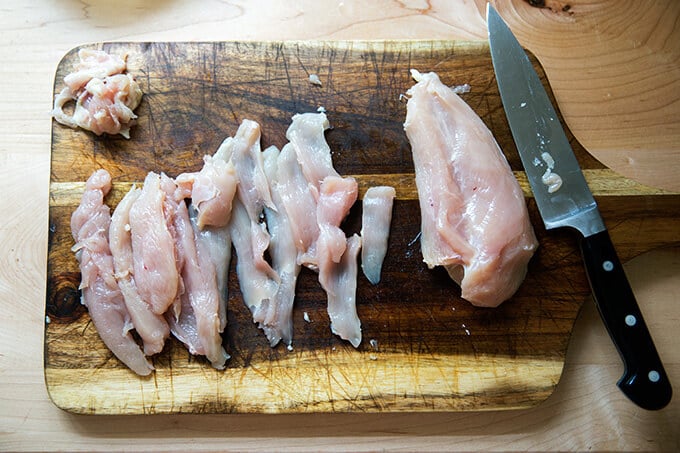
- Thinly sliced chicken breasts. Celadon uses chicken breasts that are sliced thinly and threaded onto skewers (as opposed to using cubed meat), so I’ve done the same here. What I love about using the thinly sliced breasts is that they cook incredibly quickly on the stovetop. So while threading the breasts onto skewers may feel a bit too much like hard work on a Tuesday night, know that the chicken will cook in about 4 minutes total. (30-second slicing video included below.)
- Skewers . I have no doubt that part of the appeal of this chicken for children is that it arrives on a stick. Small 6-inch skewers are key for ensuring the stovetop cooking process is as painless as possible — larger ones won’t fit into the pan. If you only have large ones, break them.
- Medium-high heat . The first time I made the chicken, I made the mistake of using a screaming hot pan to get that char I love so much. But children (mine at least) don’t love char. There is no need to get your pans smoking hot here. Medium to medium-high heat should cook the chicken quickly without caramelizing it too much.
- Peanut sauce: Where is it? Shockingly, my kids don’t eat the peanut sauce with the satay. At first I found myself pushing it on them, and then I thought: what am I doing? If they eat the chicken without it, that’s one less thing to worry about. If you, however, are looking to serve this satay with a peanut sauce, this one is excellent: All-Purpose Thai Peanut Sauce.
Final note:
This recipe was designed with children in mind, but this is a meal the whole family can enjoy. You can always make it spicier by squirting some Sriracha or other prepared hot sauce over the cooked chicken or into the peanut sauce. I made this recently for a dear friend and her four children, and my friend took one bite and said: Al, you should put this on your blog. Music to my ears.
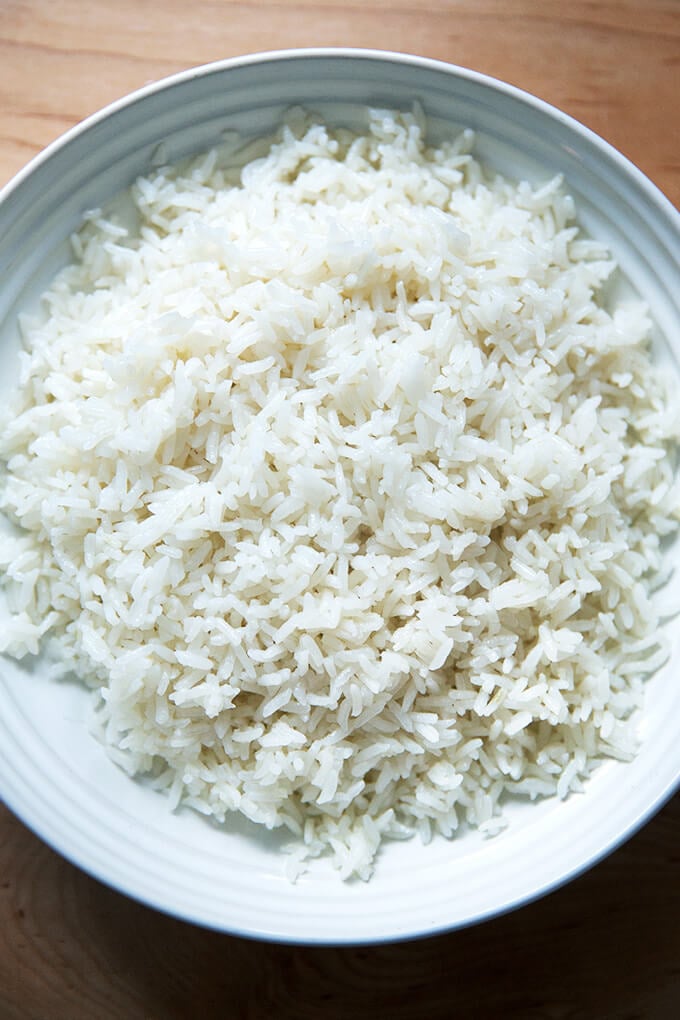
How to Make Perfect Coconut Rice
- Use white Basmati rice or Jasmine rice.
- Rinse the rice. Rinsing rice is one of my least favorite kitchen tasks, but more and more, I find it makes a difference. To rinse rice: place it in a large bowl, fill it with cold water, swoosh the rice around a little bit; then tip the bowl to dump out the cloudy water. Repeat this process 3 to 4 more times.
- Use a ratio of 1 part liquid to 1 part rice, and with the liquid use a ratio of 3 parts coconut milk to 1 part water . So, for this recipe, for 1 cup of rice, I use 3/4 cup coconut milk and 1/4 cup water. For 2 cups of rice, use 1 1/2 cups coconut milk and 1/2 cup water.
- Cook the rice covered over low heat for 15 minutes. Turn off the heat, and do not remove the lid for at least 10 minutes . Then, uncover, fluff with a fork and serve.
Here’s the play-by-play: Stir together the satay marinade.
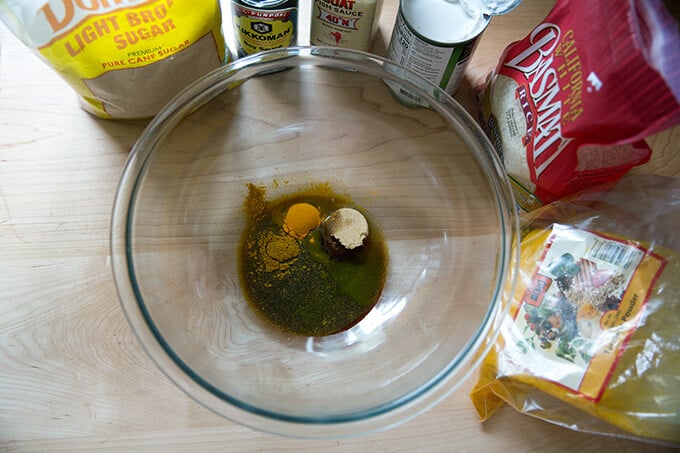
3/4 cup of the unsweetened coconut milk goes with the rice; the remainder goes into the marinade.
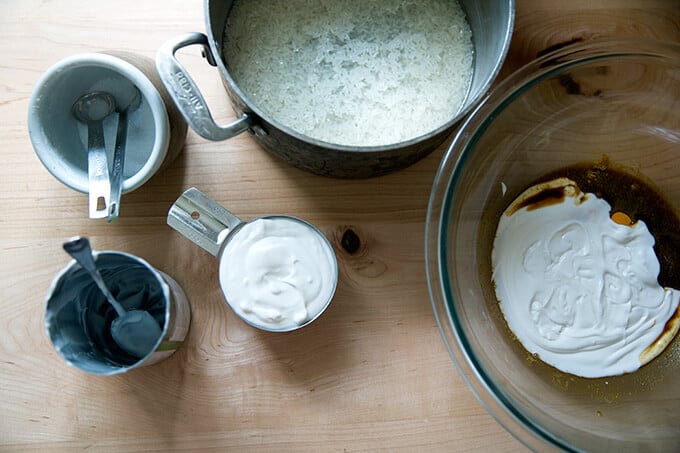
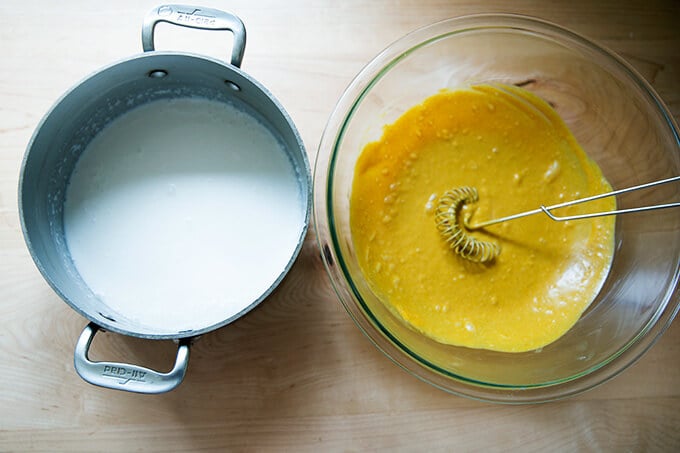
On the left: coconut rice ready to go. One the right: Thai satay marinade ready to go.
Thinly sliced chicken breasts.
30-second slicing video:
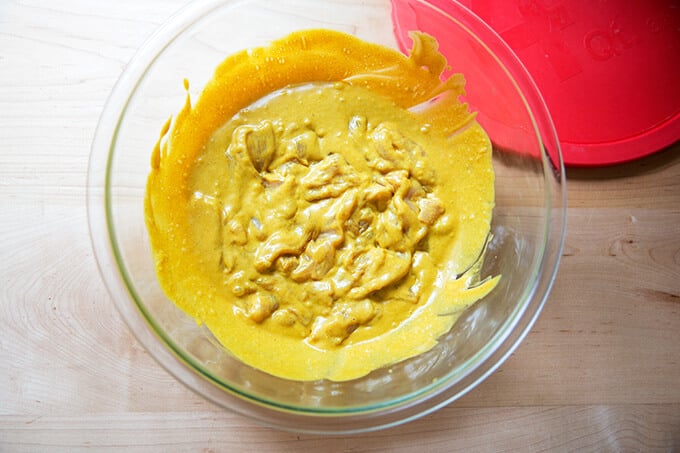
Marinating chicken breasts. (This 4-qt Pyrex bowl with lid is so handy for marinating.)
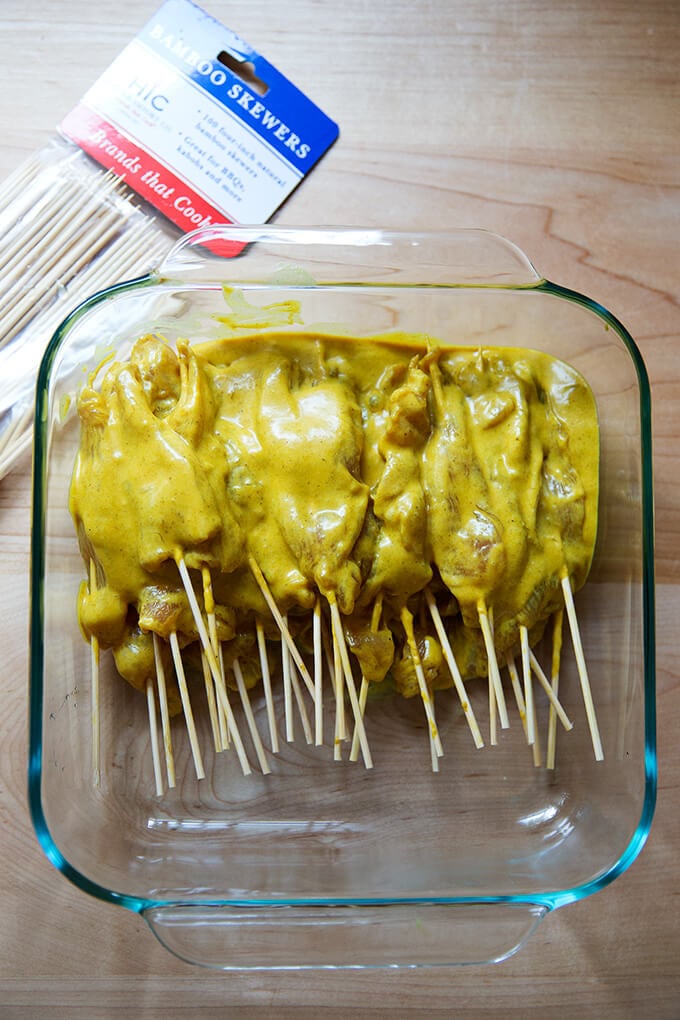
Skewered chicken breasts. These skewers are great .
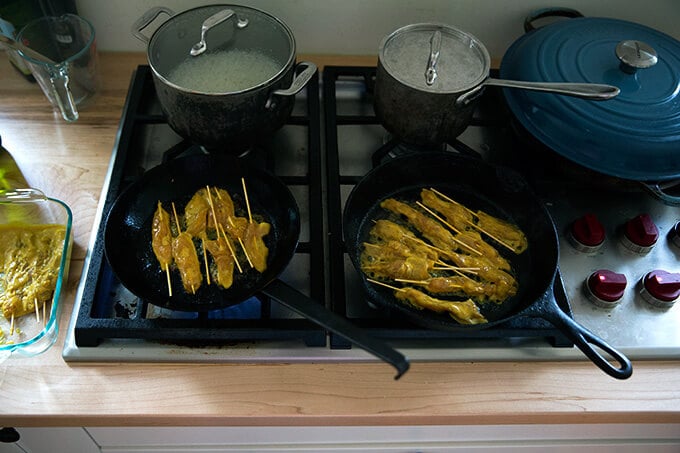
Cooking the Thai chicken satay.
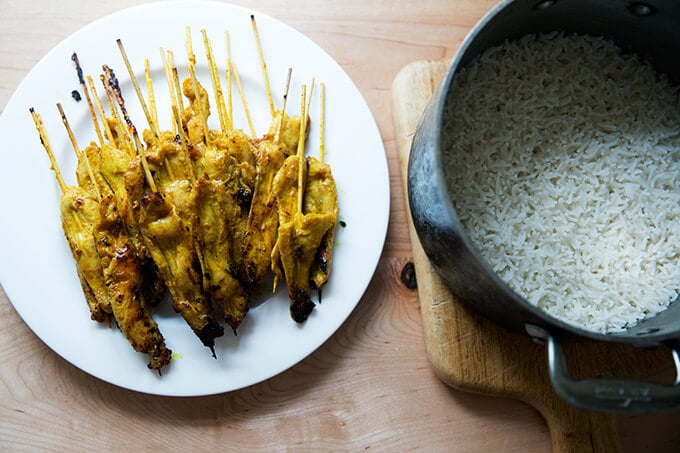
Cooked Thai chicken satay; cooked coconut rice.
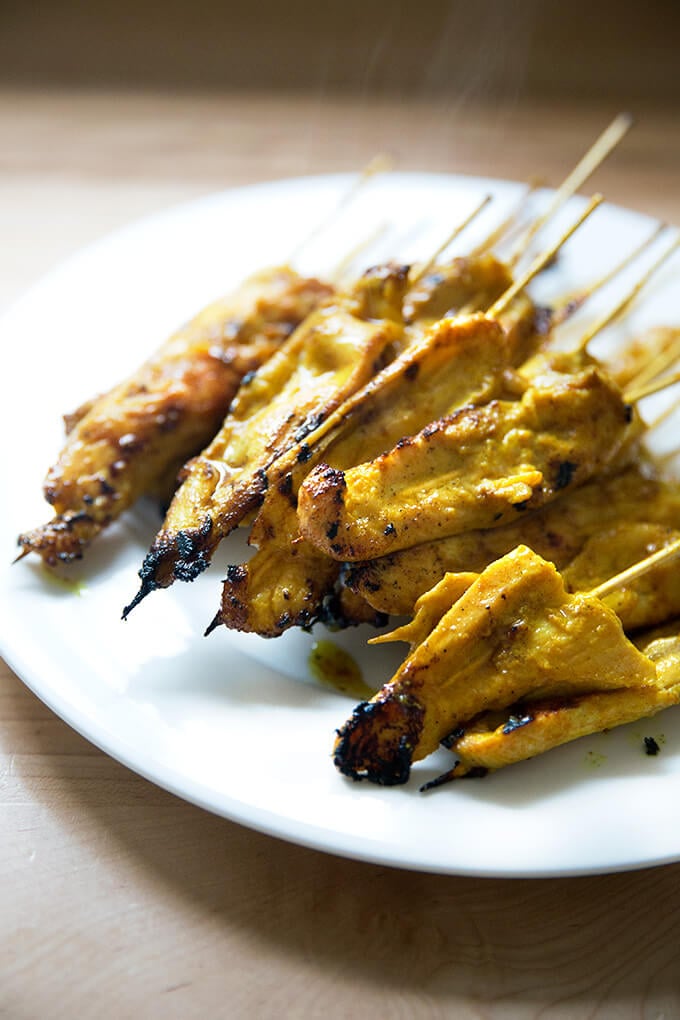
Thai chicken satay ready to be served.
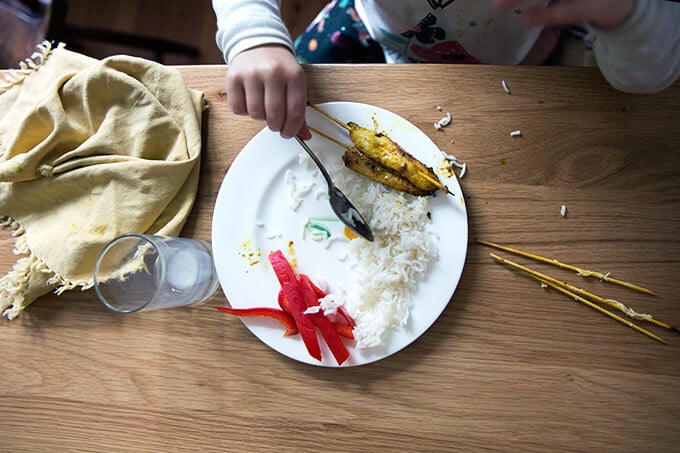
Happy eater.
Happy mother.
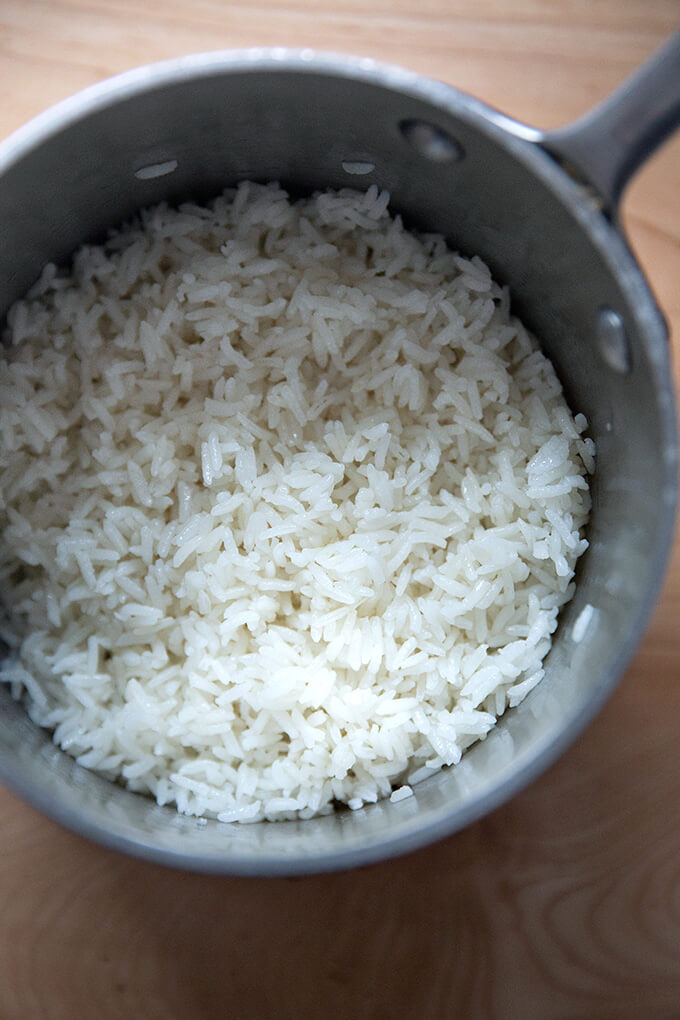
Perfect coconut rice: it’s a beautiful thing.
Description
A Few Notes:
- This marinade yields enough for 4 chicken breasts. I always use 2, but don’t be afraid to slice up 4.
- 6-inch skewers make the cooking process painless — large skewers won’t fit into the pan, and they’ll burn if propped against the edge of the pan for too long. If you only have large skewers, break them.
- To rinse rice: place it in a large bowl, fill it with cold water, swoosh the rice around a little bit; then tip the bowl to dump out the cloudy water. Repeat this process 3 to 4 more times. You don’t have to rinse it until the water runs clear, but rinsing 4 to 5 times will make a difference. Drain the rice by placing it in a fine-meshed colander, and letting it hang over a bowl for a few minutes to allow the excess water to drain out.
For the satay marinade:
- 1 can unsweetened coconut milk (you’ll use some for the rice — if you’re not making the rice, use about 3/4 cup )
- 2 tablespoons brown sugar
- 2 tablespoons fish sauce
- 1 tablespoon soy sauce
- 1 teaspoon turmeric
- 1 teaspoon curry powder, such as Madras
- 2 to 4 boneless, skinless chicken breasts, very thinly sliced, see video below
- grapeseed oil or other neutral oil for cooking the chicken
For the coconut rice:
- 1 cup white basmati rice, rinsed and drained, see notes above
- 3/4 cup well-stirred unsweetened coconut milk
- 1/4 cup water
- 1/4 teaspoon kosher salt
- Marinate the chicken. Open the can of coconut milk and stir it well. Measure 3/4 cup and set it aside for the rice. Dump the remaining coconut milk (it’s about 3/4 cup) into a large bowl. Stir in the brown sugar, fish sauce, soy sauce, turmeric, and curry powder. Add the chicken and toss to coat. Set aside to marinate for at least an hour and up to 24 hours (or longer).
- Get the rice ready: Combine the rinsed and drained rice, 3/4 cup coconut milk, 1/4 cup water, and salt in a medium saucepan. Stir. You can mix this several hours before cooking just to get it out of the way. When ready to cook: bring to a simmer over high heat. Turn heat to low. Cover. Cook 15 minutes. Remove pan from heat. Don’t uncover for at least 10 more minutes.
- Cook the chicken. Thread the chicken breasts onto small (6-inch) skewers. Heat one or two large skillets over medium-high heat. Add a tablespoon of oil (or so) into each skillet. Add the skewers, alternating them head to toe to fit as many as possible into the pan at one time. Cook for about a minute a side — if you cut them more thickly than I have here, you may need to cook them a little bit longer. Transfer skewers to a plate and repeat with the remaining chicken.
- Serve with rice on the side.
- Prep Time: 1 hour
- Cook Time: 20 minutes
- Category: Chicken
- Method: Stovetop
- Cuisine: Thai
