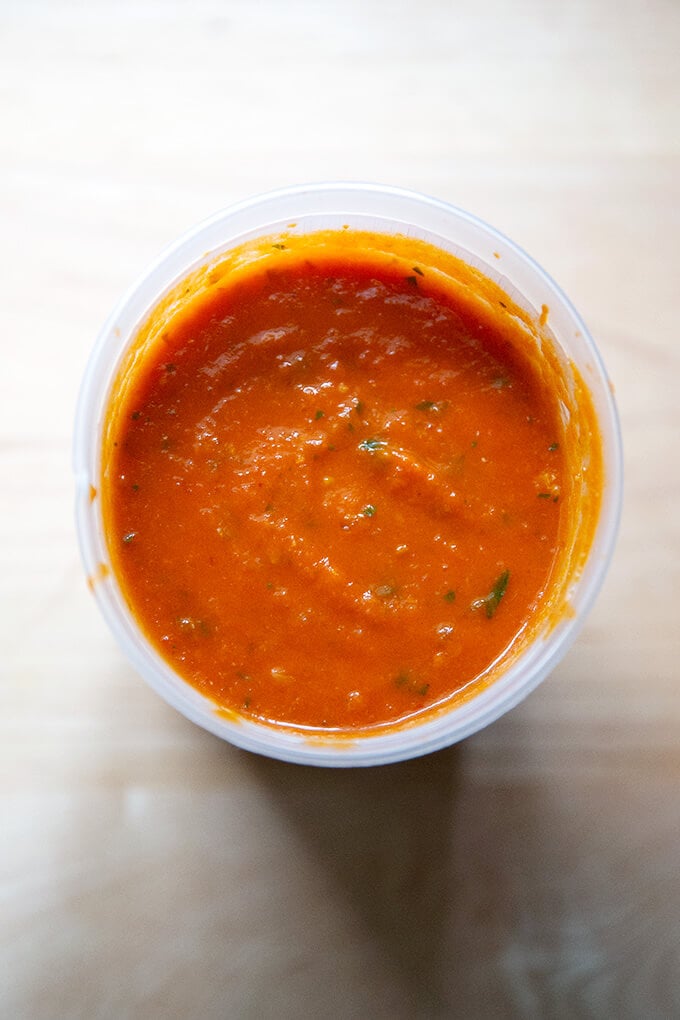
This has become my go-to sauce for homemade pizza, pasta, lasagna, and the like! Made with canned tomatoes, onion, garlic, and lots of fresh basil, it tastes incredibly fresh and comes together in just about 20 minutes. What’s more, you can easily adapt it to make a quick, creamy vodka sauce!
Last month, Memorial Day weekend’s frigid temperatures and relentless rain upended our annual camping trip with my sister’s family, sending us straight past the exit for the campsite, en route to her home instead.
So in place of heating chili and cornbread over a campfire, we baked pizzas under a roof, in the shelter of a waterproof house, a woodburning oven keeping us cozy all the while. My brother-in-law had made the pizza dough that morning, balled it up, and chilled it until we arrived.
Upon learning the pizza plan, I set to work making sauce. Without enough time to make Ina’s vodka sauce , my favorite for pizza, I turned to a faster sauce I hadn’t made in years: Marcella Hazan’s other tomato sauce . Unlike her famous one , this one calls for sautéed onions, crushed garlic, white wine, fresh parsley, and a pinch of crushed red pepper flakes. After 20 minutes of simmering, it’s done.
Friends, I had forgotten how simple and fresh tasting this miraculous little sauce is! That night, I used basil instead of parsley, cut back the oil slightly, and simmered it for 5 minutes less — what can I say, we were hungry! The pizzas, topped with this basil-scented sauce, a hodgepodge of cheeses and toppings exhumed from the fridge, and my brother-in-law’s homegrown wine cap mushrooms (delicious!) and garden greens were fabulous.
The most exciting revelation about this sauce came upon returning home when I again found myself short on time and wanting Ina’s vodka sauce. In place of the wine, I used vodka, and I added 1/2 cup of heavy cream at the end. It turned out beautifully! Delicious, homemade vodka sauce in one-third the time? I’ll take it.
Hope you love it, too.
5 More Favorite Tomato Sauces
Tomato season couldn’t arrive a second too soon, and when it does, these are the fresh sauces I make on repeat:
- Quick, Fresh Tomato-Basil Sauce (This one calls for bell peppers, too, and the combination is lovely.)
- Quick Red Enchilada Sauce (Fast, fresh, and delicious.)
- Roasted Broccoli Steaks with Roasted Tomato “Butter” (The tomato “butter” comes together in no time.)
- Pasta with Quick Cherry Tomato Sauce (A late-summer staple.)
- Marcella Hazan’s Tomato Sauce with Onion and Butter, Simplified (No tomato peeling here!)
Quick Homemade Tomato Sauce, Step by Step
First: gather your ingredients.
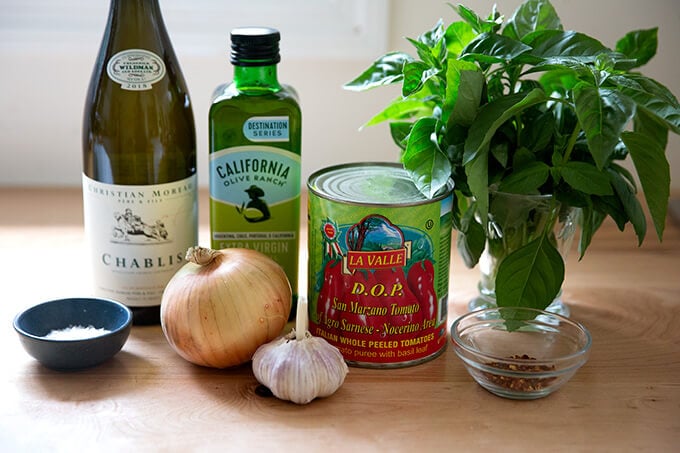
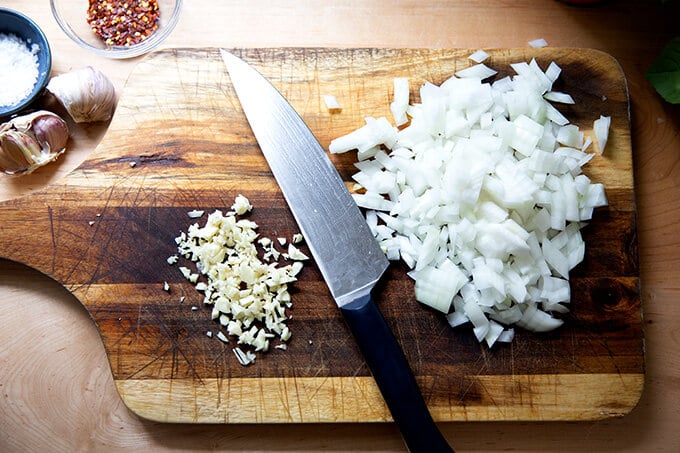
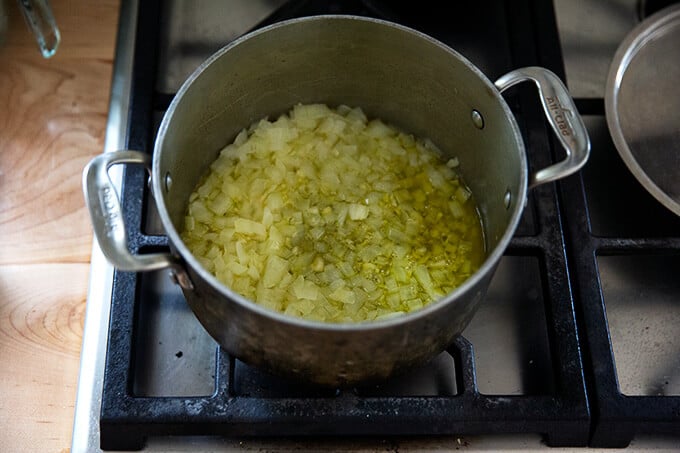
You need about 2 cups of diced onions and about a tablespoon of minced garlic (from two cloves).
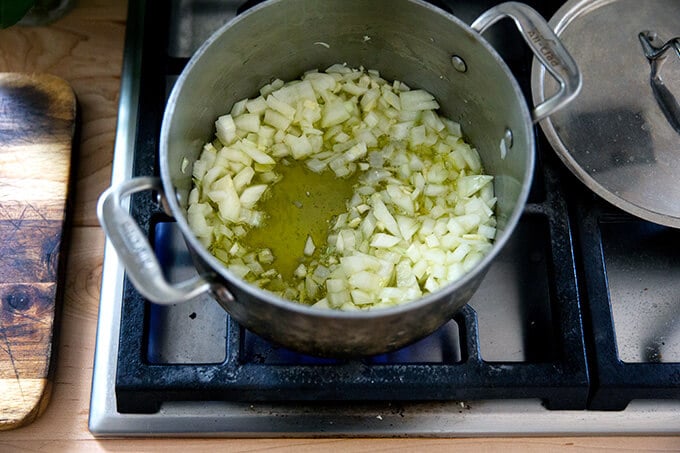
Sauté the onions and garlic in olive oil until they are soft.
Then add white wine and simmer 2-3 minutes or until the alcohol smell dissipates.
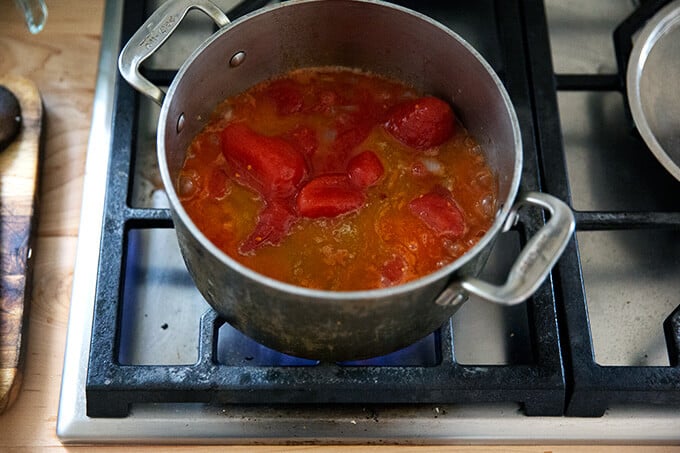
Add a can of peeled tomatoes.
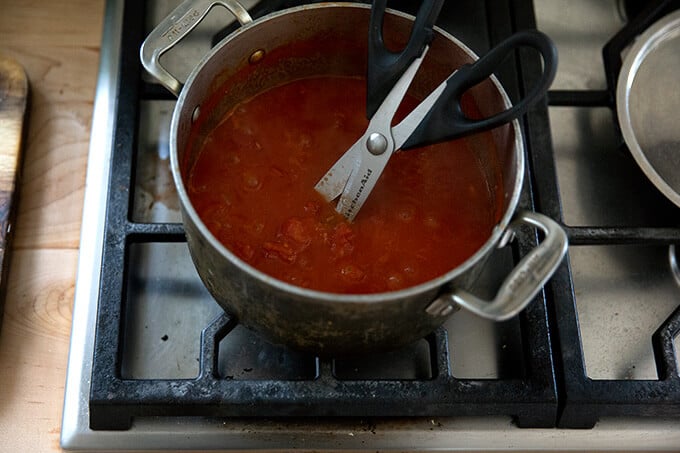
Snip them with scissors right in the pot; then simmer 15 minutes.
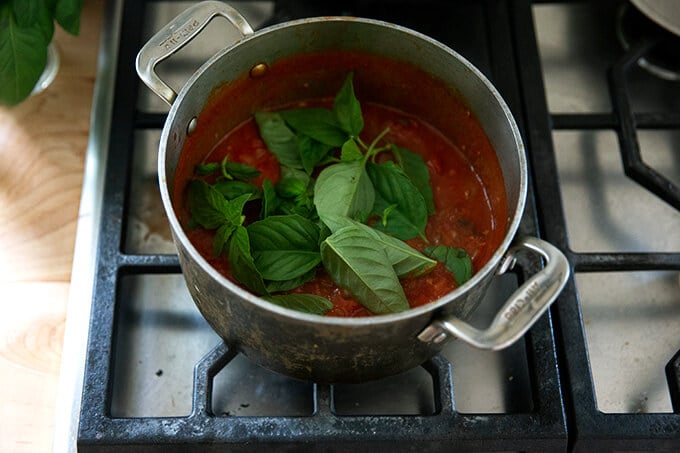
Add basil.
Purée with an immersion blender or transfer to a food processor or blender and purée until smooth.
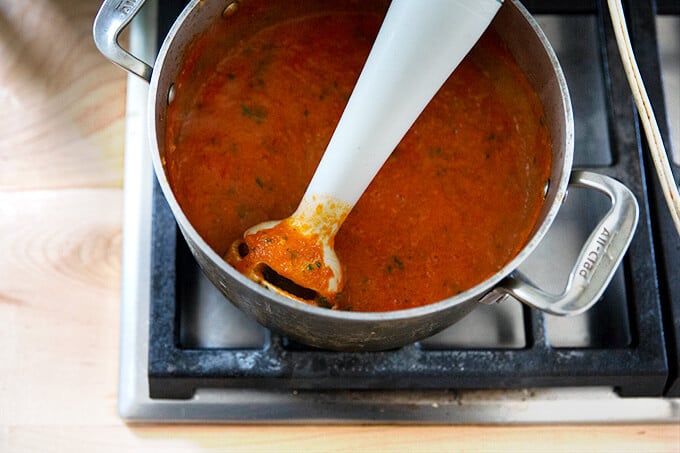
Taste, and adjust seasoning with salt to taste.
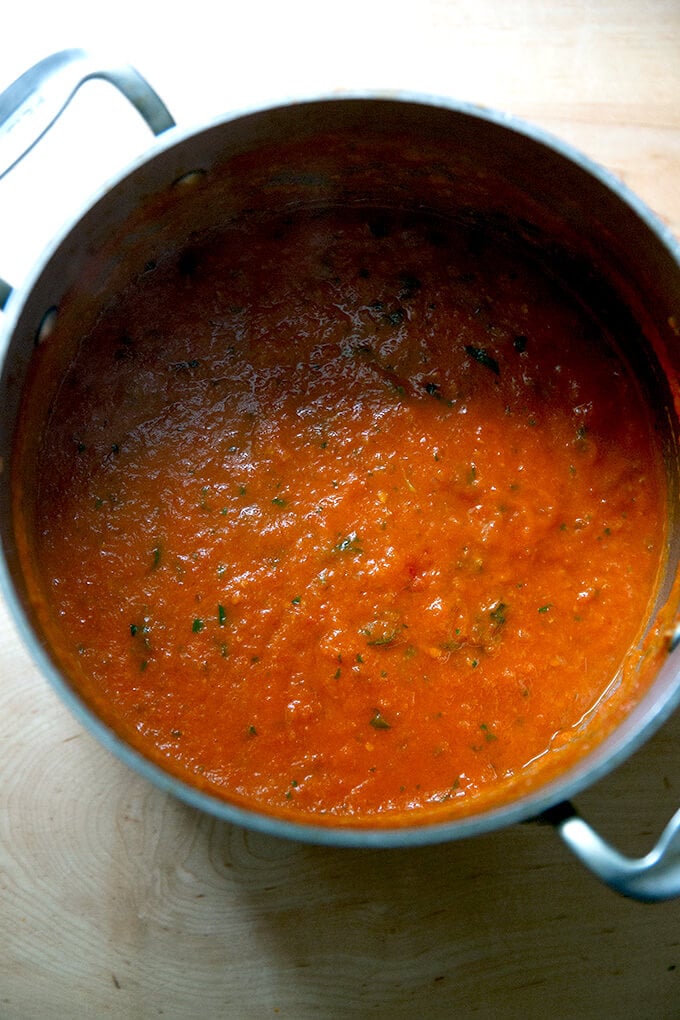
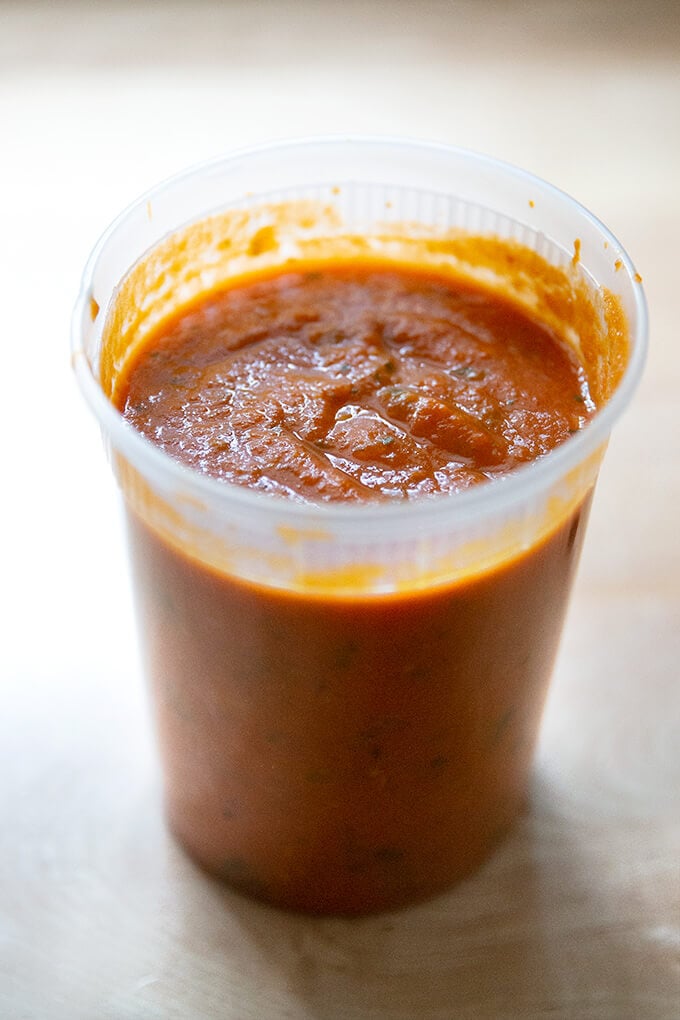
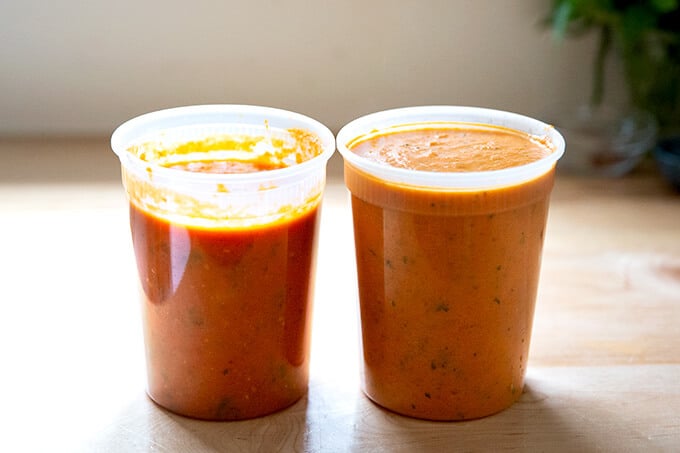
This will give you about a quart of sauce. I love these deli containers for storing sauces and dressings. At this point, you can freeze the sauce for up to 3 months.
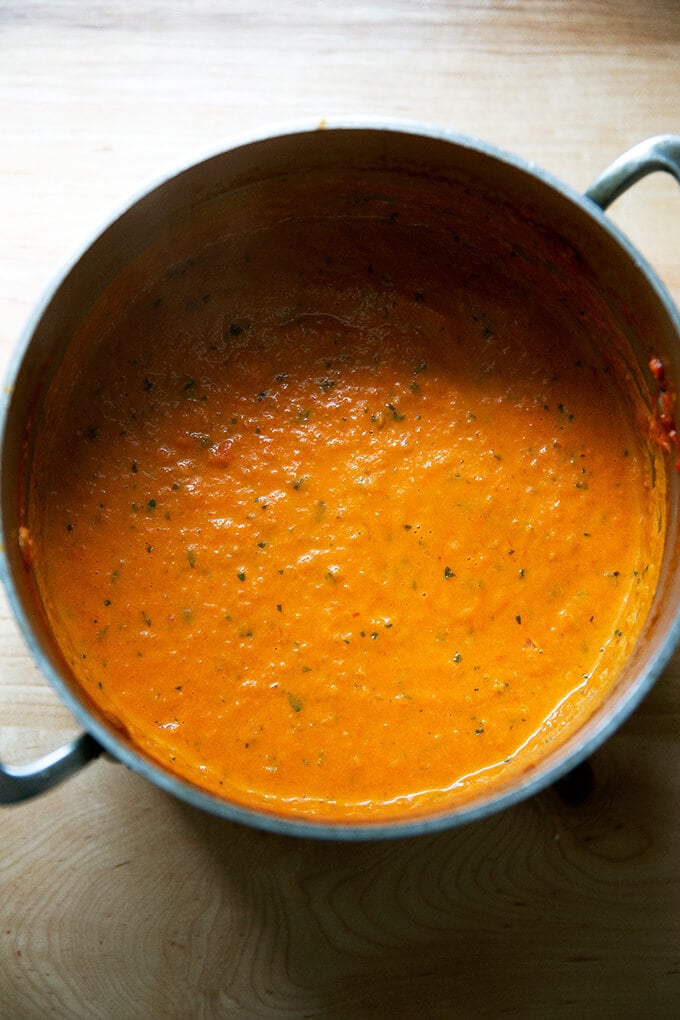
Here’s the vodka sauce variation:
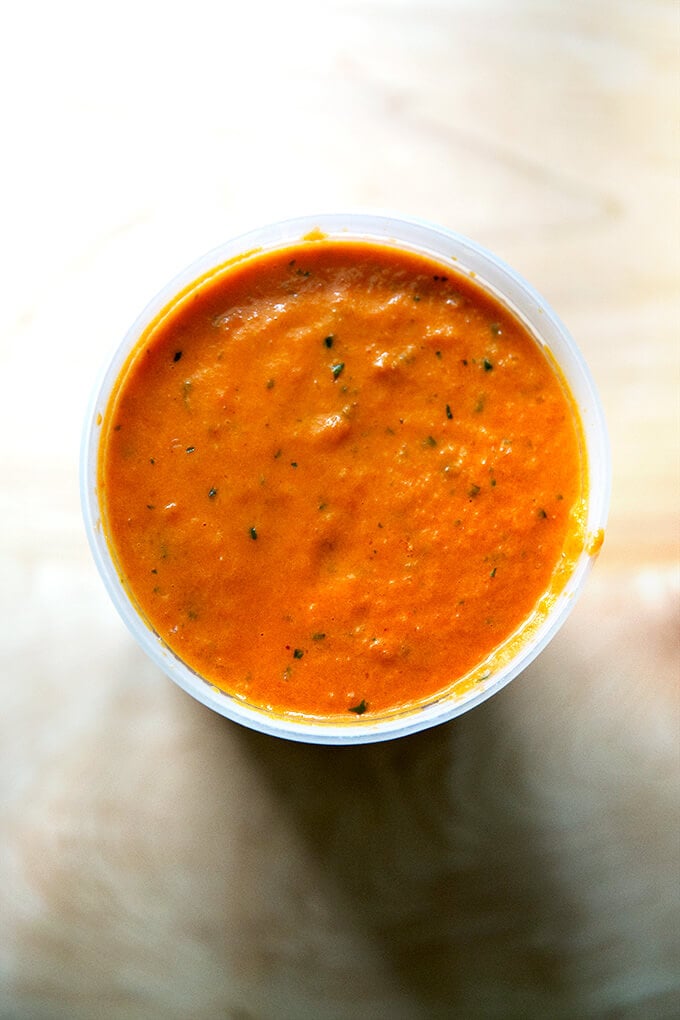
Such a great feeling having homemade sauce on hand!
Description
This recipe has been adapted from this favorite Marcella Hazan recipe (not the famous 3-ingredient recipe .)
Notes:
These are a few brands of canned tomatoes I really like: La Valle, Mutti , DiNapoli, and Cento .
To make a vodka variation, use vodka in place of the white wine, and purée the sauce with 1/2 cup of cream at the end.
Freeze the sauce for up to 3 months. I love these deli containers for storing sauces and dressings.
1/4 cup olive oil
2 cups finely chopped white or yellow onion
3 cloves garlic, minced
kosher salt
Pinch crushed chili flakes
1/2 cup white wine
1 28-oz can of peeled whole San Marzano tomatoes, see notes above
1/2 cup (packed) fresh basil (about 1/2 ounce )
- In a medium pot, combine the oil, onions, and garlic. Add a pinch of salt. Turn the heat to high. As soon as the onions and garlic begin simmering, give them a stir, turn the heat to low, and cover the pot. Cook for 10 minutes.
- Uncover the pot, add a pinch of crushed red pepper flakes, stir once or twice, raise the heat to high; then add the wine. Let it simmer for 2 to 3 minutes or until the alcohol smell dissipates.
- Add the tomatoes. Using scissors, snip the tomatoes into smaller pieces. Season with a generous pinch of salt, and cook at a gentle simmer for 15 minutes.
- Transfer the sauce to a blender or food processor. Add the basil. Purée until smooth. Taste and adjust with more salt if necessary. (Alternatively use an immersion blender to purée)
- Prep Time: 5 minutes
- Cook Time: 25 minutes
- Category: Sauce
- Method: Stovetop
- Cuisine: Italian, American
Description
This recipe has been adapted from this favorite Marcella Hazan recipe (not the famous 3-ingredient recipe .)
Notes:
These are a few brands of canned tomatoes I really like: La Valle, Mutti , DiNapoli, and Cento .
To make a vodka variation, use vodka in place of the white wine, and purée the sauce with 1/2 cup of cream at the end.
Freeze the sauce for up to 3 months. I love these deli containers for storing sauces and dressings.
1/4 cup olive oil
2 cups finely chopped white or yellow onion
3 cloves garlic, minced
kosher salt
Pinch crushed chili flakes
1/2 cup white wine
1 28-oz can of peeled whole San Marzano tomatoes, see notes above
1/2 cup (packed) fresh basil (about 1/2 ounce )
- In a medium pot, combine the oil, onions, and garlic. Add a pinch of salt. Turn the heat to high. As soon as the onions and garlic begin simmering, give them a stir, turn the heat to low, and cover the pot. Cook for 10 minutes.
- Uncover the pot, add a pinch of crushed red pepper flakes, stir once or twice, raise the heat to high; then add the wine. Let it simmer for 2 to 3 minutes or until the alcohol smell dissipates.
- Add the tomatoes. Using scissors, snip the tomatoes into smaller pieces. Season with a generous pinch of salt, and cook at a gentle simmer for 15 minutes.
- Transfer the sauce to a blender or food processor. Add the basil. Purée until smooth. Taste and adjust with more salt if necessary. (Alternatively use an immersion blender to purée)
- Prep Time: 5 minutes
- Cook Time: 25 minutes
- Category: Sauce
- Method: Stovetop
- Cuisine: American, Italian
Find it online : https://alexandracooks.com/2021/06/15/quick-homemade-tomato-sauce-canned-tomatoes/

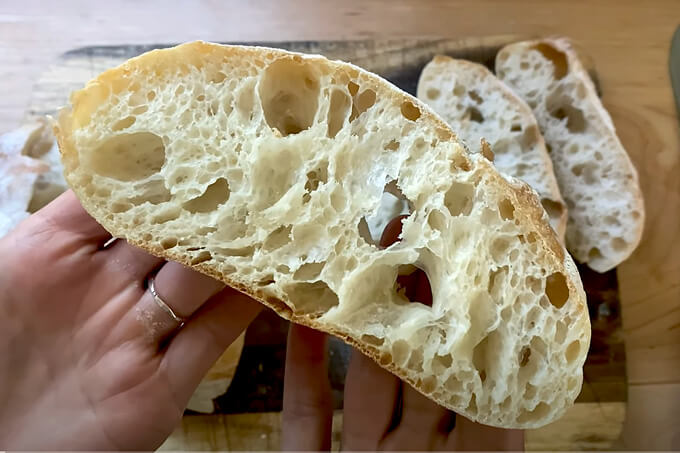
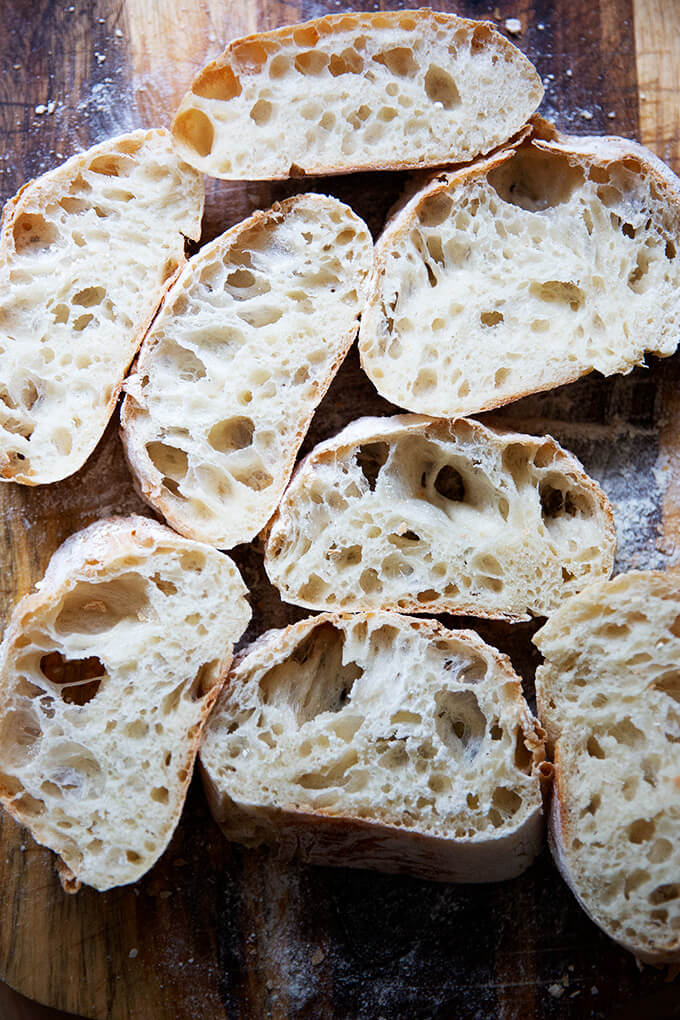
This post will teach you how to make a crusty, open-crumbed loaf of ciabatta bread. Below you will find a detailed guide full of tips and tricks to help you make a loaf of ciabatta bread with a crisp, golden exterior and a light, airy crumb. Find video guidance below, too!
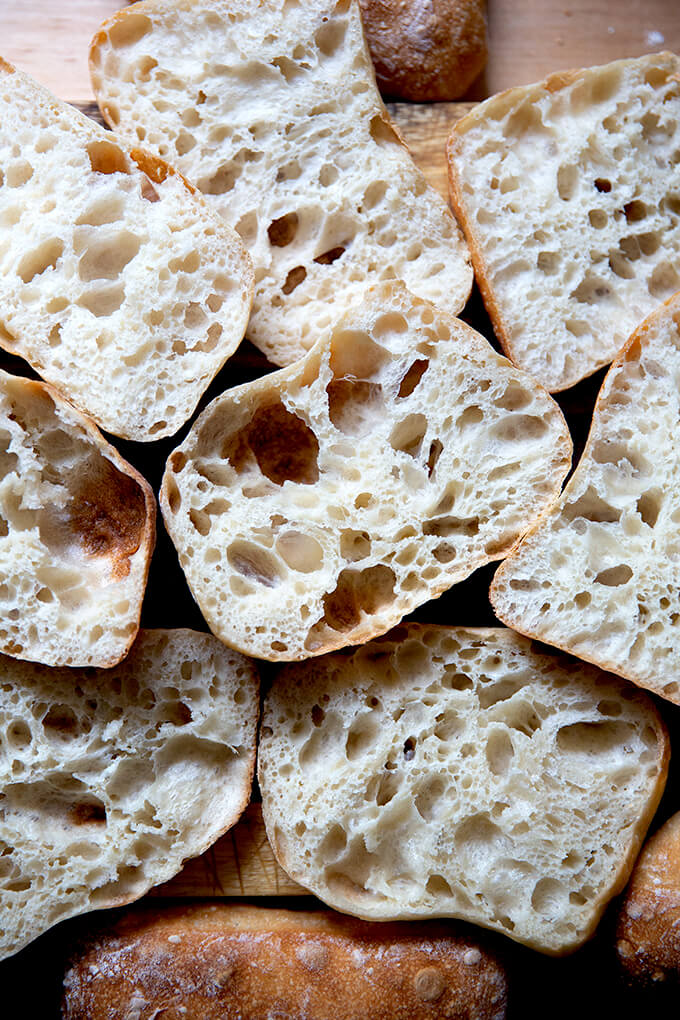
Originating from the Lake Como region of northern Italy, ciabatta means “slipper” in Italian and is characterized by a crusty exterior and a porous, chewy crumb. Traditionally, ciabatta is made with a poolish or biga , which is a small amount of flour and water mixed with a leavening agent, left to ferment for a short time. Ciabatta dough is wet and sticky, with hydration levels often 80% or higher.
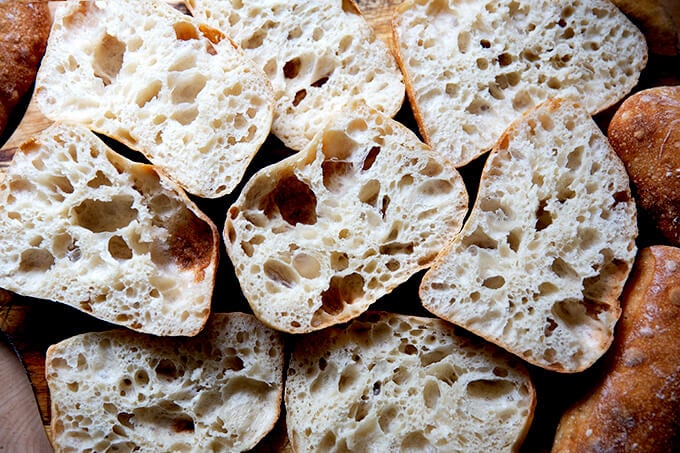
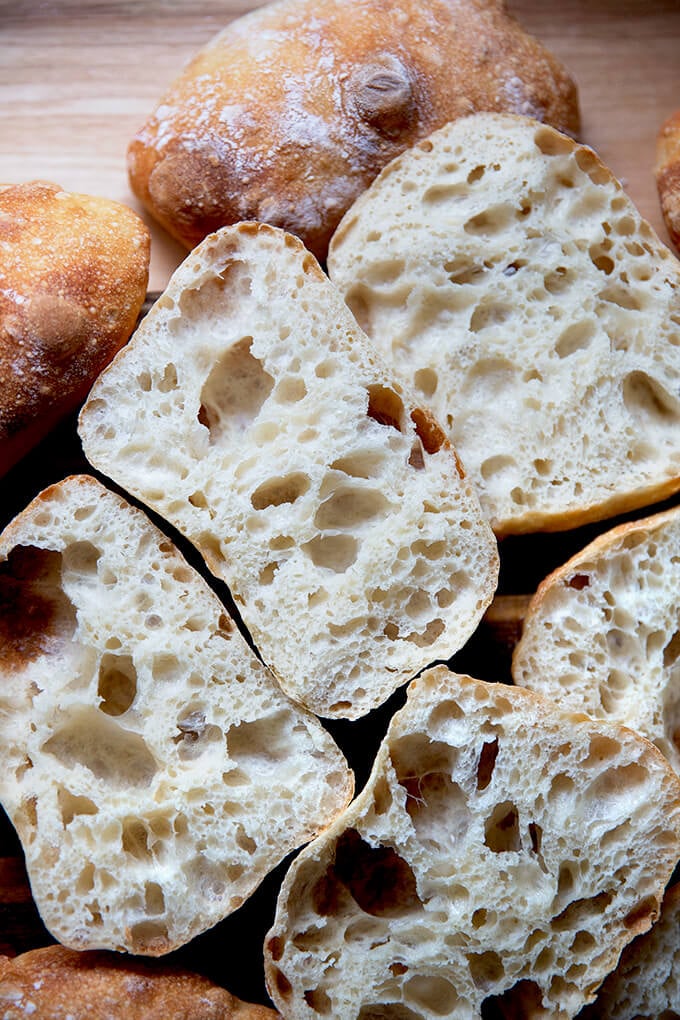
The recipe below is made in this traditional style, using a poolish that ferments for 3 to 4 hours and has an overall hydration of 82%. A few sets of stretches and folds make the dough completely manageable to work with, and the loaves emerge from the oven with a light and airy crumb full of amorphous holes.
This bread is perfect for halving and sandwiching with fillings of all kinds; its crustiness ensures it won’t get soggy if you pack it for the beach or a hike. It’s also, of course, an excellent dinner bread, served alongside a pool of olive oil to dunk into at will.
PS: Simple Sourdough Ciabatta
How to Make Ciabatta Bread, Step by Step
The first step of the recipe calls for making the poolish . To do so, gather your ingredients: flour, water, and instant yeast. SAF is my preference.
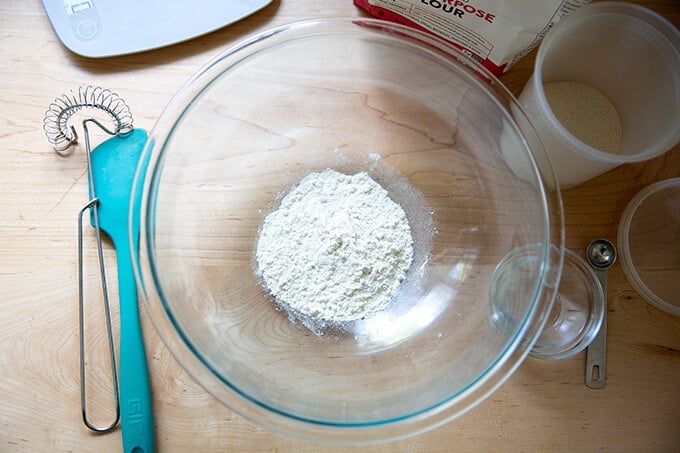
Whisk together 50 grams flour and 1/2 teaspoon instant yeast.
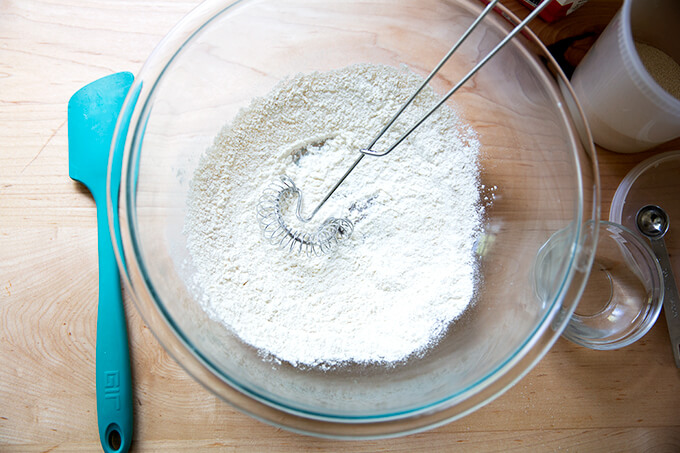
Add 50 grams water.
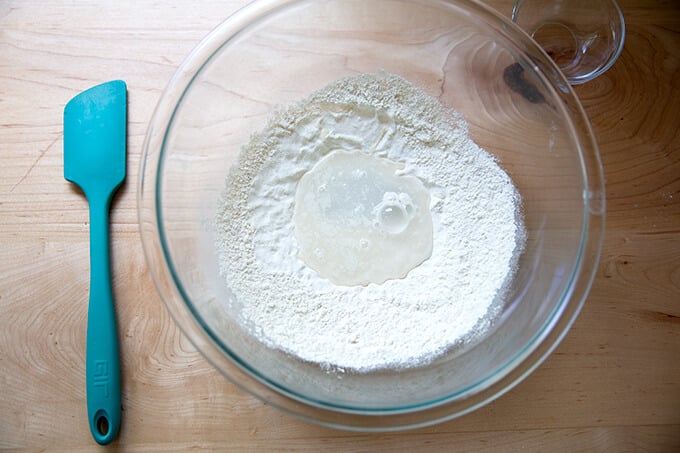
Stir to combine. Cover the bowl and let sit for 3 to 4 hours or until…
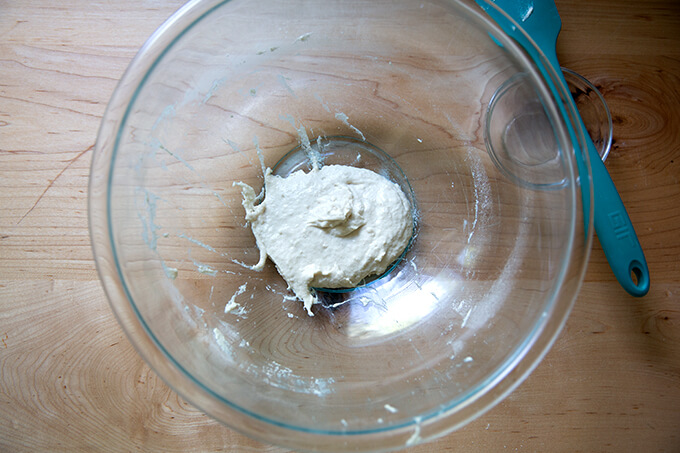
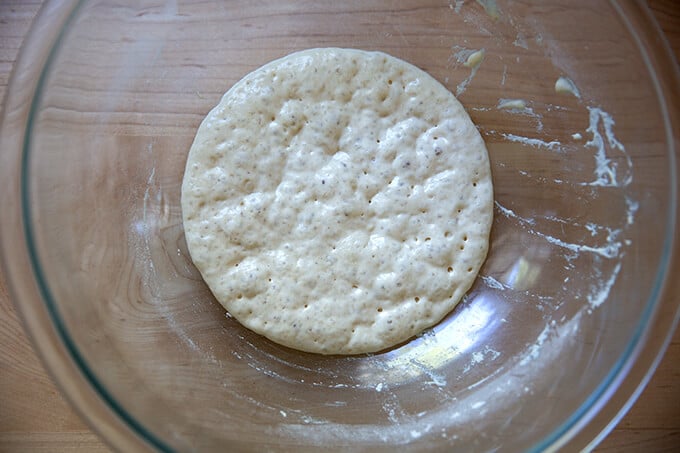
… the surface of the dough is dimpled with air pockets.
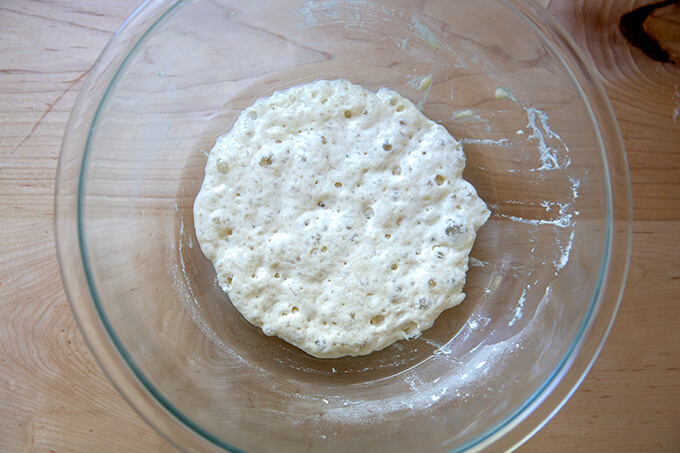
Add 360 grams water. (This part is really fun … the poolish bubbles up as a unit and floats on top of the water… it really feels alive!)
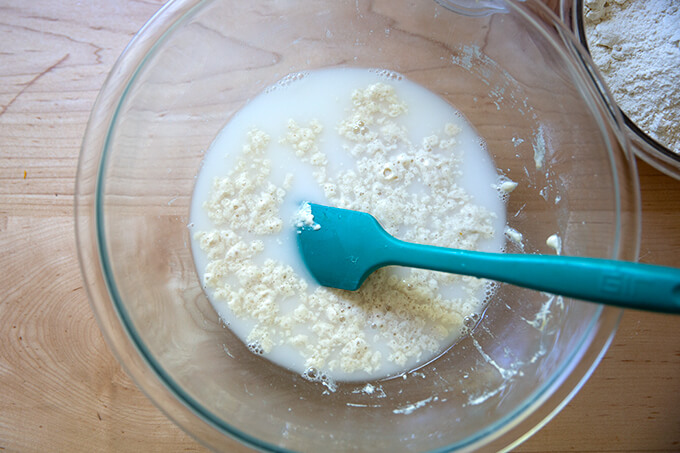
Stir to combine; then add 12 grams salt and stir again to combine.
Add 450 grams flour, preferably bread flour.
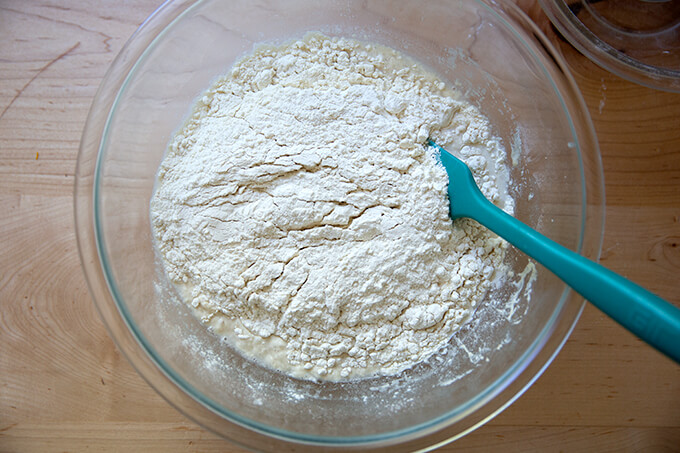
Using a spatula, stir until you have a sticky dough ball. Cover and set aside for 30 minutes.
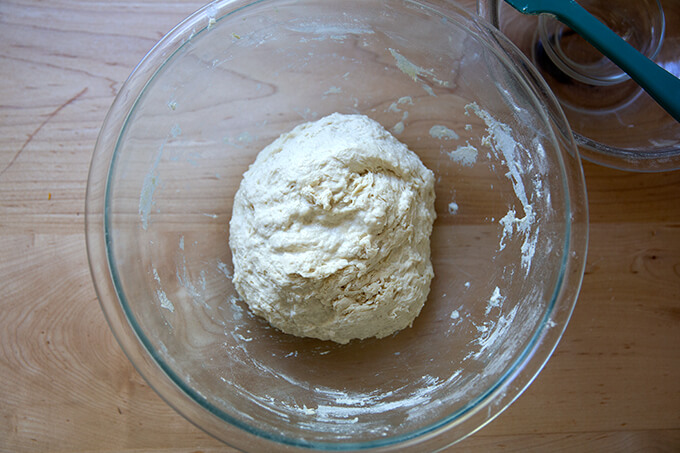
With wet hands, perform a set of stretches and folds, by grabbing one side of the dough, and pulling it up and to the center. Rotate the bowl a quarter turn, and repeat the grabbing and pulling. Do this until you’ve made a full circle. ( Watch the video for more guidance. I employ a sort of “slap and fold” technique, which is helpful with this very wet dough.) Cover the bowl.
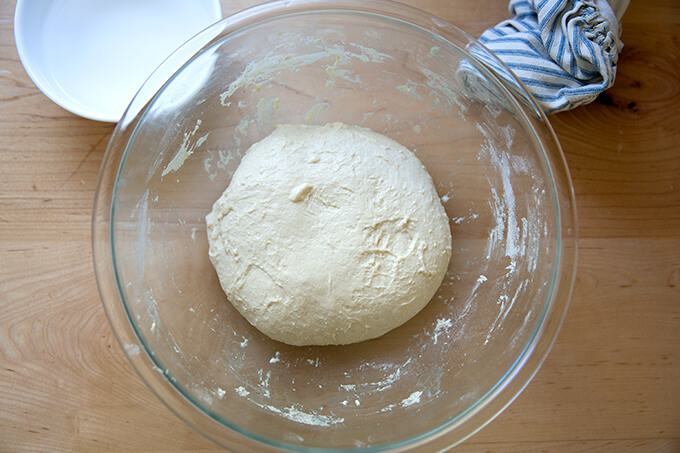
Thirty minutes later, repeat the stretching and folding.
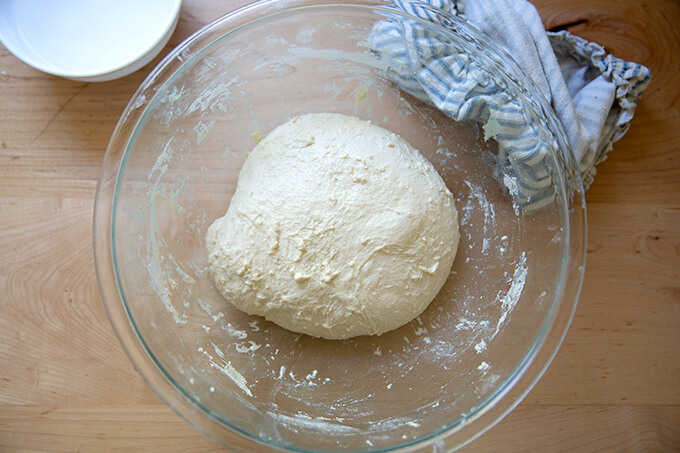
If time permits, repeat this stretching and folding twice more at 30-minute intervals. This is what the dough looks like after the third set of stretches and folds:
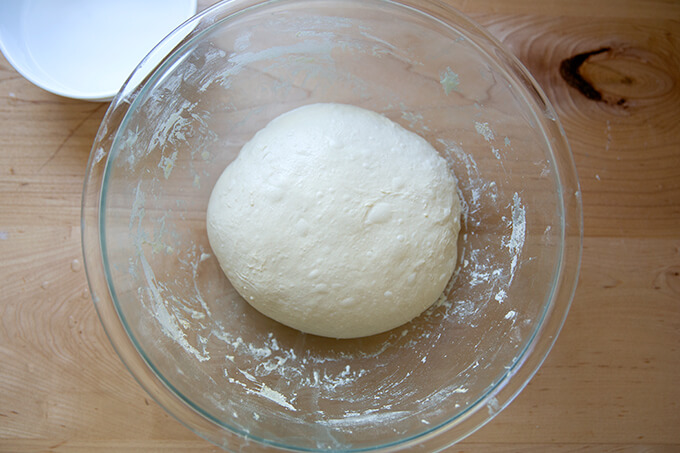
This is what the dough looks like after the 4th set. Feeling the dough transform from a sticky dough ball to a smooth and elastic one is really cool.
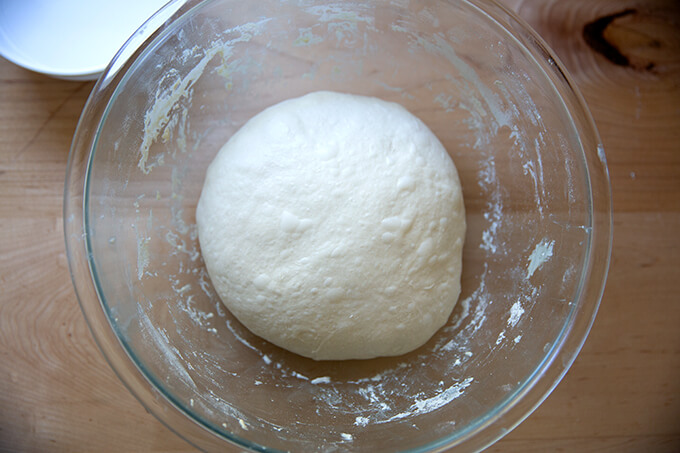
Transfer the dough to a straight-sided vessel and let it rise at room temperature until…
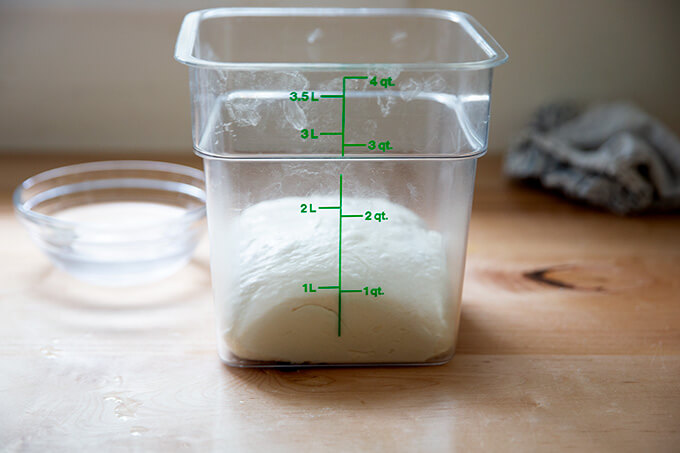
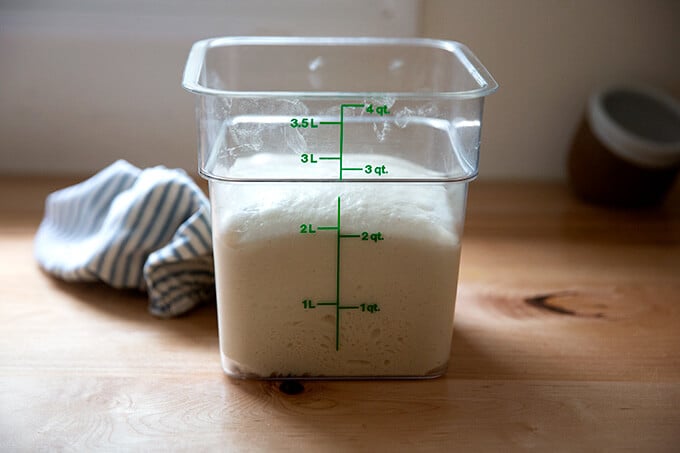
… it doubles in volume. (Note: If you don’t have a straight-sided vessel , you can simply let the dough rise in a bowl.)
Then, punch down (deflate) the dough — I like to remove the dough from the vessel …
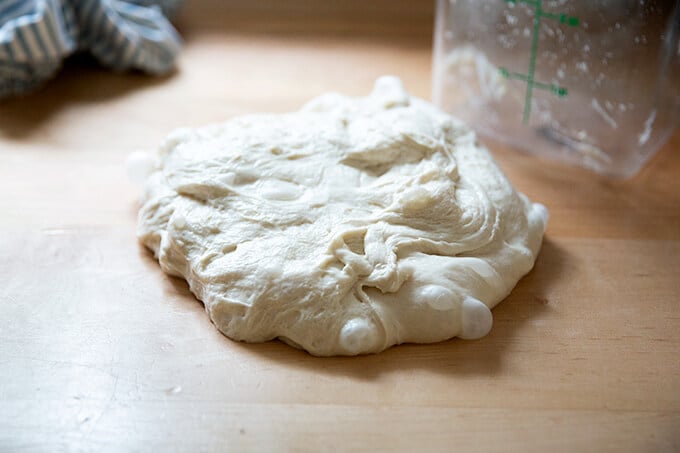
… and ball it up using wet hands.
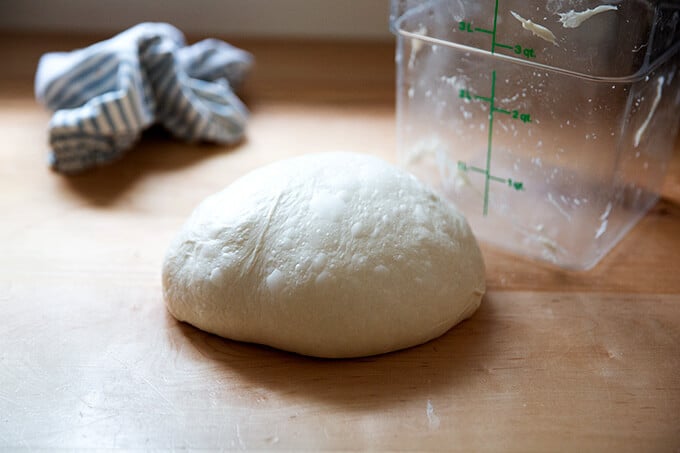
Return the dough to the vessel; then transfer to the fridge.
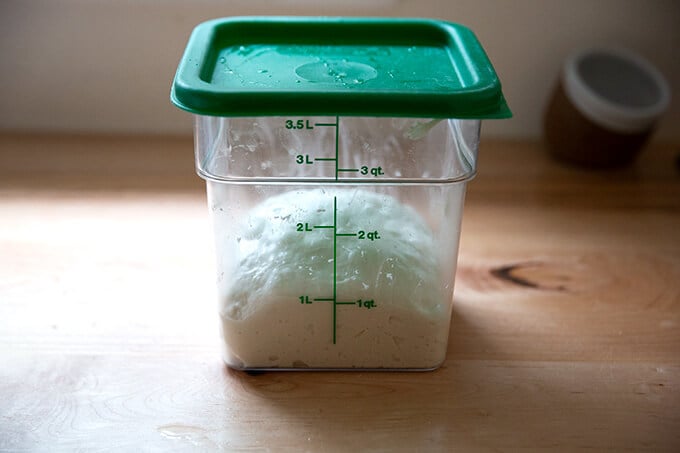
The dough will likely double in volume overnight in the fridge.
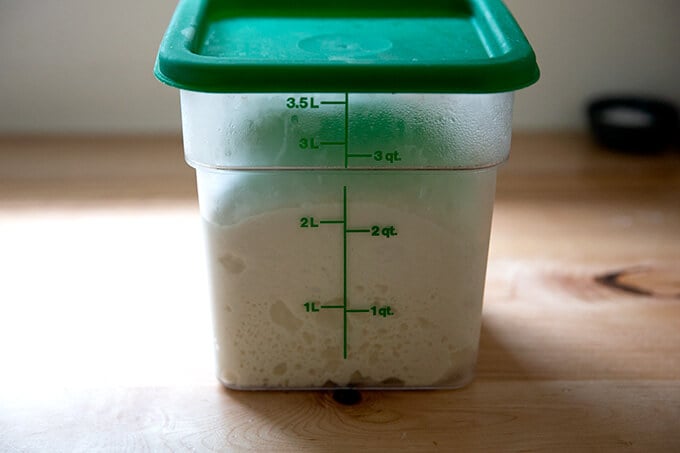
Remove the dough, turn it out onto a work surface…
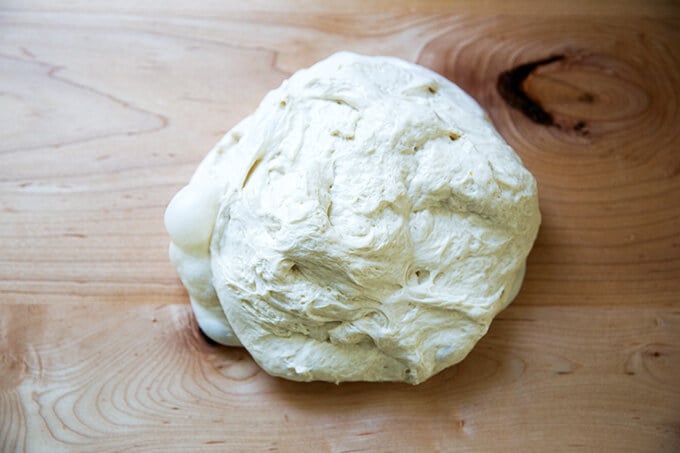
… then ball it up.
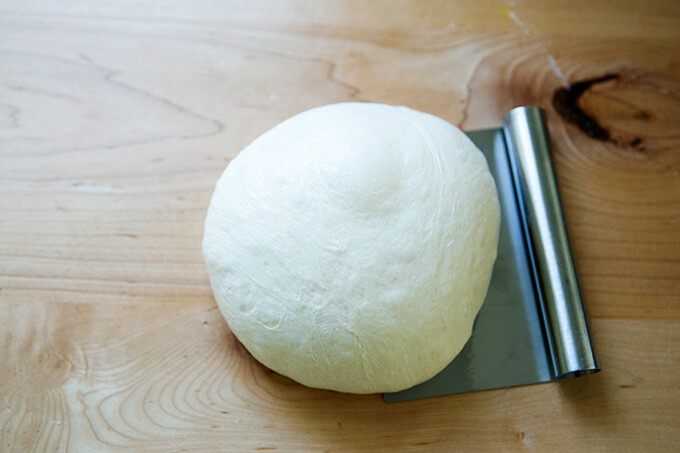
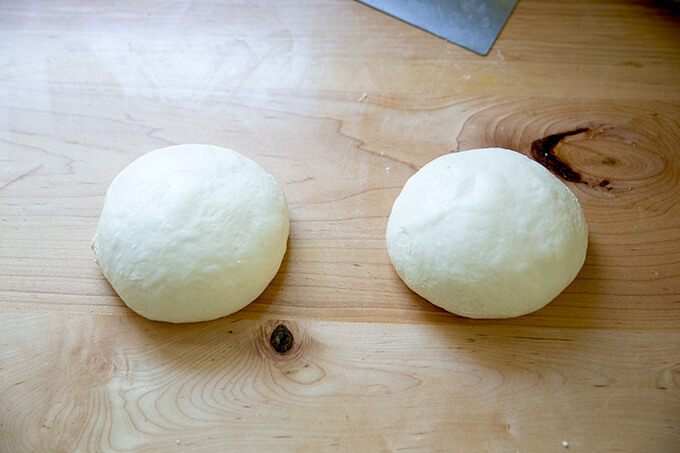
Divide the dough into two equal portions. Ball up each portion. I like to do this with very little or no flour — I find I get better tension with less flour.
Sprinkle a work surface liberally with flour. Place the balls top-side down (the smooth side); then sprinkle the balls liberally with flour. Cover with a tea towel and let rest for 2.5 hours. Line a sheet pan with parchment paper.
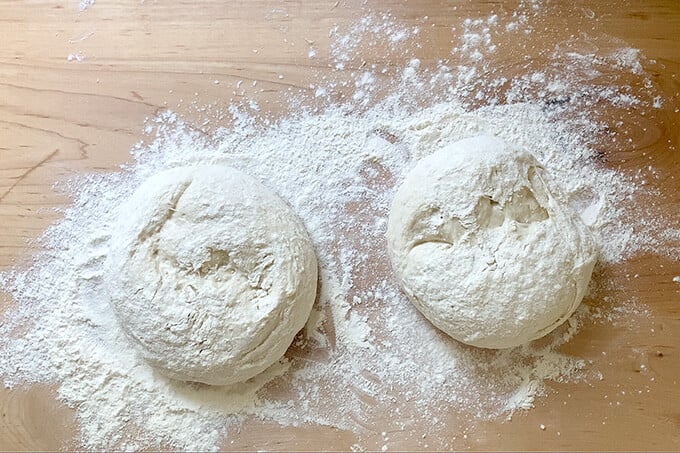
After the 2.5 hours… the dough balls will look like this:
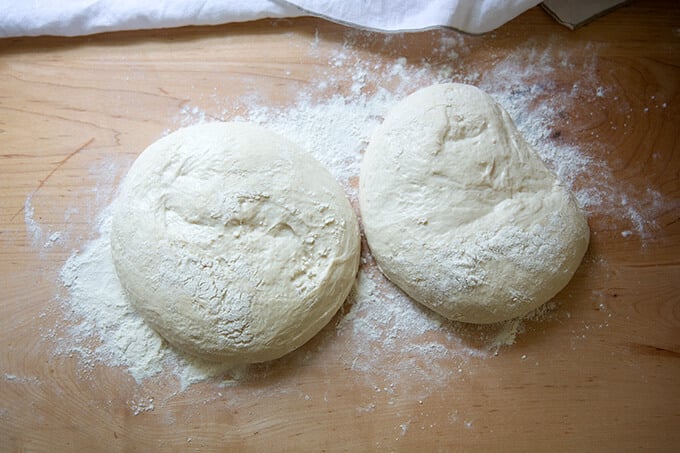
Turn the balls back over…
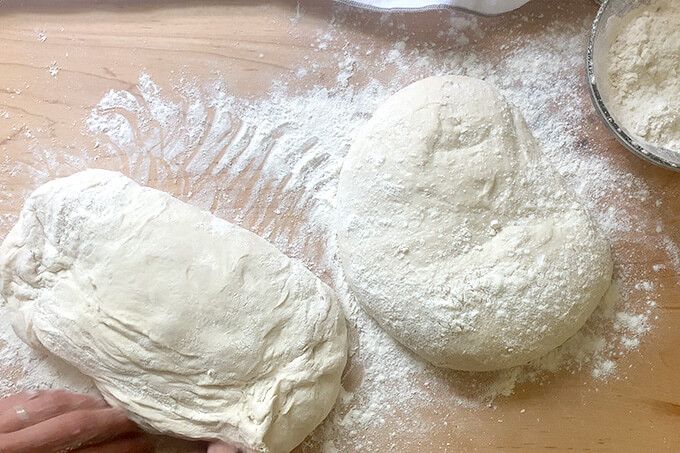
… then carefully transfer them to a parchment-lined sheet pan.
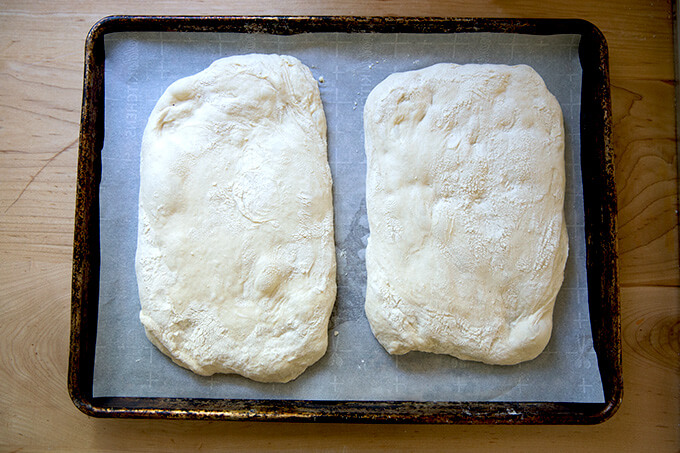
Bake at 425ºF for 20-25 minutes or until nicely golden:
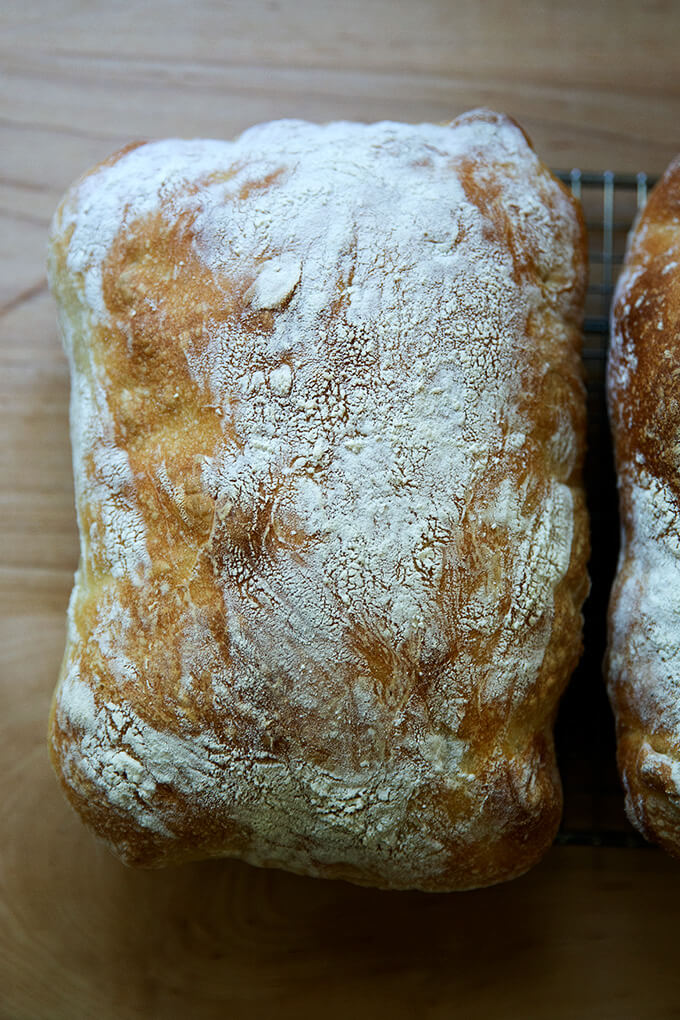
Let cool at least 20 minutes before slicing.
How to Make Ciabatta Rolls
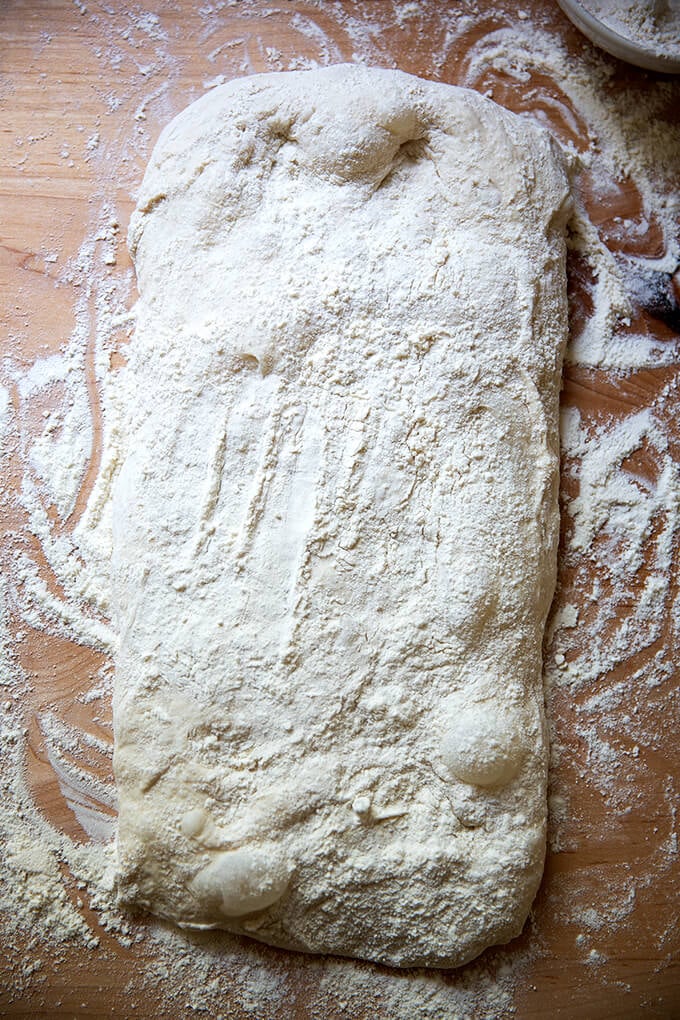
Follow the recipe in the recipe box below until the step where you remove the dough from the refrigerator; then sprinkle a work surface with flour. Turn the dough out, sprinkle the surface with more flour, and pat it into a rectangle.
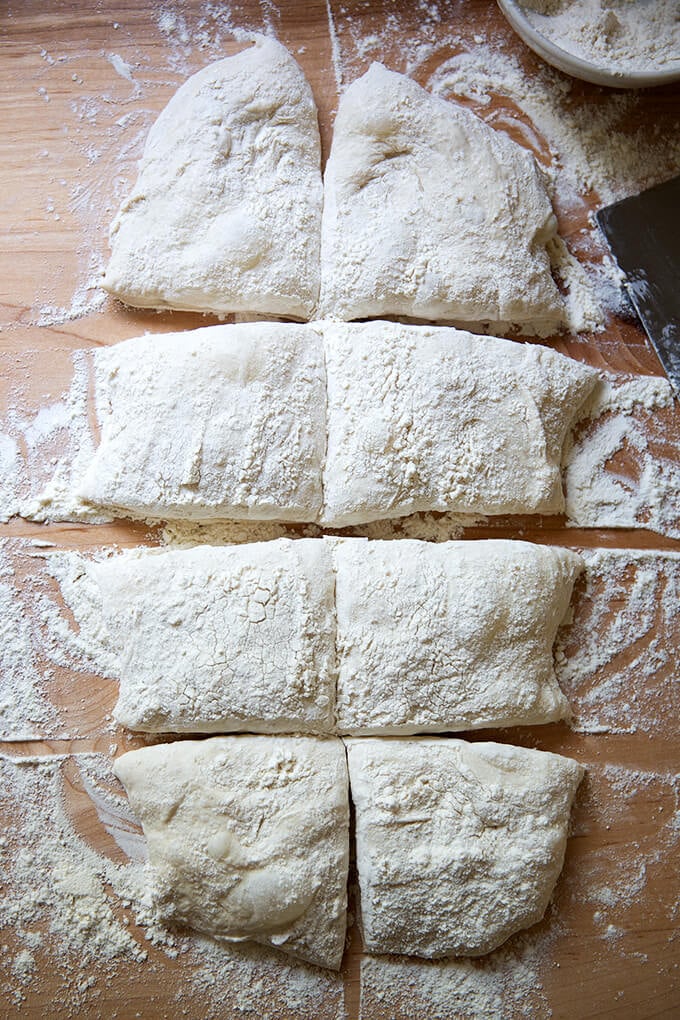
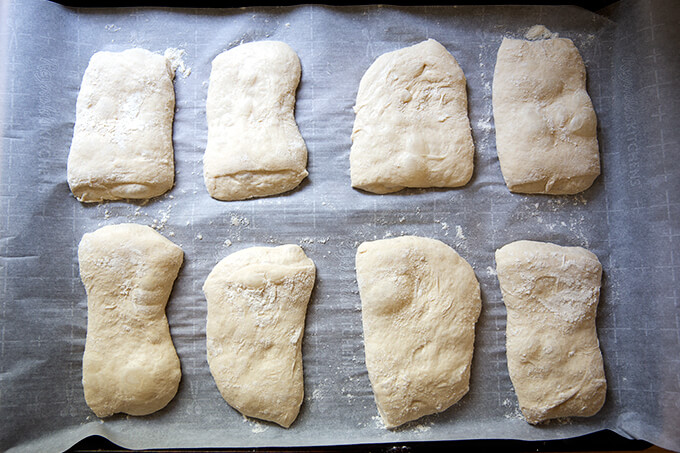
Divide into 8 portions.
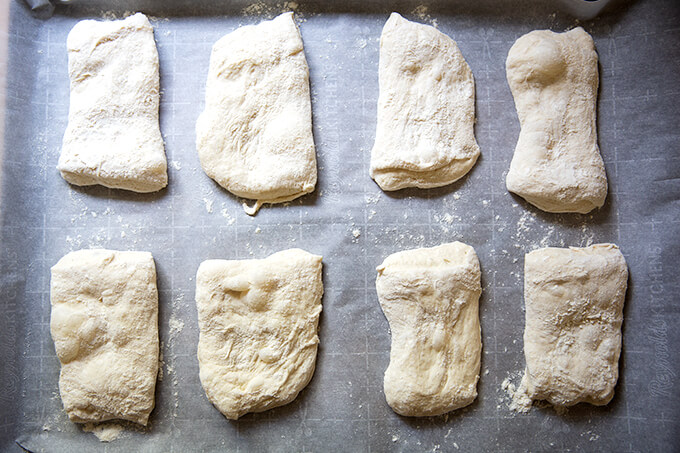
Transfer to a sheet pan, cover with a tea towel, and let stand for 2 to 2.5 hours.
Transfer the pan to the oven, and bake at 425ºF for 20 to 25 minutes.
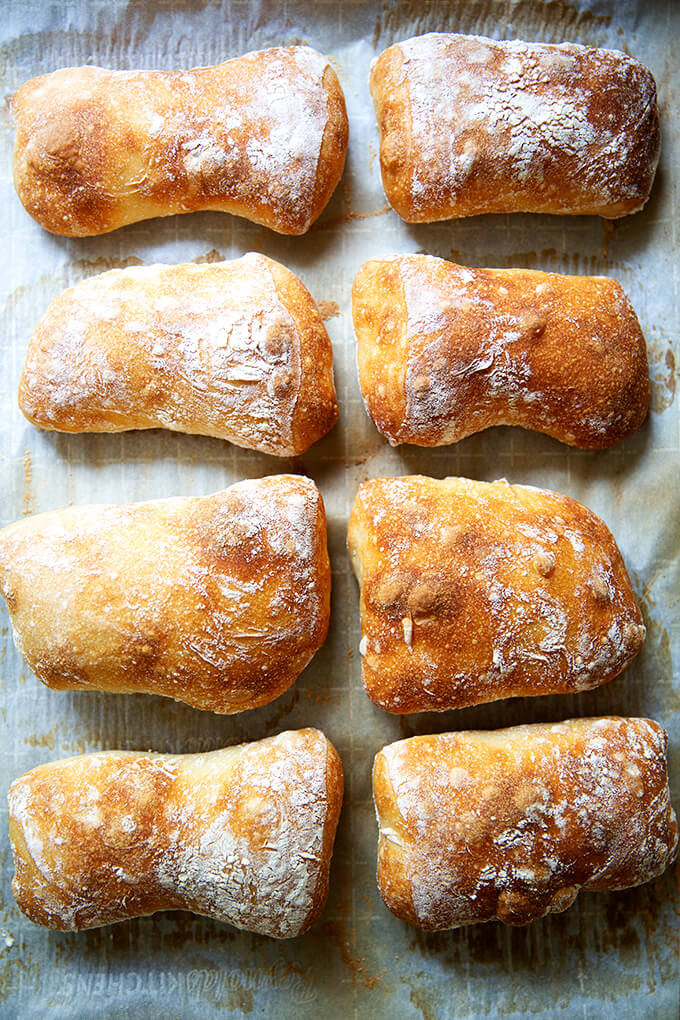
Let cool for at least 20 minutes before halving or slicing.
Description
This post will teach you how to make a crusty, open-crumbed loaf of ciabatta bread. Below you will find a detailed guide full of tips and tricks to help you make a loaf of ciabatta bread with a crisp, golden exterior and a light, airy crumb. Find video guidance below, too.
Notes:
- As always, for best results, use a digital scale to measure the flour.
- I find a bench scraper particularly helpful for this recipe.
- I also really love using a straight-sided vessel (with lid ) both for letting the dough rise and storing it in the fridge.
- Water: This is a very high-hydration dough, and depending on the flour you are using and your environment (if you live in a humid environment, for instance), you may need to reduce the amount of water. If, for example, when doing your stretches and folds, the dough never came together in a cohesive ball, I would reduce the water by 50 to 60 grams next time around.
- Flour: I have had success using all-purpose flour, but if you can get your hands on bread flour (I use King Arthur Flour Bread Flour, which is 12.7% protein), that is ideal. All flours absorb water differently. Through troubleshooting with people all over the world, I have learned that the type of flour being used plays a critical role in how the dough turns out, and often the amount of water needs to be reduced, especially if you live in Canada or abroad. You can make the recipe once as written or add the water slowly, mixing as you do, until the dough resembles the dough in the video.
- Tunneling: A common problem with ciabatta is tunneling: large gaping holes running through a loaf of bread. If you end up baking a loaf of hollow ciabatta, try lengthening the final proof. Why? Because when under-proofed dough enters an oven, the remaining energy in the yeast leads to fast and furious gas production. This explosion of gas breaks the gluten structure of the bread, causing the tunnel to form.
For the sponge:
- 50 grams (about 1/3 cup ) all-purpose flour
- 2 grams ( 1/2 teaspoon ) instant yeast, SAF is my preference
- 50 grams (about 1/4 cup ) water, lukewarm or room temperature
For the ciabatta dough:
- 360 grams (about 1.5 cups ) water, lukewarm or room temperature
- 12 grams (about 2 teaspoons ) salt, kosher or sea salt
- 450 grams (about 3.5 cups ) bread flour, see notes above
- Make the poolish: In a large bowl, whisk together the 50 grams flour and the 2 grams (1/2 teaspoon) instant yeast. Add 50 grams water and stir with a spatula until combined. Cover the bowl with a tea towel or cloth bowl cover and set aside for 3 to 4 hours or until the dough’s surface is dimpled with holes.
- Make the dough: To the bowl of the poolish, add the water. The sponge should release from the bowl and parts of it, if not all of it, will float. Add the salt and stir briefly. Add the flour, and stir until you have a wet, sticky dough ball — dough will be very sticky. Cover with a tea towel or cloth bowl cover and let sit for 30 minutes.
- Stretches and folds : With wet hands, grab one side of the dough, and pull up and to the center. Rotate the bowl a quarter turn, and repeat the grabbing and pulling. Do this until you’ve made a full circle. (Watch the video for more guidance. I employ a “slap-and-fold” technique, which is helpful when handling these wet doughs.) Cover the bowl. If time permits, repeat this process three more times at 30-minute intervals for a total of 4 sets of stretches and folds over the course of two hours. If you are short on time, know that doing just one or two sets of stretches and folds is totally fine.
- Let it rise: Transfer the dough to a straight-sided vessel, if you have one, or leave it in the bowl if you don’t. Cover the vessel with a towel and let rise until doubled in volume. Punch down (deflate) the dough — if your dough is still in the bowl, you can deflate it using wet hands right in the bowl; if your dough is in a straight-sided vessel, it may be easier to turn the dough out onto a work surface and ball it up using wet hands to prevent sticking. Return the dough to the vessel, cover it with an airtight lid, and transfer it to the refrigerator immediately for at least 12 hours. The dough can remain in the fridge for as long as 48 hours.
- Portion, shape, and proof: For Ciabatta Loaves: Turn the dough out onto a work surface. I prefer to do this step without flour, but absolutely sprinkle your surface lightly with flour as needed to make the dough manageable to work with. Using a bench scraper or your hands, shape the dough into a tight ball; then use the bench scraper to divide the dough in half. If you want perfectly even balls, each portion will way roughly 455 grams. Again, use the bench scraper or your hands to ball up each portion into a tight ball — see video for guidance. Sprinkle your countertop liberally with flour. Place the balls top-side (smooth side) down onto the flour. The seam-side will be on top now, and it may split open — this is fine. Sprinkle the top surface of the balls liberally with flour. Cover with a tea towel and let rest for 2.5 hours. For Ciabatta Rolls: Sprinkle a work surface with flour. Turn the dough out onto the work surface, sprinkle the dough with more flour, and pat it into a rectangle. Using a bench scraper, divide into 8 portions. Transfer each portion to a parchment-lined sheet pan, cover with a tea towel, and let stand for 2.5 hours.
- Preheat the oven: After the dough has proofed for 2 hours, heat the oven to 425ºF .
- Bake: For Ciabatta Loaves: When the dough has finished proofing, gently flip each ball over — I find a bench scraper to be helpful here. Then use both hands to stretch each ball out gently into a rectangular shaped “slipper”. Transfer to a parchment-lined sheet pan. Transfer the pan to the oven and bake for 20 – 25 minutes or until the loaves are golden all around. For Ciabatta Rolls: Remove the towel, transfer the pan to the oven, and bake for 20 – 25 minutes, or until the loaves are golden all around.
- Cool: Remove pan from oven. Transfer ciabatta rolls to a cooling rack. Let cool for 20 to 30 minutes before slicing.
- Prep Time: 24 hours
- Cook Time: 20 minutes
- Category: Bread
- Method: Yeast
- Cuisine: Italian, American
