The dough for this no-knead brioche bread comes together in 5 minutes and requires nothing more than a bowl, whisk, and spatula. Start to finish, it can be made in 4 hours, but requires only 25 minutes of active time. Find step-by-step instructions below 🍞🍞
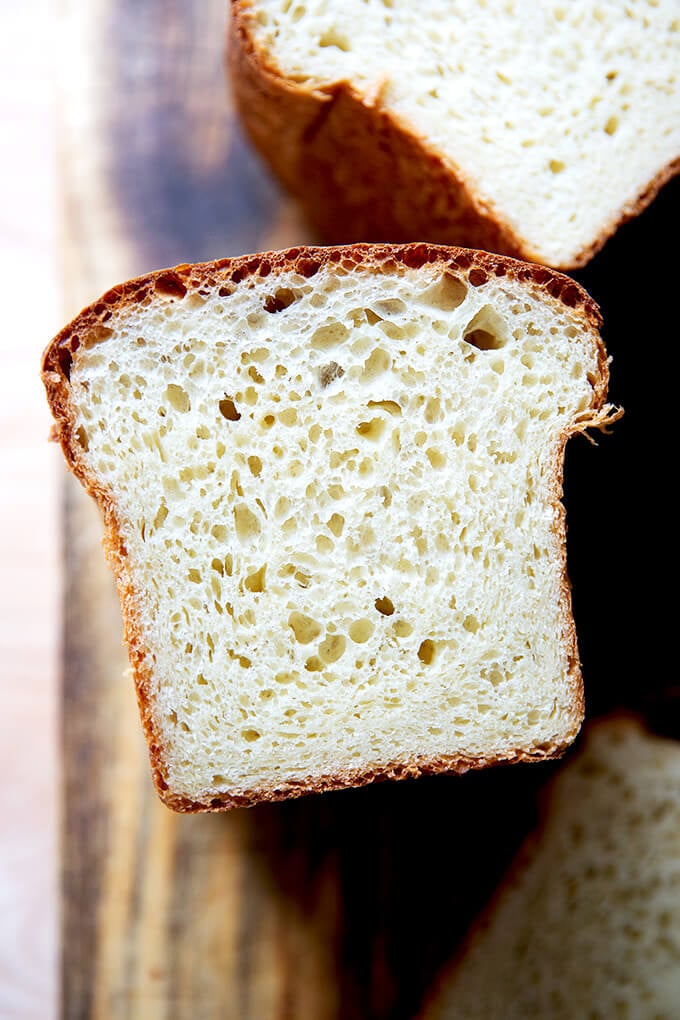
Brioche is a soft-textured, slightly sweet, rich-tasting bread often made with sugar, milk, and heaps of eggs and butter. I recently came across a recipe calling for 6 eggs and 20 tablespoons of butter. The recipe yielded one loaf. One loaf! Two and a half sticks of butter for one loaf!
Even if that brioche is the brioche to end all brioches, I will never make it. How could I when I know that a lean dough — one made with flour, water, and salt alone — can produce something as completely delicious and satisfying?
In the original Tartine cookbook, the authors note “different types of brioche dough are made depending on how they will be used , with the formulas varying primarily in the percentage of butter.” Tartine makes a less-rich brioche because they use it for bread pudding and bostock.
This is the most compelling reason in my mind to make a “light” brioche: if you view brioche mostly as a vehicle for making exceptional bread pudding , French toast , and the like, it might be wise to save all of those eggs and all of that butter for a recipe in which they’ll really shine.
PS: No-Knead Brioche Rolls
How to Make Brioche, Step by Step
Gather your ingredients.
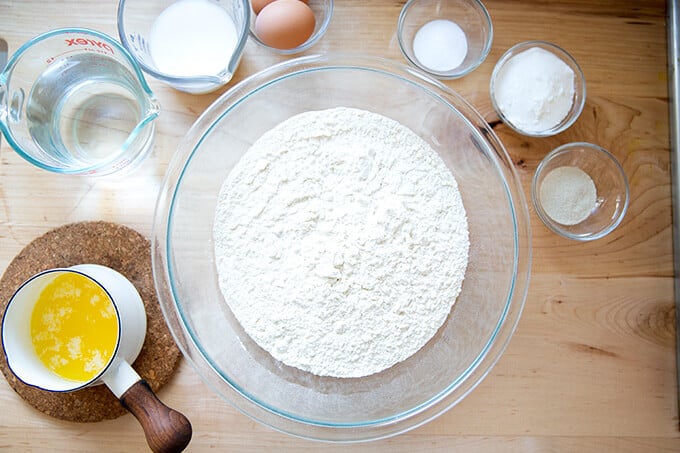
Stir together the dry ingredients. Whisk together the wet.
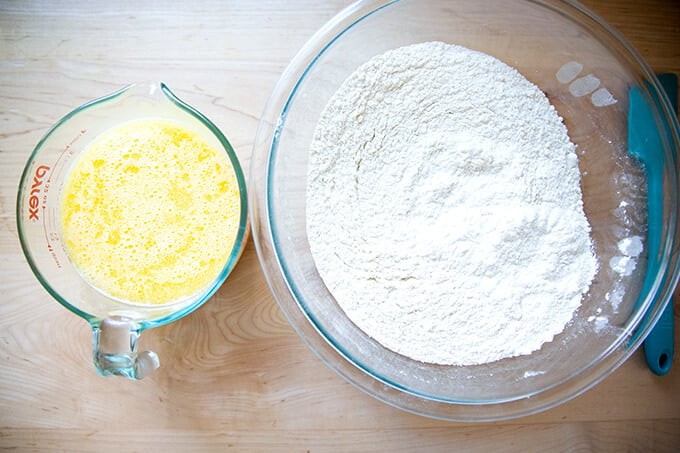
Combine the two until until you have a sticky dough ball:
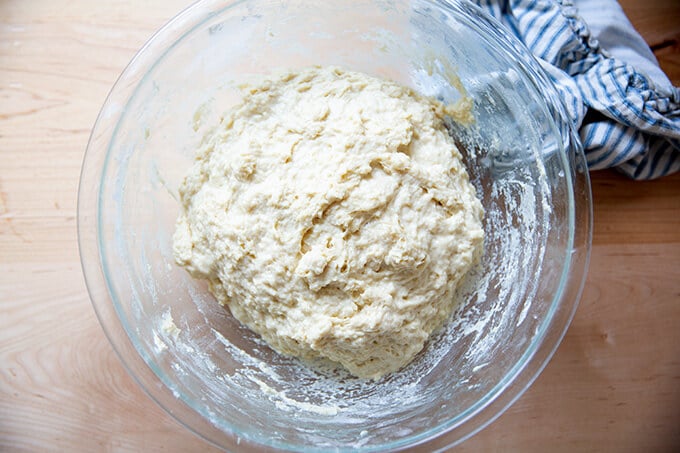
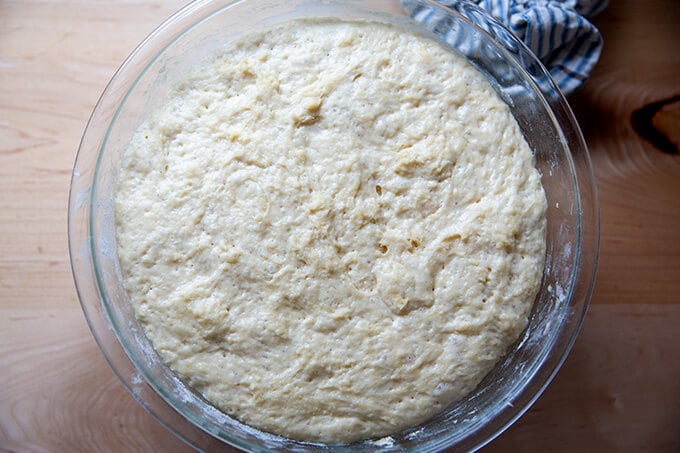
Let rise in a warm spot until doubled in volume, roughly two hours.
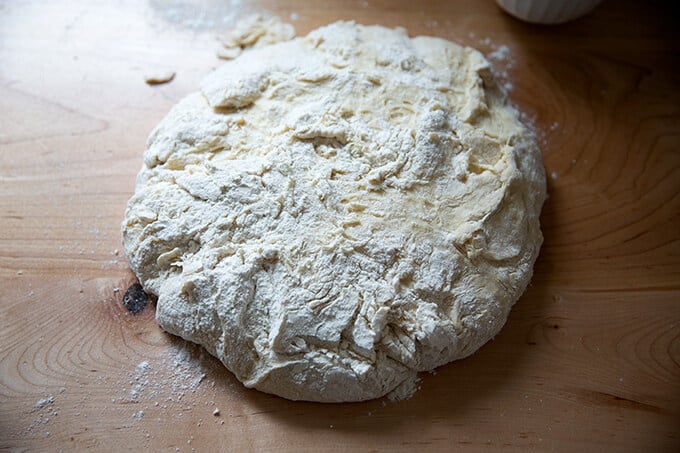
Turn out onto a lightly floured work surface:
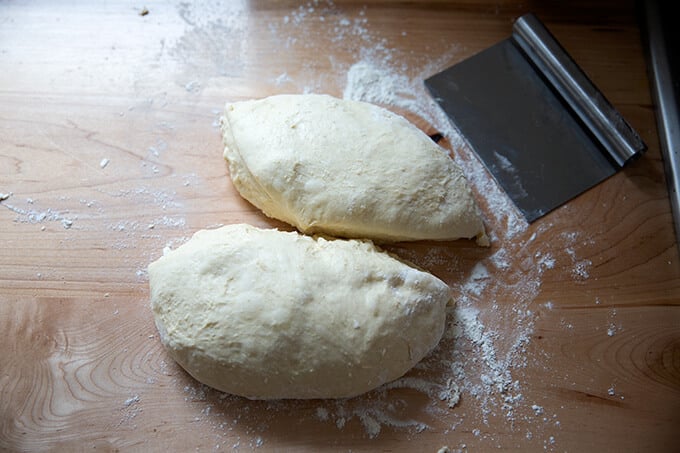
Divide into two equal portions.
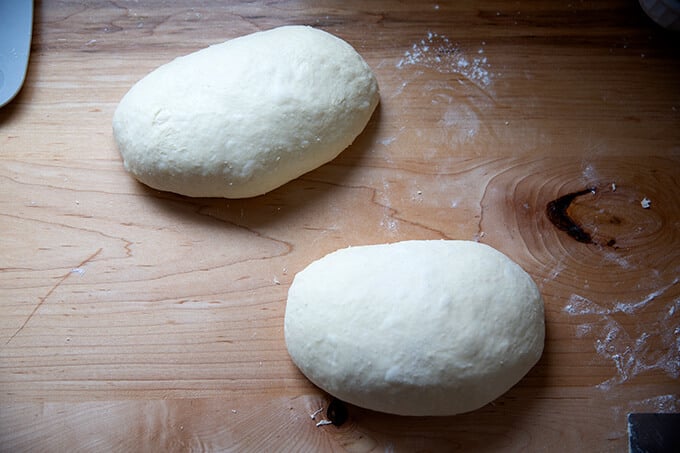
Shape into batards.
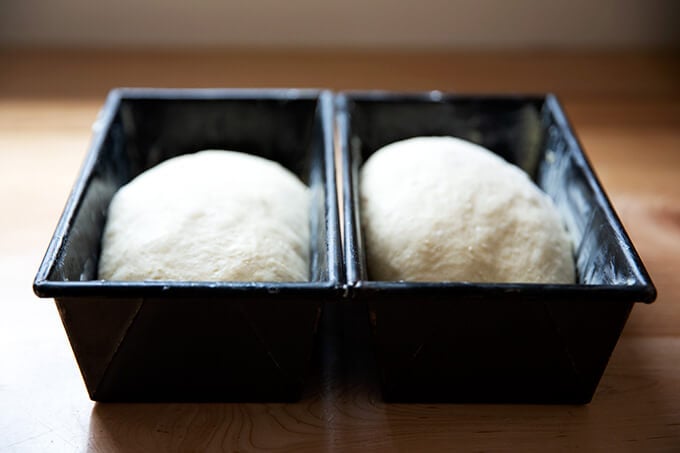
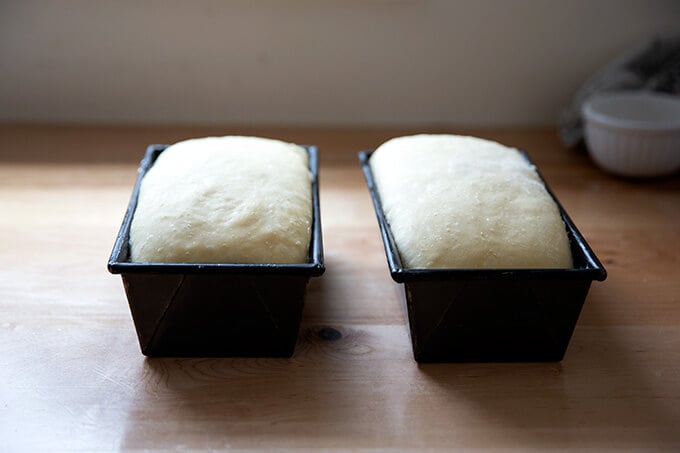
Transfer to buttered loaf pans and let rise until the dough crowns the rim of the pans. I love these pans for this recipe and others (namely this banana bread .)
Transfer to a 375ºF oven for roughly 45 minutes.
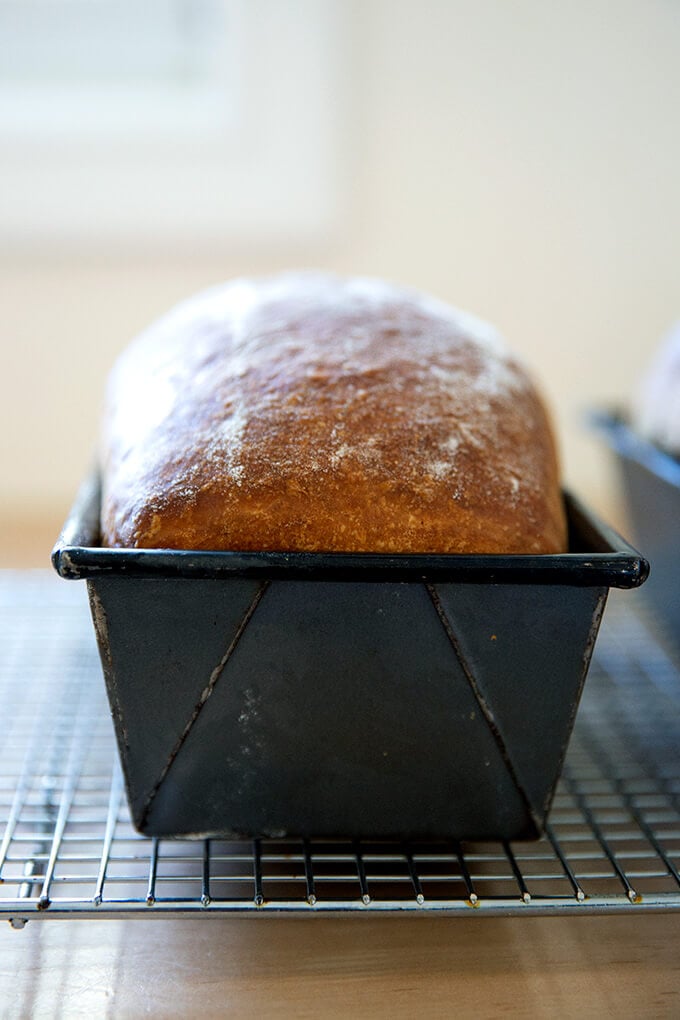
Let cool for at least 30 minutes before slicing.
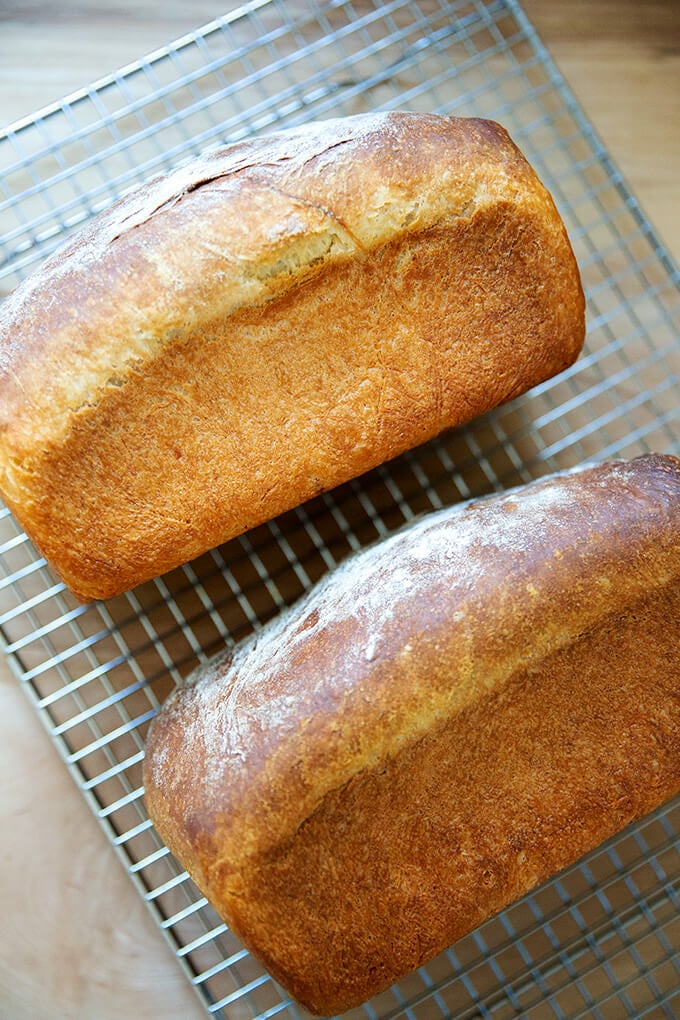
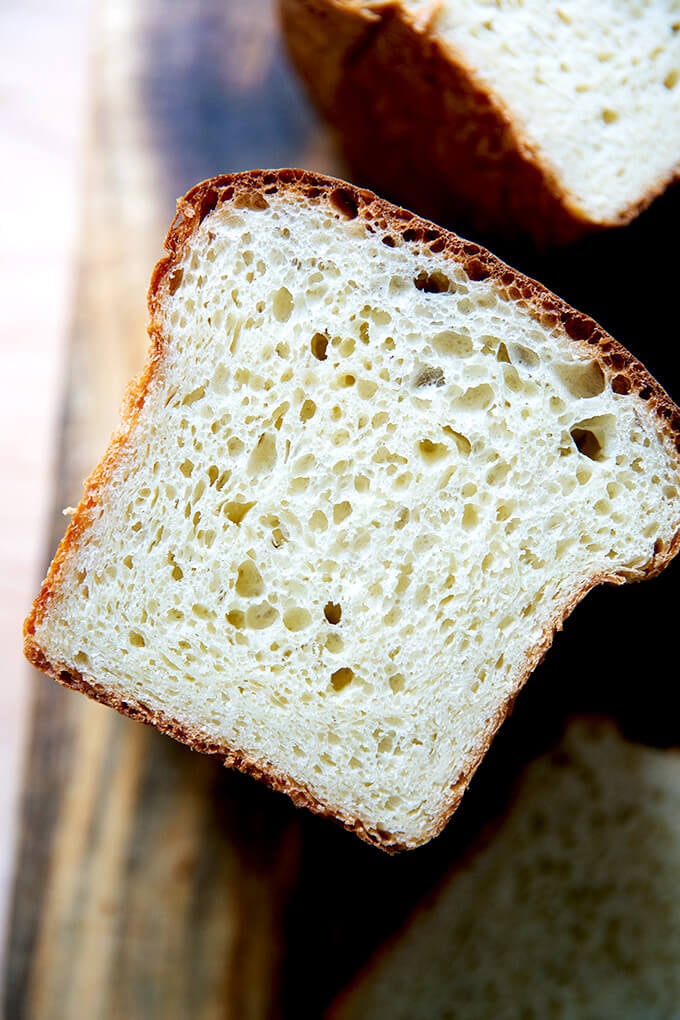
This brioche is delicious toasted with butter and jam, but it’s especially good in this brioche bread pudding recipe. It freezes beautifully, too. See notes in the recipe below.
Description
The dough for this no-knead brioche bread comes together in 5 minutes and requires nothing more than a bowl, whisk, and spatula. Start to finish, it can be made in 4 hours, but requires only 25 minutes of active time.
Notes:
Recipe adapted from my cookbook, Bread T oast Crumbs.
This recipe is very similar to the one in my book, but I’ve added weights for all of the ingredients, and instead of simply dividing the dough and plopping it into bread pans, I now like to turn it out onto a floured work surface, divide it into two even portions (by weight), and shape it before transferring it to the buttered loaf pans.
To create a warm spot for your bread to rise , turn your oven on for one minute, then shut it off. That brief blast of heat will create a cozy place for your bread to rise.
As always: for best results, use a digital scale to weigh the ingredients.
For a half recipe , see the notes below.
Water: This is a very wet dough. If you live in a humid area or you have trouble working with sticky doughs, I would start with 1.75 cups (425 g). Reference the photos above and the video for how sticky/wet the dough should appear.
If using active dry yeast: Sprinkle the yeast over the whisked together wet ingredients (which should be lukewarm to the touch) and let stand for 15 minutes or until it gets foamy; then proceed with the recipe.
To freeze: Let the loaves cool completely, then tuck them into an airtight bag or vessel and freeze for up to 3 months (or a bit longer).
- 6 cups ( 768 g ) all-purpose or bread flour
- 1 tablespoon ( 15 g ) kosher salt
- 2.5 teaspoons ( 8 g ) instant yeast, see notes above if using active dry yeast
- 1/3 cup ( 77 g ) sugar
- 1.75 – 2 cups ( 425-450 g ) lukewarm water, see notes above
- 2 eggs (100 g)
- 1/2 cup ( 125 g ) milk
- 6 tablespoons ( 80 g ) butter, melted
- Whisk together the flour, salt, yeast, and sugar.
- In a medium bowl, whisk together the eggs, milk, water, and melted butter.
- Pour the wet ingredients into the dry ingredients, and stir with a spatula till you have a sticky dough ball.
- Cover bowl and let rise in a warm area (see notes above) for 2 to 3 hours or until doubled. Alternatively, stick bowl in the fridge immediately and let it rise overnight or for 12 to 18 hours.
- Grease two 8.5 x 4.5 inch loaf pans with butter. Heat your oven to 375ºF.
- There are two ways to proceed after the first rise: 1. You can simply deflate the dough using forks to release the dough from the sides of the bowl and to divide it into two equal portions; then use oiled hands to transfer the dough to your prepared pans. (Dough is very wet and sticky—this is normal.) 2. Or you can cover a work surface with flour. Turn the dough out onto the floured work surface and shape it into a rough ball, using as much flour as necessary—the dough is very wet and sticky. Use a bench scraper to divide the dough into two equal portions. (Depending on how much water you are using, each portion will weigh between 790-805 grams.) Shape each portion into an oblong loaf or batard ( see video guidance here ) and transfer to prepared loaf pans.
- Let rise until dough begins to crown the rim of your pan. This may take 45 minutes to an hour (or more or less depending on how warm your kitchen is).
- Transfer pans to oven and bake for about 45 minutes or until evenly golden or until an instant-read thermometer registers 205ºF or higher. Turn loaves out onto cooling racks and let cool for at least 30 minutes before cutting.
Notes
Half Recipe Quantities:
3 cups ( 384 g ) all-purpose or bread flour
1.5 teaspoons ( 7 g ) kosher salt
1.5 teaspoons ( 5 g ) instant yeast
3 tablespoons (38 g ) sugar
0.75 –1 cups ( 170-227 g ) lukewarm water, see notes above
1 egg (50 g)
1/4 cup ( 62 g ) milk
3 tablespoons ( 40 g ) butter, melted
Prep Time: 3 hours 15 minutes
Cook Time: 45 minutes
Category: Bread
Method: Oven
Cuisine: French
The dough for this no-knead brioche bread comes together in 5 minutes and requires nothing more than a bowl, whisk, and spatula. Start to finish, it can be made in 4 hours, but requires only 25 minutes of active time. Find step-by-step instructions below 🍞🍞
Brioche is a soft-textured, slightly sweet, rich-tasting bread often made with sugar, milk, and heaps of eggs and butter. I recently came across a recipe calling for 6 eggs and 20 tablespoons of butter. The recipe yielded one loaf. One loaf! Two and a half sticks of butter for one loaf!
Even if that brioche is the brioche to end all brioches, I will never make it. How could I when I know that a lean dough — one made with flour, water, and salt alone — can produce something as completely delicious and satisfying?
In the original Tartine cookbook, the authors note “different types of brioche dough are made depending on how they will be used , with the formulas varying primarily in the percentage of butter.” Tartine makes a less-rich brioche because they use it for bread pudding and bostock.
This is the most compelling reason in my mind to make a “light” brioche: if you view brioche mostly as a vehicle for making exceptional bread pudding , French toast , and the like, it might be wise to save all of those eggs and all of that butter for a recipe in which they’ll really shine.
PS: No-Knead Brioche Rolls
How to Make Brioche, Step by Step
Gather your ingredients.
Stir together the dry ingredients. Whisk together the wet.
Combine the two until until you have a sticky dough ball:
Let rise in a warm spot until doubled in volume, roughly two hours.
Turn out onto a lightly floured work surface:
Divide into two equal portions.
Shape into batards.
Transfer to buttered loaf pans and let rise until the dough crowns the rim of the pans. I love these pans for this recipe and others (namely this banana bread .)
Transfer to a 375ºF oven for roughly 45 minutes.
Let cool for at least 30 minutes before slicing.
This brioche is delicious toasted with butter and jam, but it’s especially good in this brioche bread pudding recipe. It freezes beautifully, too. See notes in the recipe below.
Description
The dough for this no-knead brioche bread comes together in 5 minutes and requires nothing more than a bowl, whisk, and spatula. Start to finish, it can be made in 4 hours, but requires only 25 minutes of active time.
Notes:
Recipe adapted from my cookbook, Bread T oast Crumbs.
This recipe is very similar to the one in my book, but I’ve added weights for all of the ingredients, and instead of simply dividing the dough and plopping it into bread pans, I now like to turn it out onto a floured work surface, divide it into two even portions (by weight), and shape it before transferring it to the buttered loaf pans.
To create a warm spot for your bread to rise , turn your oven on for one minute, then shut it off. That brief blast of heat will create a cozy place for your bread to rise.
As always: for best results, use a digital scale to weigh the ingredients.
For a half recipe , see the notes below.
Water: This is a very wet dough. If you live in a humid area or you have trouble working with sticky doughs, I would start with 1.75 cups (425 g). Reference the photos above and the video for how sticky/wet the dough should appear.
If using active dry yeast: Sprinkle the yeast over the whisked together wet ingredients (which should be lukewarm to the touch) and let stand for 15 minutes or until it gets foamy; then proceed with the recipe.
To freeze: Let the loaves cool completely, then tuck them into an airtight bag or vessel and freeze for up to 3 months (or a bit longer).
- 6 cups ( 768 g ) all-purpose or bread flour
- 1 tablespoon ( 15 g ) kosher salt
- 2.5 teaspoons ( 8 g ) instant yeast, see notes above if using active dry yeast
- 1/3 cup ( 77 g ) sugar
- 1.75 – 2 cups ( 425-450 g ) lukewarm water, see notes above
- 2 eggs (100 g)
- 1/2 cup ( 125 g ) milk
- 6 tablespoons ( 80 g ) butter, melted
- Whisk together the flour, salt, yeast, and sugar.
- In a medium bowl, whisk together the eggs, milk, water, and melted butter.
- Pour the wet ingredients into the dry ingredients, and stir with a spatula till you have a sticky dough ball.
- Cover bowl and let rise in a warm area (see notes above) for 2 to 3 hours or until doubled. Alternatively, stick bowl in the fridge immediately and let it rise overnight or for 12 to 18 hours.
- Grease two 8.5 x 4.5 inch loaf pans with butter. Heat your oven to 375ºF.
- There are two ways to proceed after the first rise: 1. You can simply deflate the dough using forks to release the dough from the sides of the bowl and to divide it into two equal portions; then use oiled hands to transfer the dough to your prepared pans. (Dough is very wet and sticky—this is normal.) 2. Or you can cover a work surface with flour. Turn the dough out onto the floured work surface and shape it into a rough ball, using as much flour as necessary—the dough is very wet and sticky. Use a bench scraper to divide the dough into two equal portions. (Depending on how much water you are using, each portion will weigh between 790-805 grams.) Shape each portion into an oblong loaf or batard ( see video guidance here ) and transfer to prepared loaf pans.
- Let rise until dough begins to crown the rim of your pan. This may take 45 minutes to an hour (or more or less depending on how warm your kitchen is).
- Transfer pans to oven and bake for about 45 minutes or until evenly golden or until an instant-read thermometer registers 205ºF or higher. Turn loaves out onto cooling racks and let cool for at least 30 minutes before cutting.
Notes
Half Recipe Quantities:
3 cups ( 384 g ) all-purpose or bread flour
1.5 teaspoons ( 7 g ) kosher salt
1.5 teaspoons ( 5 g ) instant yeast
3 tablespoons (38 g ) sugar
0.75 –1 cups ( 170-227 g ) lukewarm water, see notes above
1 egg (50 g)
1/4 cup ( 62 g ) milk
3 tablespoons ( 40 g ) butter, melted
Prep Time: 3 hours 15 minutes
Cook Time: 45 minutes
Category: Bread
Method: Oven
Cuisine: French
The dough for this no-knead brioche bread comes together in 5 minutes and requires nothing more than a bowl, whisk, and spatula. Start to finish, it can be made in 4 hours, but requires only 25 minutes of active time. Find step-by-step instructions below 🍞🍞
Brioche is a soft-textured, slightly sweet, rich-tasting bread often made with sugar, milk, and heaps of eggs and butter. I recently came across a recipe calling for 6 eggs and 20 tablespoons of butter. The recipe yielded one loaf. One loaf! Two and a half sticks of butter for one loaf!
Even if that brioche is the brioche to end all brioches, I will never make it. How could I when I know that a lean dough — one made with flour, water, and salt alone — can produce something as completely delicious and satisfying?
In the original Tartine cookbook, the authors note “different types of brioche dough are made depending on how they will be used , with the formulas varying primarily in the percentage of butter.” Tartine makes a less-rich brioche because they use it for bread pudding and bostock.
This is the most compelling reason in my mind to make a “light” brioche: if you view brioche mostly as a vehicle for making exceptional bread pudding , French toast , and the like, it might be wise to save all of those eggs and all of that butter for a recipe in which they’ll really shine.
PS: No-Knead Brioche Rolls
How to Make Brioche, Step by Step
Gather your ingredients.
Stir together the dry ingredients. Whisk together the wet.
Combine the two until until you have a sticky dough ball:
Let rise in a warm spot until doubled in volume, roughly two hours.
Turn out onto a lightly floured work surface:
Divide into two equal portions.
Shape into batards.
Transfer to buttered loaf pans and let rise until the dough crowns the rim of the pans. I love these pans for this recipe and others (namely this banana bread .)
Transfer to a 375ºF oven for roughly 45 minutes.
Let cool for at least 30 minutes before slicing.
This brioche is delicious toasted with butter and jam, but it’s especially good in this brioche bread pudding recipe. It freezes beautifully, too. See notes in the recipe below.
Description
The dough for this no-knead brioche bread comes together in 5 minutes and requires nothing more than a bowl, whisk, and spatula. Start to finish, it can be made in 4 hours, but requires only 25 minutes of active time.
Notes:
Recipe adapted from my cookbook, Bread T oast Crumbs.
This recipe is very similar to the one in my book, but I’ve added weights for all of the ingredients, and instead of simply dividing the dough and plopping it into bread pans, I now like to turn it out onto a floured work surface, divide it into two even portions (by weight), and shape it before transferring it to the buttered loaf pans.
To create a warm spot for your bread to rise , turn your oven on for one minute, then shut it off. That brief blast of heat will create a cozy place for your bread to rise.
As always: for best results, use a digital scale to weigh the ingredients.
For a half recipe , see the notes below.
Water: This is a very wet dough. If you live in a humid area or you have trouble working with sticky doughs, I would start with 1.75 cups (425 g). Reference the photos above and the video for how sticky/wet the dough should appear.
If using active dry yeast: Sprinkle the yeast over the whisked together wet ingredients (which should be lukewarm to the touch) and let stand for 15 minutes or until it gets foamy; then proceed with the recipe.
To freeze: Let the loaves cool completely, then tuck them into an airtight bag or vessel and freeze for up to 3 months (or a bit longer).
- 6 cups ( 768 g ) all-purpose or bread flour
- 1 tablespoon ( 15 g ) kosher salt
- 2.5 teaspoons ( 8 g ) instant yeast, see notes above if using active dry yeast
- 1/3 cup ( 77 g ) sugar
- 1.75 – 2 cups ( 425-450 g ) lukewarm water, see notes above
- 2 eggs (100 g)
- 1/2 cup ( 125 g ) milk
- 6 tablespoons ( 80 g ) butter, melted
- Whisk together the flour, salt, yeast, and sugar.
- In a medium bowl, whisk together the eggs, milk, water, and melted butter.
- Pour the wet ingredients into the dry ingredients, and stir with a spatula till you have a sticky dough ball.
- Cover bowl and let rise in a warm area (see notes above) for 2 to 3 hours or until doubled. Alternatively, stick bowl in the fridge immediately and let it rise overnight or for 12 to 18 hours.
- Grease two 8.5 x 4.5 inch loaf pans with butter. Heat your oven to 375ºF.
- There are two ways to proceed after the first rise: 1. You can simply deflate the dough using forks to release the dough from the sides of the bowl and to divide it into two equal portions; then use oiled hands to transfer the dough to your prepared pans. (Dough is very wet and sticky—this is normal.) 2. Or you can cover a work surface with flour. Turn the dough out onto the floured work surface and shape it into a rough ball, using as much flour as necessary—the dough is very wet and sticky. Use a bench scraper to divide the dough into two equal portions. (Depending on how much water you are using, each portion will weigh between 790-805 grams.) Shape each portion into an oblong loaf or batard ( see video guidance here ) and transfer to prepared loaf pans.
- Let rise until dough begins to crown the rim of your pan. This may take 45 minutes to an hour (or more or less depending on how warm your kitchen is).
- Transfer pans to oven and bake for about 45 minutes or until evenly golden or until an instant-read thermometer registers 205ºF or higher. Turn loaves out onto cooling racks and let cool for at least 30 minutes before cutting.
Notes
Half Recipe Quantities:
3 cups ( 384 g ) all-purpose or bread flour
1.5 teaspoons ( 7 g ) kosher salt
1.5 teaspoons ( 5 g ) instant yeast
3 tablespoons (38 g ) sugar
0.75 –1 cups ( 170-227 g ) lukewarm water, see notes above
1 egg (50 g)
1/4 cup ( 62 g ) milk
3 tablespoons ( 40 g ) butter, melted
Prep Time: 3 hours 15 minutes
Cook Time: 45 minutes
Category: Bread
Method: Oven
Cuisine: French
Description
The dough for this no-knead brioche bread comes together in 5 minutes and requires nothing more than a bowl, whisk, and spatula. Start to finish, it can be made in 4 hours, but requires only 25 minutes of active time.
Notes:
Recipe adapted from my cookbook, Bread T oast Crumbs.
This recipe is very similar to the one in my book, but I’ve added weights for all of the ingredients, and instead of simply dividing the dough and plopping it into bread pans, I now like to turn it out onto a floured work surface, divide it into two even portions (by weight), and shape it before transferring it to the buttered loaf pans.
To create a warm spot for your bread to rise , turn your oven on for one minute, then shut it off. That brief blast of heat will create a cozy place for your bread to rise.
As always: for best results, use a digital scale to weigh the ingredients.
For a half recipe , see the notes below.
Water: This is a very wet dough. If you live in a humid area or you have trouble working with sticky doughs, I would start with 1.75 cups (425 g). Reference the photos above and the video for how sticky/wet the dough should appear.
If using active dry yeast: Sprinkle the yeast over the whisked together wet ingredients (which should be lukewarm to the touch) and let stand for 15 minutes or until it gets foamy; then proceed with the recipe.
To freeze: Let the loaves cool completely, then tuck them into an airtight bag or vessel and freeze for up to 3 months (or a bit longer).
- 6 cups ( 768 g ) all-purpose or bread flour
- 1 tablespoon ( 15 g ) kosher salt
- 2.5 teaspoons ( 8 g ) instant yeast, see notes above if using active dry yeast
- 1/3 cup ( 77 g ) sugar
- 1.75 - 2 cups ( 425-450 g ) lukewarm water, see notes above
- 2 eggs (100 g)
- 1/2 cup ( 125 g ) milk
- 6 tablespoons ( 80 g ) butter, melted
- Whisk together the flour, salt, yeast, and sugar.
- In a medium bowl, whisk together the eggs, milk, water, and melted butter.
- Pour the wet ingredients into the dry ingredients, and stir with a spatula till you have a sticky dough ball.
- Cover bowl and let rise in a warm area (see notes above) for 2 to 3 hours or until doubled. Alternatively, stick bowl in the fridge immediately and let it rise overnight or for 12 to 18 hours.
- Grease two 8.5 x 4.5 inch loaf pans with butter. Heat your oven to 375ºF.
- There are two ways to proceed after the first rise: 1. You can simply deflate the dough using forks to release the dough from the sides of the bowl and to divide it into two equal portions; then use oiled hands to transfer the dough to your prepared pans. (Dough is very wet and sticky—this is normal.) 2. Or you can cover a work surface with flour. Turn the dough out onto the floured work surface and shape it into a rough ball, using as much flour as necessary—the dough is very wet and sticky. Use a bench scraper to divide the dough into two equal portions. (Depending on how much water you are using, each portion will weigh between 790-805 grams.) Shape each portion into an oblong loaf or batard ( see video guidance here ) and transfer to prepared loaf pans.
- Let rise until dough begins to crown the rim of your pan. This may take 45 minutes to an hour (or more or less depending on how warm your kitchen is).
- Transfer pans to oven and bake for about 45 minutes or until evenly golden or until an instant-read thermometer registers 205ºF or higher. Turn loaves out onto cooling racks and let cool for at least 30 minutes before cutting.
Notes
Half Recipe Quantities:
3 cups ( 384 g ) all-purpose or bread flour
1.5 teaspoons ( 7 g ) kosher salt
1.5 teaspoons ( 5 g ) instant yeast
3 tablespoons (38 g ) sugar
0.75 –1 cups ( 170-227 g ) lukewarm water, see notes above
1 egg (50 g)
1/4 cup ( 62 g ) milk
3 tablespoons ( 40 g ) butter, melted
Prep Time: 3 hours 15 minutes
Cook Time: 45 minutes
Category: Bread
Method: Oven
Cuisine: French
Find it online : https://alexandracooks.com/2021/03/21/easy-brioche-loaf-recipe-no-knead/
This oven-baked ham recipe is so simple, with no scoring and no studding with cloves. This recipe uses a moist heat cooking method for the first half, and the ham is finished with a blast of high heat to caramelize the surface. The result yields meat that is juicy, tender, and full of flavor. This baked ham recipe is perfect for entertaining!
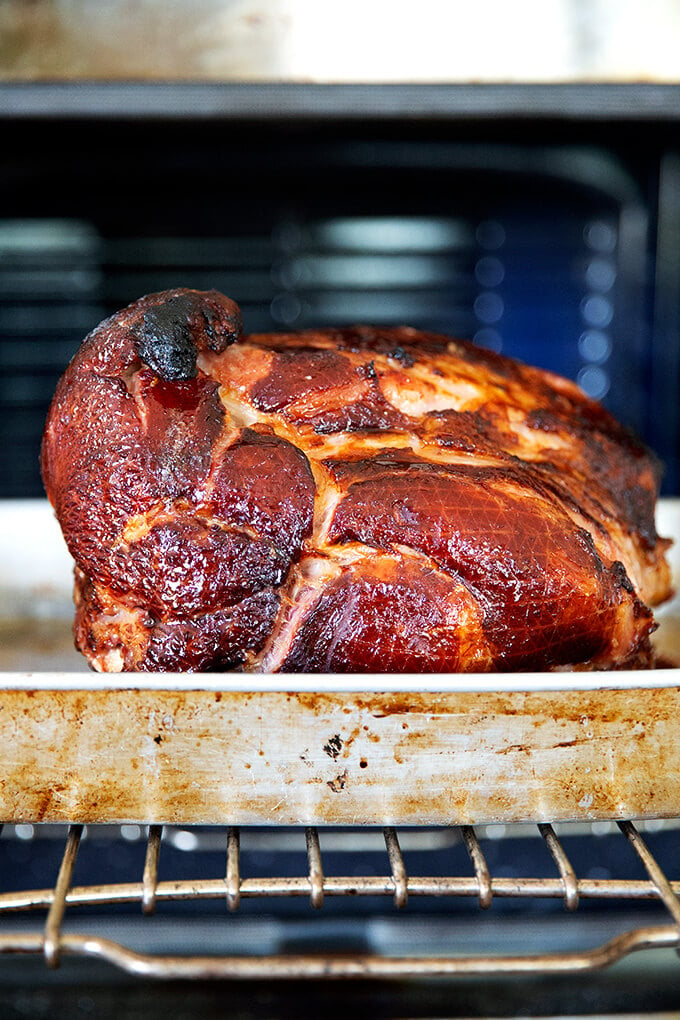
Last Christmas, I bought a half, bone-in ham from Dakin Farm . I scored it, studded it with cloves, and baked it as directed for 10 minutes a pound at 325ºF. During the last 15 minutes, I cranked up the heat and brushed it with a simple glaze, a mix of brown sugar, maple syrup, and freshly squeezed orange juice.
In my post Christmas after-action report, I wrote: “The ham was spectacular; the mustard sauce outrageously delicious.”
But I had questions still: Was scoring necessary? Were cloves necessary? Was a glaze even necessary?
And so I emailed Dakin Farm: To Score or Not? A man named Eric wrote me back and said, “My advice to everyone is to add a little water to the pan and cover with foil. This really helps in preventing the ham from being dry.”
He also noted that studding with cloves is not necessary, but it won’t dry the ham out either. And added that glazing is nice for visual purposes.
This all made sense to me, and the next time around, I followed his advice. I roasted my unscored, un-cloved whole ham (a 13-pounder) for an hour and 45 minutes at 325ºF in a pan with a little bit of water covered in foil. For the last 30 minutes, I removed the foil, cranked up the heat to 425ºF, and generously glazed the ham twice at 15 minute intervals.
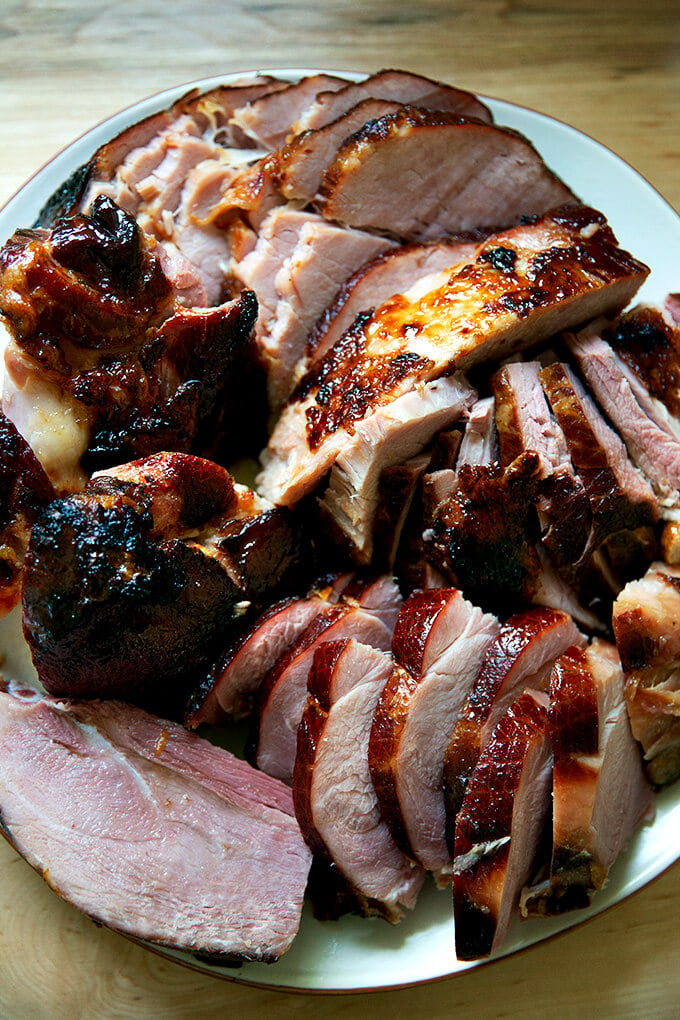
The result? A beautifully burnished, glazed ham with super moist, tender meat. And no thanks to anything I did: the meat was super flavorful.
Let me explain …
The Secret to Baking A Good Ham?
… lies in the ham. If you buy a good one, you’ll bake a good one. If you buy a bad one, you won’t. No glaze or scoring or cooking technique will save a bad ham. You’re not marinating or brining a ham (and how nice! ) — you’re simply heating it through. And the glaze, while delicious, doesn’t penetrate beyond the outer layer.
As you can gather, I am a huge fan of Dakin Farm (no affiliation here! just a fan!) For as long as I can remember, my Vermont aunt and uncle always have had some sort of Dakin Farm ham product on hand when we visit, and it is always fabulous. I’ve purchased both their whole and half hams, and they never disappoint. A half ham will feed at least 12 people, making the cost per serving about $4.66.
My mother’s advice regarding ham is to never buy a spiral or frozen ham. One year, I bought just that: a frozen, spiral ham (from a highly regarded source). It looked beautiful emerging from the oven — and I thought: just this once, I’ll show her! — but in the end, it was dry and flavorless. Should have known.
Baked Ham Best Practices
- Cook 10 minutes a pound at 325ºF.
- Cook fat-side up in a roasting pan filled with about 1/2 inch of water covered tightly in foil for the bulk of the time.
- During the last 30 minutes, remove the foil, crank the heat up to 425ºF, brush with a simple glaze at least twice.
- Let rest 20 minutes before carving.
Brown Sugar Ham Glaze Recipe
A ham glaze recipe should include something sweet — brown sugar, sugar, honey, maple syrup, etc. — which will promote good caramelization in the oven. There is no need to glaze the ham throughout the entire cooking process — during the last 30 minutes (with the oven cranked up to 425ºF) will suffice and will leave the ham beautifully burnished.
To make this glaze, stir together:
- 1/4 cup brown sugar
- 1/4 cup maple syrup
- 1/4 cup freshly squeezed orange juice
Halve the recipe if you are making a half ham.
How to Roast a Whole Bone-In Ham
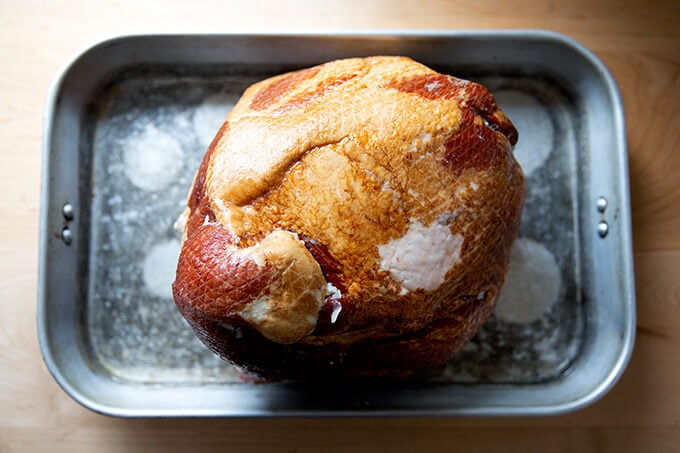
Here’s the play-by-play: Place ham, fat side up, in a large roasting pan. Add 2 cups of water, roughly, or enough water so that it reaches 1/2-inch up the sides of the pan.
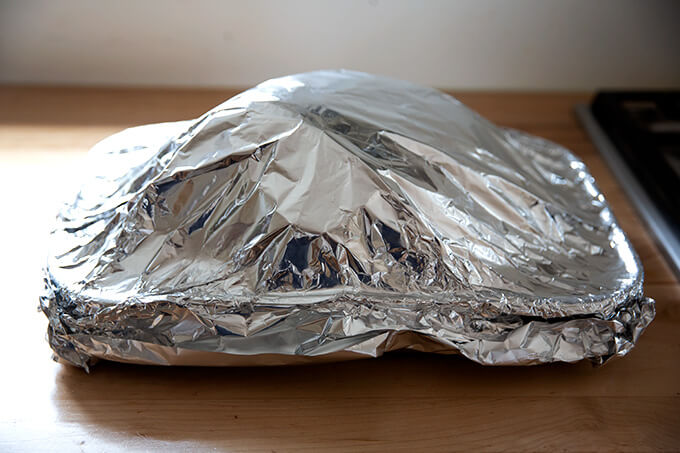
Cover the pan with foil and transfer to a 325ºF oven.
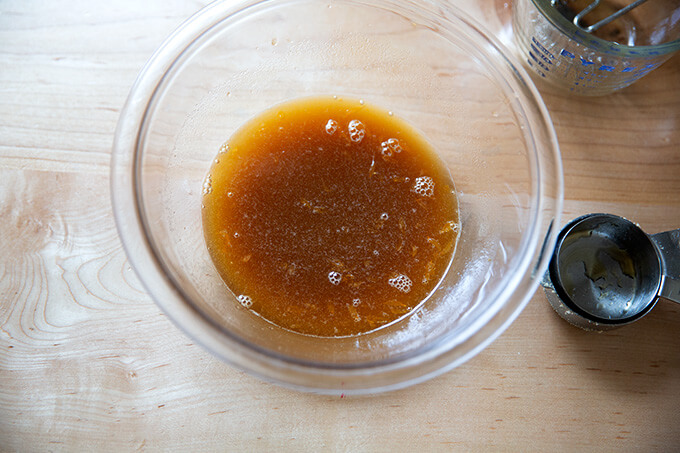
Meanwhile, stir together the glaze: 1/4 cup each freshly squeezed orange juice, brown sugar, and maple syrup.
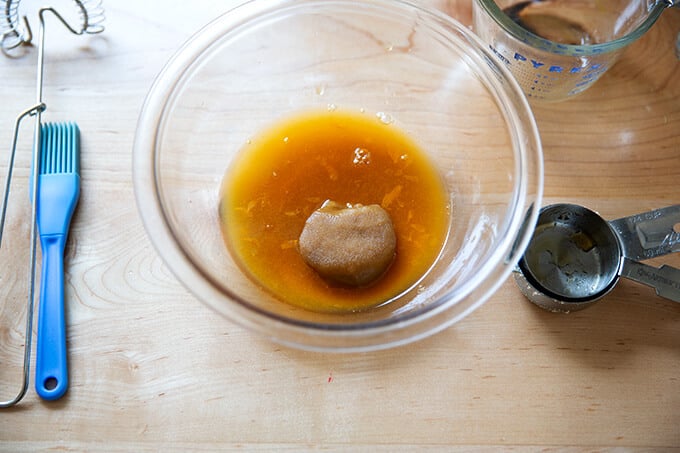
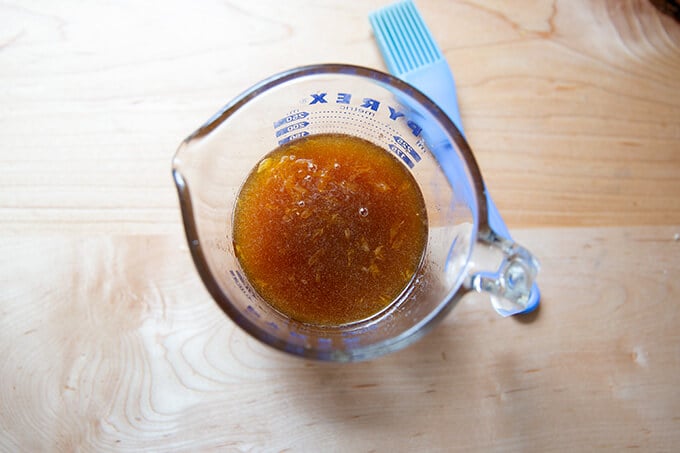
Transfer it to a small liquid measure for easy brushing (if you wish):
Thirty minutes before the ham is cooked (see recipe box for timing notes), remove the ham from the oven, remove the foil, and increase the oven temperature to 425ºF.
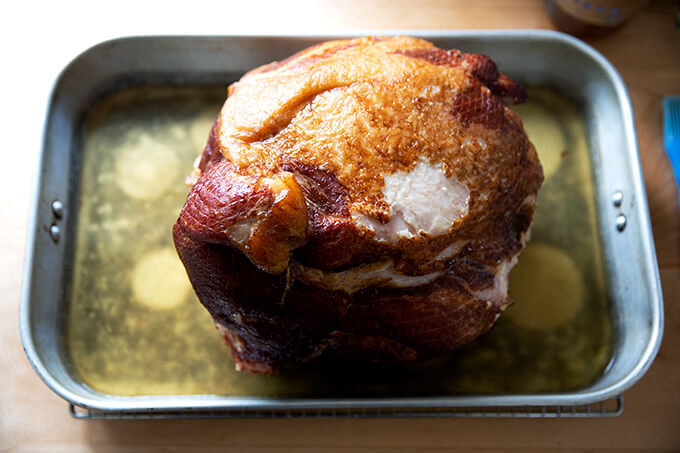
Brush the ham with the glaze, and return it to the oven for 15 minutes:
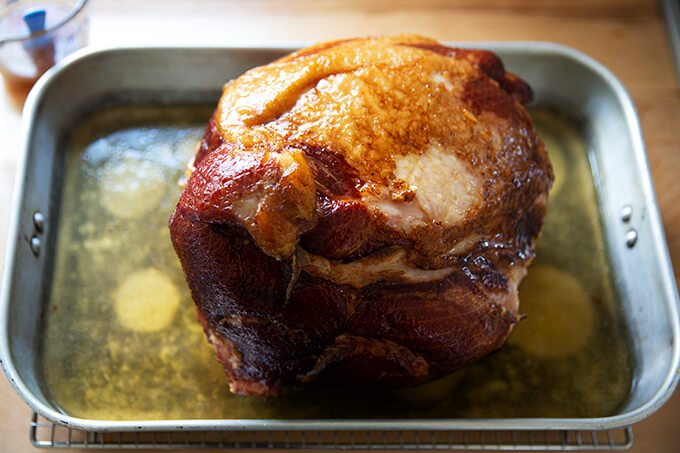
Remove the ham and give it another brush with the glaze. Return it to the oven for a final 15 minutes.
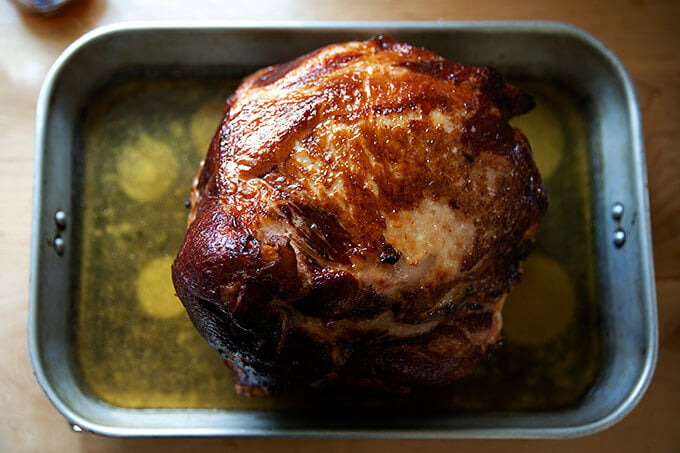
Remove it from the oven:
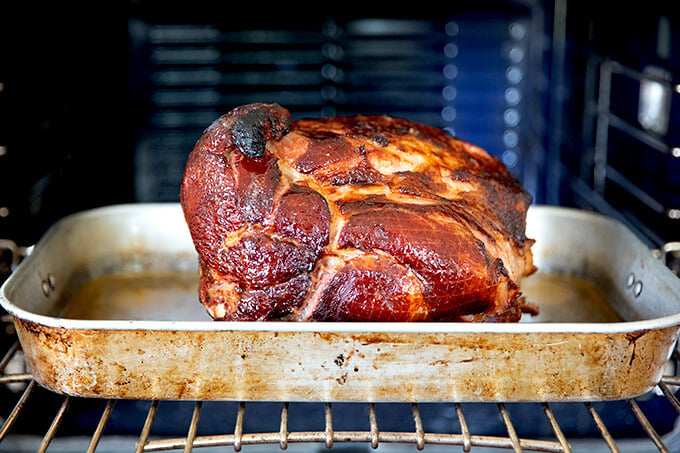
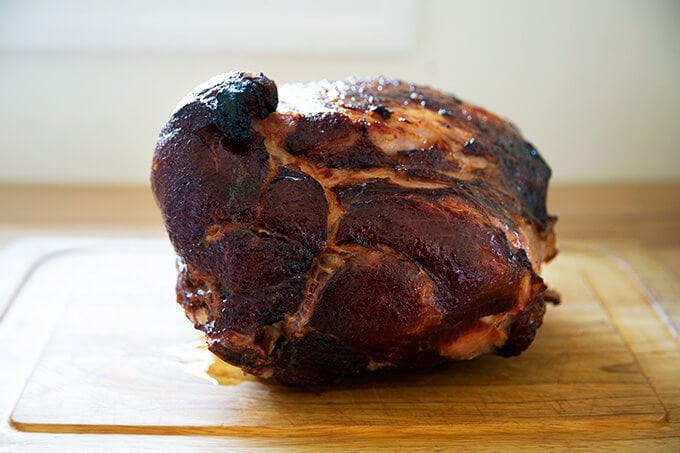
Transfer the ham to a board to rest for at least 20 minutes before carving.
Remove as many large lobes from the ham as possible; then carve into slices:
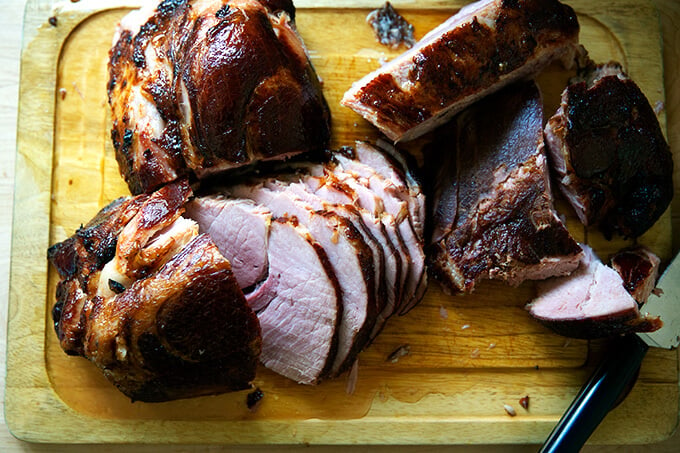
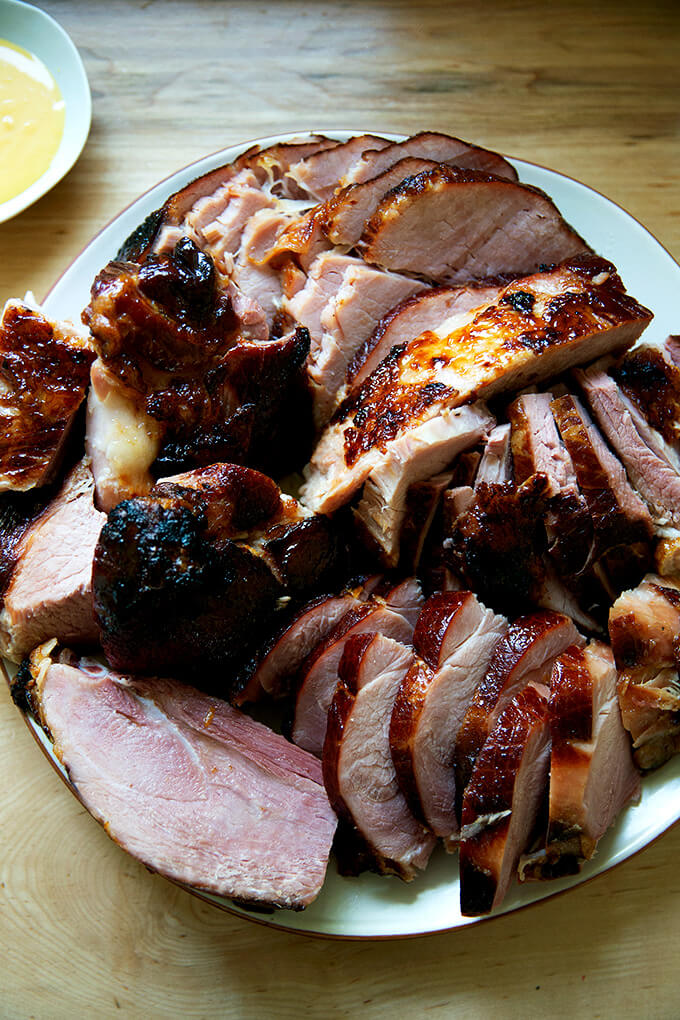
Transfer to a serving platter:
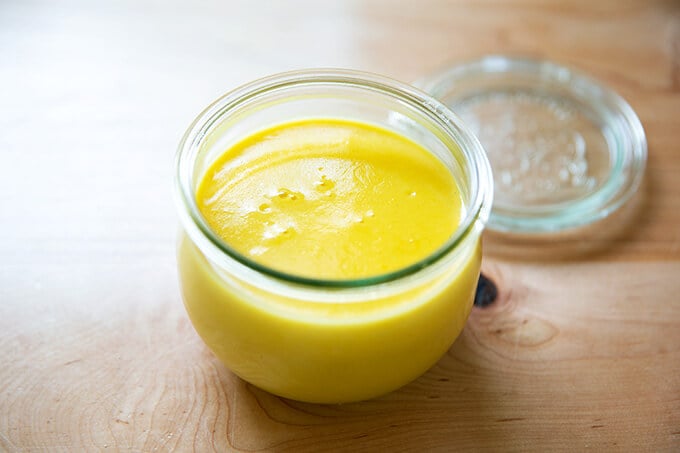
Don’t forget the ham sauce ! It’s so, so delicious.
Tend to the ham bone (and removing as much meat as possible from it) after dinner:
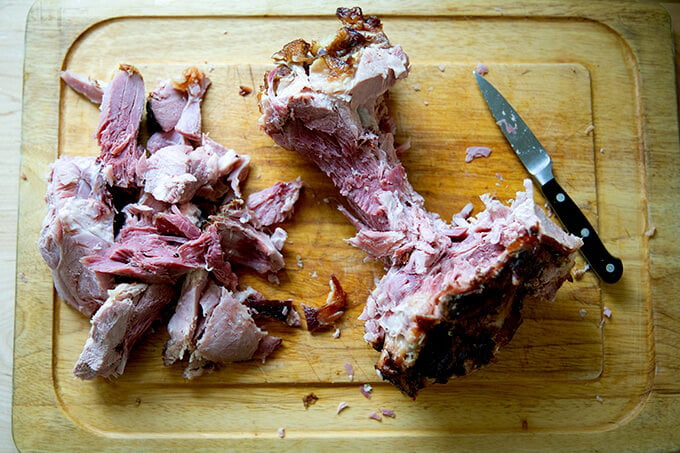
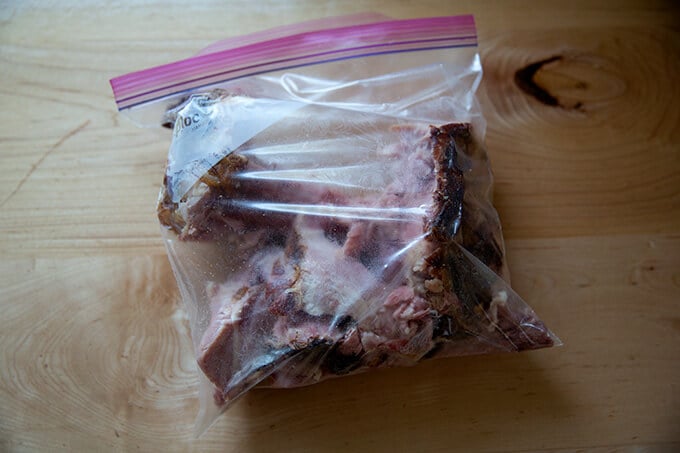
Save the bone for split pea and ham soup. Or freeze for up to 3 months.
Description
This is a very simple baked ham recipe. There’s no scoring and no studding with cloves, because neither of those steps is necessary. Using a moist heat cooking method for the first half of the process, followed by a blast of high heat at the end to caramelize the surface will yield a beautifully burnished ham with moist, tender meat.
Ham : I am a huge fan of Dakin Farm hams (no affiliation here … truly just a long-time fan since my VT aunt and uncle introduced me to their products years ago.) I think the secret to making a good ham lies in the quality of the ham itself. Regardless of what brand you use, you need a cooked ham. All you’re doing here is reheating it.
Notes:
- Dakin recommends estimating 1/4 lb per person buffet style or 1/2 lb per person for dinner, depending on appetites.
- Cook 10 minutes a pound at 325ºF.
- Cook fat-side up in a roasting pan filled with about 1/2 inch of water covered tightly in foil for the bulk of the time.
- During the last 30 minutes, remove the foil, crank the heat up to 425ºF, brush with a simple glaze at least twice.
- Let rest 20 minutes before carving.
For the ham:
- 1 bone-in whole ham ( 11 – 13 lbs.) or half ham ( 5 – 6 lbs), see notes above
- water
- foil, heavy-duty is nice here
For the glaze (halve this recipe if making a half ham):
- 1/4 cup brown sugar
- 1/4 cup maple syrup
- 1/4 cup fresh orange juice
For serving:
- my grandmother’s mustard sauce , aka “the ham sauce”
- Heat oven to 325ºF.
- Calculate your ham’s cooking time. For this recipe, you’re going to roast your ham for 10 minutes a pound total, but you’re going to crank the oven temperature up to 425ºF during the last 30 minutes, during which time you’ll glaze it twice. So, calculate your ham’s total cooking time; then subtract 30 minutes to calculate how long the ham will be in the oven for the first portion of the cooking period. (For example, if your ham weighs 13.69 lbs, you’ll roast it for 1 hour and 45 minutes at 325ºF; then 30 minutes at 425ºF.)
- Place ham, fat side up, in a roasting pan large enough to fit it. Add 2 cups of water or enough so that the water reaches about 1/2 inch up the sides of the pan. Cover the pan tightly with foil and transfer to the oven. Set the timer for the amount of time you calculated in step 2.
- Meanwhile, make the glaze: whisk together the brown sugar, maple syrup, and freshly squeezed orange juice. Set aside.
- After the first portion of the cooking is complete, remove the ham from the oven, and increase the oven temperature to 425ºF. Remove the foil. Brush the ham all over generously with the glaze and return the ham to the oven for 15 minutes. Brush the ham again generously all over with the glaze and cook for another 15 minutes. (If you have any leftover glaze, dump it over the ham during the last 5 minutes of cooking time.)
- Remove ham from the oven and let rest for at least 20 minutes before carving.
- Carve by removing large chunks of meat and slicing up those chunks. See video for guidance . Don’t worry too much about the ham bone — save that for after dinner. Remove as much meat as possible. Save the bone for soup.
- Prep Time: 5 minutes
- Cook Time: 2 hours 15 minutes
- Category: Dinner
- Method: Baking
- Cuisine: American
