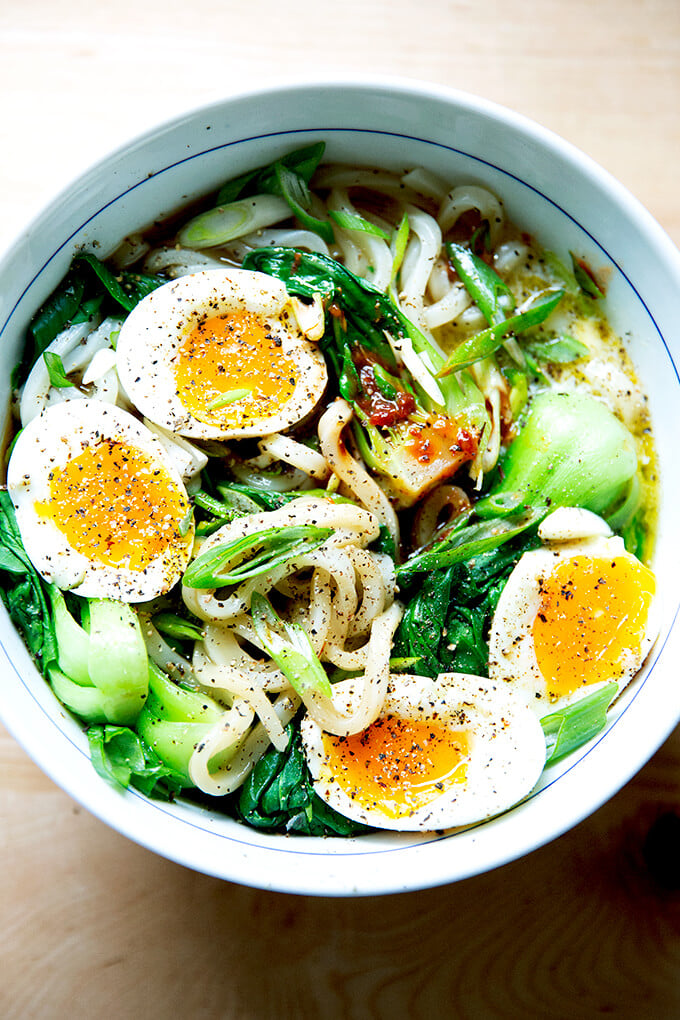
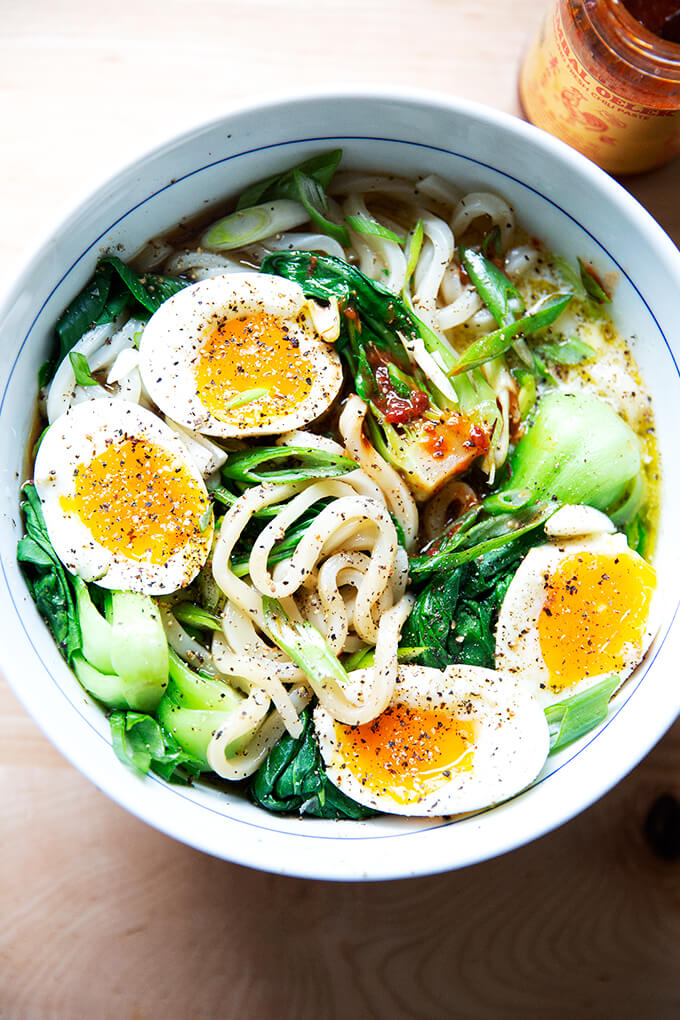
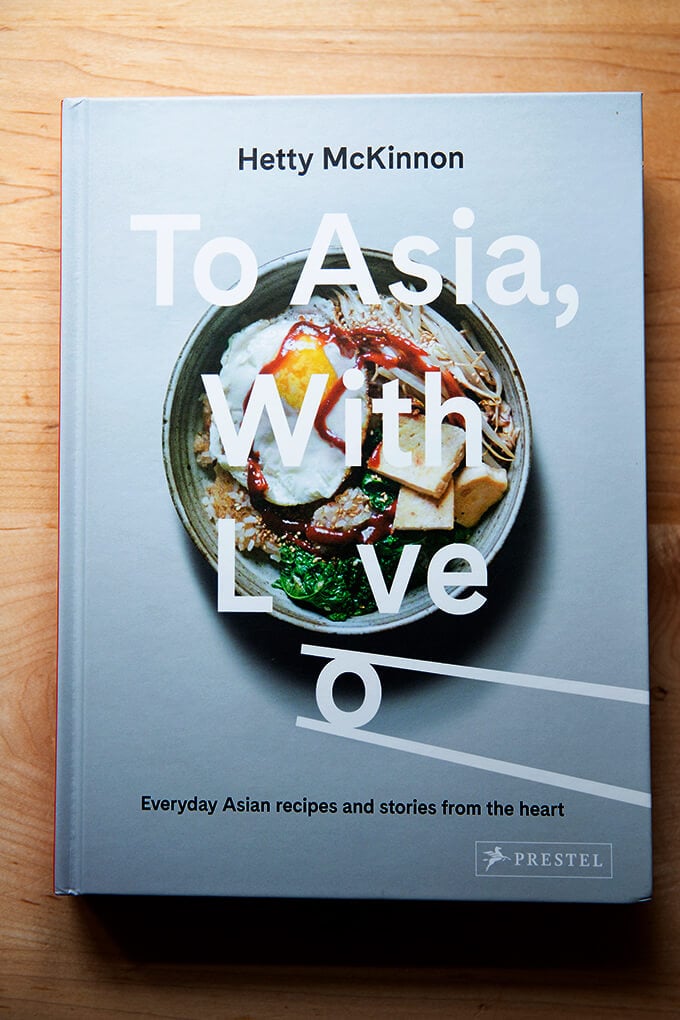
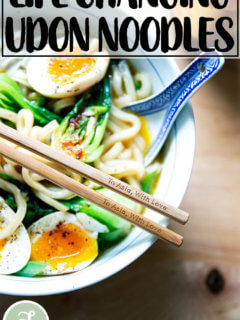
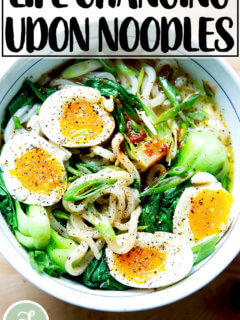
If you are under the impression you need to spend hours toiling over a pot of bones to make a highly seasoned broth to then make a good bowl of noodles, you must make Hetty McKinnon’s “life-changing” udon noodles from her latest book To Asia, With Love .
The broth is made with three ingredients — vegetable stock, soy sauce, and mirin — and after it comes to a simmer, it’s done. The rest of the broth’s flavor comes from garnishes: a pat of butter, a drizzle of sesame oil, a sprinkling of scallions, a pinch of sea salt, and lots of freshly cracked black pepper. The yolks of soft-boiled eggs impart the broth with a richness, and if you like a bit of spice, a spoonful of Sambal Oeleck or chili paste of choice seasons it further.
I love adding a heap of baby bok choy or other greens to make it a meal. If you like this idea, too, simply add them to the pot of boiling udon noodles, which typically cook in 1-3 minutes — the frozen udon noodles I buy cook in 1 minute, which is all the time most greens need.
Every time I make this soup, I am astounded by how quickly it comes together and by how flavorful and nourishing it is. In the intro to the recipe, Hetty writes that the recipe was inspired by a dish served at Shin Udon in Tokyo, the flavors and textures of which were “life-changing.”
About To Asia With Love
- Something I love about To Asia, With Love are the anecdotes, such as the one mentioned above. Many of the stories in TAWL are rooted in travel and discovery, which I think we all are craving right now.
- Like all of Hetty’s previous three books, To Asia, With Love is beautiful: its design, its photography, its recipes. In Hetty’s newsletter last fall, when she first shared this recipe, she described this book as her “most personal to date,” noting that it is “full of everyday Asian recipes made with simple ingredients (many of which you will already have in your pantry) along with personal stories of growing up in a Chinese household in Sydney.”
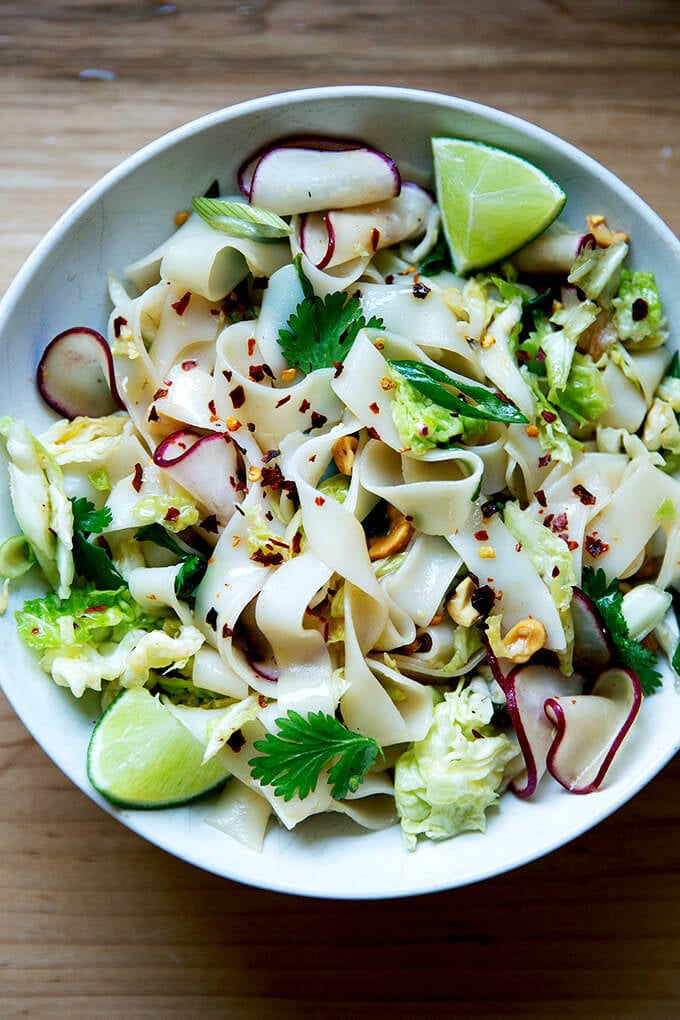
- I want to make everything in TAWL , namely the “restaurant greens”, which is my favorite thing to order at Chinese restaurants. I recently made the TAWL pad Thai salad, which was absolutely delicious (photo below). I’ll be sharing that recipe on my Instagram stories tomorrow, so follow along on Instagram if you’d like to try that recipe. I’ll keep it highlighted in my stories.
- There are two ways I keep up with Hetty: her Instagram and her newsletter . She is wonderful.
PS: Hetty’s Sushi Salad (This recipe comes from Hetty’s last book, Family , and after discovering it, I made it on repeat for weeks. It’s one of my favorites.)
How to Make Life-Changing Noodles
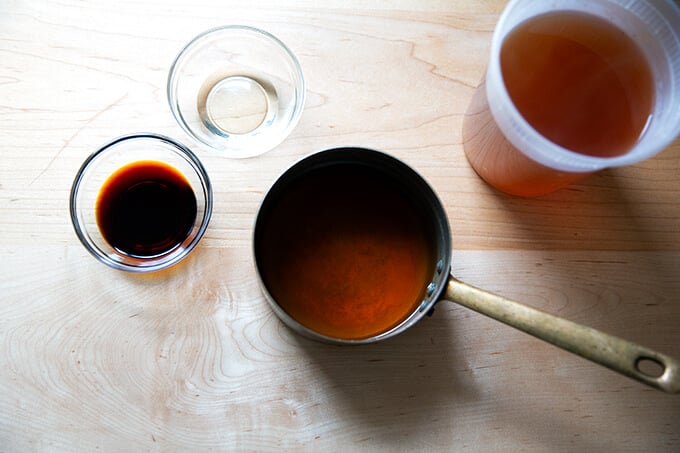
First, get the broth going by combining vegetable stock , soy sauce or tamari, and mirin in a pot. Bring it to a simmer.
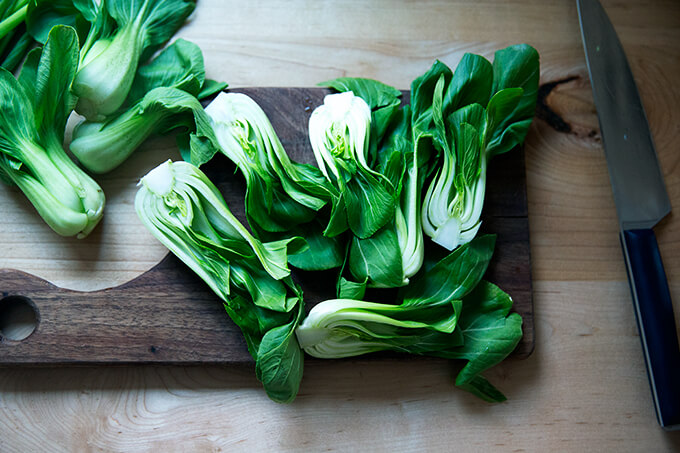
Meanwhile, halve small heads of baby bok choy or other greens of choice.
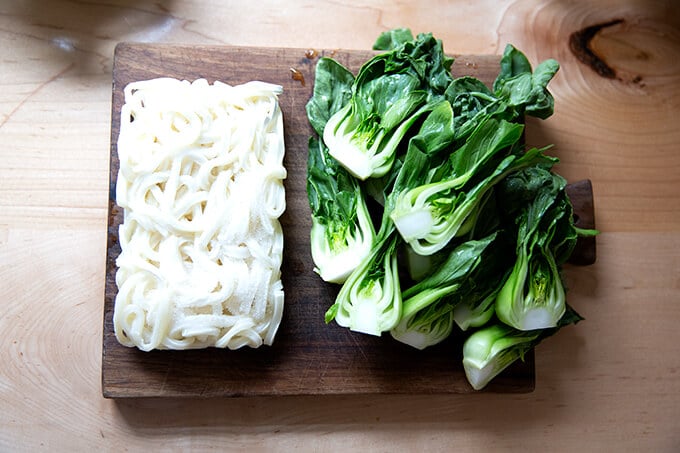
You’ll need udon noodles (or other) noodles for this soup. I can’t recommend buying frozen udon noodles enough. They cook in 1 minute, and couldn’t be more delicious.
What your stovetop will look like: 1 pot for the noodles and greens (if using), 1 pot for the eggs, and 1 pot for the broth.
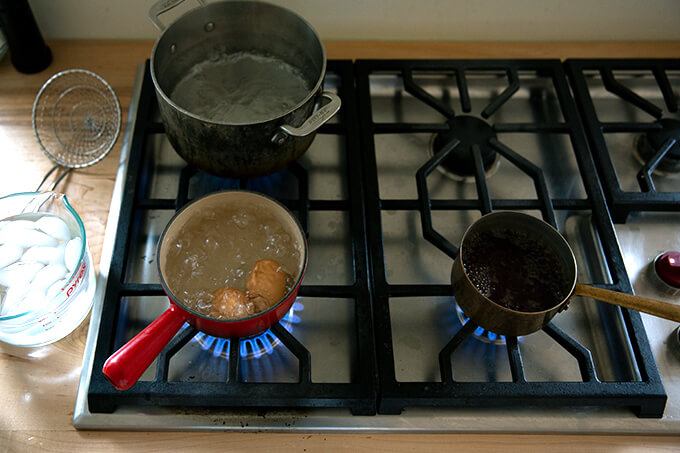
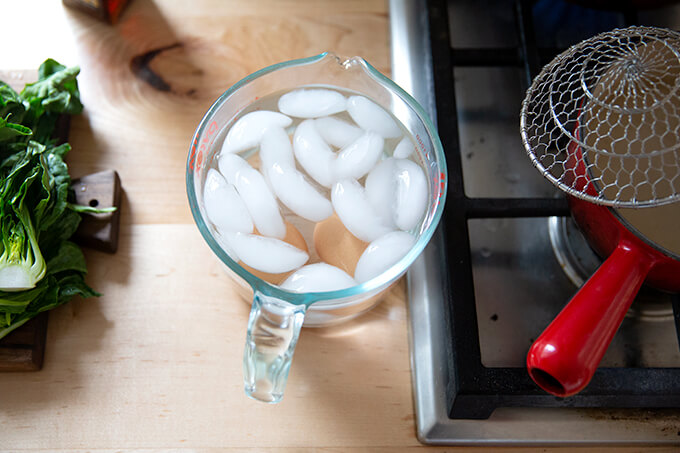
Cook the eggs for 6 minutes (for very soft boiled eggs) or 7 minutes for less runny soft-boiled eggs. Transfer to an ice bath immediately.
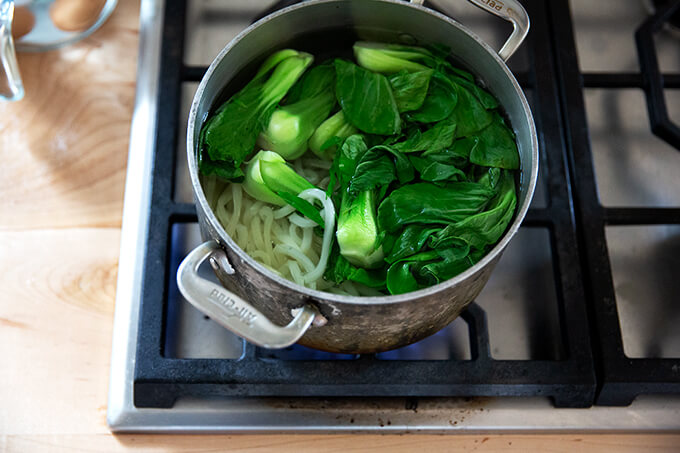
Cook the noodles and greens for 1 to 3 minutes.
Drain.
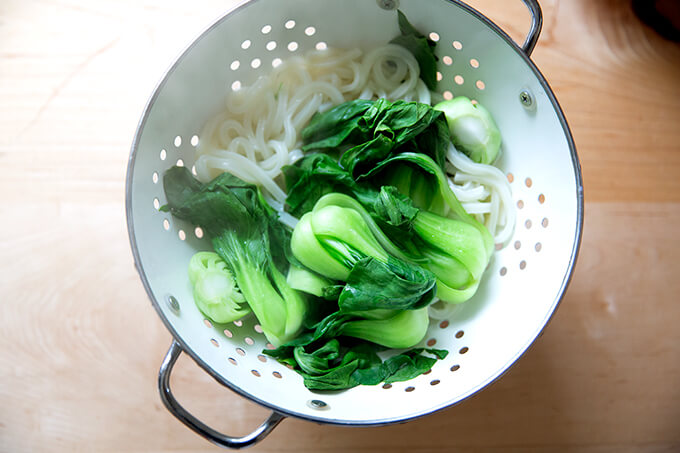
Transfer greens and noodles to a bowl; then pour the broth over top.
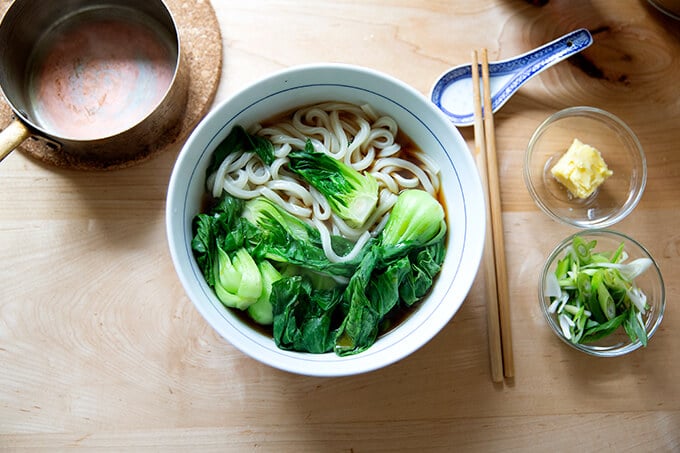
Add a knob of butter, a drizzle of sesame oil, and a handful of scallions.
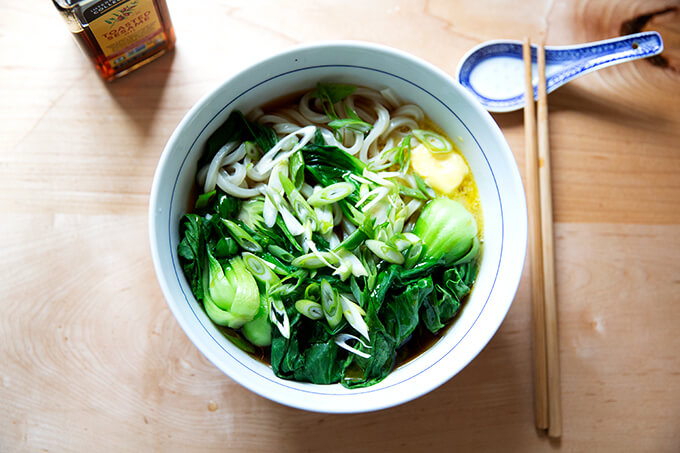
Top with soft-boiled eggs. Season with sea salt and lots of pepper.
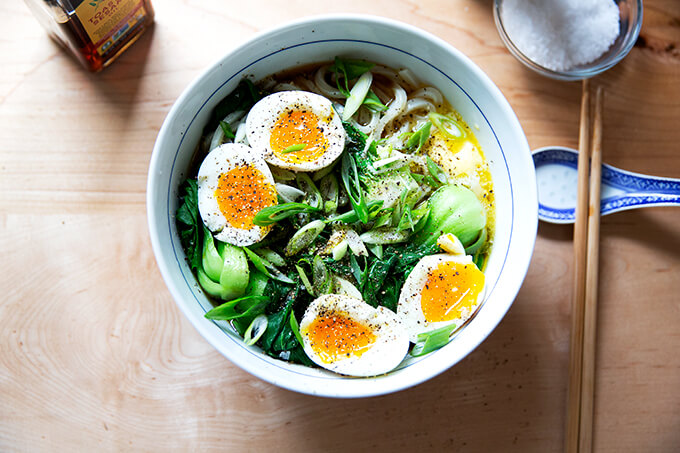
Add some chili paste if you wish.
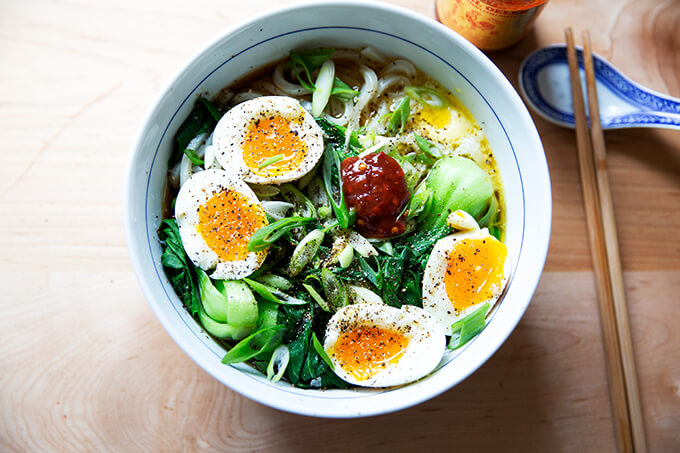
Enjoy!
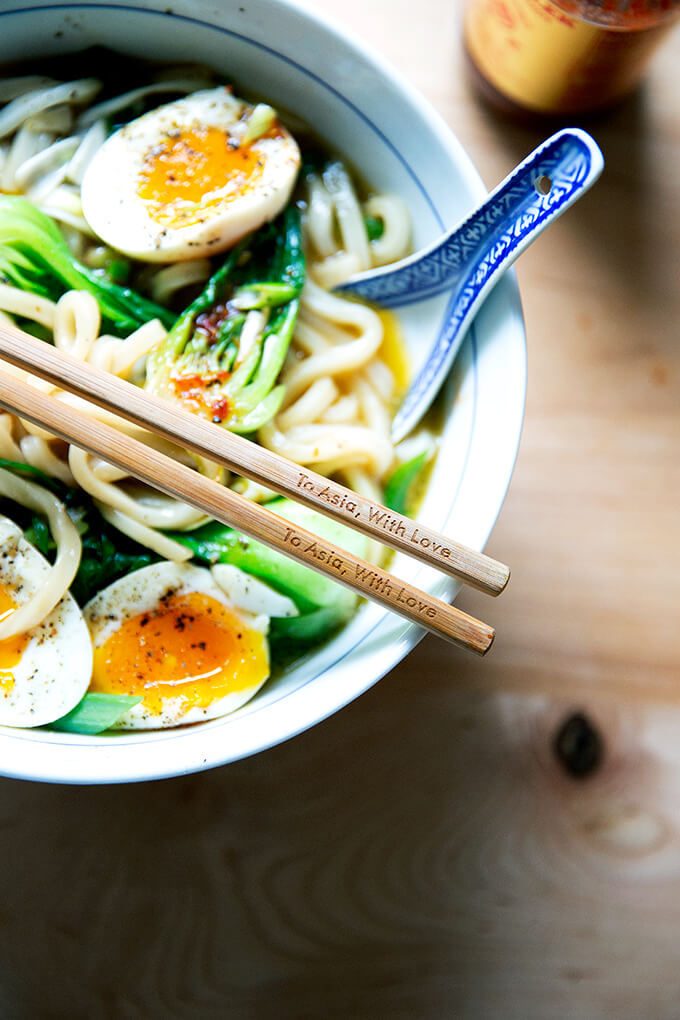
Such a good one! To Asia, With Love
This is the pad Thai salad from TAWL . Follow along on Instagram for the recipe tomorrow, April 7th.
Description
From Hetty McKinnon’s To Asia, With Love
Notes:
Every recipe in To Asia, With Love is vegetarian. Hetty’s note from the book: To veganise this recipe, omit the eggs and use vegan butter.
You may find you might want more of the broth (it’s so good), so just keep the ingredients handy — the veg stock , tamari or soy, and mirin. I often make a double batch of broth.
Scale the recipe as needed. I often make a half recipe, which is perfect for Ben and me. Note: In the video, I make a half recipe, but I do not halve the amount of soy sauce — I use 2 tablespoons instead of 1.5 tablespoons. One of you noted that this made for a salty broth, so please keep this in mind if halving the recipe. Start with 1.5 tablespoons and add more salt to taste.
4 large eggs
1.75 lbs. (800 g) udon noodles
1/4 to 1/2 lb. of greens such as baby bok choy, optional
2 cups ( 500 ml) vegetable stock
3 to 4 tablespoons tamari or soy sauce
2 teaspoons mirin
4 scallions, thinly sliced
80 g ( 6 tbsp ) butter, cubed, or to taste (I just add a nice knob, maybe a tablespoon, per bowl)
1 tablespoon sesame oil or to taste
sea salt and black pepper to taste
Sambal Oelek or other chili paste, optional
- Bring a small saucepan of water to a boil. Add the eggs and set the timer for 6 minutes. As soon as the buzzer goes, immediately drain the eggs into a colander and run under cold water (or transfer to an ice bath) until they are completely cold. (This will make very soft-boiled eggs – if you prefer a firmer yolk, cook them for another minute.) Peel and set aside.
- Cook the udon noodles (and greens if using) in a large saucepan of salted water according to the packet instructions until al dente. This should only take 1–3 minutes, depending on whether your noodles are fresh, vacuum-sealed, or frozen. Drain, then scoop the hot noodles (and greens) into four bowls (or two large bowls).
- Meanwhile, combine the stock, tamari or soy sauce, and mirin in a small saucepan and place over low heat until hot.
- Pour the hot broth over each bowl of noodles (and greens), and top with a soft-boiled egg. Add a knob of butter and allow it to melt into the noodles. Add the scallions and scatter a generous amount of black pepper over the noodles (use as much pepper as you like, but this dish is intended to be very peppery). Finish with a little drizzle of sesame oil and sprinkle with sea salt.
- If you like spicy, stir in a spoonful of Sambal Oelek or hot sauce of choice.
- Prep Time: 20 minutes
- Cook Time: 7 minutes
- Category: Soup
- Method: Stovetop
- Cuisine: Asian
If you are under the impression you need to spend hours toiling over a pot of bones to make a highly seasoned broth to then make a good bowl of noodles, you must make Hetty McKinnon’s “life-changing” udon noodles from her latest book To Asia, With Love .
The broth is made with three ingredients — vegetable stock, soy sauce, and mirin — and after it comes to a simmer, it’s done. The rest of the broth’s flavor comes from garnishes: a pat of butter, a drizzle of sesame oil, a sprinkling of scallions, a pinch of sea salt, and lots of freshly cracked black pepper. The yolks of soft-boiled eggs impart the broth with a richness, and if you like a bit of spice, a spoonful of Sambal Oeleck or chili paste of choice seasons it further.
I love adding a heap of baby bok choy or other greens to make it a meal. If you like this idea, too, simply add them to the pot of boiling udon noodles, which typically cook in 1-3 minutes — the frozen udon noodles I buy cook in 1 minute, which is all the time most greens need.
Every time I make this soup, I am astounded by how quickly it comes together and by how flavorful and nourishing it is. In the intro to the recipe, Hetty writes that the recipe was inspired by a dish served at Shin Udon in Tokyo, the flavors and textures of which were “life-changing.”
About To Asia With Love
- Something I love about To Asia, With Love are the anecdotes, such as the one mentioned above. Many of the stories in TAWL are rooted in travel and discovery, which I think we all are craving right now.
- Like all of Hetty’s previous three books, To Asia, With Love is beautiful: its design, its photography, its recipes. In Hetty’s newsletter last fall, when she first shared this recipe, she described this book as her “most personal to date,” noting that it is “full of everyday Asian recipes made with simple ingredients (many of which you will already have in your pantry) along with personal stories of growing up in a Chinese household in Sydney.”
- I want to make everything in TAWL , namely the “restaurant greens”, which is my favorite thing to order at Chinese restaurants. I recently made the TAWL pad Thai salad, which was absolutely delicious (photo below). I’ll be sharing that recipe on my Instagram stories tomorrow, so follow along on Instagram if you’d like to try that recipe. I’ll keep it highlighted in my stories.
- There are two ways I keep up with Hetty: her Instagram and her newsletter . She is wonderful.
PS: Hetty’s Sushi Salad (This recipe comes from Hetty’s last book, Family , and after discovering it, I made it on repeat for weeks. It’s one of my favorites.)
How to Make Life-Changing Noodles
First, get the broth going by combining vegetable stock , soy sauce or tamari, and mirin in a pot. Bring it to a simmer.
Meanwhile, halve small heads of baby bok choy or other greens of choice.
You’ll need udon noodles (or other) noodles for this soup. I can’t recommend buying frozen udon noodles enough. They cook in 1 minute, and couldn’t be more delicious.
What your stovetop will look like: 1 pot for the noodles and greens (if using), 1 pot for the eggs, and 1 pot for the broth.
Cook the eggs for 6 minutes (for very soft boiled eggs) or 7 minutes for less runny soft-boiled eggs. Transfer to an ice bath immediately.
Cook the noodles and greens for 1 to 3 minutes.
Drain.
Transfer greens and noodles to a bowl; then pour the broth over top.
Add a knob of butter, a drizzle of sesame oil, and a handful of scallions.
Top with soft-boiled eggs. Season with sea salt and lots of pepper.
Add some chili paste if you wish.
Enjoy!
Such a good one! To Asia, With Love
This is the pad Thai salad from TAWL . Follow along on Instagram for the recipe tomorrow, April 7th.
Description
From Hetty McKinnon’s To Asia, With Love
Notes:
Every recipe in To Asia, With Love is vegetarian. Hetty’s note from the book: To veganise this recipe, omit the eggs and use vegan butter.
You may find you might want more of the broth (it’s so good), so just keep the ingredients handy — the veg stock , tamari or soy, and mirin. I often make a double batch of broth.
Scale the recipe as needed. I often make a half recipe, which is perfect for Ben and me. Note: In the video, I make a half recipe, but I do not halve the amount of soy sauce — I use 2 tablespoons instead of 1.5 tablespoons. One of you noted that this made for a salty broth, so please keep this in mind if halving the recipe. Start with 1.5 tablespoons and add more salt to taste.
4 large eggs
1.75 lbs. (800 g) udon noodles
1/4 to 1/2 lb. of greens such as baby bok choy, optional
2 cups ( 500 ml) vegetable stock
3 to 4 tablespoons tamari or soy sauce
2 teaspoons mirin
4 scallions, thinly sliced
80 g ( 6 tbsp ) butter, cubed, or to taste (I just add a nice knob, maybe a tablespoon, per bowl)
1 tablespoon sesame oil or to taste
sea salt and black pepper to taste
Sambal Oelek or other chili paste, optional
- Bring a small saucepan of water to a boil. Add the eggs and set the timer for 6 minutes. As soon as the buzzer goes, immediately drain the eggs into a colander and run under cold water (or transfer to an ice bath) until they are completely cold. (This will make very soft-boiled eggs – if you prefer a firmer yolk, cook them for another minute.) Peel and set aside.
- Cook the udon noodles (and greens if using) in a large saucepan of salted water according to the packet instructions until al dente. This should only take 1–3 minutes, depending on whether your noodles are fresh, vacuum-sealed, or frozen. Drain, then scoop the hot noodles (and greens) into four bowls (or two large bowls).
- Meanwhile, combine the stock, tamari or soy sauce, and mirin in a small saucepan and place over low heat until hot.
- Pour the hot broth over each bowl of noodles (and greens), and top with a soft-boiled egg. Add a knob of butter and allow it to melt into the noodles. Add the scallions and scatter a generous amount of black pepper over the noodles (use as much pepper as you like, but this dish is intended to be very peppery). Finish with a little drizzle of sesame oil and sprinkle with sea salt.
- If you like spicy, stir in a spoonful of Sambal Oelek or hot sauce of choice.
- Prep Time: 20 minutes
- Cook Time: 7 minutes
- Category: Soup
- Method: Stovetop
- Cuisine: Asian
If you are under the impression you need to spend hours toiling over a pot of bones to make a highly seasoned broth to then make a good bowl of noodles, you must make Hetty McKinnon’s “life-changing” udon noodles from her latest book To Asia, With Love .
The broth is made with three ingredients — vegetable stock, soy sauce, and mirin — and after it comes to a simmer, it’s done. The rest of the broth’s flavor comes from garnishes: a pat of butter, a drizzle of sesame oil, a sprinkling of scallions, a pinch of sea salt, and lots of freshly cracked black pepper. The yolks of soft-boiled eggs impart the broth with a richness, and if you like a bit of spice, a spoonful of Sambal Oeleck or chili paste of choice seasons it further.
I love adding a heap of baby bok choy or other greens to make it a meal. If you like this idea, too, simply add them to the pot of boiling udon noodles, which typically cook in 1-3 minutes — the frozen udon noodles I buy cook in 1 minute, which is all the time most greens need.
Every time I make this soup, I am astounded by how quickly it comes together and by how flavorful and nourishing it is. In the intro to the recipe, Hetty writes that the recipe was inspired by a dish served at Shin Udon in Tokyo, the flavors and textures of which were “life-changing.”
About To Asia With Love
- Something I love about To Asia, With Love are the anecdotes, such as the one mentioned above. Many of the stories in TAWL are rooted in travel and discovery, which I think we all are craving right now.
- Like all of Hetty’s previous three books, To Asia, With Love is beautiful: its design, its photography, its recipes. In Hetty’s newsletter last fall, when she first shared this recipe, she described this book as her “most personal to date,” noting that it is “full of everyday Asian recipes made with simple ingredients (many of which you will already have in your pantry) along with personal stories of growing up in a Chinese household in Sydney.”
- I want to make everything in TAWL , namely the “restaurant greens”, which is my favorite thing to order at Chinese restaurants. I recently made the TAWL pad Thai salad, which was absolutely delicious (photo below). I’ll be sharing that recipe on my Instagram stories tomorrow, so follow along on Instagram if you’d like to try that recipe. I’ll keep it highlighted in my stories.
- There are two ways I keep up with Hetty: her Instagram and her newsletter . She is wonderful.
PS: Hetty’s Sushi Salad (This recipe comes from Hetty’s last book, Family , and after discovering it, I made it on repeat for weeks. It’s one of my favorites.)
How to Make Life-Changing Noodles
First, get the broth going by combining vegetable stock , soy sauce or tamari, and mirin in a pot. Bring it to a simmer.
Meanwhile, halve small heads of baby bok choy or other greens of choice.
You’ll need udon noodles (or other) noodles for this soup. I can’t recommend buying frozen udon noodles enough. They cook in 1 minute, and couldn’t be more delicious.
What your stovetop will look like: 1 pot for the noodles and greens (if using), 1 pot for the eggs, and 1 pot for the broth.
Cook the eggs for 6 minutes (for very soft boiled eggs) or 7 minutes for less runny soft-boiled eggs. Transfer to an ice bath immediately.
Cook the noodles and greens for 1 to 3 minutes.
Drain.
Transfer greens and noodles to a bowl; then pour the broth over top.
Add a knob of butter, a drizzle of sesame oil, and a handful of scallions.
Top with soft-boiled eggs. Season with sea salt and lots of pepper.
Add some chili paste if you wish.
Enjoy!
Such a good one! To Asia, With Love
This is the pad Thai salad from TAWL . Follow along on Instagram for the recipe tomorrow, April 7th.
Description
From Hetty McKinnon’s To Asia, With Love
Notes:
Every recipe in To Asia, With Love is vegetarian. Hetty’s note from the book: To veganise this recipe, omit the eggs and use vegan butter.
You may find you might want more of the broth (it’s so good), so just keep the ingredients handy — the veg stock , tamari or soy, and mirin. I often make a double batch of broth.
Scale the recipe as needed. I often make a half recipe, which is perfect for Ben and me. Note: In the video, I make a half recipe, but I do not halve the amount of soy sauce — I use 2 tablespoons instead of 1.5 tablespoons. One of you noted that this made for a salty broth, so please keep this in mind if halving the recipe. Start with 1.5 tablespoons and add more salt to taste.
4 large eggs
1.75 lbs. (800 g) udon noodles
1/4 to 1/2 lb. of greens such as baby bok choy, optional
2 cups ( 500 ml) vegetable stock
3 to 4 tablespoons tamari or soy sauce
2 teaspoons mirin
4 scallions, thinly sliced
80 g ( 6 tbsp ) butter, cubed, or to taste (I just add a nice knob, maybe a tablespoon, per bowl)
1 tablespoon sesame oil or to taste
sea salt and black pepper to taste
Sambal Oelek or other chili paste, optional
- Bring a small saucepan of water to a boil. Add the eggs and set the timer for 6 minutes. As soon as the buzzer goes, immediately drain the eggs into a colander and run under cold water (or transfer to an ice bath) until they are completely cold. (This will make very soft-boiled eggs – if you prefer a firmer yolk, cook them for another minute.) Peel and set aside.
- Cook the udon noodles (and greens if using) in a large saucepan of salted water according to the packet instructions until al dente. This should only take 1–3 minutes, depending on whether your noodles are fresh, vacuum-sealed, or frozen. Drain, then scoop the hot noodles (and greens) into four bowls (or two large bowls).
- Meanwhile, combine the stock, tamari or soy sauce, and mirin in a small saucepan and place over low heat until hot.
- Pour the hot broth over each bowl of noodles (and greens), and top with a soft-boiled egg. Add a knob of butter and allow it to melt into the noodles. Add the scallions and scatter a generous amount of black pepper over the noodles (use as much pepper as you like, but this dish is intended to be very peppery). Finish with a little drizzle of sesame oil and sprinkle with sea salt.
- If you like spicy, stir in a spoonful of Sambal Oelek or hot sauce of choice.
- Prep Time: 20 minutes
- Cook Time: 7 minutes
- Category: Soup
- Method: Stovetop
- Cuisine: Asian
If you are under the impression you need to spend hours toiling over a pot of bones to make a highly seasoned broth to then make a good bowl of noodles, you must make Hetty McKinnon’s “life-changing” udon noodles from her latest book To Asia, With Love .
The broth is made with three ingredients — vegetable stock, soy sauce, and mirin — and after it comes to a simmer, it’s done. The rest of the broth’s flavor comes from garnishes: a pat of butter, a drizzle of sesame oil, a sprinkling of scallions, a pinch of sea salt, and lots of freshly cracked black pepper. The yolks of soft-boiled eggs impart the broth with a richness, and if you like a bit of spice, a spoonful of Sambal Oeleck or chili paste of choice seasons it further.
I love adding a heap of baby bok choy or other greens to make it a meal. If you like this idea, too, simply add them to the pot of boiling udon noodles, which typically cook in 1-3 minutes — the frozen udon noodles I buy cook in 1 minute, which is all the time most greens need.
Every time I make this soup, I am astounded by how quickly it comes together and by how flavorful and nourishing it is. In the intro to the recipe, Hetty writes that the recipe was inspired by a dish served at Shin Udon in Tokyo, the flavors and textures of which were “life-changing.”
About To Asia With Love
- Something I love about To Asia, With Love are the anecdotes, such as the one mentioned above. Many of the stories in TAWL are rooted in travel and discovery, which I think we all are craving right now.
- Like all of Hetty’s previous three books, To Asia, With Love is beautiful: its design, its photography, its recipes. In Hetty’s newsletter last fall, when she first shared this recipe, she described this book as her “most personal to date,” noting that it is “full of everyday Asian recipes made with simple ingredients (many of which you will already have in your pantry) along with personal stories of growing up in a Chinese household in Sydney.”
- I want to make everything in TAWL , namely the “restaurant greens”, which is my favorite thing to order at Chinese restaurants. I recently made the TAWL pad Thai salad, which was absolutely delicious (photo below). I’ll be sharing that recipe on my Instagram stories tomorrow, so follow along on Instagram if you’d like to try that recipe. I’ll keep it highlighted in my stories.
- There are two ways I keep up with Hetty: her Instagram and her newsletter . She is wonderful.
PS: Hetty’s Sushi Salad (This recipe comes from Hetty’s last book, Family , and after discovering it, I made it on repeat for weeks. It’s one of my favorites.)
How to Make Life-Changing Noodles
First, get the broth going by combining vegetable stock , soy sauce or tamari, and mirin in a pot. Bring it to a simmer.
Meanwhile, halve small heads of baby bok choy or other greens of choice.
You’ll need udon noodles (or other) noodles for this soup. I can’t recommend buying frozen udon noodles enough. They cook in 1 minute, and couldn’t be more delicious.
What your stovetop will look like: 1 pot for the noodles and greens (if using), 1 pot for the eggs, and 1 pot for the broth.
Cook the eggs for 6 minutes (for very soft boiled eggs) or 7 minutes for less runny soft-boiled eggs. Transfer to an ice bath immediately.
Cook the noodles and greens for 1 to 3 minutes.
Drain.
Transfer greens and noodles to a bowl; then pour the broth over top.
Add a knob of butter, a drizzle of sesame oil, and a handful of scallions.
Top with soft-boiled eggs. Season with sea salt and lots of pepper.
Add some chili paste if you wish.
Enjoy!
Such a good one! To Asia, With Love
This is the pad Thai salad from TAWL . Follow along on Instagram for the recipe tomorrow, April 7th.
Description
From Hetty McKinnon’s To Asia, With Love
Notes:
Every recipe in To Asia, With Love is vegetarian. Hetty’s note from the book: To veganise this recipe, omit the eggs and use vegan butter.
You may find you might want more of the broth (it’s so good), so just keep the ingredients handy — the veg stock , tamari or soy, and mirin. I often make a double batch of broth.
Scale the recipe as needed. I often make a half recipe, which is perfect for Ben and me. Note: In the video, I make a half recipe, but I do not halve the amount of soy sauce — I use 2 tablespoons instead of 1.5 tablespoons. One of you noted that this made for a salty broth, so please keep this in mind if halving the recipe. Start with 1.5 tablespoons and add more salt to taste.
4 large eggs
1.75 lbs. (800 g) udon noodles
1/4 to 1/2 lb. of greens such as baby bok choy, optional
2 cups ( 500 ml) vegetable stock
3 to 4 tablespoons tamari or soy sauce
2 teaspoons mirin
4 scallions, thinly sliced
80 g ( 6 tbsp ) butter, cubed, or to taste (I just add a nice knob, maybe a tablespoon, per bowl)
1 tablespoon sesame oil or to taste
sea salt and black pepper to taste
Sambal Oelek or other chili paste, optional
- Bring a small saucepan of water to a boil. Add the eggs and set the timer for 6 minutes. As soon as the buzzer goes, immediately drain the eggs into a colander and run under cold water (or transfer to an ice bath) until they are completely cold. (This will make very soft-boiled eggs – if you prefer a firmer yolk, cook them for another minute.) Peel and set aside.
- Cook the udon noodles (and greens if using) in a large saucepan of salted water according to the packet instructions until al dente. This should only take 1–3 minutes, depending on whether your noodles are fresh, vacuum-sealed, or frozen. Drain, then scoop the hot noodles (and greens) into four bowls (or two large bowls).
- Meanwhile, combine the stock, tamari or soy sauce, and mirin in a small saucepan and place over low heat until hot.
- Pour the hot broth over each bowl of noodles (and greens), and top with a soft-boiled egg. Add a knob of butter and allow it to melt into the noodles. Add the scallions and scatter a generous amount of black pepper over the noodles (use as much pepper as you like, but this dish is intended to be very peppery). Finish with a little drizzle of sesame oil and sprinkle with sea salt.
- If you like spicy, stir in a spoonful of Sambal Oelek or hot sauce of choice.
- Prep Time: 20 minutes
- Cook Time: 7 minutes
- Category: Soup
- Method: Stovetop
- Cuisine: Asian
Description
From Hetty McKinnon’s To Asia, With Love
Notes:
Every recipe in To Asia, With Love is vegetarian. Hetty’s note from the book: To veganise this recipe, omit the eggs and use vegan butter.
You may find you might want more of the broth (it’s so good), so just keep the ingredients handy — the veg stock , tamari or soy, and mirin. I often make a double batch of broth.
Scale the recipe as needed. I often make a half recipe, which is perfect for Ben and me. Note: In the video, I make a half recipe, but I do not halve the amount of soy sauce — I use 2 tablespoons instead of 1.5 tablespoons. One of you noted that this made for a salty broth, so please keep this in mind if halving the recipe. Start with 1.5 tablespoons and add more salt to taste.
4 large eggs
1.75 lbs. (800 g) udon noodles
1/4 to 1/2 lb. of greens such as baby bok choy, optional
2 cups ( 500 ml) vegetable stock
3 to 4 tablespoons tamari or soy sauce
2 teaspoons mirin
4 scallions, thinly sliced
80 g ( 6 tbsp ) butter, cubed, or to taste (I just add a nice knob, maybe a tablespoon, per bowl)
1 tablespoon sesame oil or to taste
sea salt and black pepper to taste
Sambal Oelek or other chili paste, optional
- Bring a small saucepan of water to a boil. Add the eggs and set the timer for 6 minutes. As soon as the buzzer goes, immediately drain the eggs into a colander and run under cold water (or transfer to an ice bath) until they are completely cold. (This will make very soft-boiled eggs – if you prefer a firmer yolk, cook them for another minute.) Peel and set aside.
- Cook the udon noodles (and greens if using) in a large saucepan of salted water according to the packet instructions until al dente. This should only take 1–3 minutes, depending on whether your noodles are fresh, vacuum-sealed, or frozen. Drain, then scoop the hot noodles (and greens) into four bowls (or two large bowls).
- Meanwhile, combine the stock, tamari or soy sauce, and mirin in a small saucepan and place over low heat until hot.
- Pour the hot broth over each bowl of noodles (and greens), and top with a soft-boiled egg. Add a knob of butter and allow it to melt into the noodles. Add the scallions and scatter a generous amount of black pepper over the noodles (use as much pepper as you like, but this dish is intended to be very peppery). Finish with a little drizzle of sesame oil and sprinkle with sea salt.
- If you like spicy, stir in a spoonful of Sambal Oelek or hot sauce of choice.
- Prep Time: 20 minutes
- Cook Time: 7 minutes
- Category: Soup
- Method: Stovetop
- Cuisine: Asian
Find it online : https://alexandracooks.com/2021/04/06/life-changing-udon-noodles/
Made with four ingredients, this sourdough ciabatta has a crisp crust, a beautiful honeycomb crumb, and a lovely lightness and chew. The process is truly simple, and the ciabatta is so tasty, perfect for sandwiches of all kinds, for dunking into soup, or transforming into bruschetta.
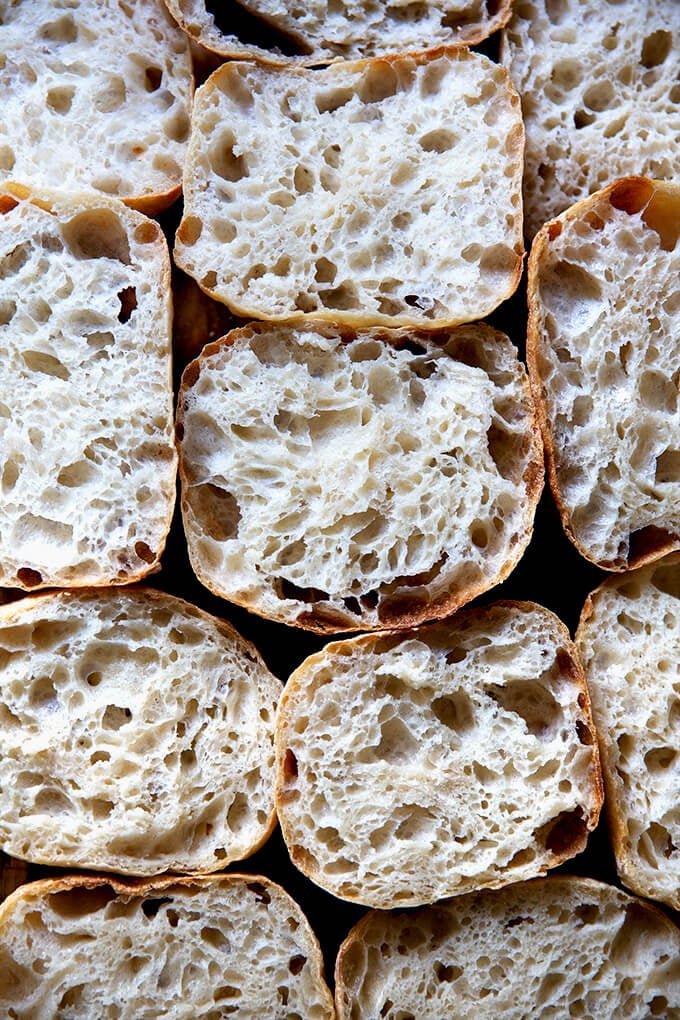
Originating from the Lake Como region of northern Italy, ciabatta means “slipper” in Italian. Traditional ciabatta is characterized by its slipper shape and extremely porous, light texture, created with a biga (a preferment), a high-hydration dough, and a long, slow rise.
A biga is made with a small amount of yeast, flour, and water. In this recipe, I’ve replaced the biga with a sourdough starter, but kept the remaining elements the same: the high-hydration dough is made with four ingredients and requires a long, slow rise, which produces a crisp crust, a beautiful honeycomb crumb, and a lovely lightness and chew. This ciabatta is perfect for sandwiches.
Best of all: the process is truly simple. The dough does not require an autolyse, a preheated Dutch oven, or a baking stone. If you have a sheet pan, you’re good to go. What’s more, there’s no shaping, scoring, or balling up dough. After the bulk fermentation, you turn the dough out onto a floured work surface, pat it into a rectangle, and divide it into 8 pieces. You then transfer those pieces, irregularly shaped and all, to a sheet pan, and bake them one hour later.
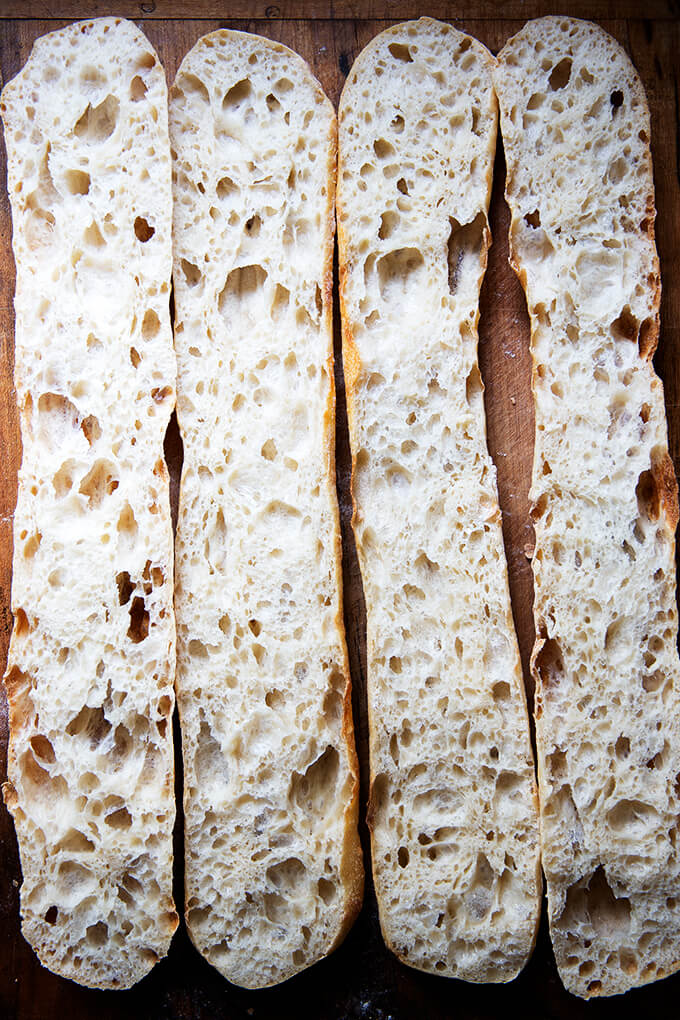
Can I tell you the most exciting part? This dough makes an excellent baguette! Unscored and flour-dusted, it has a crumb and flavor better than any other I’ve attempted previously. See photos below.
PS: If sourdough isn’t your thing, please try this yeast-leavened ciabatta bread recipe .
How to Make Sourdough Ciabatta, Step by Step
Gather your ingredients: bread flour, water, salt, and a sourdough starter . I am a proponent of buying a starter (see recipe box for sources), but if you are up for it, you can build a starter from scratch in just about 1 week .
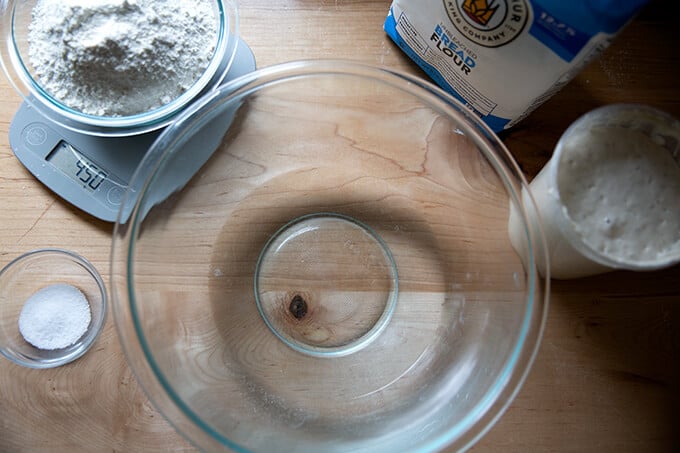
For this recipe, you’ll need: 100 grams sourdough starter, 360 grams water, 450 grams flour, and 12 grams salt. It’s 80% hydration.
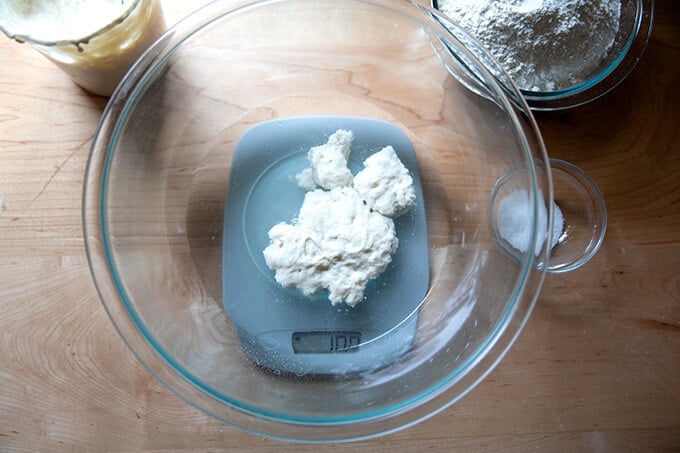
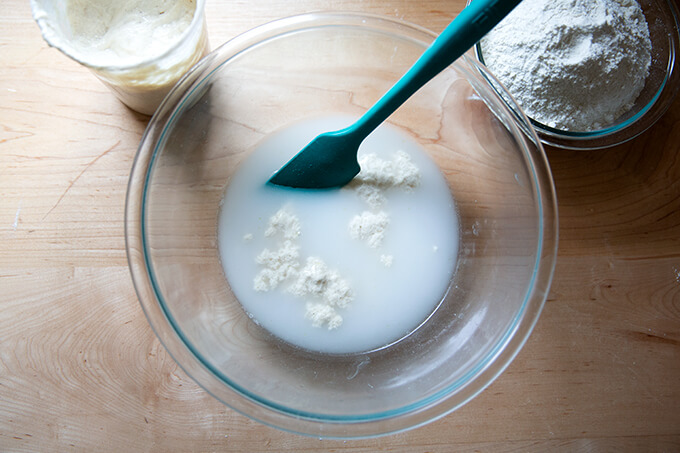
Mix together the water, sourdough starter, and salt.
Add the flour and mix to form a sticky dough ball.
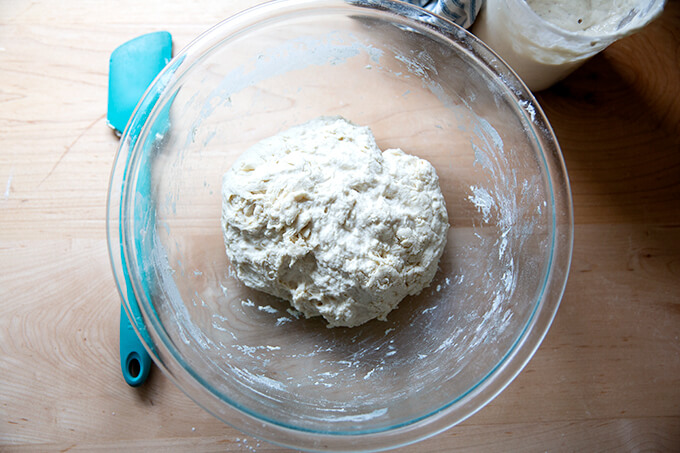
Cover the bowl and let rest for 30 minutes. Then perform a set of stretches and folds. See the video above or in the recipe box for guidance. This is what the dough will look like after one set of stretches and folds.
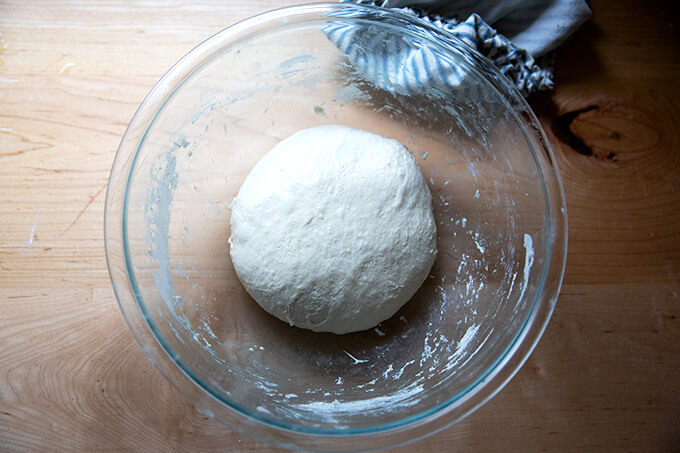
This is what the dough will look like after 4 sets of stretches and folds.
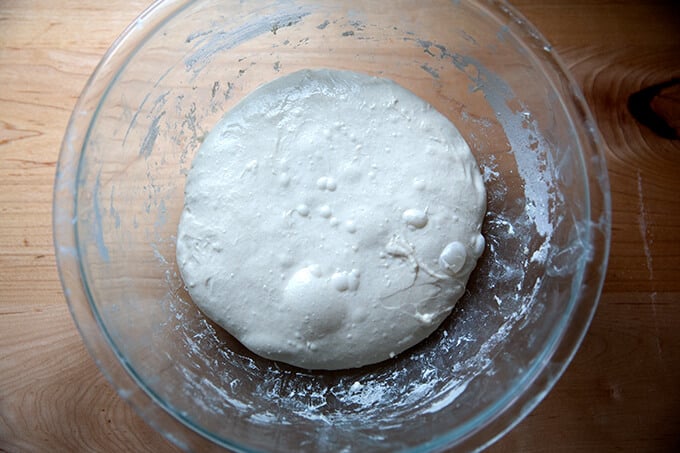
Transfer dough to a straight-sided vessel (this one is 8 cups, but anything similarly sized will do) for the bulk fermentation (the first rise):
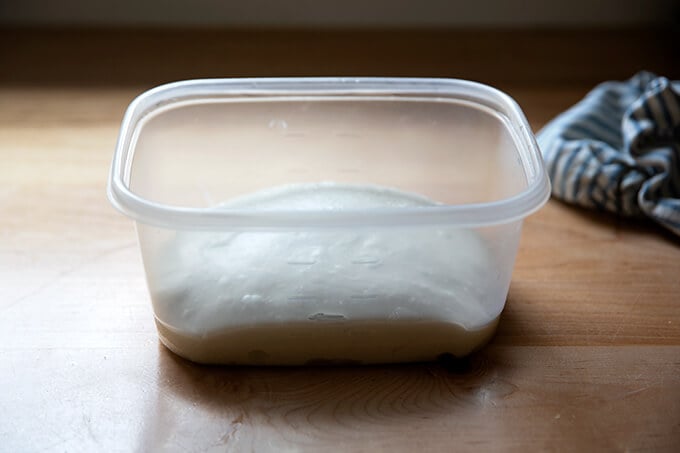
Mark the height of the dough on the vessel, cover the vessel, and let the dough rise until it increases in volume by roughly 75%.
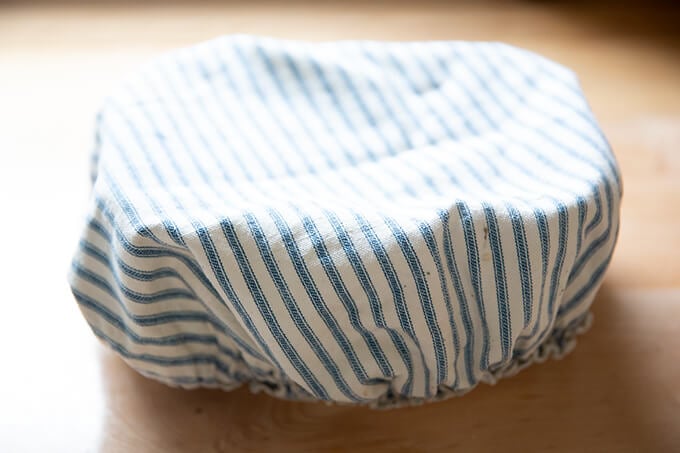
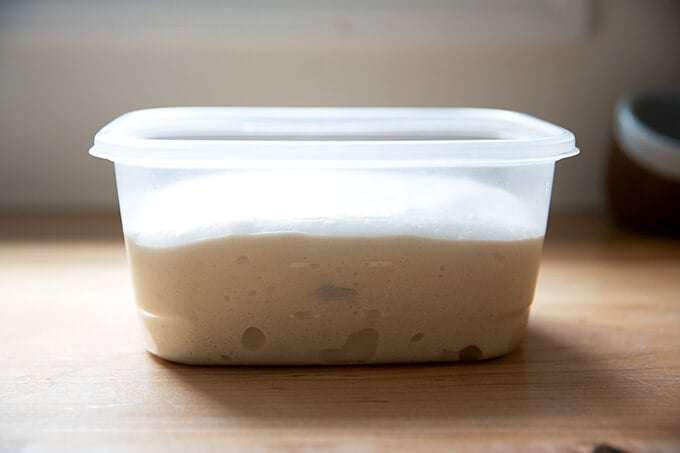
When the dough has increased by 75% (roughly), place a lid on the vessel, and transfer it to the fridge for 12-24 hours.
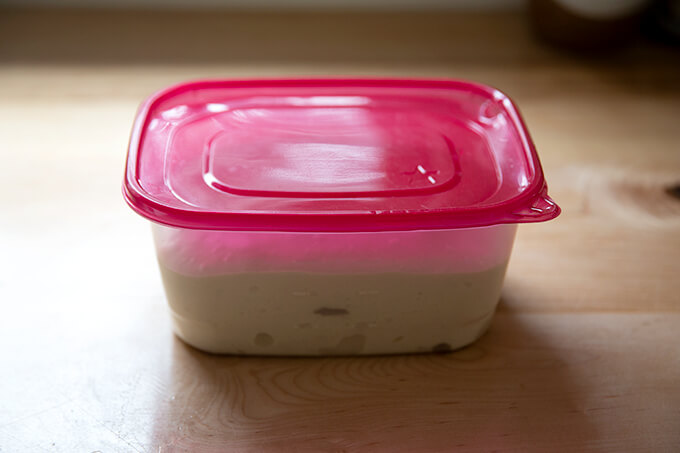
When ready to bake, remove the vessel from the fridge.
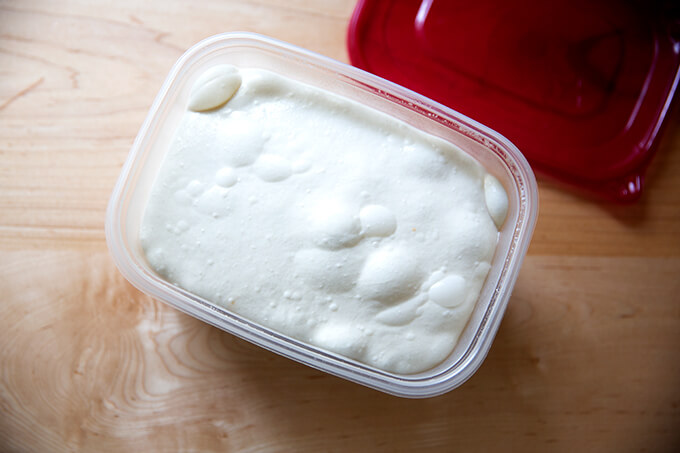
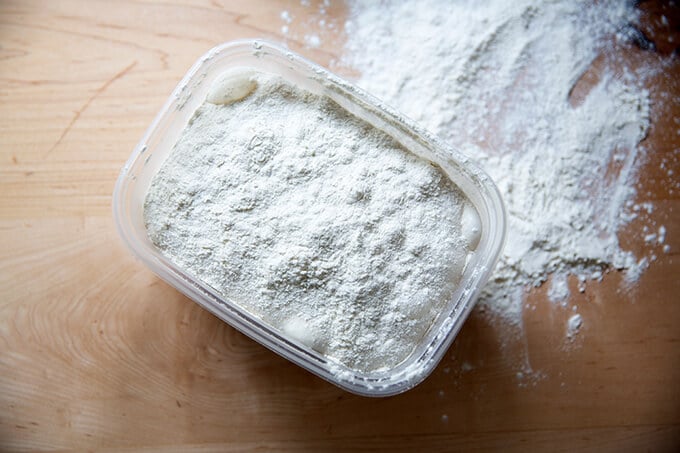
Dust the top of the dough liberally with flour. Dust a work surface liberally with flour, too.
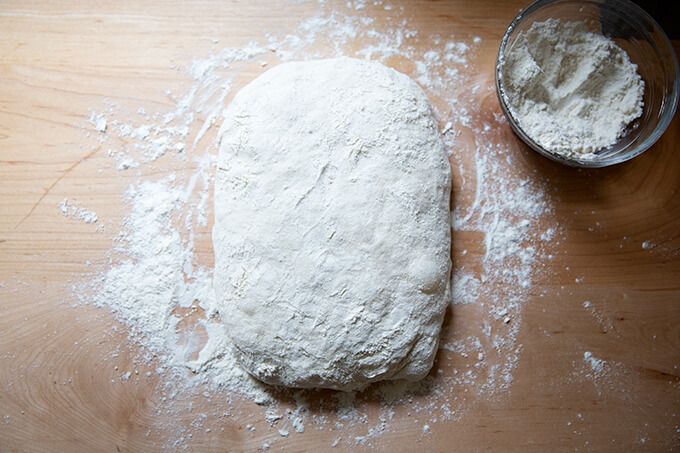
Turn the dough out onto the prepared work surface.
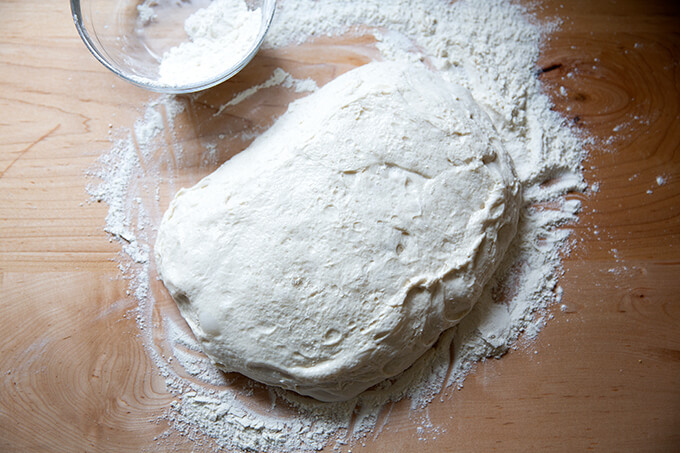
Pat the dough into a rectangle.
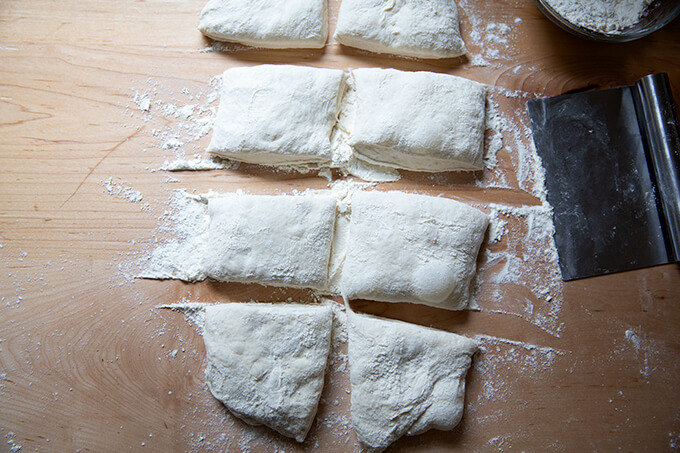
Cut the rectangle into 8 roughly equal portions.
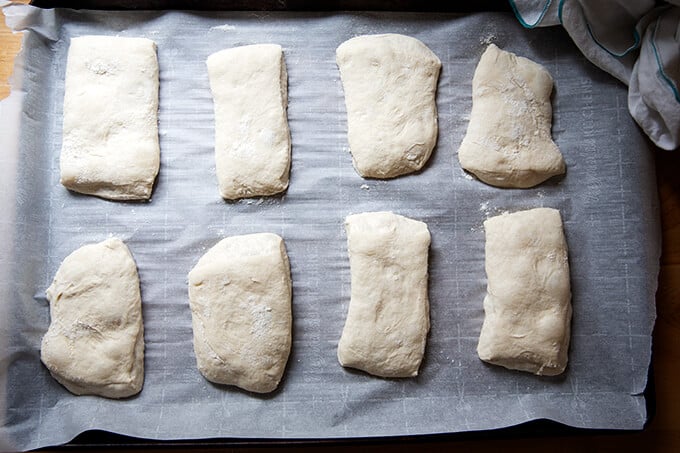
Transfer the portions to a parchment-lined sheet pan. Let rest for 1 hour. Then transfer to a 475ºF oven for 10 minutes. Lower the heat to 450ºF and bake for 10 minutes more.
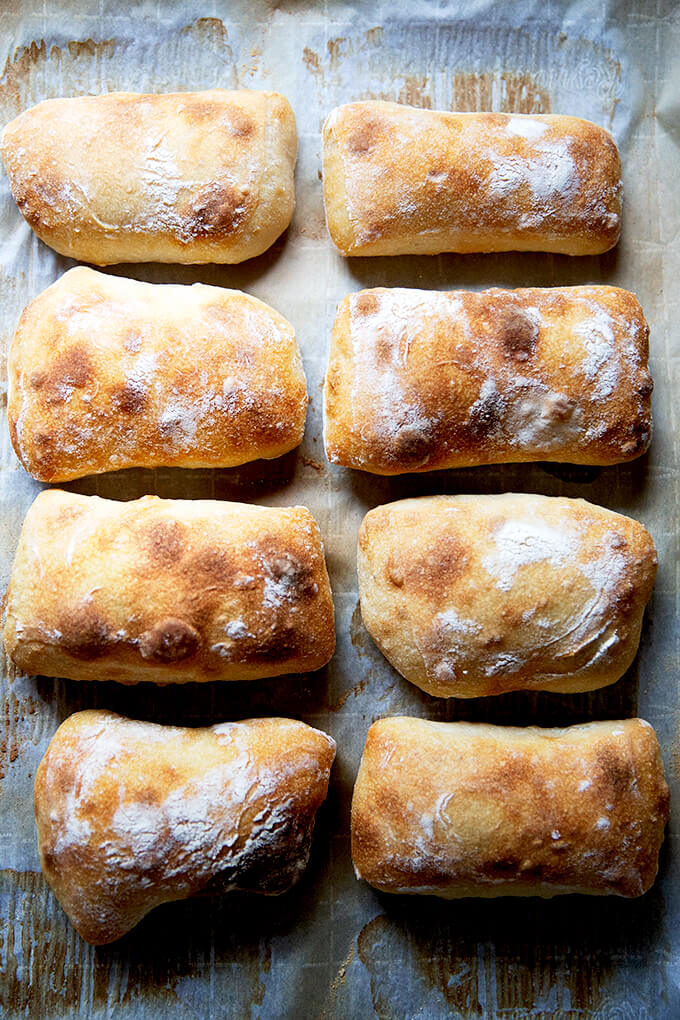
Transfer the rolls immediately to a cooling rack, and let cool for at least 20 minutes before cutting.

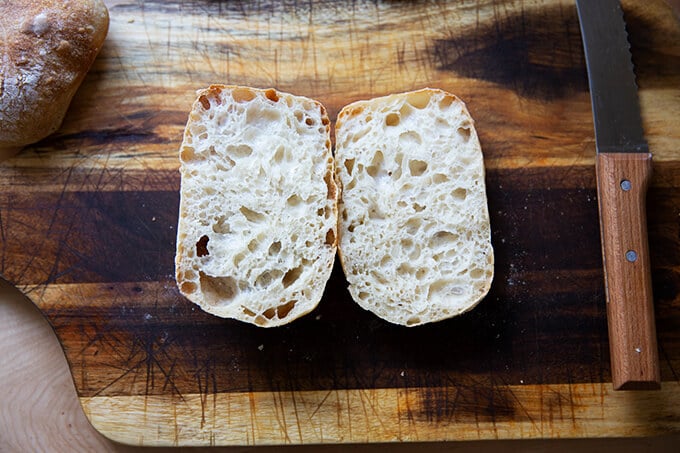
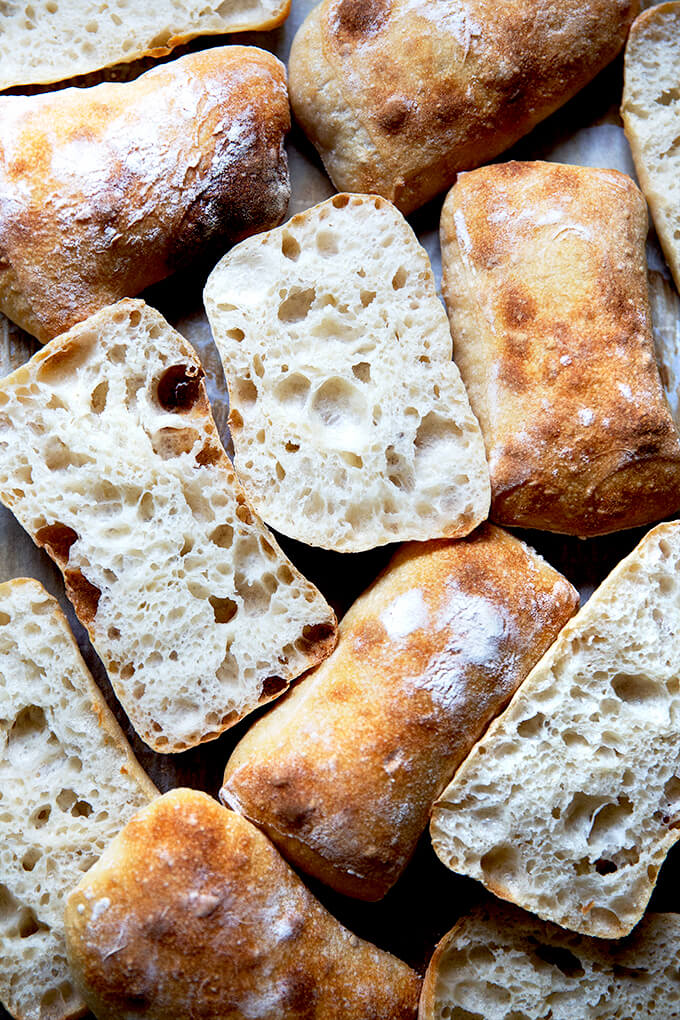
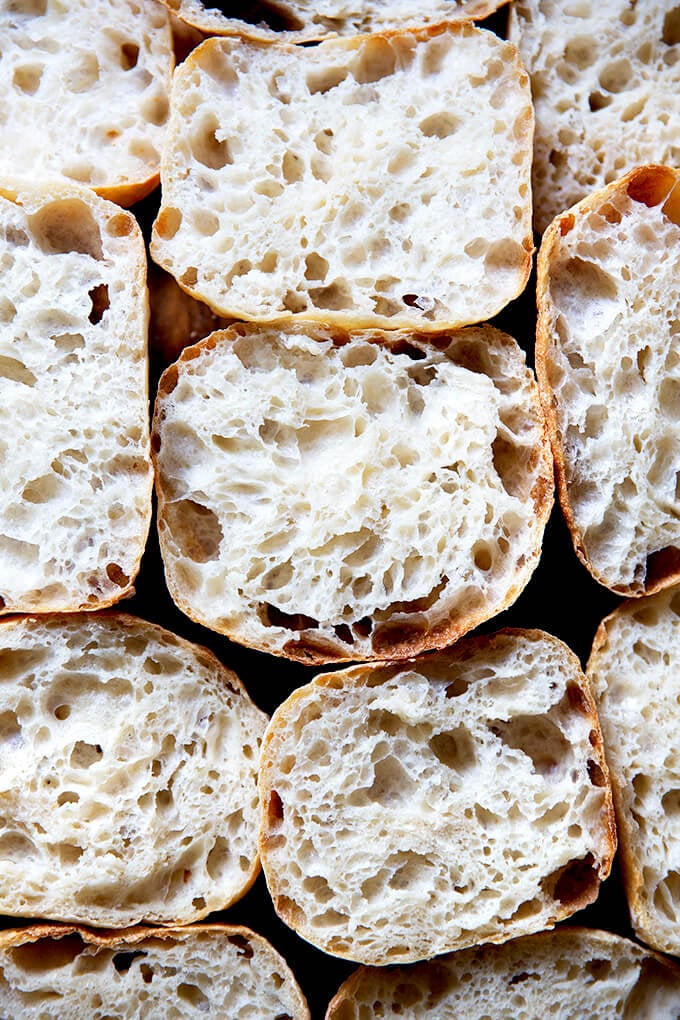
How pretty is that crumb?
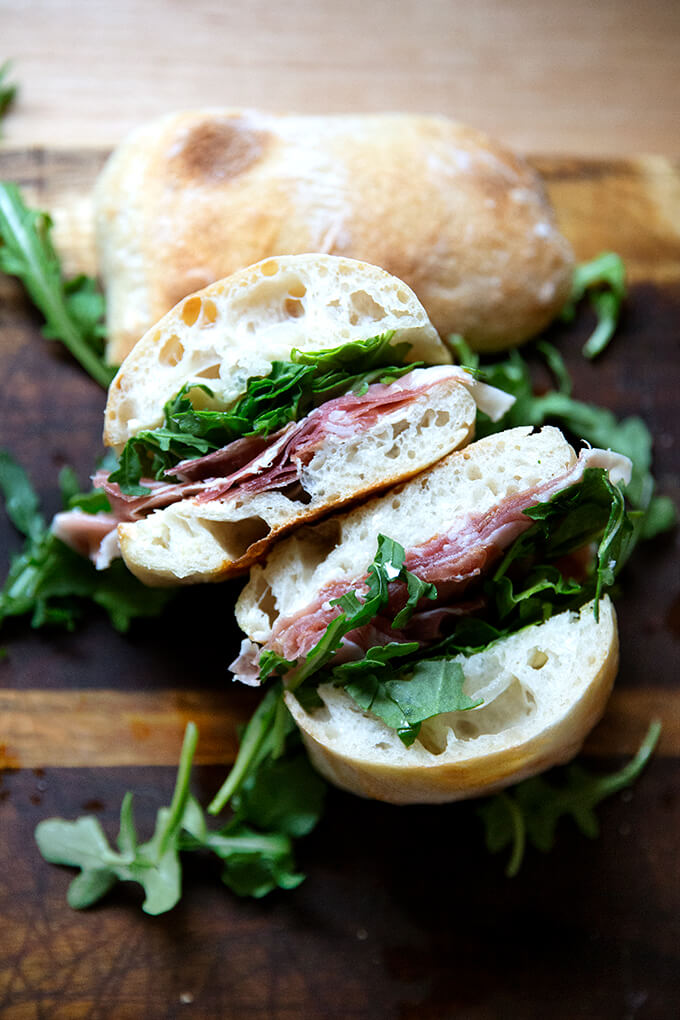
Ciabatta sandwich: This recipe is inspired by Gabrielle Hamilton’s Blood, Bones, and Butter . In short, the success of the sandwich relies on a delicate balance: “the perfection of three fats together — butter, olive oil, and the white fat from prosciutto or lardo.” To make it, spread good bread with “cool waxy butter,” top with prosciutto (more than you think), and arugula. Drizzle it all with good olive oil.
Sourdough Ciabatta “Baguettes” 🥖🥖🥖
To make baguettes, follow the same process, but instead of dividing the rectangle of dough into 8 portions, divide it into two. I find an extra-large sheet pan to be necessary to bake both baguettes at the same time. If you don’t have an extra-large sheet pan, I would bake one baguette at a time, and orient it at a diagonal angle from one corner to another.
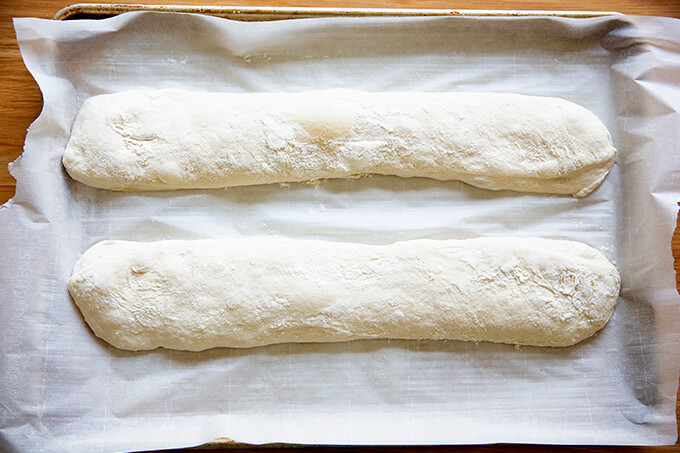
Bake the baguettes at the same temperature and for the same amount of time as the rolls.

Not bad for the effort, right?
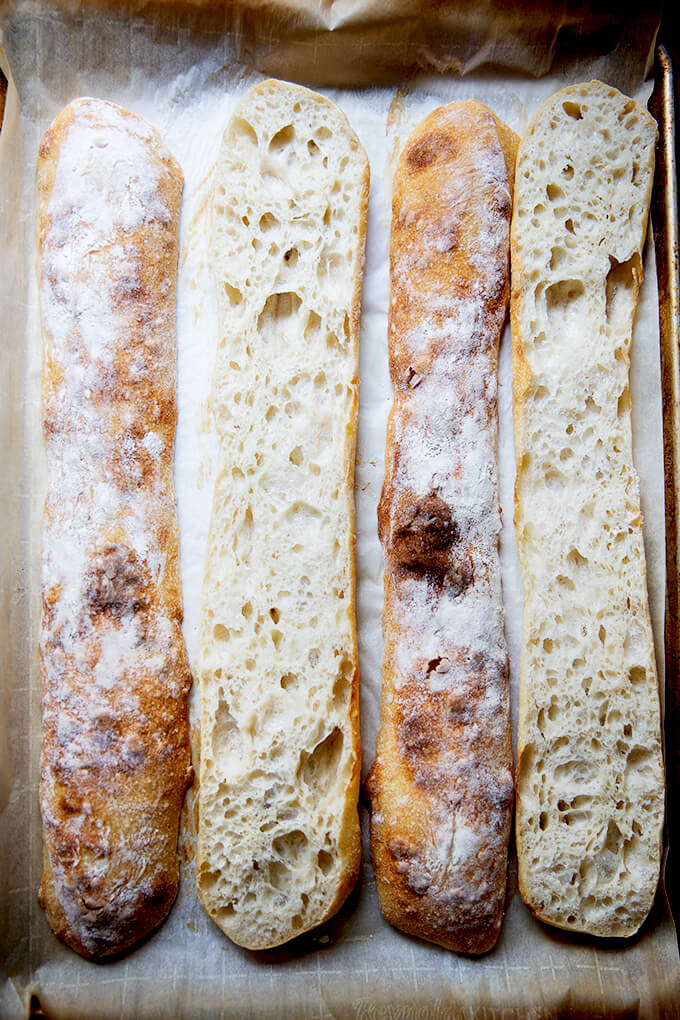
These ciabatta “baguettes” would be great vessels for giant sandwiches.
Description
Made with four ingredients, this sourdough ciabatta has a crisp crust, a beautiful honeycomb crumb, and a lovely lightness and chew. The process is truly simple, and the ciabatta is so tasty, perfect for sandwiches of all kinds, for dunking into soup, or transforming into bruschetta.
Notes:
- You need an active sourdough starter. You can build a starter from scratch in just about 1 week . But I am a huge proponent of buying a starter. Here are two sources: King Arthur Flour Breadtopia
- As always, I highly recommend investing in a digital scale before beginning any bread baking adventure.
Flour: I have had success using all-purpose flour, but if you can get your hands on bread flour, that is ideal, especially if you live in Canada or abroad. Moreover, if you live in Canada or abroad, you may need to reduce the water amount. Consider holding back some of the water during the mixing process to ensure you don’t end up with a soupy mess.
Straight-Sided Vessel:
The vessel I use in this recipe, similar to this one , is 8 cups. Most grocery stores carry storage vessels similarly sized.
Using a straight-sided vessel for the bulk fermentation will help prevent over-fermentation because it allows you to see when the dough has truly increased by 75% (or slightly more or less) in volume.
360 grams (about 1.5 cups ) water
12 grams (about 2 teaspoons ) salt
100 grams (about 1/2 cup ) active sourdough starter, see notes above
450 grams (about 3.5 cups ) bread flour, see notes above
- Mix the dough: Place the water in a large bowl. Add the salt and stir briefly. Add the starter and stir briefly to incorporate. Add the flour, and stir until you have a wet, sticky dough ball. Knead briefly with your hands if necessary to incorporate the flour. Cover with a tea towel or cloth bowl cover and let sit for 30 minutes.
- Stretches and folds : With wet hands, grab one side of the dough, and pull up and to the center. Rotate the bowl a quarter turn, and repeat the grabbing and pulling. Do this until you’ve made a full circle. (Watch the video for more guidance. I do a few more pulls and turns in the video.) Cover the bowl. Repeat this process three more times at 30-minute intervals for a total of 4 sets of stretches and folds over the course of two hours. (In the video, I switch to coil folds for the last two sets of stretches and folds.)
- Bulk fermentation: Transfer the dough to a straight-sided vessel. Cover the vessel with a towel. Let rise at room temperature until the dough nearly doubles in volume (shoot for a 75% increase in volume). Times will vary depending on your environment and the strength of your starter. Recently, this has taken about 4 hours for me, but don’t worry if it takes longer for you. Cover vessel with a lid (ideally) or a towel (if you are using a towel, slick the top of the dough with oil to prevent it from drying out.) Transfer to fridge for 12-24 hours.
- Shape: Remove vessel from fridge. Remove lid. Sprinkle top of dough liberally with flour. Turn dough out onto a floured work surface. Pat dough into a rectangle. Sprinkle top with flour. Use a bench scraper to cut the dough in half vertically. Then make three cuts equally spaced in each half to create 8 small rectangles.
- Line a sheet pan with parchment paper. With floured hands, transfer each rectangle to the prepared pan, gently pulling outward. Cover the pan with a towel. Let stand for one hour.
- Bake: Heat oven to 475ºF. Transfer pan to oven and bake for 10 minutes. Lower heat to 450ºF, rotate pan, and bake for 10 minutes more. Remove pan from oven. Transfer ciabatta rolls to a cooling rack. Let cool for 20 to 30 minutes before slicing.
- Prep Time: 24 hours
- Cook Time: 20 minutes
- Category: Bread
- Method: Oven
- Cuisine: American, Italian
