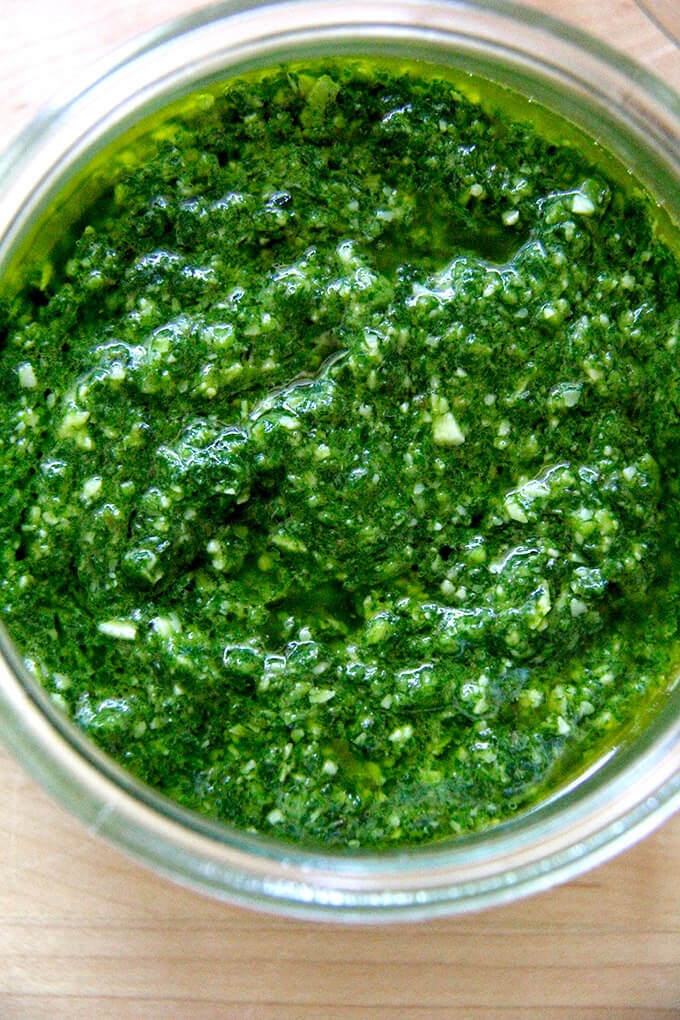
I’ve been trying to get this post out for weeks and almost, in fact, didn’t publish it because I feared at this point in the summer it might be irrelevant, but a trip to the Schenectady Greenmarket this past Sunday quelled my worries. Basil—in large bunches—is still readily available and affordable. And perhaps your backyard basil bushes are flourishing, too? (Mine are dead.)
Three weeks in a row (several weeks ago now), an enormous bunch (or two!) of basil arrived in our CSA. Initially I used the basil as needed, but the bounty eventually caught up with me, so I made a very large batch of basil pesto, and for the first time ever, I froze it in individual blocks using my ice cube tray. This is probably something you all have been doing for years, and I absolutely should have been, too, but alas I have not. Note: Historically my freezer is the place where things go to die.
There is a recipe below for a straight-up, large-batch basil pesto with notes for making a small batch as well as for adapting the recipe to whatever herbs and nuts you have on hand. I hope it might be handy should you find yourself with an overload of herbs.
Hope your summer is going well, Friends. I feel a bit in the weeds in regard to the blog, but I suppose this is a good thing? I’ve been spending my days with the kids at the town pool or park or with my in-laws or parents, and for the first time, I’ve actually been really enjoying* it. Hope you all are so well.
*I did, however, just sign the kids up for a week of full-day soccer camp because this “fun mom” is running out of steam.
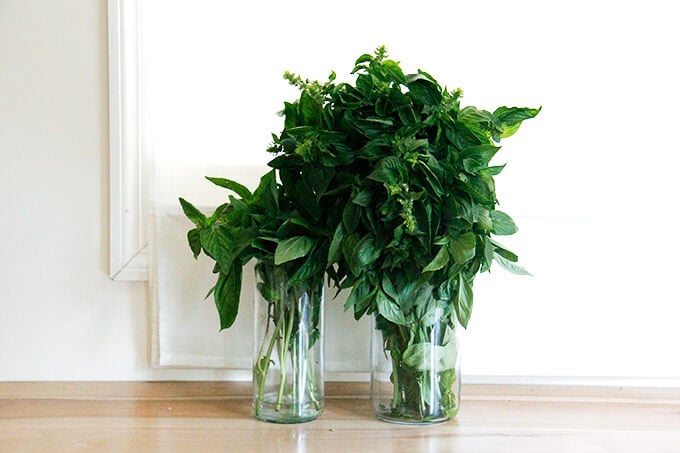
Reminder: Store basil out of the fridge in a tall glass with a little bit of water. Here’s a how-to-make-pesto play-by-play:
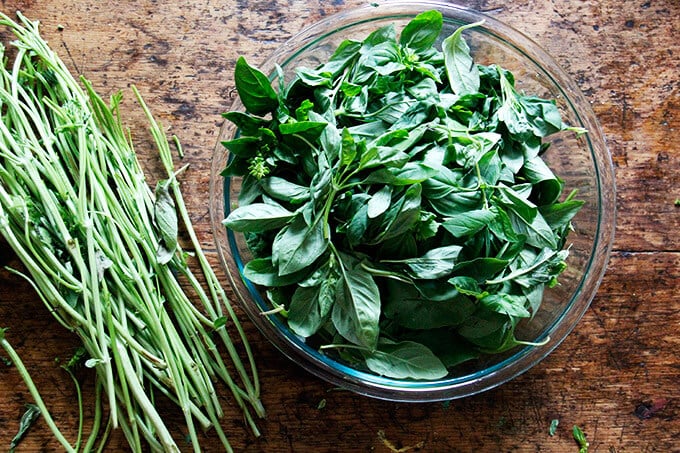
Remove tough stems; tender ones are OK:
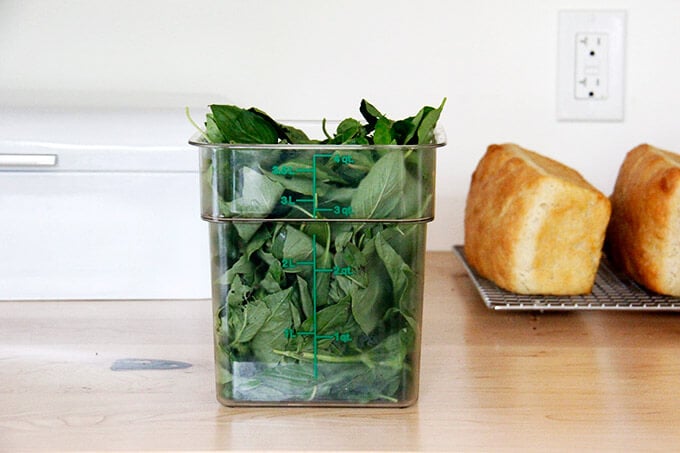
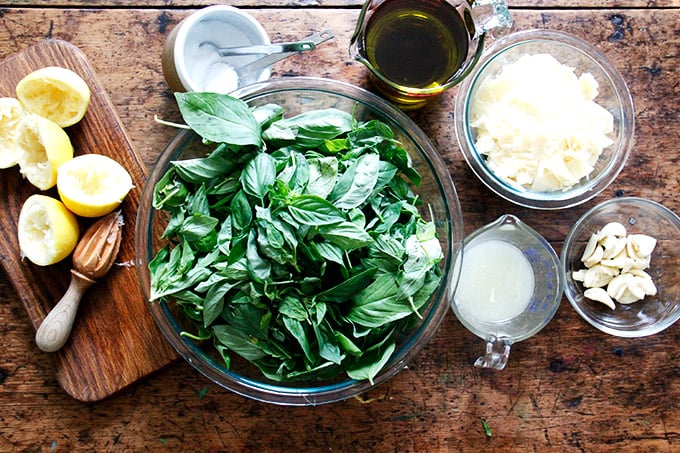
Gather your ingredients. I have not been using nuts, but absolutely use nuts if you wish.
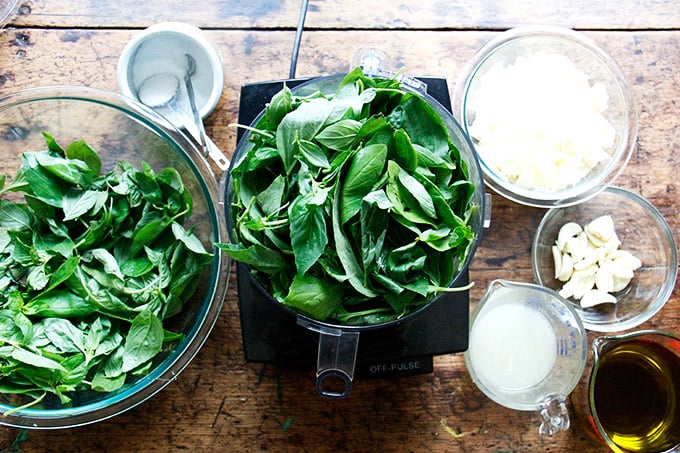
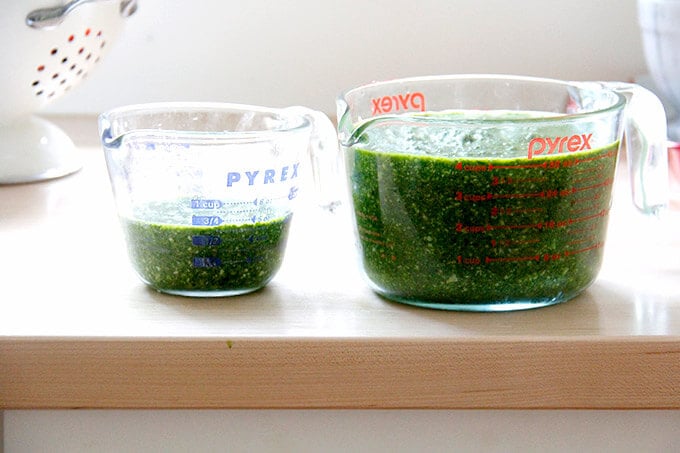
If you are making a large batch, you’ll likely have to process the pesto in batches.
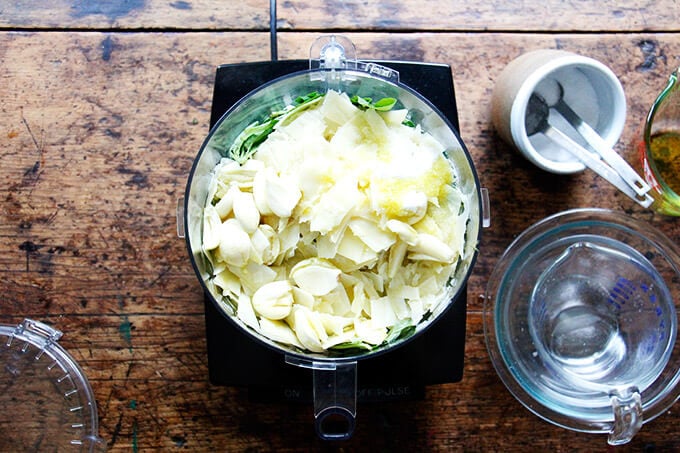
Add herbs, cheese, garlic, nuts, etc. into food processor:
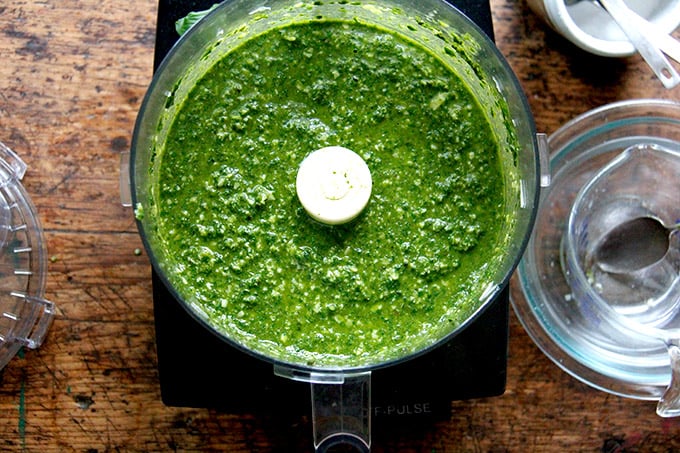
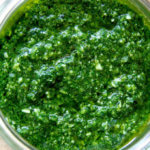
Purée until everything is combined. Taste, and adjust seasoning as desired with more salt, lemon, oil, etc:
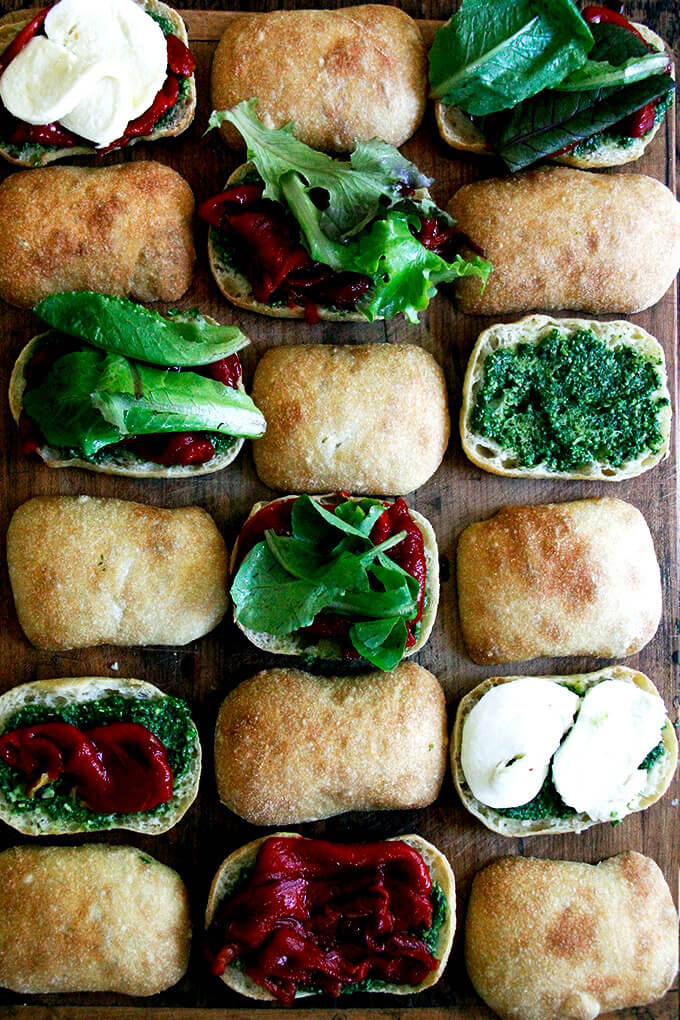
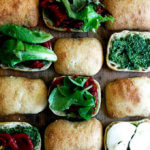
I’ve been using the pesto on sandwiches. Love this one: roasted red peppers , fresh mozzarella, and greens on ciabatta :
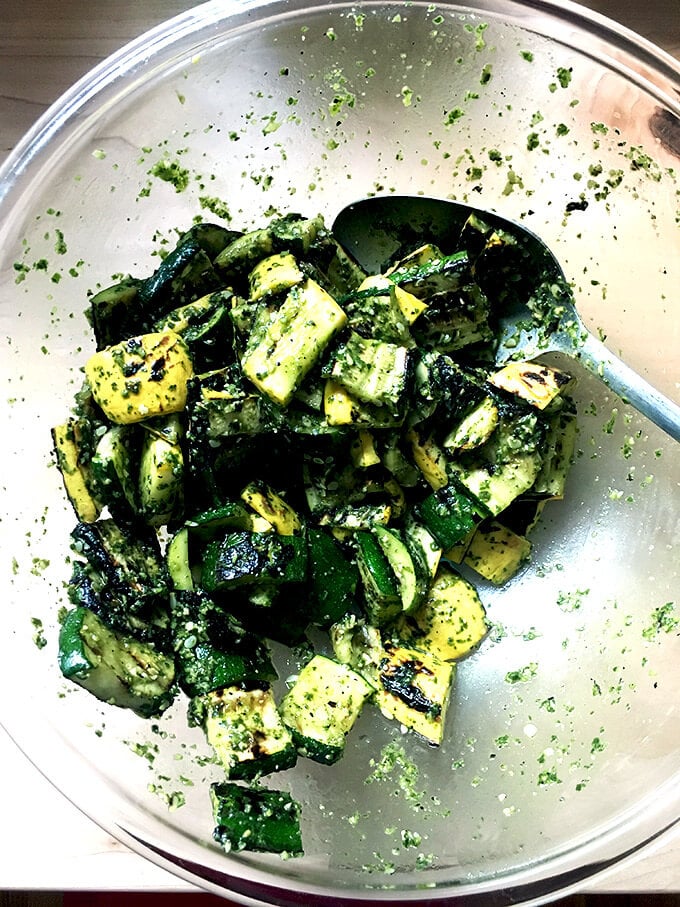
Also great tossed with grilled vegetables:
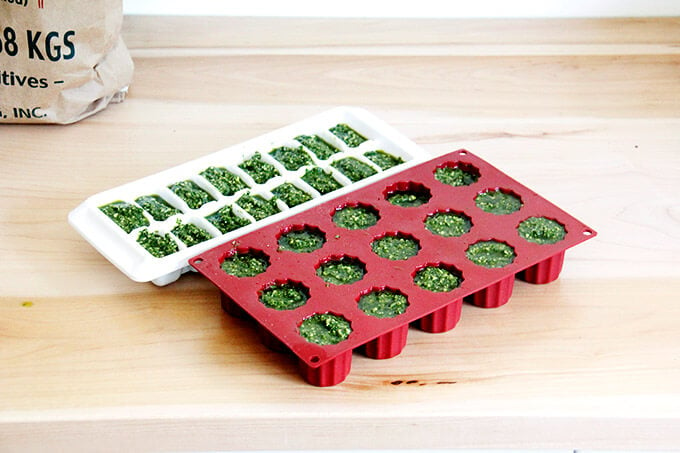
Store pesto in fridge or freezer. Freeze pesto in ice cube trays; then transfer the frozen cubes to a ziplock bag and return to the freezer. Look: I found purpose for my canelé mold I have yet to use—score!
Description
Pesto can be made with many a herb (parsley, chives, tarragon, cilantro) as well as many a vegetable (kale), cheese (pecorino), and/or nut (walnuts, almonds, hazelnuts). Because our CSA had gifted us three enormous bundles in two weeks, I made a straight-up basil pesto, omitting the nuts mostly because they’re so darn expensive. If you like the texture and flavor offered by nuts, you can definitely add them here. Quantities are listed in ingredient list.
Pesto freezes beautifully. Freezing in ice cube trays or something similar is handy, because it allows you to remove small portions as needed.
Re kosher salt: I note the brand I use, Diamond Crystal, because saltiness varies among brands. If you use Morton’s kosher salt, for example, you should cut the amount of salt back because Morton’s is saltier than Diamond Crystal.
To make a small batch of pesto, use these quantities:
4 cups (85 g) loosely packed basil
2 to 4 cloves garlic, peeled
1 to 2 tablespoons fresh lemon juice
1 teaspoon kosher salt (Diamond Crystal brand, see notes)
1/2 cup (57 g) grated Parmigiano Reggiano
1/4 cup toasted pine nuts, almonds, or walnuts (optional)
1/2 cup extra-virgin olive oil
16 cups ( 320 g ) basil
1 head garlic, peeled
1/2 cup fresh lemon juice
3 to 3.5 teaspoons kosher salt (Diamond Crystal brand, see notes)
2 cups ( 215 g ) grated Parmigiano Reggiano
1 cup toasted pine nuts, almonds, or walnuts (optional)
2 cups extra-virgin olive oil
Combine basil, garlic, lemon, 3 teaspoons of the salt, and the cheese in a food processor. Pulse to combine—you may have to pulse in batches. Add the oil and purée to combine. Taste. Adjust with more salt, lemon or oil to taste. Store in fridge or transfer to ice cube trays and freeze; then transfer to a ziplock bag and store in freezer.
- Prep Time: 20 minutes
- Category: Condiment
- Method: Food Processor
- Cuisine: Italian
Description
Pesto can be made with many a herb (parsley, chives, tarragon, cilantro) as well as many a vegetable (kale), cheese (pecorino), and/or nut (walnuts, almonds, hazelnuts). Because our CSA had gifted us three enormous bundles in two weeks, I made a straight-up basil pesto, omitting the nuts mostly because they’re so darn expensive. If you like the texture and flavor offered by nuts, you can definitely add them here. Quantities are listed in ingredient list.
Pesto freezes beautifully. Freezing in ice cube trays or something similar is handy, because it allows you to remove small portions as needed.
Re kosher salt: I note the brand I use, Diamond Crystal, because saltiness varies among brands. If you use Morton’s kosher salt, for example, you should cut the amount of salt back because Morton’s is saltier than Diamond Crystal.
To make a small batch of pesto, use these quantities:
4 cups (85 g) loosely packed basil
2 to 4 cloves garlic, peeled
1 to 2 tablespoons fresh lemon juice
1 teaspoon kosher salt (Diamond Crystal brand, see notes)
1/2 cup (57 g) grated Parmigiano Reggiano
1/4 cup toasted pine nuts, almonds, or walnuts (optional)
1/2 cup extra-virgin olive oil
16 cups ( 320 g ) basil
1 head garlic, peeled
1/2 cup fresh lemon juice
3 to 3.5 teaspoons kosher salt (Diamond Crystal brand, see notes)
2 cups ( 215 g ) grated Parmigiano Reggiano
1 cup toasted pine nuts, almonds, or walnuts (optional)
2 cups extra-virgin olive oil
Combine basil, garlic, lemon, 3 teaspoons of the salt, and the cheese in a food processor. Pulse to combine—you may have to pulse in batches. Add the oil and purée to combine. Taste. Adjust with more salt, lemon or oil to taste. Store in fridge or transfer to ice cube trays and freeze; then transfer to a ziplock bag and store in freezer.
- Prep Time: 20 minutes
- Category: Condiment
- Method: Food Processor
- Cuisine: Italian
Find it online : https://alexandracooks.com/2018/08/01/large-batch-basil-pesto/
Chewy, golden, seed-crusted bagels at home? Yes. You. Can. This dough comes together in 90 seconds. Find step-by-step instructions below 🥯🥯🥯
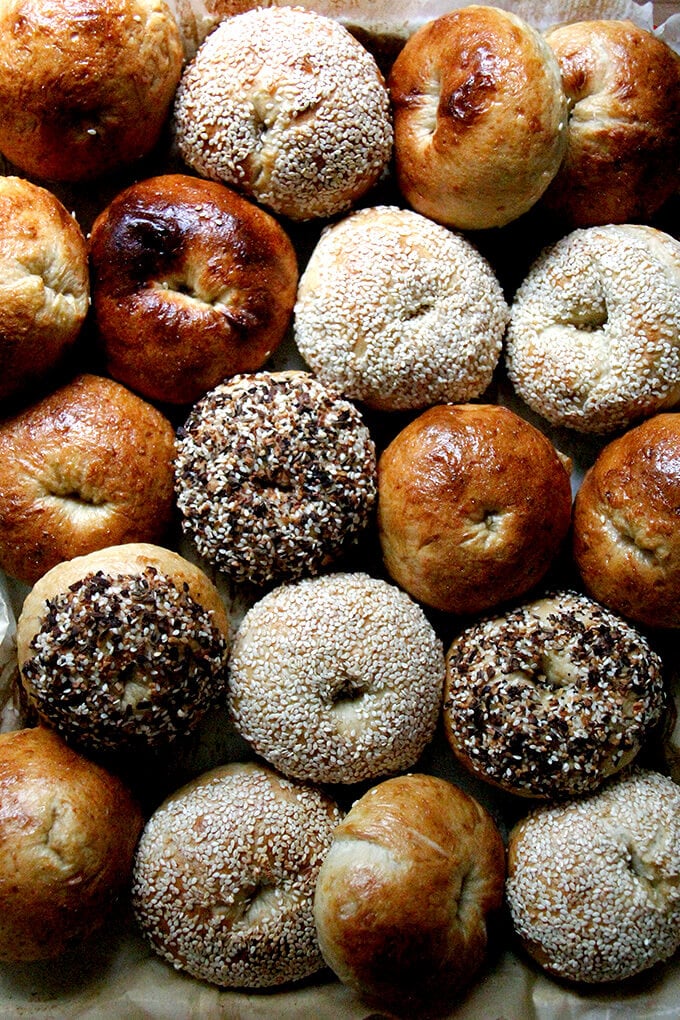
Unlike many of the bread recipes in this site’s archives, bagels are made with a low-hydration dough and, as a result, require kneading to allow the dough to come together. Moreover, due to their nature, bagels require shaping, boiling, and egg washing.
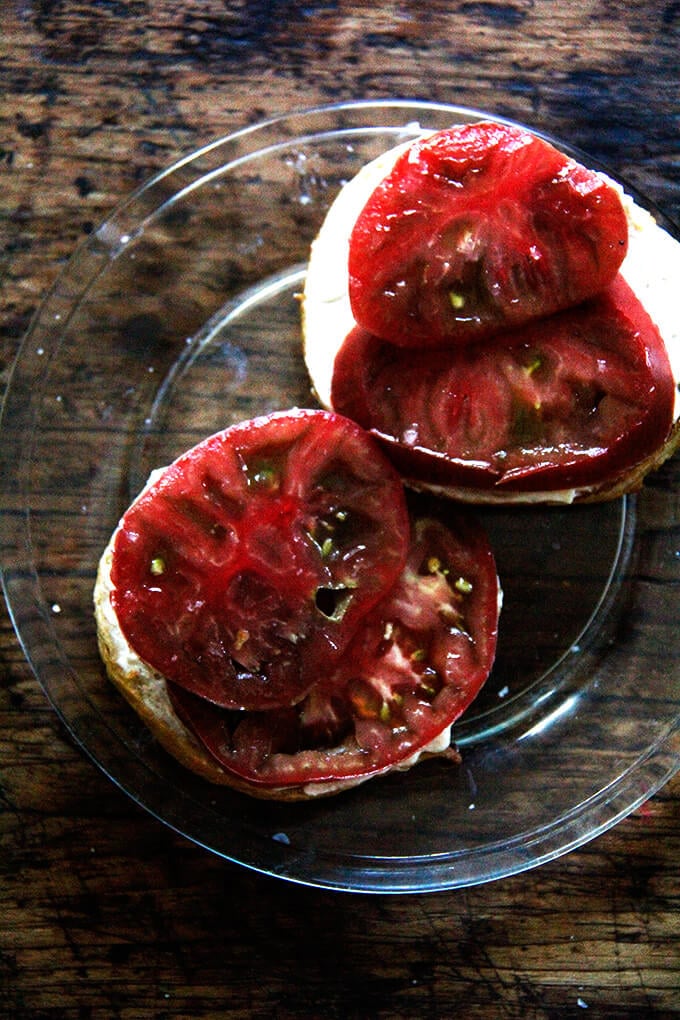
But overall, the process is simple — the dough comes together in 90 seconds — and the result — a chewy vessel perfect for cradling juicy summer tomatoes or cream cheese and lox — is well worth the effort. Find three tips for making deliciously chewy bagels at home and step-by-step instructions below.
3 Tips for Excellent Homemade Bagels
- Knead the dough. To get that characteristic chewiness—in other words, to ensure bagels don’t simply taste like bread shaped like bagels— the dough needs to be kneaded. You can do this in the food processor, which takes 90 seconds.
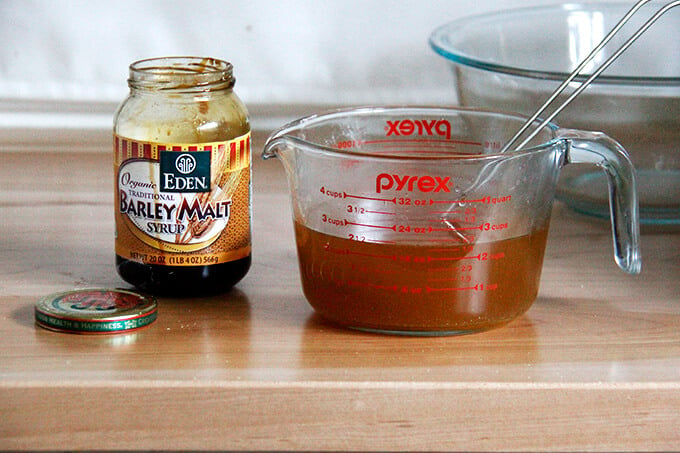
- Pick up a bottle of barley malt syrup . I learned from this Stella Parks article that barley malt syrup , not only provides flavor, but also promotes “a more delicate texture in the crust, one that’s chewy and crisp rather than crunchy and hard.” If you don’t feel like picking up another product, you can use honey, molasses, or maple syrup in its place.
- Use an egg wash. To get that nice, golden sheen during the baking, an egg wash is essential . Commercial bakers often boil their bagels in a lye solution , which promotes browning and gives the bagel crust a crispness. As lye is something I am unwilling to experiment with, an egg wash is a fine substitute.
PS: Foolproof Homemade Bialys: A Step by Step Guide
How to Make Homemade Bagels: A Step-by-Step Guide
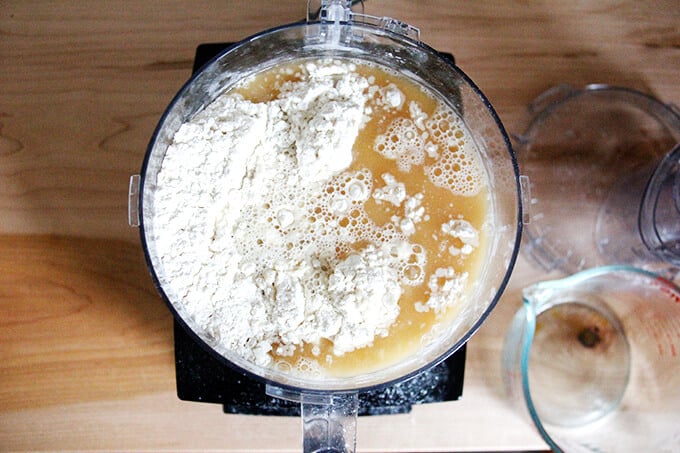
First, whisk together the flour, salt, and instant yeast. You can do this in the food processor or stand mixer, depending on which you are using.
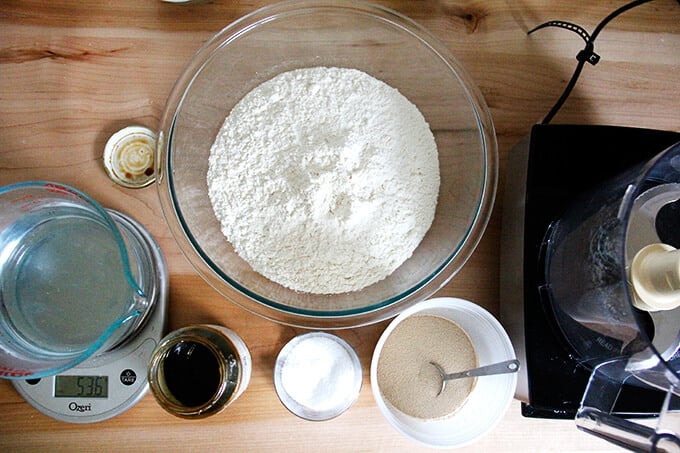
Whisk together the water and barley malt syrup:
Add the liquid ingredients to the dry ingredients, and knead for 90 seconds:
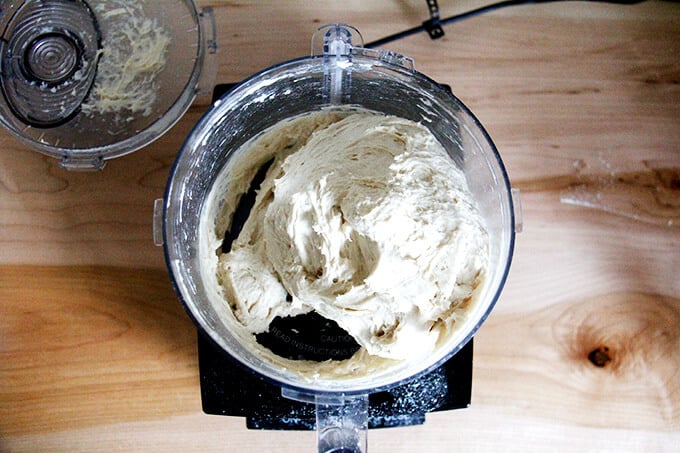
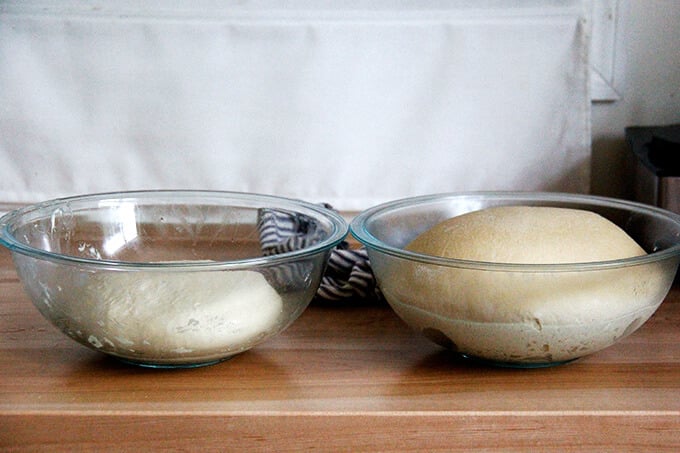
Use greased hands to transfer it to a bowl. Coat it with a little bit of olive or grapeseed oil. Cover the bowl with a lid and transfer to the fridge (see recipe box if you want to skip the overnight rise). On the left: just-mixed dough. On the right: dough after a night in the fridge.
Turn the dough out onto a lightly floured work surface.
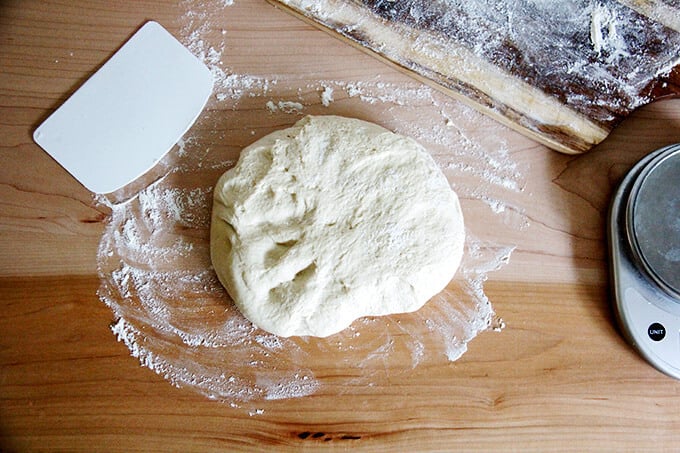
Portion the dough into 12 pieces:
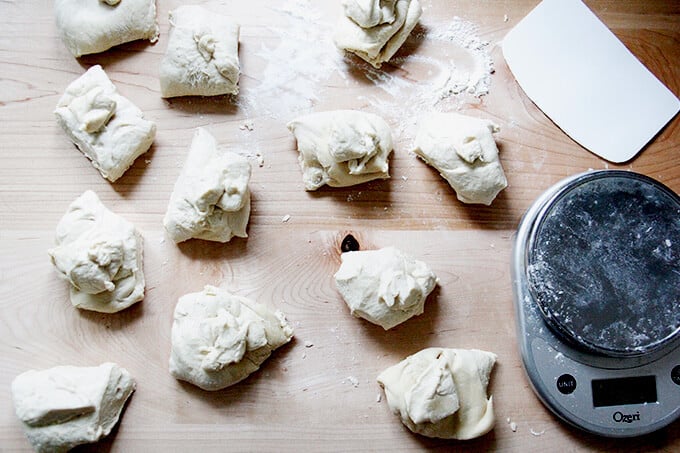
Ball them up and let them rest for 1 hour, covered with a towel or plastic wrap:
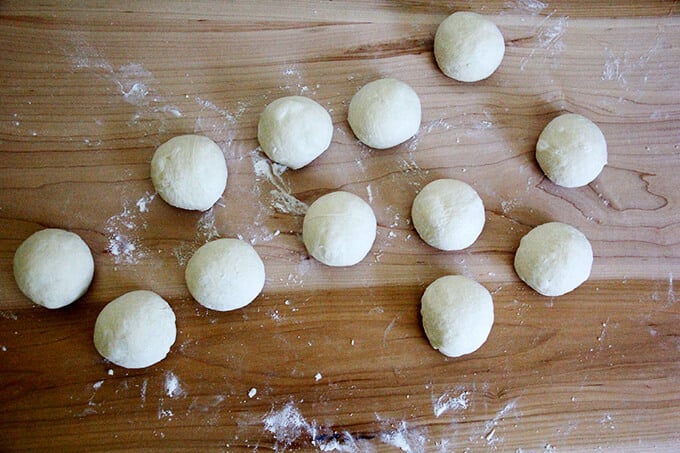
Shape them into rings, by using your thumb to poke a hole in the center of the round, then both hands to stretch the dough out and under—don’t be afraid to be aggressive.
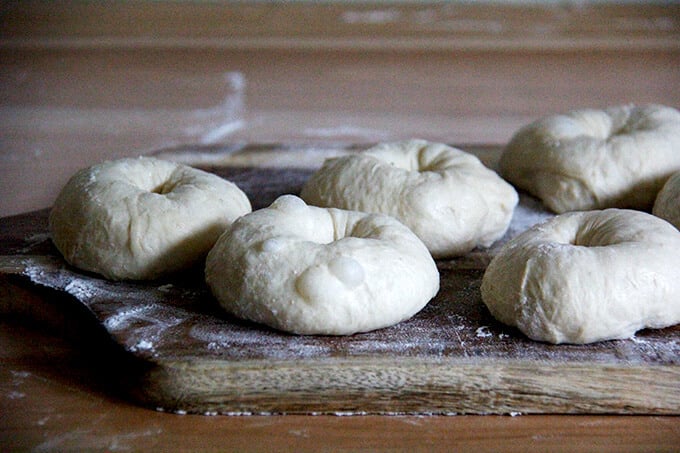
Prepare the water bath by boiling water with barley malt syrup or maple syrup.
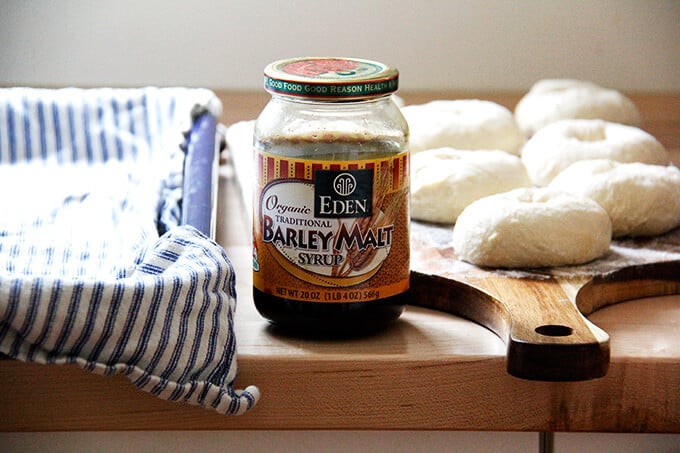
Get ready to boil:
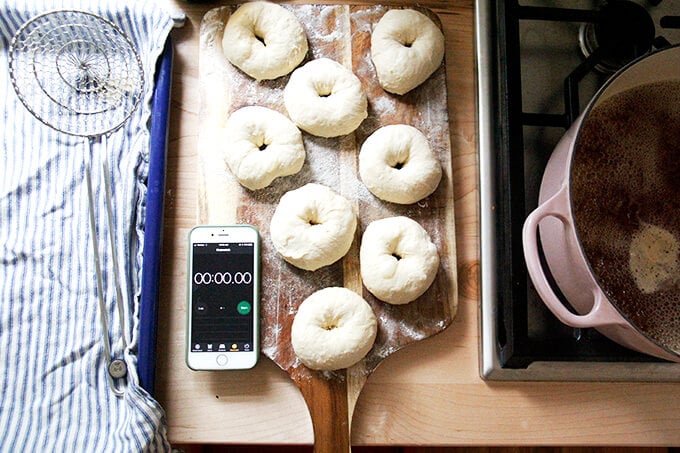
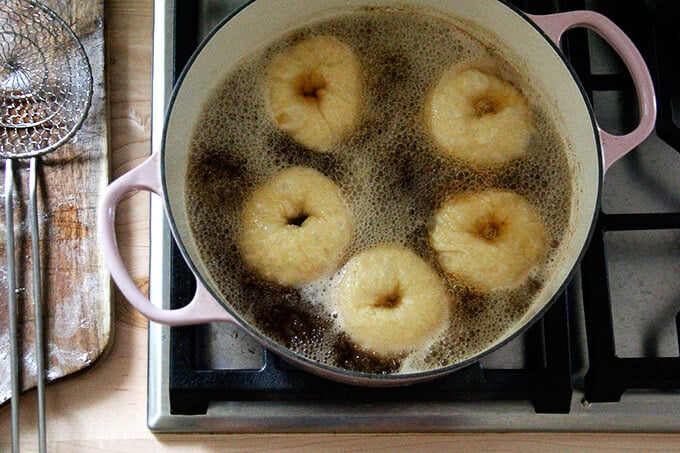
Boil 30 seconds a side:
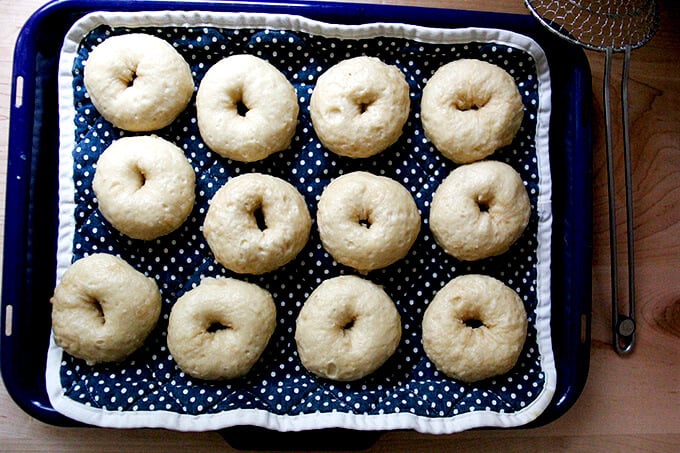
Transfer boiled bagels to a tea towel-lined sheet pan.
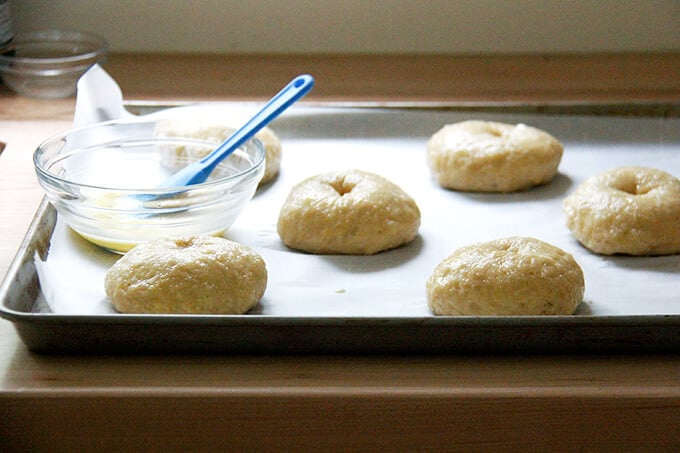
Brush bagels with an egg wash:
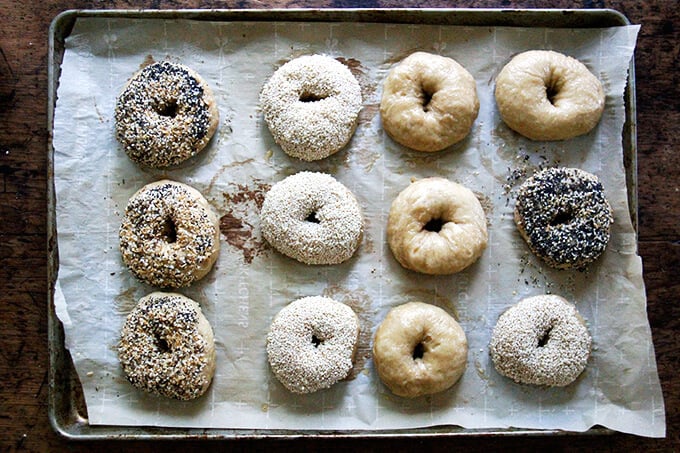
Dip in desired seasonings:
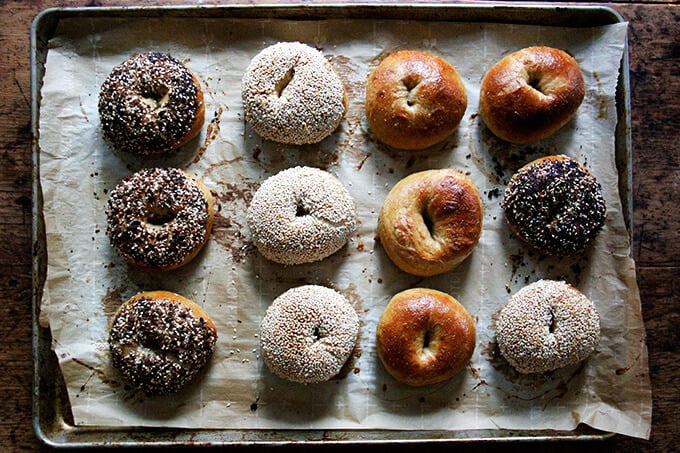
Bake until golden.
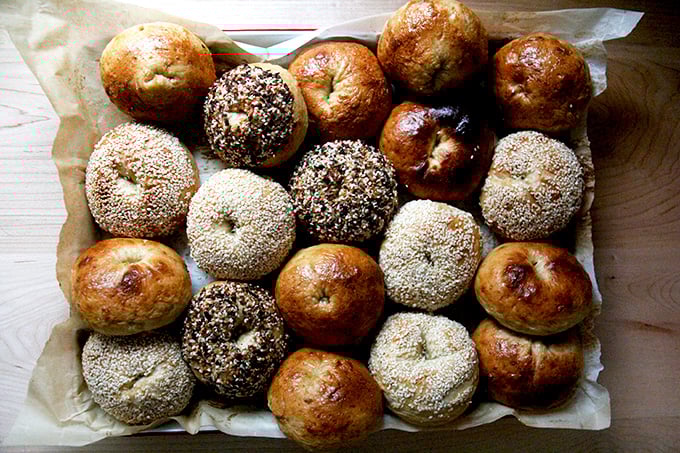
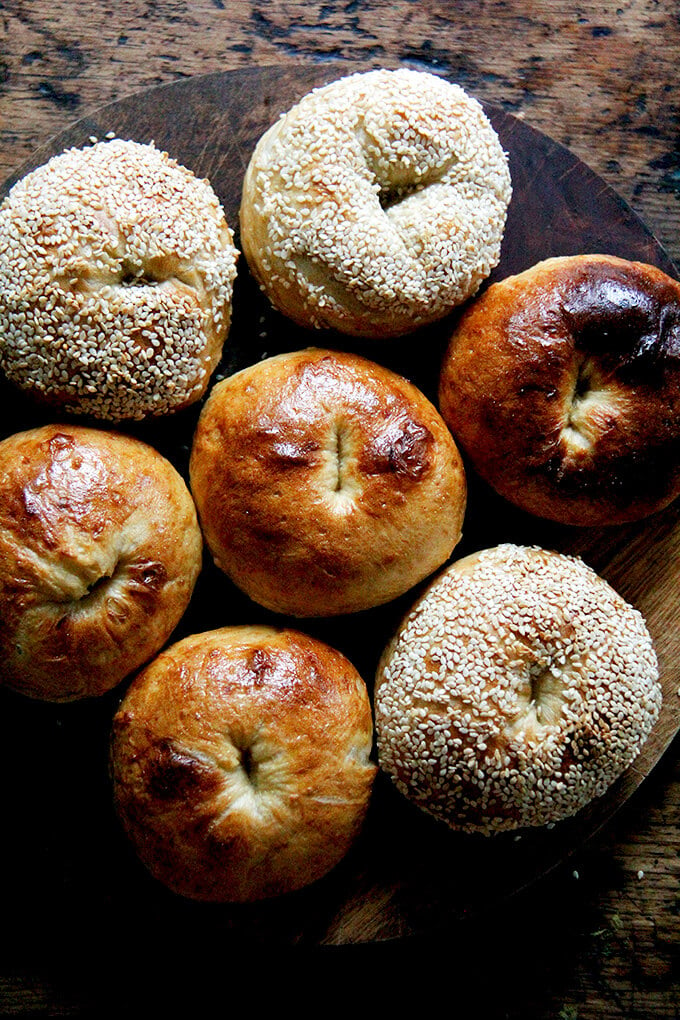
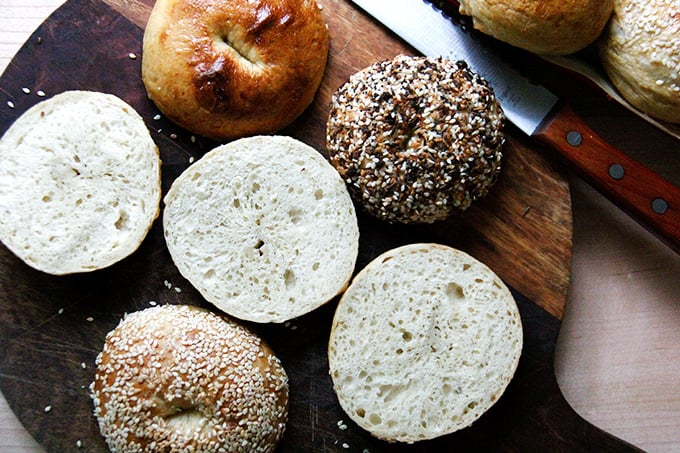
Invite some friends over for brunch. Find yourself some good tomatoes; enter summer-morning breakfast nirvana.
Description
Chewy, golden, seed-crusted bagels at home? Yes. You. Can. This dough comes together in 90 seconds. Find step-by-step instructions below 🥯🥯🥯
Notes:
- Ideally the dough will spend at least 12 hours in the fridge, but if you wish to skip this rise, simply increase the yeast to 2 teaspoons, use lukewarm water, and let the dough rise at room temperature until it has doubled in volume, roughly 2 to 3 hours. Then proceed with the recipe.
Equipment Notes:
A scale is imperative to ensure you are measuring accurately.
A large sheet pan is so handy — it allows you to bake all of the bagels at once. If you don’t have a large one, you can squish them onto a standard sheet pan or use two standard sheet pans, and bake 5 to 6 on each.
You’ll need a spider or a slotted spoon to remove the bagels from the boiling water to a sheet pan.
A food processor or stand mixer will allow you to knead the dough quickly and powerfully. If you are using a food processor, be sure it is at least 14-cup capacity: I love my Cuisinart .
Note: Watch your food processor closely! This is a lot of dough for even a large food processor. You’ll only run the machine for 60 to 90 seconds, but it will work hard during that time and may jump around a bit — at any sign of the blade jamming, stop the machine and remove the dough. Also, after you add the liquids to the food processor, begin the kneading immediately to prevent the liquid from escaping through the center hole.
If you don’t have a food processor or a stand mixer, knead the dough by hand briefly, using as little additional flour as possible.
Ingredient Notes:
Bread flour or high-gluten flour makes for an especially chewy bagel, but if you don’t feel like picking up another product, don’t hesitate to use all-purpose flour. I have used it many times and my bagels always turn out chewy.
Barley malt syrup is hard to find. Shops like Whole Foods Market typically sell it. I order it online .
For homemade everything bagel seasoning, combine:
- 1/4 cup sesame seeds
- 1/4 cup poppy seeds
- 3 tablespoons dried onion flakes
- 3 tablespoons dried garlic flakes
- 2 tablespoons flaky sea salt
For the dough:
- 6 cups ( 768 g ) bread, high-gluten, or all-purpose flour
- 3 teaspoons ( 20 g ) kosher salt, I use Diamond Crystal
- 1.5 tsp ( 6 g ) instant yeast
- 2 cups ( 454 g ) water, room temperature or cold tap water
- 1 heaping teaspoon barley malt syrup, honey, molasses, or maple syrup + more for boiling
- grapeseed or olive or other neutral oil
For baking:
- 1 egg whisked with 1 tablespoon water
- various toppings: everything bagel seasoning (see above), sesame seeds, dukkah , etc.
- Make the dough: Please read all notes above before proceeding, especially the top note about timing. In the bowl of a food processor fitted with the blade attachment (or in a stand mixer fitted with the dough hook), pulse together the flour, salt and yeast (or, if using a stand mixer, stir on low). In a medium bowl, whisk together the water and the barley malt syrup. Add it to the food processor (or stand mixer) and immediately (see notes above for why) blend for 60-90 seconds, standing nearby the entire time — at any sign of the blade jamming, stop the machine. (If using a stand mixer, knead on medium speed for 90 seconds or until the dough comes together and is tacky to the touch.)
- With oiled hands, transfer the dough from the food processor to the bowl. The dough will feel warm and tacky. With oiled hands stretch the dough up, then down toward the center several times to form a ball. ( See video for guidance .) Lightly rub some oil over the dough to coat — this will prevent a crust from forming on the dough. Cover the bowl with a lid or plastic wrap. Transfer the bowl to the fridge for 12 hours or longer.
- Portion the dough: Remove the bowl of dough from the fridge. Turn the dough out onto a lightly floured work surface. For perfectly even bagels, use your scale to portion the dough into 10 to 12 pieces (I prefer 10). For 12 smaller bagels, each dough ball should weigh about 105 grams; for 10 slightly larger bagels, each dough ball should weigh 125 grams. Form each portion into a ball, using the pinky edges of your fingers to create tension. Place the balls on a lightly floured work surface and cover them with a tea towel or plastic wrap. Let them rest for 1 hour.
- Prepare your work station: When the hour is nearly up, place a large pot of water on the stovetop to boil. When it simmers, add a big glug (about ¼ cup) barley malt syrup. Preheat your oven to 425ºF. Line two sheet pans or one large pan one with parchment paper (see notes above). Prepare the egg wash. Place toppings of choice in small, rimmed plates.
- Shape the bagels: Lightly flour your hands. Use your thumb to poke a hole into the center of each dough ball. Use your hands to stretch the dough into a donut shape—don’t be afraid to really tug outward and under, almost as if you were going to turn the dough inside out, but stop before you do. Note: If you don’t pull out and under, the bagels will puff into cone-like shapes upon baking. Truly: Be aggressive with the shaping. Video guidance here .
- Prepare for boiling: Line a sheet pan with a tea towel. Have a stopwatch (or your phone or a clock) nearby. Drop 4 of the dough rings into the boiling water at one time. Boil 30 seconds on each side. Use a spider or slotted spoon to transfer the boiled rings to the towel-lined pan. Repeat until all of the rings have been boiled.
- Egg wash: Brush each ring with the egg wash. If you are using any toppings, dip the egg-washed bagels into the topping-filled bowls, then transfer to the parchment-lined sheet pan. If you are using an extra-large sheet pan (see notes), you can bake all 12 at once. If you are using a standard/smaller pan, bake 6 to 8 at a time.
- Transfer the pan or pans to the oven and bake for 20 to 25 minutes or until bagels are evenly golden all around. If you are using two pans, rotate the pans halfway through. Let bagels cool on sheet pans.
- Prep Time: 20 minutes
- Cook Time: 30 minutes
- Category: Bread
- Method: Boil & Bake
- Cuisine: American
