Crusty, airy, bakery-style bread in your home kitchen? Yes. You. Can. This dough takes 5 minutes to stir together, and from there, time does the work. If you love a rustic boule for dipping in your soup or toasting and slathering with butter and jam for breakfast, this recipe is for you.
If you’ve spent any time toiling over a loaf of sourdough bread, making Jim Lahey’s no-knead bread will feel like a breath of fresh air. This recipe calls for a very simple mixing and shaping process, requiring little equipment and skill.
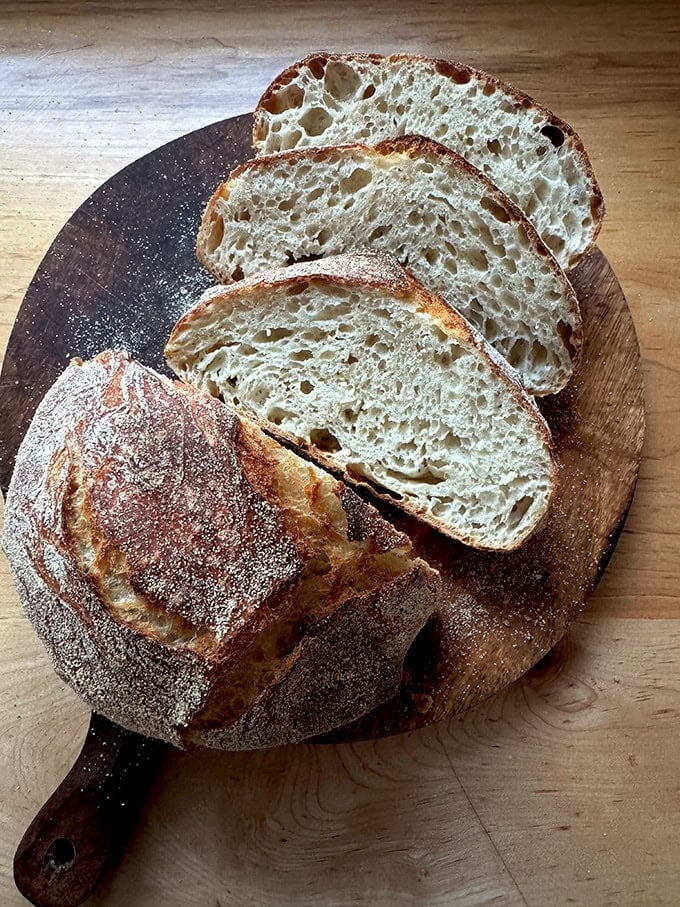
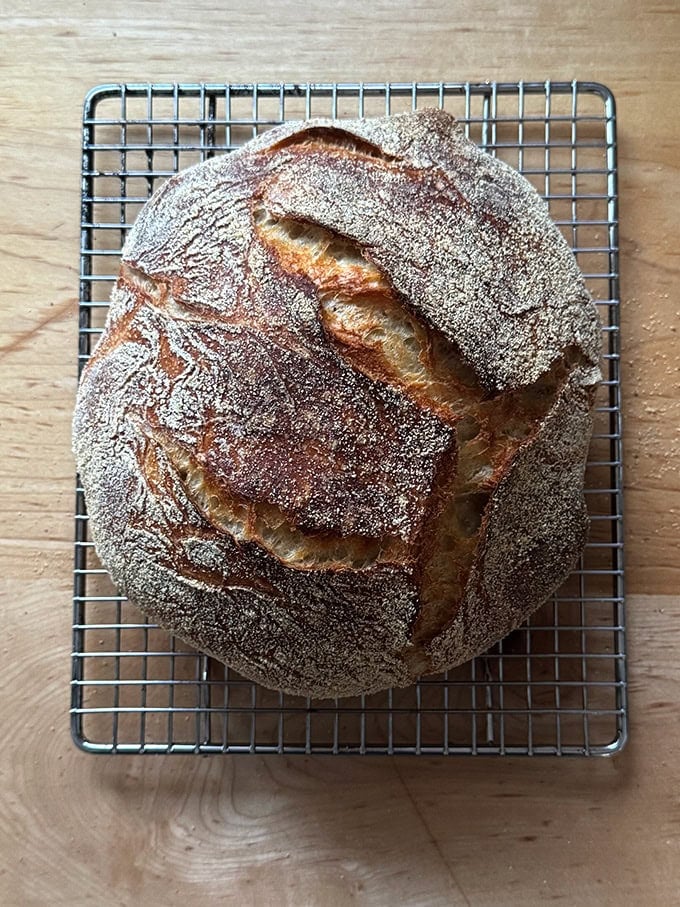
The bread emerges crusty and cornmeal-dusted, with a light, airy crumb. Why does this recipe work?
First: time. During the long, slow rise, both gluten and flavor develop.
Second: the baking method. This dough bakes in a Dutch oven, covered first, then uncovered. When the pot is covered, water in the dough evaporates and transforms into steam. Both the carbon dioxide gas in the dough and the steam push against the gluten structure, causing the dough to spring. During the last 15 minutes of baking, when the lid is removed, and the bread is exposed to dry heat, the gelatinized surface of the dough dries out, forming a crackly crust. The cornmeal further promotes a crunchy exterior.
How to Make Jim Lahey’s No-Knead Bread, Step by Step
First gather your ingredients: flour (bread or all-purpose), salt, instant yeast ( SAF is my preference), and water:
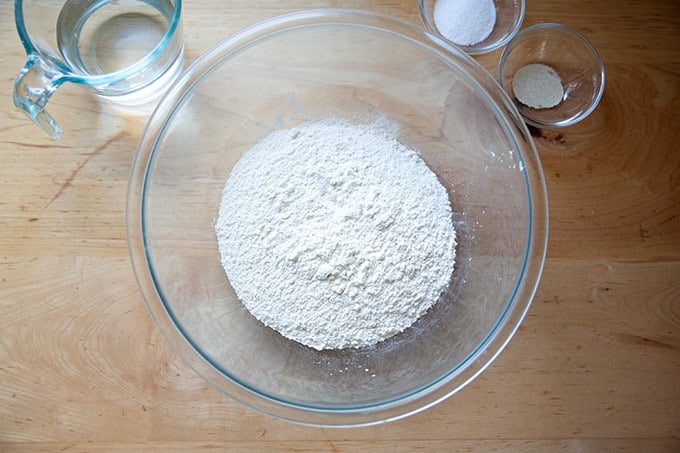
Combine the flour, yeast, and salt:
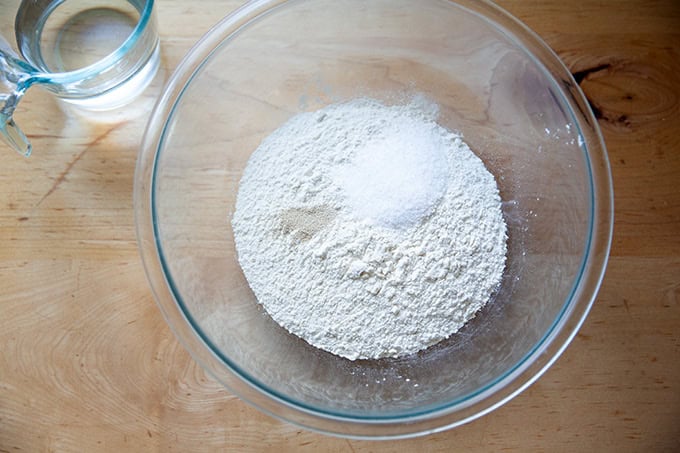
Whisk to combine, then add the water:
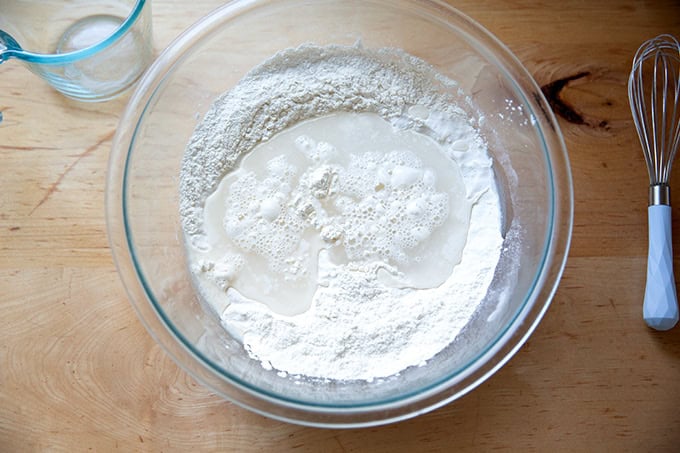
Stir until you have a sticky dough ball:
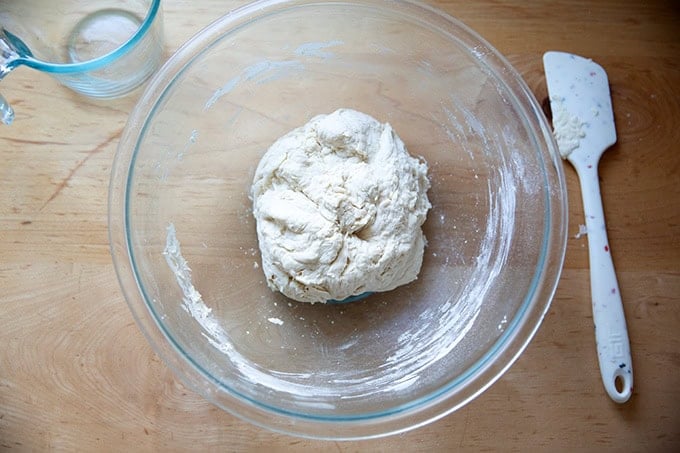
Cover the bowl. At this point, you can leave the dough untouched for 18 hours. Or, if time permits, in 15 to 20 minutes, you can perform one set of stretches and folds: simply grab an edge of the dough using a wet hand and stretch it up and in. Repeat this 8 to 10 times, grabbing a different edge each time. I find even performing just one set of stretches and folds gives my dough the teensiest bit more strength and ultimately a bit more loft.
Compare the difference between this dough after 18 hours, which experienced no stretches and folds:
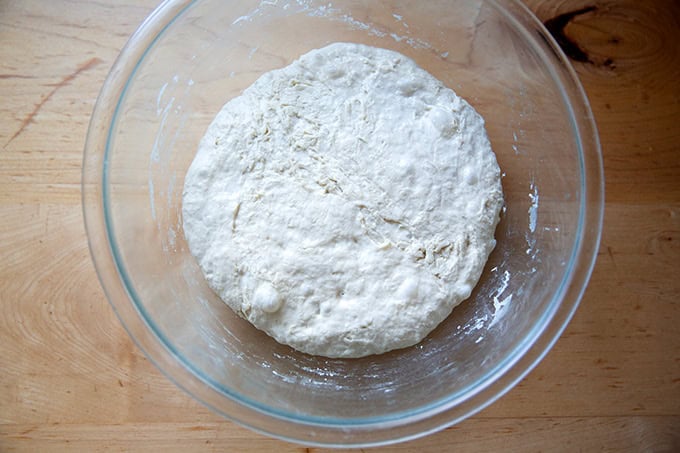
And this dough, also after 18 hours, which experienced one set of stretches and folds:
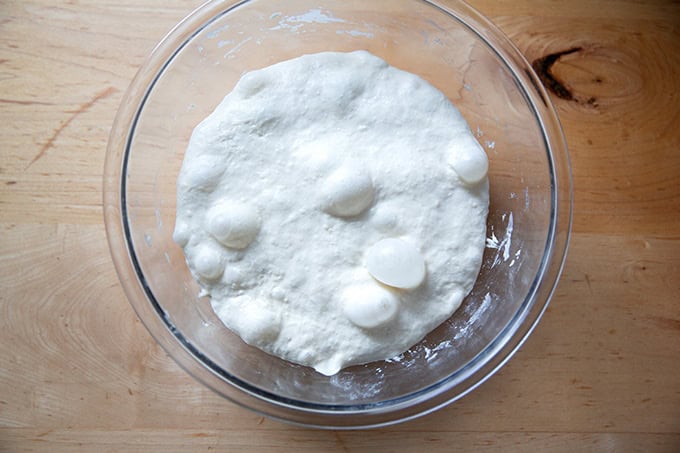
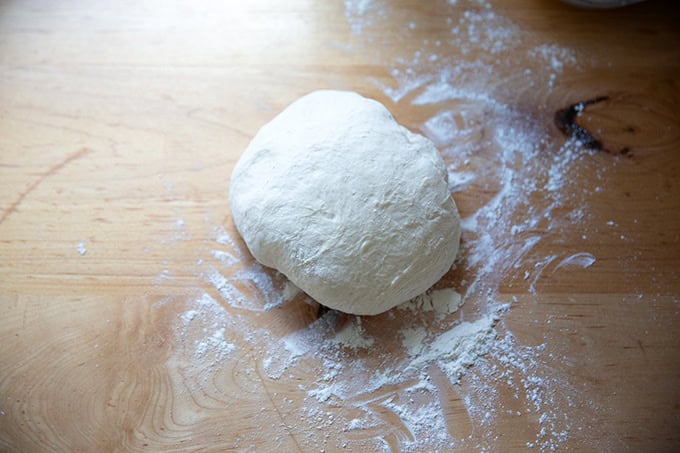
Turn the dough out onto a lightly floured work surface:
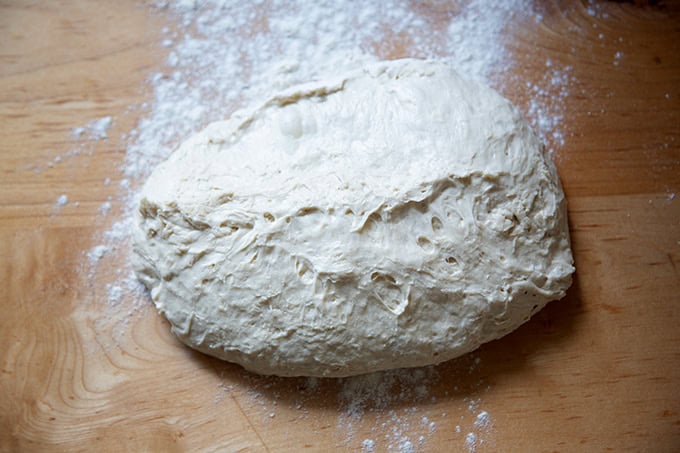
Then fold it into a rough ball:
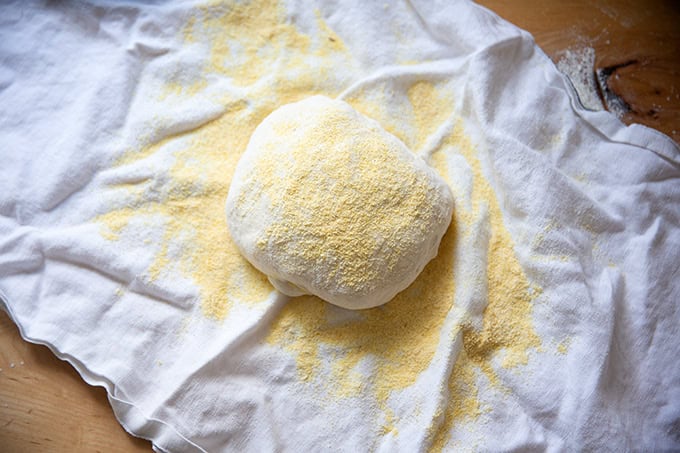
Lightly dust a tea towel or flour sack towel (I love these Flour Sack Towels ) with cornmeal and place the shaped round cut side down on the towel. Sprinkle with more cornmeal:
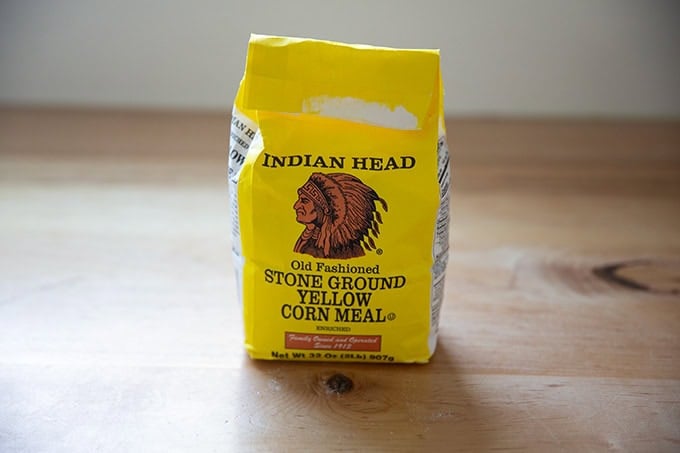
Incidentally, this is the cornmeal I buy:
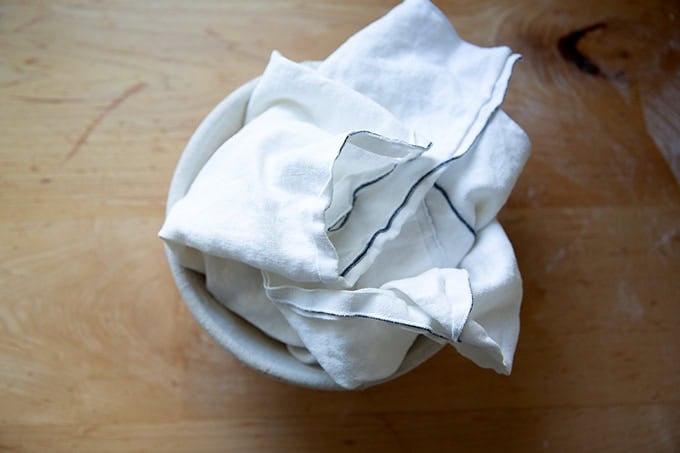
Wrap into a bundle and set in a small bowl (an 8-inch banneton or Pyrex bowl or anything similar) will work. Set aside to rise for 2 hours.
Forty-five minutes before you plan on baking, place a Dutch oven in your oven and preheat it to 450ºF. I’ve used my 5-Qt Lodge and my Challenger Bread Pan here with success.
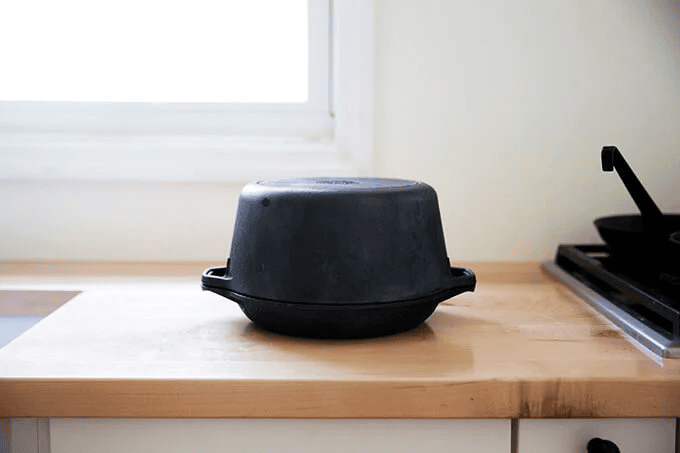
When you are ready to bake, open the towel, and remove the bowl.
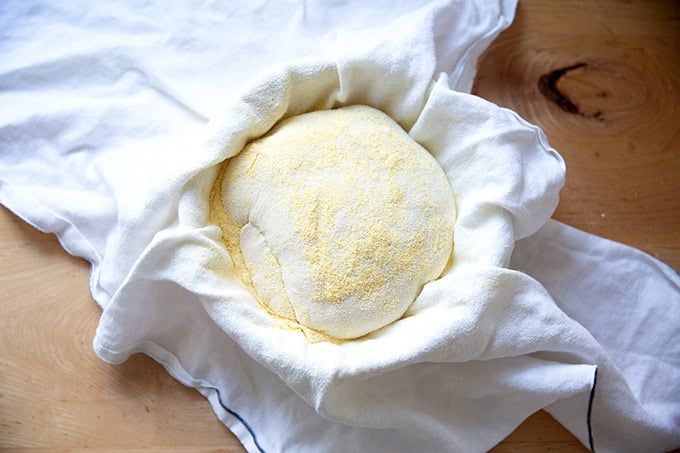
Lay a round of parchment over the top of the dough and lay one hand on top; then slide your other hand underneath the towel, and carefully flip the round onto the parchment, so that the seam side is up. ( Note: The seam will be hard to see, but it will open up in the oven.) This will make a mess of cornmeal everywhere… simply sweep it away. I love these parchment rounds for both pizza and this bread.
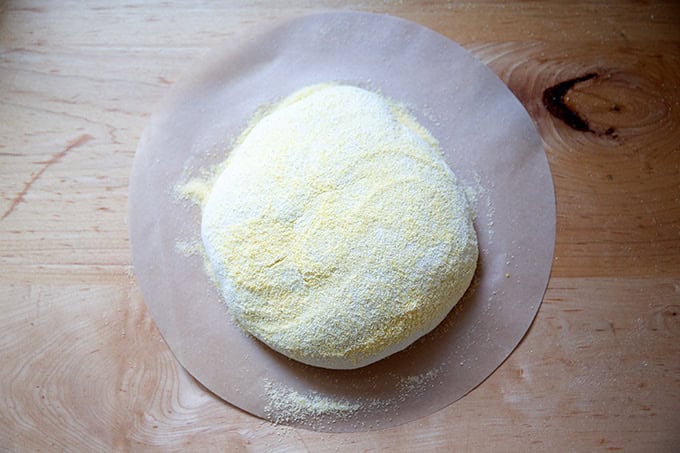
Remove the Dutch oven from the oven and set it on a cooling rack. Remove the lid and carefully lower the bread, parchment paper and all into the pot:
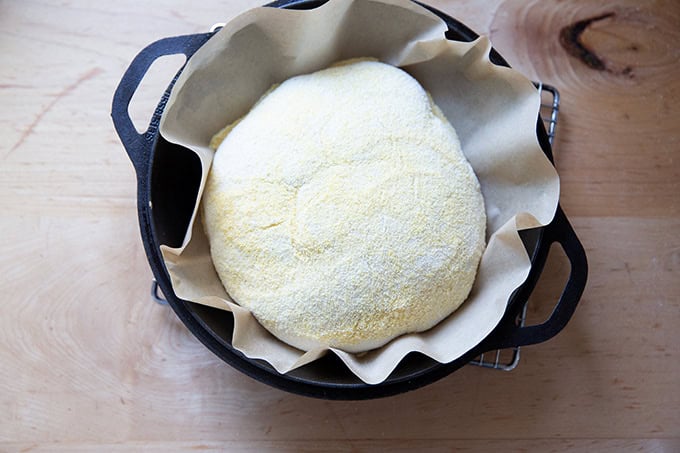
Cover the pot and transfer to the oven for 30 minutes. Then remove the lid:
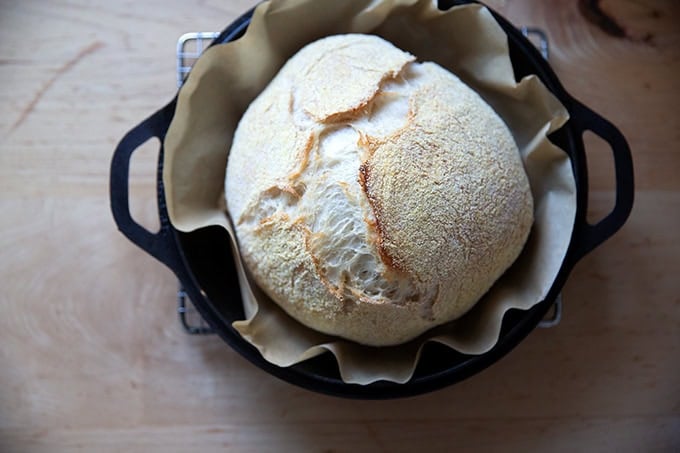
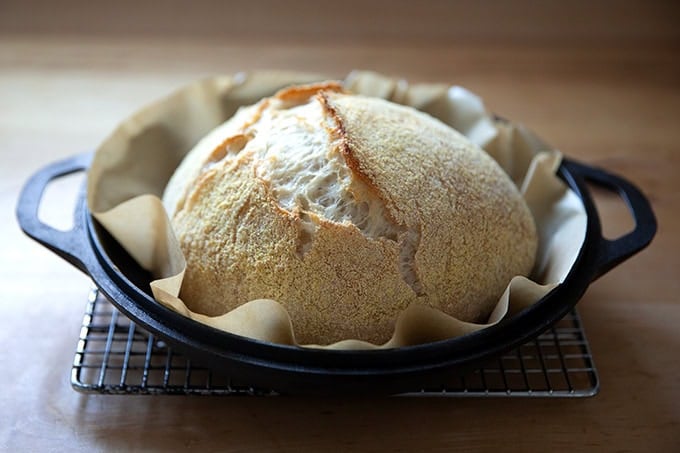
Return the pan to the oven for another 15 minutes or until browned to your liking:
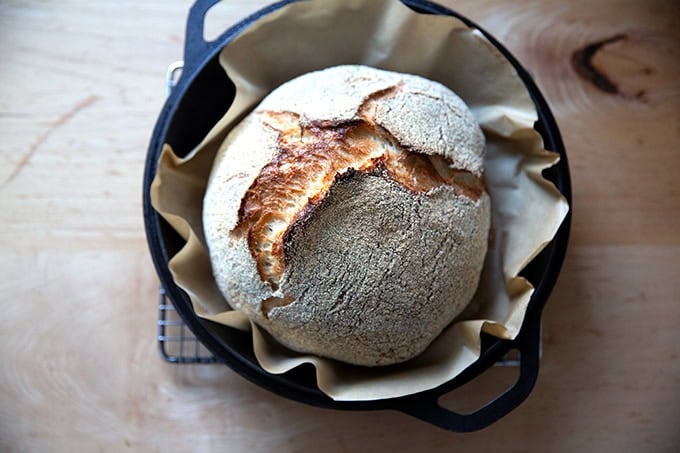
Transfer bread to a cooling rack and let cool for at least 30 minutes before slicing.
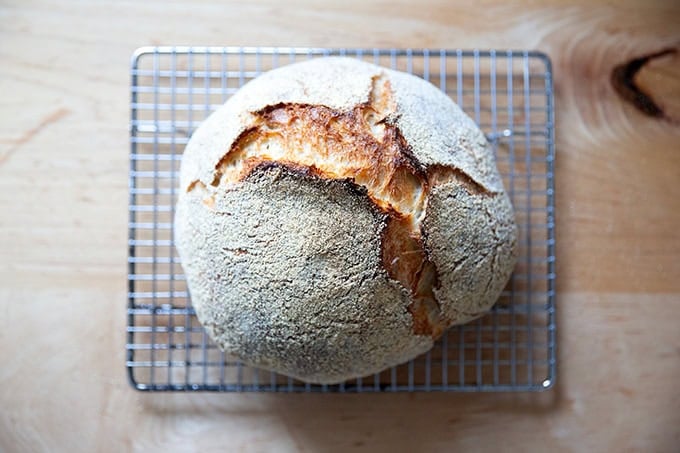
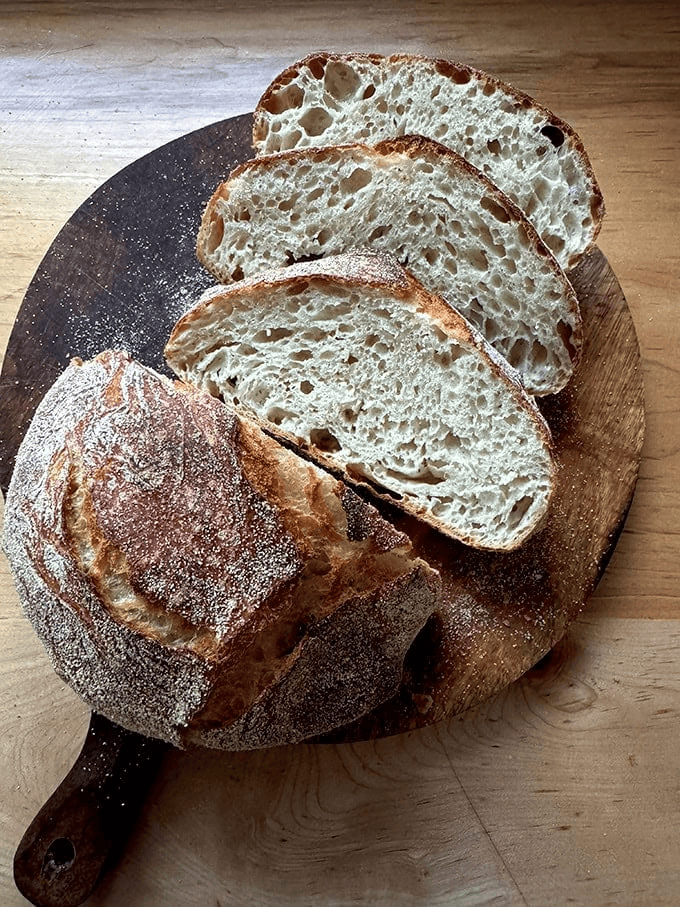
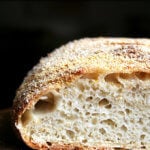
Look at that light airy crumb:
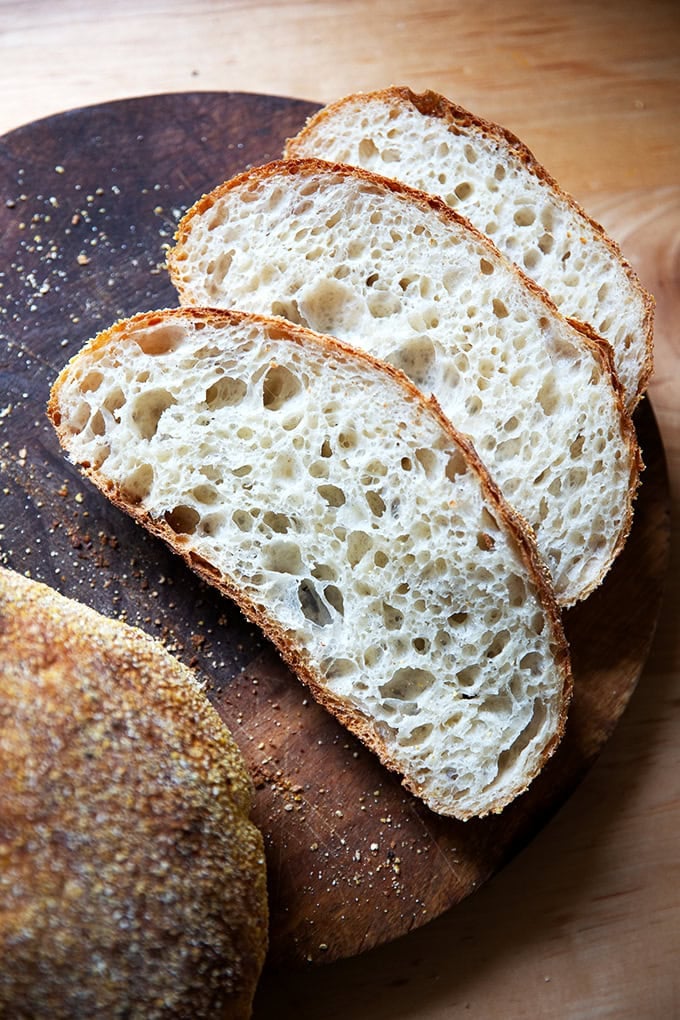
Lahey bread made with half bread flour and halfPetra 0102:
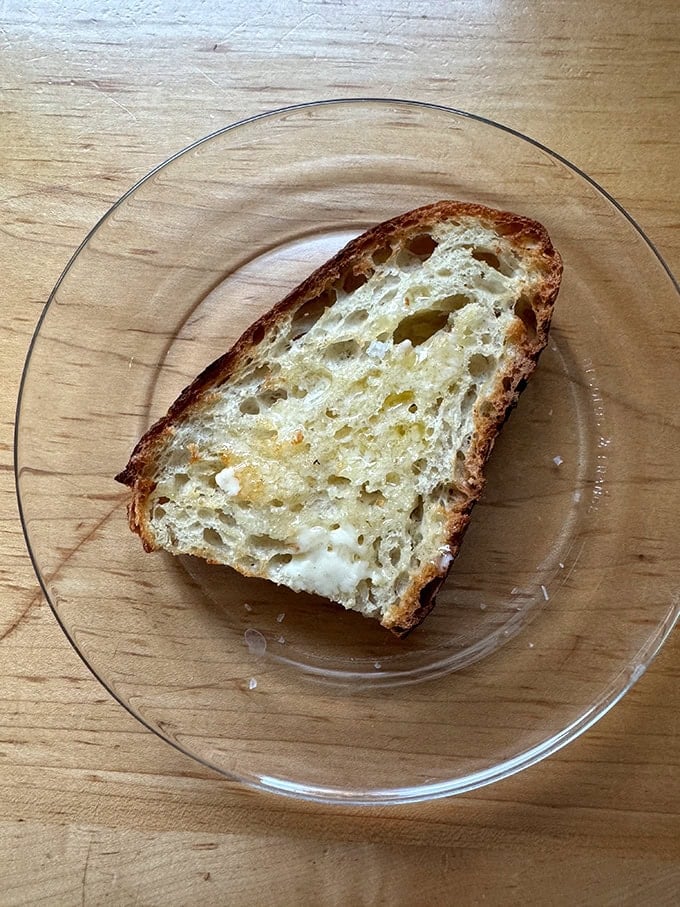
The no-knead loaf will feed a crowd but should you find yourself with leftovers, it makes delicious toast and freezes beautifully:
Description
Crusty, airy, bakery-style bread in your home kitchen? Yes. You. Can. This dough takes 5 minutes to stir together, and from there, time does the work. If you love a rustic boule for dipping in your soup or toasting and slathering with butter and jam for breakfast, this recipe is for you.
Adapted from Mark Bittman’s “The Minimalist” column in The New York Times: Dining In November 8, 2006 / Recipe from Jim Lahey
Notes:
Flour/Salt : I’ve adjusted the recipe by adding a touch more salt than suggested in the article and converting the recipe to grams. The key here is to use roughly an 80% hydration dough, so regardless of how much flour you use, be sure the water amount is roughly 80% the amount of flour. Similarly, the salt should be roughly 2 to 3 % the weight of the flour, which for this recipe is 7 to 11 grams.
Equipment: You’ll need a lidded vessel to bake this loaf. I use my 5-qt Lodge Double Dutch Oven for this one. Parchment paper is helpful as well for transferring the dough from the towel to the preheated Dutch oven.
- 385 grams (about 3 cups ) bread flour, plus more for dusting
- 1 gram ( ¼ teaspoon ) instant yeast
- 11 grams (about 2 teaspoons ) kosher salt
- 308 grams (about 1 5/8 cups ) water
- Cornmeal, wheat bran, or oat bran as needed
- In a large bowl, combine the flour, yeast, and salt. Add the water, and stir until blended. The dough will be sticky. Cover the bowl with plastic wrap and let rest for 12-18 hours at room temperature. ( Note: Optional Step: If time permits, 15 to 20 minutes after you cover the bowl, perform one set of stretches and folds: simply grab an edge of the dough using a wet hand and stretch it up and in. Repeat this 8 to 10 times, grabbing a different edge each time. I find performing a set of stretches and folds gives my dough the teensiest bit more strength and ultimately a bit more loft. See photos in the post above.)
- After the 12 to 18 hours, or when the surface of the dough is dotted with bubbles, lightly flour a work surface and place the dough on it. Sprinkle a little more flour on the dough and fold it over on itself once or twice. Cover loosely with plastic wrap and let rest for about 15 minutes.
- Meanwhile, lay a clean kitchen towel (not terry cloth) on a counter or tabletop in a draft-free area. Generously coat it with cornmeal, wheat bran, oat bran, or any combination of the three. After the 15 minutes, using as much flour as necessary to keep the dough from sticking to your fingers and the work surface, quickly shape the dough into a ball and place seam side down in the center of the prepared towel. Dust with more cornmeal, wheat bran, or oat bran. If the towel is large enough, fold the sides up over the bread so that it is completely covered. Otherwise, cover it with another towel. Let rise for another 2 hours. (I like to set my towel-wrapped dough into a bowl or banneton to provide a little more support during these 2 hours.)
- Forty-five minutes before the dough is ready, preheat the oven to 450°F. Place a 6- to 8-quart heavy-covered pot (I use this Lodge Double Dutch Oven ) in the oven while it heats. When the dough is ready, carefully remove the pot from the oven. Slide your hand under the towel and turn the dough over into the pot, seam side up. This is tricky — I find that parchment paper helps: open your towel, lay a sheet of parchment paper over the dough, place your hand on the parchment paper and carefully flip the dough over so that the seam side is up and the dough is resting on the parchment paper. Use the overhanging parts of the parchment paper as handles, then lay the bread, parchment paper and all, into the Dutch oven.
- Cover with the lid and bake for 30 minutes. Remove the lid and bake for another 10 to 15 minutes or until it sounds hollow when tapped. Remove from oven, and turn out onto a cooling rack.
- Prep Time: 5 minutes
- Cook Time: 45 minutes
- Category: Bread
- Method: Dutch Oven
- Cuisine: American
Crusty, airy, bakery-style bread in your home kitchen? Yes. You. Can. This dough takes 5 minutes to stir together, and from there, time does the work. If you love a rustic boule for dipping in your soup or toasting and slathering with butter and jam for breakfast, this recipe is for you.
If you’ve spent any time toiling over a loaf of sourdough bread, making Jim Lahey’s no-knead bread will feel like a breath of fresh air. This recipe calls for a very simple mixing and shaping process, requiring little equipment and skill.
The bread emerges crusty and cornmeal-dusted, with a light, airy crumb. Why does this recipe work?
First: time. During the long, slow rise, both gluten and flavor develop.
Second: the baking method. This dough bakes in a Dutch oven, covered first, then uncovered. When the pot is covered, water in the dough evaporates and transforms into steam. Both the carbon dioxide gas in the dough and the steam push against the gluten structure, causing the dough to spring. During the last 15 minutes of baking, when the lid is removed, and the bread is exposed to dry heat, the gelatinized surface of the dough dries out, forming a crackly crust. The cornmeal further promotes a crunchy exterior.
How to Make Jim Lahey’s No-Knead Bread, Step by Step
First gather your ingredients: flour (bread or all-purpose), salt, instant yeast ( SAF is my preference), and water:
Combine the flour, yeast, and salt:
Whisk to combine, then add the water:
Stir until you have a sticky dough ball:
Cover the bowl. At this point, you can leave the dough untouched for 18 hours. Or, if time permits, in 15 to 20 minutes, you can perform one set of stretches and folds: simply grab an edge of the dough using a wet hand and stretch it up and in. Repeat this 8 to 10 times, grabbing a different edge each time. I find even performing just one set of stretches and folds gives my dough the teensiest bit more strength and ultimately a bit more loft.
Compare the difference between this dough after 18 hours, which experienced no stretches and folds:
And this dough, also after 18 hours, which experienced one set of stretches and folds:
Turn the dough out onto a lightly floured work surface:
Then fold it into a rough ball:
Lightly dust a tea towel or flour sack towel (I love these Flour Sack Towels ) with cornmeal and place the shaped round cut side down on the towel. Sprinkle with more cornmeal:
Incidentally, this is the cornmeal I buy:
Wrap into a bundle and set in a small bowl (an 8-inch banneton or Pyrex bowl or anything similar) will work. Set aside to rise for 2 hours.
Forty-five minutes before you plan on baking, place a Dutch oven in your oven and preheat it to 450ºF. I’ve used my 5-Qt Lodge and my Challenger Bread Pan here with success.
When you are ready to bake, open the towel, and remove the bowl.
Lay a round of parchment over the top of the dough and lay one hand on top; then slide your other hand underneath the towel, and carefully flip the round onto the parchment, so that the seam side is up. ( Note: The seam will be hard to see, but it will open up in the oven.) This will make a mess of cornmeal everywhere… simply sweep it away. I love these parchment rounds for both pizza and this bread.
Remove the Dutch oven from the oven and set it on a cooling rack. Remove the lid and carefully lower the bread, parchment paper and all into the pot:
Cover the pot and transfer to the oven for 30 minutes. Then remove the lid:
Return the pan to the oven for another 15 minutes or until browned to your liking:
Transfer bread to a cooling rack and let cool for at least 30 minutes before slicing.
Look at that light airy crumb:
Lahey bread made with half bread flour and halfPetra 0102:
The no-knead loaf will feed a crowd but should you find yourself with leftovers, it makes delicious toast and freezes beautifully:
Description
Crusty, airy, bakery-style bread in your home kitchen? Yes. You. Can. This dough takes 5 minutes to stir together, and from there, time does the work. If you love a rustic boule for dipping in your soup or toasting and slathering with butter and jam for breakfast, this recipe is for you.
Adapted from Mark Bittman’s “The Minimalist” column in The New York Times: Dining In November 8, 2006 / Recipe from Jim Lahey
Notes:
Flour/Salt : I’ve adjusted the recipe by adding a touch more salt than suggested in the article and converting the recipe to grams. The key here is to use roughly an 80% hydration dough, so regardless of how much flour you use, be sure the water amount is roughly 80% the amount of flour. Similarly, the salt should be roughly 2 to 3 % the weight of the flour, which for this recipe is 7 to 11 grams.
Equipment: You’ll need a lidded vessel to bake this loaf. I use my 5-qt Lodge Double Dutch Oven for this one. Parchment paper is helpful as well for transferring the dough from the towel to the preheated Dutch oven.
- 385 grams (about 3 cups ) bread flour, plus more for dusting
- 1 gram ( ¼ teaspoon ) instant yeast
- 11 grams (about 2 teaspoons ) kosher salt
- 308 grams (about 1 5/8 cups ) water
- Cornmeal, wheat bran, or oat bran as needed
- In a large bowl, combine the flour, yeast, and salt. Add the water, and stir until blended. The dough will be sticky. Cover the bowl with plastic wrap and let rest for 12-18 hours at room temperature. ( Note: Optional Step: If time permits, 15 to 20 minutes after you cover the bowl, perform one set of stretches and folds: simply grab an edge of the dough using a wet hand and stretch it up and in. Repeat this 8 to 10 times, grabbing a different edge each time. I find performing a set of stretches and folds gives my dough the teensiest bit more strength and ultimately a bit more loft. See photos in the post above.)
- After the 12 to 18 hours, or when the surface of the dough is dotted with bubbles, lightly flour a work surface and place the dough on it. Sprinkle a little more flour on the dough and fold it over on itself once or twice. Cover loosely with plastic wrap and let rest for about 15 minutes.
- Meanwhile, lay a clean kitchen towel (not terry cloth) on a counter or tabletop in a draft-free area. Generously coat it with cornmeal, wheat bran, oat bran, or any combination of the three. After the 15 minutes, using as much flour as necessary to keep the dough from sticking to your fingers and the work surface, quickly shape the dough into a ball and place seam side down in the center of the prepared towel. Dust with more cornmeal, wheat bran, or oat bran. If the towel is large enough, fold the sides up over the bread so that it is completely covered. Otherwise, cover it with another towel. Let rise for another 2 hours. (I like to set my towel-wrapped dough into a bowl or banneton to provide a little more support during these 2 hours.)
- Forty-five minutes before the dough is ready, preheat the oven to 450°F. Place a 6- to 8-quart heavy-covered pot (I use this Lodge Double Dutch Oven ) in the oven while it heats. When the dough is ready, carefully remove the pot from the oven. Slide your hand under the towel and turn the dough over into the pot, seam side up. This is tricky — I find that parchment paper helps: open your towel, lay a sheet of parchment paper over the dough, place your hand on the parchment paper and carefully flip the dough over so that the seam side is up and the dough is resting on the parchment paper. Use the overhanging parts of the parchment paper as handles, then lay the bread, parchment paper and all, into the Dutch oven.
- Cover with the lid and bake for 30 minutes. Remove the lid and bake for another 10 to 15 minutes or until it sounds hollow when tapped. Remove from oven, and turn out onto a cooling rack.
- Prep Time: 5 minutes
- Cook Time: 45 minutes
- Category: Bread
- Method: Dutch Oven
- Cuisine: American
Crusty, airy, bakery-style bread in your home kitchen? Yes. You. Can. This dough takes 5 minutes to stir together, and from there, time does the work. If you love a rustic boule for dipping in your soup or toasting and slathering with butter and jam for breakfast, this recipe is for you.
If you’ve spent any time toiling over a loaf of sourdough bread, making Jim Lahey’s no-knead bread will feel like a breath of fresh air. This recipe calls for a very simple mixing and shaping process, requiring little equipment and skill.
The bread emerges crusty and cornmeal-dusted, with a light, airy crumb. Why does this recipe work?
First: time. During the long, slow rise, both gluten and flavor develop.
Second: the baking method. This dough bakes in a Dutch oven, covered first, then uncovered. When the pot is covered, water in the dough evaporates and transforms into steam. Both the carbon dioxide gas in the dough and the steam push against the gluten structure, causing the dough to spring. During the last 15 minutes of baking, when the lid is removed, and the bread is exposed to dry heat, the gelatinized surface of the dough dries out, forming a crackly crust. The cornmeal further promotes a crunchy exterior.
How to Make Jim Lahey’s No-Knead Bread, Step by Step
First gather your ingredients: flour (bread or all-purpose), salt, instant yeast ( SAF is my preference), and water:
Combine the flour, yeast, and salt:
Whisk to combine, then add the water:
Stir until you have a sticky dough ball:
Cover the bowl. At this point, you can leave the dough untouched for 18 hours. Or, if time permits, in 15 to 20 minutes, you can perform one set of stretches and folds: simply grab an edge of the dough using a wet hand and stretch it up and in. Repeat this 8 to 10 times, grabbing a different edge each time. I find even performing just one set of stretches and folds gives my dough the teensiest bit more strength and ultimately a bit more loft.
Compare the difference between this dough after 18 hours, which experienced no stretches and folds:
And this dough, also after 18 hours, which experienced one set of stretches and folds:
Turn the dough out onto a lightly floured work surface:
Then fold it into a rough ball:
Lightly dust a tea towel or flour sack towel (I love these Flour Sack Towels ) with cornmeal and place the shaped round cut side down on the towel. Sprinkle with more cornmeal:
Incidentally, this is the cornmeal I buy:
Wrap into a bundle and set in a small bowl (an 8-inch banneton or Pyrex bowl or anything similar) will work. Set aside to rise for 2 hours.
Forty-five minutes before you plan on baking, place a Dutch oven in your oven and preheat it to 450ºF. I’ve used my 5-Qt Lodge and my Challenger Bread Pan here with success.
When you are ready to bake, open the towel, and remove the bowl.
Lay a round of parchment over the top of the dough and lay one hand on top; then slide your other hand underneath the towel, and carefully flip the round onto the parchment, so that the seam side is up. ( Note: The seam will be hard to see, but it will open up in the oven.) This will make a mess of cornmeal everywhere… simply sweep it away. I love these parchment rounds for both pizza and this bread.
Remove the Dutch oven from the oven and set it on a cooling rack. Remove the lid and carefully lower the bread, parchment paper and all into the pot:
Cover the pot and transfer to the oven for 30 minutes. Then remove the lid:
Return the pan to the oven for another 15 minutes or until browned to your liking:
Transfer bread to a cooling rack and let cool for at least 30 minutes before slicing.
Look at that light airy crumb:
Lahey bread made with half bread flour and halfPetra 0102:
The no-knead loaf will feed a crowd but should you find yourself with leftovers, it makes delicious toast and freezes beautifully:
Description
Crusty, airy, bakery-style bread in your home kitchen? Yes. You. Can. This dough takes 5 minutes to stir together, and from there, time does the work. If you love a rustic boule for dipping in your soup or toasting and slathering with butter and jam for breakfast, this recipe is for you.
Adapted from Mark Bittman’s “The Minimalist” column in The New York Times: Dining In November 8, 2006 / Recipe from Jim Lahey
Notes:
Flour/Salt : I’ve adjusted the recipe by adding a touch more salt than suggested in the article and converting the recipe to grams. The key here is to use roughly an 80% hydration dough, so regardless of how much flour you use, be sure the water amount is roughly 80% the amount of flour. Similarly, the salt should be roughly 2 to 3 % the weight of the flour, which for this recipe is 7 to 11 grams.
Equipment: You’ll need a lidded vessel to bake this loaf. I use my 5-qt Lodge Double Dutch Oven for this one. Parchment paper is helpful as well for transferring the dough from the towel to the preheated Dutch oven.
- 385 grams (about 3 cups ) bread flour, plus more for dusting
- 1 gram ( ¼ teaspoon ) instant yeast
- 11 grams (about 2 teaspoons ) kosher salt
- 308 grams (about 1 5/8 cups ) water
- Cornmeal, wheat bran, or oat bran as needed
- In a large bowl, combine the flour, yeast, and salt. Add the water, and stir until blended. The dough will be sticky. Cover the bowl with plastic wrap and let rest for 12-18 hours at room temperature. ( Note: Optional Step: If time permits, 15 to 20 minutes after you cover the bowl, perform one set of stretches and folds: simply grab an edge of the dough using a wet hand and stretch it up and in. Repeat this 8 to 10 times, grabbing a different edge each time. I find performing a set of stretches and folds gives my dough the teensiest bit more strength and ultimately a bit more loft. See photos in the post above.)
- After the 12 to 18 hours, or when the surface of the dough is dotted with bubbles, lightly flour a work surface and place the dough on it. Sprinkle a little more flour on the dough and fold it over on itself once or twice. Cover loosely with plastic wrap and let rest for about 15 minutes.
- Meanwhile, lay a clean kitchen towel (not terry cloth) on a counter or tabletop in a draft-free area. Generously coat it with cornmeal, wheat bran, oat bran, or any combination of the three. After the 15 minutes, using as much flour as necessary to keep the dough from sticking to your fingers and the work surface, quickly shape the dough into a ball and place seam side down in the center of the prepared towel. Dust with more cornmeal, wheat bran, or oat bran. If the towel is large enough, fold the sides up over the bread so that it is completely covered. Otherwise, cover it with another towel. Let rise for another 2 hours. (I like to set my towel-wrapped dough into a bowl or banneton to provide a little more support during these 2 hours.)
- Forty-five minutes before the dough is ready, preheat the oven to 450°F. Place a 6- to 8-quart heavy-covered pot (I use this Lodge Double Dutch Oven ) in the oven while it heats. When the dough is ready, carefully remove the pot from the oven. Slide your hand under the towel and turn the dough over into the pot, seam side up. This is tricky — I find that parchment paper helps: open your towel, lay a sheet of parchment paper over the dough, place your hand on the parchment paper and carefully flip the dough over so that the seam side is up and the dough is resting on the parchment paper. Use the overhanging parts of the parchment paper as handles, then lay the bread, parchment paper and all, into the Dutch oven.
- Cover with the lid and bake for 30 minutes. Remove the lid and bake for another 10 to 15 minutes or until it sounds hollow when tapped. Remove from oven, and turn out onto a cooling rack.
- Prep Time: 5 minutes
- Cook Time: 45 minutes
- Category: Bread
- Method: Dutch Oven
- Cuisine: American
Description
Crusty, airy, bakery-style bread in your home kitchen? Yes. You. Can. This dough takes 5 minutes to stir together, and from there, time does the work. If you love a rustic boule for dipping in your soup or toasting and slathering with butter and jam for breakfast, this recipe is for you.
Adapted from Mark Bittman’s “The Minimalist” column in The New York Times: Dining In November 8, 2006 / Recipe from Jim Lahey
Notes:
Flour/Salt : I’ve adjusted the recipe by adding a touch more salt than suggested in the article and converting the recipe to grams. The key here is to use roughly an 80% hydration dough, so regardless of how much flour you use, be sure the water amount is roughly 80% the amount of flour. Similarly, the salt should be roughly 2 to 3 % the weight of the flour, which for this recipe is 7 to 11 grams.
Equipment: You’ll need a lidded vessel to bake this loaf. I use my 5-qt Lodge Double Dutch Oven for this one. Parchment paper is helpful as well for transferring the dough from the towel to the preheated Dutch oven.
- 385 grams (about 3 cups ) bread flour, plus more for dusting
- 1 gram ( ¼ teaspoon ) instant yeast
- 11 grams (about 2 teaspoons ) kosher salt
- 308 grams (about 1 5/8 cups ) water
- Cornmeal, wheat bran, or oat bran as needed
- In a large bowl, combine the flour, yeast, and salt. Add the water, and stir until blended. The dough will be sticky. Cover the bowl with plastic wrap and let rest for 12-18 hours at room temperature. ( Note: Optional Step: If time permits, 15 to 20 minutes after you cover the bowl, perform one set of stretches and folds: simply grab an edge of the dough using a wet hand and stretch it up and in. Repeat this 8 to 10 times, grabbing a different edge each time. I find performing a set of stretches and folds gives my dough the teensiest bit more strength and ultimately a bit more loft. See photos in the post above.)
- After the 12 to 18 hours, or when the surface of the dough is dotted with bubbles, lightly flour a work surface and place the dough on it. Sprinkle a little more flour on the dough and fold it over on itself once or twice. Cover loosely with plastic wrap and let rest for about 15 minutes.
- Meanwhile, lay a clean kitchen towel (not terry cloth) on a counter or tabletop in a draft-free area. Generously coat it with cornmeal, wheat bran, oat bran, or any combination of the three. After the 15 minutes, using as much flour as necessary to keep the dough from sticking to your fingers and the work surface, quickly shape the dough into a ball and place seam side down in the center of the prepared towel. Dust with more cornmeal, wheat bran, or oat bran. If the towel is large enough, fold the sides up over the bread so that it is completely covered. Otherwise, cover it with another towel. Let rise for another 2 hours. (I like to set my towel-wrapped dough into a bowl or banneton to provide a little more support during these 2 hours.)
- Forty-five minutes before the dough is ready, preheat the oven to 450°F. Place a 6- to 8-quart heavy-covered pot (I use this Lodge Double Dutch Oven ) in the oven while it heats. When the dough is ready, carefully remove the pot from the oven. Slide your hand under the towel and turn the dough over into the pot, seam side up. This is tricky — I find that parchment paper helps: open your towel, lay a sheet of parchment paper over the dough, place your hand on the parchment paper and carefully flip the dough over so that the seam side is up and the dough is resting on the parchment paper. Use the overhanging parts of the parchment paper as handles, then lay the bread, parchment paper and all, into the Dutch oven.
- Cover with the lid and bake for 30 minutes. Remove the lid and bake for another 10 to 15 minutes or until it sounds hollow when tapped. Remove from oven, and turn out onto a cooling rack.
- Prep Time: 5 minutes
- Cook Time: 45 minutes
- Category: Bread
- Method: Dutch Oven
- Cuisine: American
Find it online : https://alexandracooks.com/2006/11/26/no-knead-bread/
Skip to Recipe

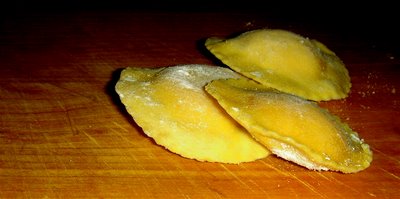
A few weeks ago I was motivated to make homemade butternut squash ravioli with sage brown butter sauce. When I initially started shaping the pasta dough I started questioning why I had begun such a tedious process. The first few ravioli I shaped were irregular, soggy and just plain hideous. As I persevered, however, the shaping process became easier and I finally developed my own, relatively efficient system. I froze most of what I created and my husband and I were able to enjoy this classic combination of savory sage and sweet squash for a second time last night. If you can overcome the frustrating preliminary shaping trials, I think you will find that your hard work will more than reward you with a few delicious and elegant dinners.
1 large butternut squash (about 1 lb)
kosher salt and freshly ground pepper
1/2 tsp . olive oil for the baking sheet
1 1/4 cups freshly grated Parmigiano Reggiano
2 eggs, lightly beaten
1 recipe pasta dough (see below)
2 T. unsalted butter
2 T. extra-virgin olive oil
8 fresh sage leaves
- Preheat the oven to 375 degrees F. Cut the squash in half lengthwise and scoop out and discard the seeds. Lightly season the inside with salt and pepper, and place on a lightly oiled baking sheet. Bake for about 1 hour or until the flesh is knife-tender.
- Remove from oven and let cool slightly. Scoop out flesh and pass through the fine disk of a food mill or purée in a food processor. Measure the purée, you should have about 2 cups (slightly more or less is fine). Stir in one cup of the grated Parmigiano. Add salt and pepper to taste. Keep testing the mixture until it tastes good to you–there is no salt in the dough, so correct the seasoning at this point. Stir in the eggs, and set aside. This mixture can be made 1-2 days in advance.
- To finish the dish, bring a large pot of water to a boil and add 1 tablespoon of salt. Combine butter and olive oil in a large non-stick sauté pan and heat until almost smoking. Add sage leaves and let sizzle until crisp, about 1-2 minutes total. Remove leaves with slotted spoon and drain on paper towel. Set aside. When water boils, add ravioli and cook until tender about 2-3 minutes (frozen ravioli also take only about 3 minutes). Reserve 1/4 cup of the pasta cooking water. When ravioli are done, drain, but do not rinse under cold water. Heat butter and oil again until hot, add ravioli (be careful, it will splatter), add reserved cooking water, remaining 1/4 cup of cheese and reserved sage leaves. Serve immediately.
- Prep Time: 15 minutes
- Cook Time: 1 hours 25 minutes
- 3 1/2 cups all-purpose flour, plus extra for kneading
- 5 large eggs lightly beaten
- Mound flour in the center of a medium-sized bowl. Make a well in the center of the mound of flour. Add the eggs to the center. Using a fork, beat the eggs and begin to incorporate the flour, starting with the inner rim of the well. (If you are skilled at employing the “well” method on a large wooden board, go ahead and do that. I have never had much luck using a board–the eggs usually break through the mound and run all over the cutting board. I’ve found that the bowl helps contain “run-away” eggs.) When the eggs are almost completely incorporated, start kneading the dough in the bowl and then transfer to a large, lightly floured wooden board and continue to knead for 10 minutes, dusting the board with additional flour as necessary. The dough should feel elastic and a little sticky. Wrap the dough in plastic wrap and allow to rest for 30 minutes at room temperature before using.
- To make the ravioli, divide the dough into 4 pieces. While you work with one section, keep the remaining dough covered with plastic wrap.
- Lightly flour the section of dough you are working with and roughly shape into a rectangle about 1/2 inch thick.
- Pass through the widest setting on a pasta machine. Fold the dough in three, like a letter and pass through the same setting again feeding the short end in first. Repeat this step 2 times, adding flour as needed.
- Without folding the dough now, repeatedly pass it through the machine rollers, reducing the space between the rollers after each pass. When it has passed through the thinnest setting, it is ready to be shaped into ravioli. (If the dough gets too long and difficult to deal with, cut it in half and feed each piece through separately until each has passed through the thinnest setting).
- The dough should be just less than 6 inches wide. Cut in half lengthwise. On one of these halves, place tablespoon-sized dollops of the squash filling evenly spaced about every 1 and 1/2 inches. Lay remaining half of dough atop the squash-dotted sheet of pasta. (This whole process will take some practice. I can almost guarantee you that your first batch will be ugly. Once you develop your own method, shaping the remaining dough will be much easier). With a knife, cut halfway between each mound to create the individual raviolis. Gently pinch to seal the two doughs together, using a tiny bit of water if necessary. Transfer to a baking sheet dusted with flour and cover with plastic wrap while you shape the remaining sections of dough.
Notes
This recipe makes a lot. I recommend shaping all of the dough (you may have extra filling which you could freeze) and then freezing whatever extra ravioli you don’t cook immediately. Also, do not store ravioli in the refrigerator–they become a soggy mess. Cook immediately or freeze.
- Prep Time: 40 minutes
