It doesn’t get much better than croque monsieur: layers of good, toasty bread, creamy béchamel, smoky ham, and nutty Gruyère. Top it with a perfectly poached egg, and it becomes croque madame. It’s what brunch (and dinner!) dreams are made of.

Croque monsieur is an iconic French dish, a simple sandwich at its core, but gussied up with a rich, creamy sauce, also known as béchamel. This one, prepared open-faced, is one of those assemblies where the product is so much more than the sum of its parts: a tablespoon of béchamel, a slice of ham, a handful of cheese. Sprinkled with fresh thyme out of the oven, and topped with a poached egg, which makes it croque madame, this classic French dish is heaven, a perfect breakfast or, with a salad by its side, a simple dinner.
Note: You could easily make this vegetarian by swapping in sautéed greens or mushrooms or roasted asparagus or fresh tomatoes for the ham.
How to Make Croque Monsieur/ Croque Madame, Step by Step
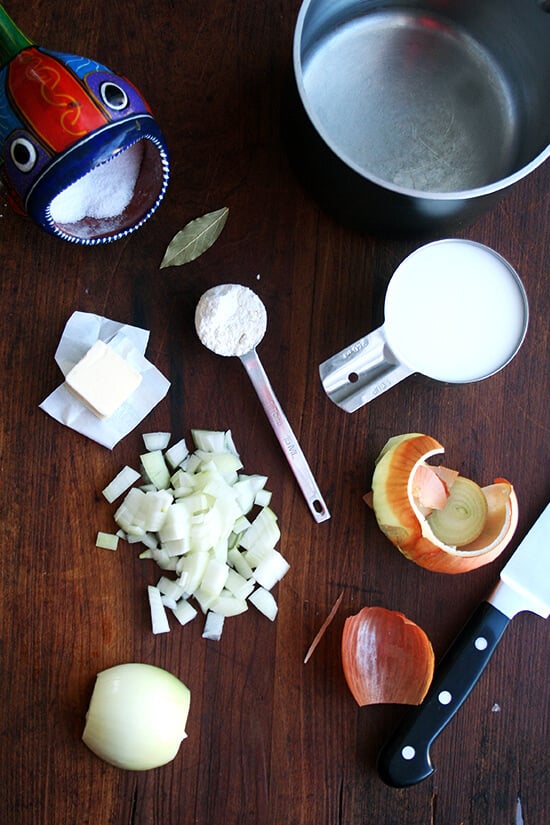
First, make the bechamel by melting the butter, sautéeing the onion, adding the flour and milk, and cooking until the mixture coats the back of a spoon.
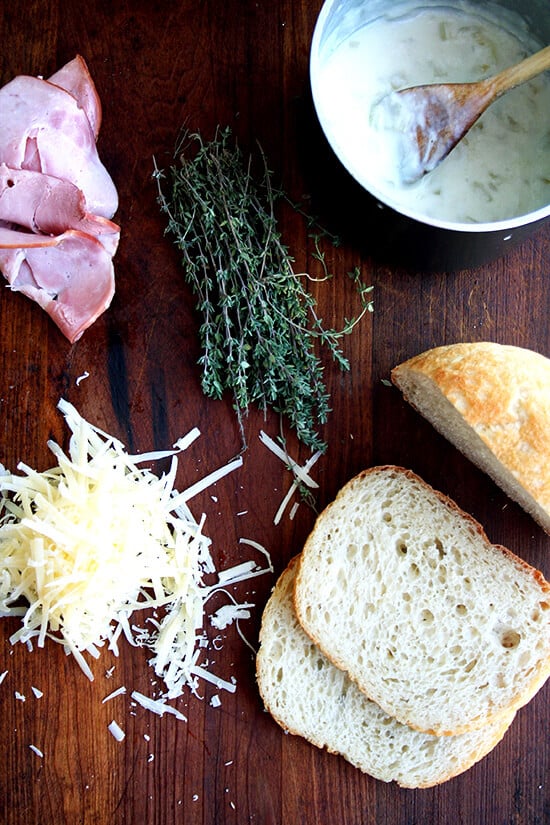
Next, gather your remaining ingredients: ham, cheese, thyme, and some good bread .
Make an open-faced sandwich as follows: broil however many slices of bread you wish for 1 minute on each side, then place the slices on a rack set atop a sheet pan. Spread bechamel over the slices, then top with sliced ham and grated cheese.

Broil until bubbly, then sprinkle with fresh thyme.

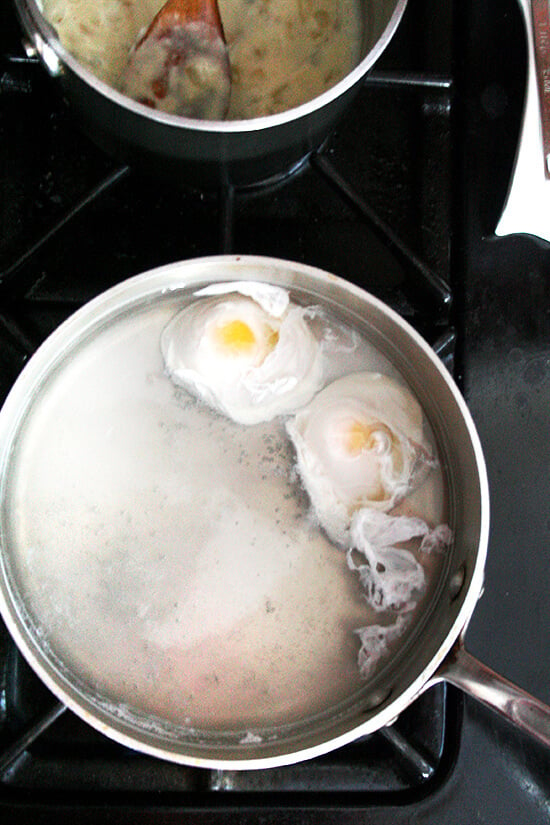
To make a croque madame, you’ll top the sandwich with a poached egg :



For a simple dinner, serve the Croque Monsieur/Madame with a simple salad.

Description
It doesn’t get much better than croque monsieur: layers of good, toasty bread, creamy béchamel, smoky ham, and nutty Gruyère. Top it with a perfectly poached egg, and it becomes croque madame. It’s what brunch (and dinner!) dreams are made of.
Notes:
Bechamel recipe adapted from Nancy Silverton’s Sandwich Book
For the croque monsieur:
- good bread , cut into thick slices
- béchamel (recipe below)
- 3 to 4 slices good ham (figure 1 to 2 per sandwich)
- grated Gruyère, Comté or Swiss cheese
- fresh thyme leaves
For the béchamel:
- 1 tablespoon butter
- 1/4 cup finely chopped onion
- kosher salt
- 1 tablespoon flour
- 1 cup whole milk
- 1 bayleaf
For the poached eggs:
- 2 eggs (count on 1 egg per sandwich)
- splash of white vinegar
- Prepare pot for eggs: Fill a shallow saucepan with two to three inches water and bring to a simmer.
- Prepare the béchamel : In a medium saucepan over medium heat, melt the butter. Add the onion and a pinch of salt and cook about 5 to 7 minutes or until the onion is soft but has not begun to color. Turn the heat to very low, add the flour, and stir to combine it with the onion and butter. Continue to cook over low heat until the flour is absorbed, stirring constantly so that it doesn’t brown, about 2 minutes or so. Slowly stir in the milk. Drop in the bay leaf.
- Over medium to medium-high heat, bring the mixture to a boil then reduce the heat to its lowest setting and cook for about 15 minutes, stirring occasionally to prevent the sauce from burning on the bottom of the pan. Taste and cook longer if the taste of raw flour is still detectable. The mixture should be thick, but if it’s too thick and becoming difficult to stir, you’ll need to whisk in a little more milk. Remove the bay leaf and discard.
- Meanwhile, preheat the broiler. Place the slices of bread on a rack on a sheet pan (or a broiling pan) and broil them about a minute on each side. Remove pan from the oven.
- Spread about 1 tablespoon of béchamel over each slice of bread. Top with 1 to 2 slices of ham. Top with grated cheese to taste. Set aside.
- Crack each egg into a small bowl or ramekin. Sprinkle about a tablespoon of vinegar into the pot of simmering shallow water. Adjust the heat so that the water is barely simmering — get the water to a simmer, then turn it down so you don’t see any bubbles. Use the handle of a wooden spoon to make a whirlpool in the water, then drop one egg into the center of the whirlpool. Repeat with other egg. Adjust the heat to keep the water just below a simmer. Set the timer for 3 minutes.
- When the eggs have cooked for 3 minutes, place the toasts under the broiler and cook until the cheese is bubbling and starting to brown. Remove from the oven. Sprinkle with the fresh thyme.
- Meanwhile, using a slotted spoon, lift one egg up from the water and shake it. The yolk should jiggle a little bit, but shouldn’t look too loose. You might have to cook the eggs for a minute longer. Note: Knowing when poached eggs are done is just a matter of practice and preference — personally I don’t like the yolk to taste raw, but I still like it runny, and for this consistency, I usually have to cook the eggs for about 4 to 5 minutes. When the eggs look cooked to your liking, remove them with a slotted spoon and transfer to a paper towel-lined plate.
- Top each sandwich with a poached egg. Sprinkle with a pinch of salt and freshly cracked pepper to taste.
- Prep Time: 10 minutes
- Cook Time: 30 minutes
- Category: Breakfast
- Method: Stovetop, Oven
- Cuisine: French, American
Description
It doesn’t get much better than croque monsieur: layers of good, toasty bread, creamy béchamel, smoky ham, and nutty Gruyère. Top it with a perfectly poached egg, and it becomes croque madame. It’s what brunch (and dinner!) dreams are made of.
Notes:
Bechamel recipe adapted from Nancy Silverton’s Sandwich Book
For the croque monsieur:
- good bread , cut into thick slices
- béchamel (recipe below)
- 3 to 4 slices good ham (figure 1 to 2 per sandwich)
- grated Gruyère, Comté or Swiss cheese
- fresh thyme leaves
For the béchamel:
- 1 tablespoon butter
- 1/4 cup finely chopped onion
- kosher salt
- 1 tablespoon flour
- 1 cup whole milk
- 1 bayleaf
For the poached eggs:
- 2 eggs (count on 1 egg per sandwich)
- splash of white vinegar
- Prepare pot for eggs: Fill a shallow saucepan with two to three inches water and bring to a simmer.
- Prepare the béchamel : In a medium saucepan over medium heat, melt the butter. Add the onion and a pinch of salt and cook about 5 to 7 minutes or until the onion is soft but has not begun to color. Turn the heat to very low, add the flour, and stir to combine it with the onion and butter. Continue to cook over low heat until the flour is absorbed, stirring constantly so that it doesn’t brown, about 2 minutes or so. Slowly stir in the milk. Drop in the bay leaf.
- Over medium to medium-high heat, bring the mixture to a boil then reduce the heat to its lowest setting and cook for about 15 minutes, stirring occasionally to prevent the sauce from burning on the bottom of the pan. Taste and cook longer if the taste of raw flour is still detectable. The mixture should be thick, but if it’s too thick and becoming difficult to stir, you’ll need to whisk in a little more milk. Remove the bay leaf and discard.
- Meanwhile, preheat the broiler. Place the slices of bread on a rack on a sheet pan (or a broiling pan) and broil them about a minute on each side. Remove pan from the oven.
- Spread about 1 tablespoon of béchamel over each slice of bread. Top with 1 to 2 slices of ham. Top with grated cheese to taste. Set aside.
- Crack each egg into a small bowl or ramekin. Sprinkle about a tablespoon of vinegar into the pot of simmering shallow water. Adjust the heat so that the water is barely simmering — get the water to a simmer, then turn it down so you don’t see any bubbles. Use the handle of a wooden spoon to make a whirlpool in the water, then drop one egg into the center of the whirlpool. Repeat with other egg. Adjust the heat to keep the water just below a simmer. Set the timer for 3 minutes.
- When the eggs have cooked for 3 minutes, place the toasts under the broiler and cook until the cheese is bubbling and starting to brown. Remove from the oven. Sprinkle with the fresh thyme.
- Meanwhile, using a slotted spoon, lift one egg up from the water and shake it. The yolk should jiggle a little bit, but shouldn’t look too loose. You might have to cook the eggs for a minute longer. Note: Knowing when poached eggs are done is just a matter of practice and preference — personally I don’t like the yolk to taste raw, but I still like it runny, and for this consistency, I usually have to cook the eggs for about 4 to 5 minutes. When the eggs look cooked to your liking, remove them with a slotted spoon and transfer to a paper towel-lined plate.
- Top each sandwich with a poached egg. Sprinkle with a pinch of salt and freshly cracked pepper to taste.
- Prep Time: 10 minutes
- Cook Time: 30 minutes
- Category: Breakfast
- Method: Oven, Stovetop
- Cuisine: French, American
Find it online : https://alexandracooks.com/2014/01/07/croque-monsieur-with-poached-eggs/





I typically don’t/never do this: 1. Post a recipe I’ve made only once. 2. Suggest you make something I’ve never tasted.
Why am I making the exception today? Well, this is the thing: preserving, as many of you know, takes time, and while I would prefer to wait a month to tell you how these preserved lemons turn out, I would prefer more if in a month from now you actually had these preserved lemons on hand, so when in the event I post about something else, something perhaps like the chicken tagine with preserved lemons and green olives I had at Tara Kitchen in early December, a dish I cannot stop thinking about and so hope to recreate at home, you’ll be able to participate, too.
Make sense? I mean, what if on February 10th, I posted about said tagine and exclaimed: Friends, you HAVE to make this. It is the BEST thing you will ever eat. All you need is a chicken, some stock, a bunch of herbs and preserved lemons. You would be like, are you serious? Oh sure, let me just run to my pantry and pull out my jar of preserved lemons. I mean, doesn’t everyone spend all of citrus season slicing and salting and stuffing Mason jars full of lemons? Couldn’t you have given us a head’s up? How hard would that have been? Am I right? Just making sure I can sleep at night.
And so today I offer you two recipes for preserved lemons, one from Jerusalem , which will be ready in four weeks, and one from the September 2013 Bon Appétit , which will be ready in two weeks. Both sound promising. Fingers crossed?
PS: M oroccan Chicken with Green Olives and Preserved Lemon s
PPS: Canal House Chicken Thighs with Preserved Lemons

The first method, from Jerusalem , calls for a two phase process. During the first phase, scored lemons stuffed with salt sit for a week in a Mason jar. During the second phase, rosemary, chile, lemon juice and olive oil are added to the jar and everything mingles together for three more weeks.

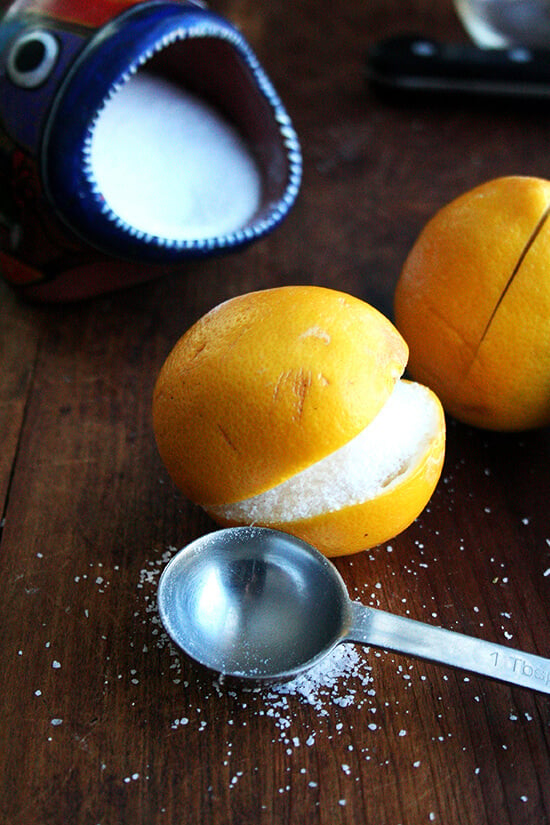
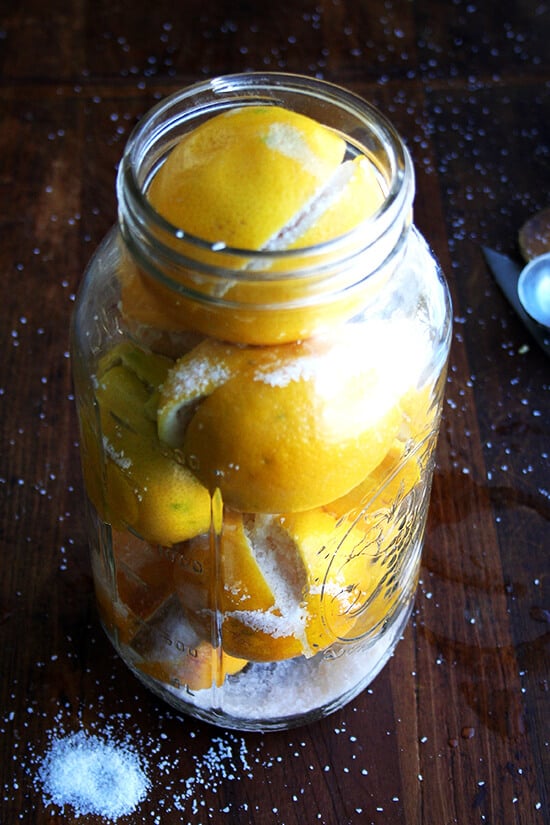
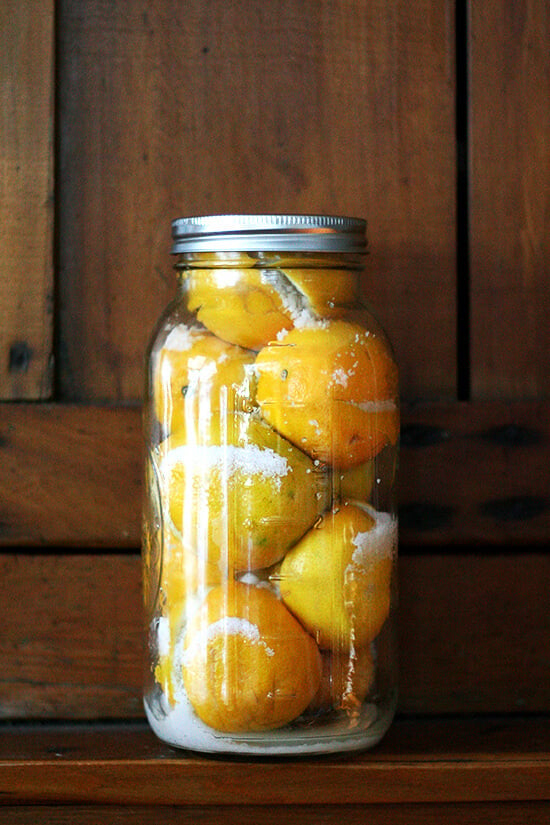

After 1 week, add a dried chili or 1/2 teaspoon crushed red pepper flakes and a sprig of rosemary.
Update: 3/10/2014: Upon returning from a Tara Kitchen cooking class and learning that the owner, Aneesa, purées her preserved lemons — lemons, salt and juice — and uses spoonfuls of the purée in her dishes, I whizzed my whole batch of Jerusalem preserved lemons in the food processor and now have a jar of purée I am certain will last a decade.
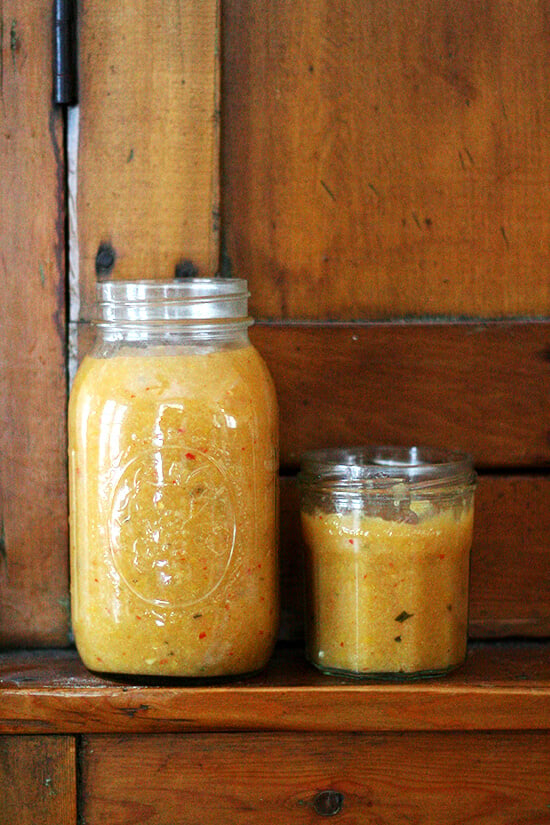
Here’s a little more I learned from Aneesa about making/using preserved lemons: Aneesa does not use Meyer lemons at the restaurant because of cost, but she believes their thin skin makes them ideal for preserving. She uses the more traditional preserving method (the Jerusalem method vs the BA method). She never rinses the lemons before using because once her lemons are preserved, she purées the whole batch and uses spoonfuls of her puréed preserved lemons in various dishes.

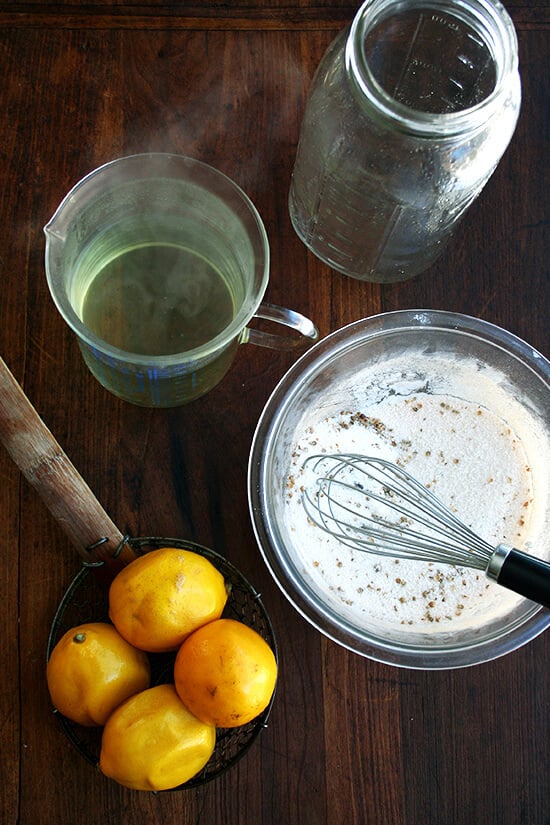
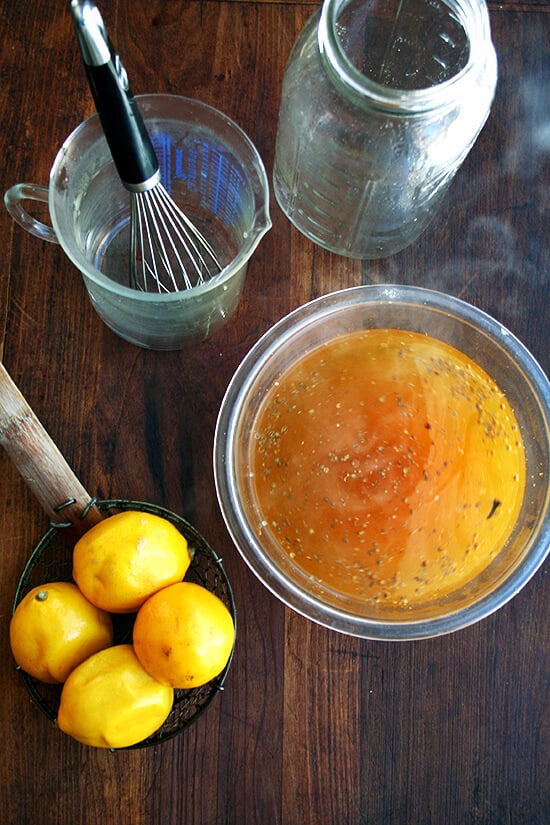
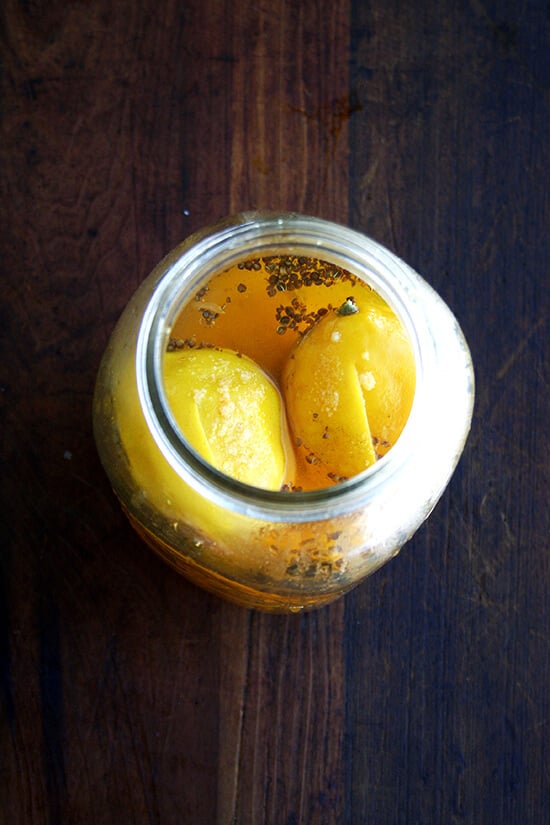
The second method, from Bon Appetit , calls for boiling the lemons first, then submerging them in a brine. From the bit of recipe comparison I did on preserving lemons, this method, which calls for a fair amount of sugar, seems to be a bit unconventional. That said, BA described the lemons as “the best [they’ve] ever tasted.” The recipe comes from Philip Krajeck, chef of Rolf & Daughters in Nashville.

Description
Having made these several times now, I’ve made a few teensy changes: I don’t add the rosemary and chilies anymore—I only use lemons, salt and lemon juice. After the 4 weeks, too, I purée the lemons, salt, juice and all. This was a tip I learned from Aneesa, the owner of Tara Kitchen in Schenectady. I find having the purée on hand to be much more user friendly.
- 6 lemons (or however many you want to make)
- 6 tablespoons coarse sea salt or kosher salt
- 2 rosemary sprigs, optional (see notes)
- 1 large red chile, optional (see notes)
- juice of 6 lemons
- olive oil (see notes)
- Before starting, find a jar large enough to accommodate all of the lemons snugly — I used a 2-quart jar for my 8 lemons. To sterilize it, fill it with boiling water, leave for a minute, and then empty it. Allow it to dry out naturally without wiping it so it remains sterilized.
- Wash the lemons and cut a deep cross all the way from the top to within ¾ inch from the base. Stuff each lemon with about 1 tablespoon of the salt (if lemons are small, use 2 teaspoons) and place in the jar. Push the lemons in tightly so they are squeezed together snugly. Seal the jar and leave in a cool spot for at least a week.
- After the initial period, remove the lid and press the lemons as hard as you can to squeeze out as much of the juice as possible. Add the rosemary and chile, if using, and the lemon juice, and cover with a thin layer of olive oil—I don’d do this olive oil step. Seal the jar, transfer to the fridge, and leave for at least 4 weeks. The longer you leave them, the better the flavor.
- If desired, purée the whole batch—lemons, salt, juice and all.
- Prep Time: 20 minutes
Description
- 4 to 8 lemons, I used Meyer but you can use any kind
- ⅔ cup sugar
- 7 tablespoons kosher salt
- 1 teaspoon crushed coriander seeds
- ¼ teaspoon ground turmeric
- 1 clove
- Boil 4 scrubbed lemons until softened, 10-12 minutes.
- Transfer lemons to a bowl of ice water. (Oops, I didn’t do this.) Reserve cooking liquid.
- Using a paring knife, deeply score lengthwise 4 times, leaving lemons intact.
- Whisk ⅔ cup sugar, 7 tablespoons kosher salt, 1 teaspoon crushed coriander seeds, ¼ teaspoon ground turmeric, 1 clove, and 3 cups hot cooking liquid in a bowl. Transfer lemons to a one- or two-quart heatproof jar and add brine. Cover and chill at least 2 weeks. Update: Store these in the fridge. I store the Jerusalem variety at room temp, but I think these (with all that sugar) should be refrigerated unless you keep your house very cold.
