This homemade ravioli recipe unites sweet, creamy pumpkin with salty, nutty parmesan to create the most delicious ravioli filling. Dressed with a brown butter sage sauce, it’s the ultimate fall comfort food.
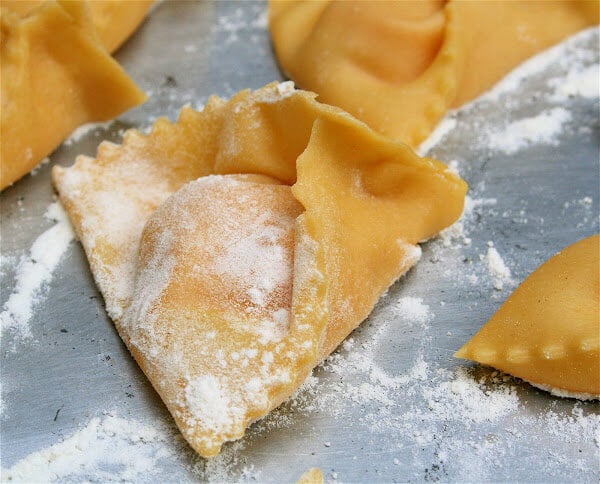
Like making bread from scratch, making pasta from scratch is a deeply rewarding process. Yes, it takes a little effort, but the reward — having a stash of pumpkin-filled pillows of goodness on hand, ready to be dressed in sage brown butter — is well worth it. I promise.
This recipe requires making homemade pasta dough and homemade pumpkin filling, shaping the ravioli, cooking them, and tossing them in a simple brown butter sage sauce.
The good news is that you can break up the work over a couple of days. This is my preferred way to do it in fact.
How To Make Homemade Pumpkin Ravioli
- Roast the squash and make the filling one day.
- Make the dough and shape the ravioli the next.
- Cook the ravioli immediately or freeze for up to 3 months.
- Make the sage brown butter sauce, which takes no time to prepare, just before serving.
Filling:
- 1 sugar pumpkin*
- olive oil
- kosher salt and pepper
- 2 cups Parmigiano Reggiano, freshly grated
- 2 eggs, lightly beaten
*Winter squash such as Hubbard, red kuri or butternut make fine substitutes for the pumpkin. One sugar pumpkin yields about two cups of flesh.
Dough:
- 3½ cups all-purpose flour, plus extra for kneading
- 5 large eggs lightly beaten
To Make:
- 4 T. unsalted butter
- 8 fresh sage leaves
- ¼ cup Parmigiano Reggiano
For the filling:
- Preheat the oven to 400ºF. Cut pumpkin in half, scoop out the seeds and discard. Drizzle about a teaspoon of olive oil on a baking sheet. Season inside of pumpkin with salt and place cut side down. Roast for about 45 minutes or until a knife inserts easily through the skin into the flesh. Remove from the oven and let cool completely.
- Scoop out flesh and place in a bowl. Add the two cups of cheese and season with salt to taste. Mix to combine. Taste and add more salt until the mixture tastes well seasoned — there is no salt in the dough, so this is your only chance to season the ravioli. Add the eggs and mix to combine. Set aside.
For the dough:
- Mound flour in the center of a medium-sized bowl. Make a well in the center of the mound of flour. Add the eggs to the center. Using a fork, beat the eggs and begin to incorporate the flour, starting with the inner rim of the well. When the eggs are almost completely incorporated, start kneading the dough in the bowl and then transfer to a large, lightly floured wooden board and continue to knead for 10 minutes, dusting the board with additional flour as necessary. The dough should feel elastic and a little sticky. Wrap the dough in plastic wrap and allow to rest for 30 minutes at room temperature before using.
To assemble:
- To make the ravioli, divide the dough into 4 pieces. Keep the dough covered with plastic wrap at all times. Lightly flour one of the pieces of dough, and shape into a rectangle about ½-inch thick.
- Pass through the widest setting on a pasta machine. Fold the dough in three, like a letter, and pass through the same setting again feeding the short end in first. Repeat this step 2 times, adding flour as needed.
- Without folding the dough now, repeatedly pass it through the machine rollers, reducing the space between the rollers after each pass. When it has passed through the thinnest setting, it is ready to be shaped into ravioli. (If the dough gets too long and difficult to deal with, cut it in half and feed each piece through separately until each has passed through the thinnest setting).
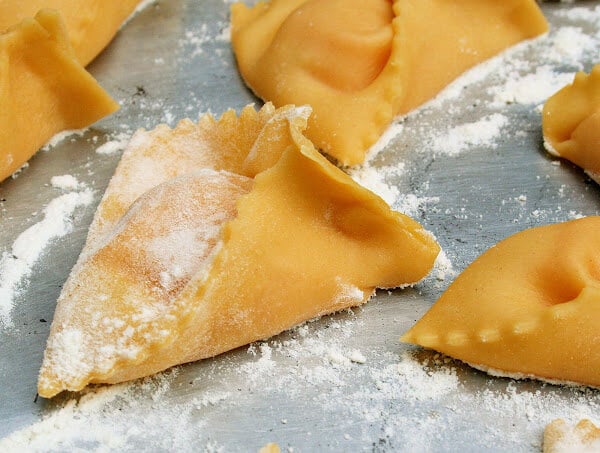
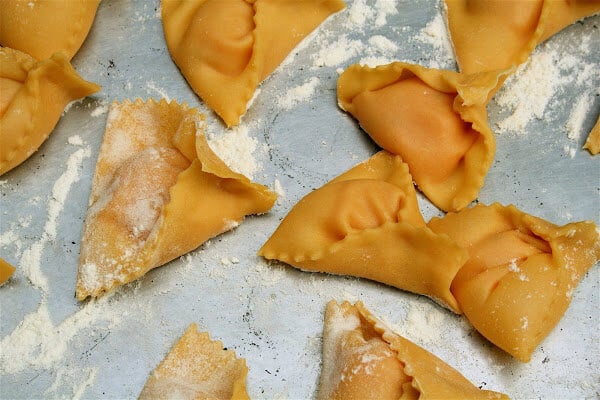
- The dough should be just less than 6 inches wide. On the bottom half of the dough, place heaping teaspoons of the squash filling, evenly spaced every 1½ inches. Fold top half of dough over bottom half. With a knife or fluted roller, cut between each mound to create the individual raviolis. Gently pinch to seal the two dough layers together, using a tiny bit of water if necessary. Transfer to a baking sheet dusted with flour and cover with plastic wrap while you shape the remaining sections of dough.
- At this point, decide how many ravioli you want to cook, and then freeze any remaining: Do not store ravioli in the refrigerator — they become a soggy mess.
To serve:
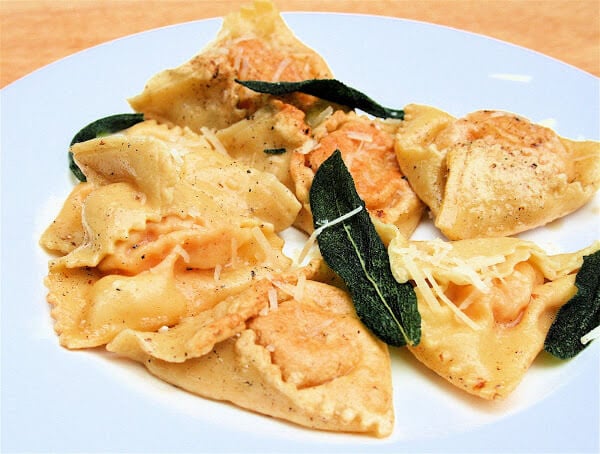
- Bring a large pot of water to a boil and add 1 tablespoon of salt. Place butter in a small sauté pan and heat until it bubbles. Add the sage leaves and let sizzle until crisp, about 1-2 minutes total. Turn off the heat, remove leaves with tongs and drain on a paper towel. Set aside. When water boils, add ravioli and cook until tender about 2-3 minutes (frozen ravioli also take only about 3 minutes). When ravioli are done, drain, or remove with a spider, but do not rinse under cold water. Place ravioli on a serving platter. Heat butter again until hot and begins to brown. Return the sage leaves and then spoon brown-butter over ravioli. Sprinkle with cheese. Serve immediately.
- Prep Time: 50 minutes
- Cook Time: 1 hours 10 minutes
- Category: Pasta
- Method: Boil, Stovetop
- Cuisine: Italian, American
Filling:
- 1 sugar pumpkin*
- olive oil
- kosher salt and pepper
- 2 cups Parmigiano Reggiano, freshly grated
- 2 eggs, lightly beaten
*Winter squash such as Hubbard, red kuri or butternut make fine substitutes for the pumpkin. One sugar pumpkin yields about two cups of flesh.
Dough:
- 3½ cups all-purpose flour, plus extra for kneading
- 5 large eggs lightly beaten
To Make:
- 4 T. unsalted butter
- 8 fresh sage leaves
- ¼ cup Parmigiano Reggiano
For the filling:
- Preheat the oven to 400ºF. Cut pumpkin in half, scoop out the seeds and discard. Drizzle about a teaspoon of olive oil on a baking sheet. Season inside of pumpkin with salt and place cut side down. Roast for about 45 minutes or until a knife inserts easily through the skin into the flesh. Remove from the oven and let cool completely.
- Scoop out flesh and place in a bowl. Add the two cups of cheese and season with salt to taste. Mix to combine. Taste and add more salt until the mixture tastes well seasoned — there is no salt in the dough, so this is your only chance to season the ravioli. Add the eggs and mix to combine. Set aside.
For the dough:
- Mound flour in the center of a medium-sized bowl. Make a well in the center of the mound of flour. Add the eggs to the center. Using a fork, beat the eggs and begin to incorporate the flour, starting with the inner rim of the well. When the eggs are almost completely incorporated, start kneading the dough in the bowl and then transfer to a large, lightly floured wooden board and continue to knead for 10 minutes, dusting the board with additional flour as necessary. The dough should feel elastic and a little sticky. Wrap the dough in plastic wrap and allow to rest for 30 minutes at room temperature before using.
To assemble:
- To make the ravioli, divide the dough into 4 pieces. Keep the dough covered with plastic wrap at all times. Lightly flour one of the pieces of dough, and shape into a rectangle about ½-inch thick.
- Pass through the widest setting on a pasta machine. Fold the dough in three, like a letter, and pass through the same setting again feeding the short end in first. Repeat this step 2 times, adding flour as needed.
- Without folding the dough now, repeatedly pass it through the machine rollers, reducing the space between the rollers after each pass. When it has passed through the thinnest setting, it is ready to be shaped into ravioli. (If the dough gets too long and difficult to deal with, cut it in half and feed each piece through separately until each has passed through the thinnest setting).
- The dough should be just less than 6 inches wide. On the bottom half of the dough, place heaping teaspoons of the squash filling, evenly spaced every 1½ inches. Fold top half of dough over bottom half. With a knife or fluted roller, cut between each mound to create the individual raviolis. Gently pinch to seal the two dough layers together, using a tiny bit of water if necessary. Transfer to a baking sheet dusted with flour and cover with plastic wrap while you shape the remaining sections of dough.
- At this point, decide how many ravioli you want to cook, and then freeze any remaining: Do not store ravioli in the refrigerator — they become a soggy mess.
To serve:
- Bring a large pot of water to a boil and add 1 tablespoon of salt. Place butter in a small sauté pan and heat until it bubbles. Add the sage leaves and let sizzle until crisp, about 1-2 minutes total. Turn off the heat, remove leaves with tongs and drain on a paper towel. Set aside. When water boils, add ravioli and cook until tender about 2-3 minutes (frozen ravioli also take only about 3 minutes). When ravioli are done, drain, or remove with a spider, but do not rinse under cold water. Place ravioli on a serving platter. Heat butter again until hot and begins to brown. Return the sage leaves and then spoon brown-butter over ravioli. Sprinkle with cheese. Serve immediately.
- Prep Time: 50 minutes
- Cook Time: 1 hours 10 minutes
- Category: Pasta
- Method: Stovetop, Boil
- Cuisine: American, Italian
Find it online : https://alexandracooks.com/2007/11/01/pumpkin-ravioli/

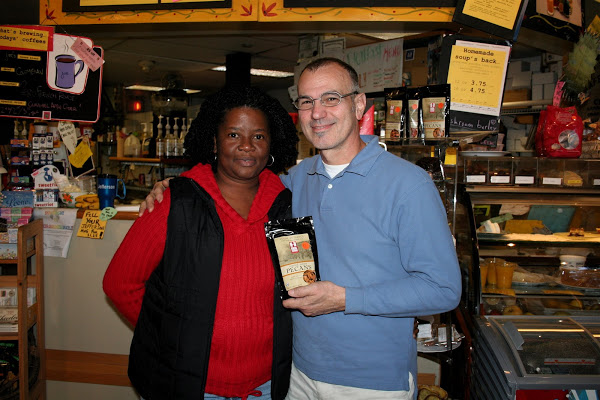
Once a term used only to label coffee, chocolate, tea and a few other imported products, Fair Trade now describes a few domestic items as well. In honor of Fair Trade month (October), four farmers — two banana farmers from Costa Rica, a pecan farmer from Georgia, and an apple farmer from Vermont — visited several East Coast cities on a tour called the Faces Of Fair Trade. Last Tuesday, Joe Coffee Bar hosted one of the tour’s stops, and I got to meet Diann Johnson (the pecan farmer), Glen Schreiter (the apple farmer) and Yocser Godoy Carranza and Carlos Vargas (the banana farmers) — the new faces of Fair Trade.
I never realized all the difficulties — isolation, for example, and low prices driven by increased market supply from countries such as China — domestic farms face, until I spoke with these farmers, especially Mr. Schreiter.
To survive in a globalized world, Mr. Schreiter had to change his game plan, and in 2000, he initiated a complete restructuring of his farm, Saxtons River Orchards, in Saxtons River, Vermont. The last straw? Mr. Scheiter couldn’t even sell his apples to his neighbors, living only 10 minutes from his farm. Before 2000, Mr. Schreiter’s 200-acre farm, equipped with a multi-million dollar packing facility, shipped their apples all over the world. After 1993, however, when NAFTA enabled China (the largest apple-producing country in the world) and New Zealand to sell their apples to consumers in the U.S. and all over the world, Mr. Screiter’s farm began suffering.
And so, Mr. Schreiter downsized his farm to 40 acres, sold the packing facility and hooked up with an organization called Red Tomato , a nonprofit organization dedicated to connecting farmers and consumers. Red Tomato purchases 50 percent of Mr. Schreiter’s apples as well as fruits and vegetables from family farms located all along the East Coast, supplying shops throughout New England. Because few farmers’ markets operate near Saxtons River, and because the farm’s isolated location discourages many visitors, Mr. Schreiter believes his orchard could not survive without Red Tomato.
In 11 years, Red Tomato has succeeded in bringing locally grown produce to markets such as Whole Foods and Trader Joe’s. In 20 years, Equal Exchange , the oldest and largest Fair Trade for-profit organization in the country, has brought numerous Fair Trade goods — including domestic nuts and dried cranberries — to hundreds of cafés and stores, reaching over a million consumers. These organizations, realizing that domestic farmers face many of the same challenges producers in marginalized regions of the world face, have changed the face of Fair Trade.
Diann Johnson (pecan farmer from Georgia) stands with Joe Cesa (owner of Joe Coffee Bar) at Joe Coffee Bar, where many Fair Trade products are sold:
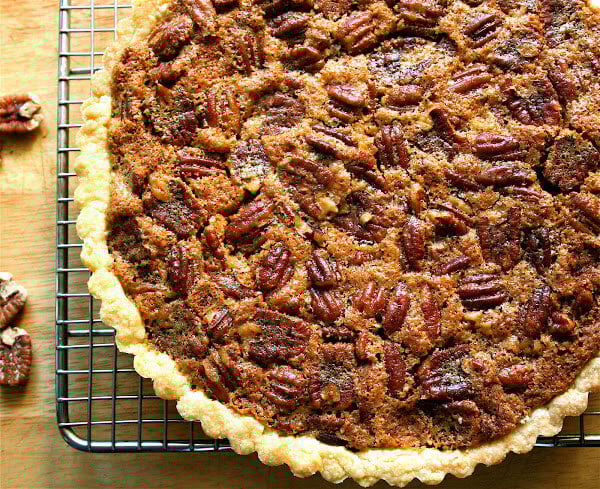
Fair Trade Pecan Tart Serves 5
1 stick unsalted butter, room temperature ¼ C. sugar 1 large egg yolk pinch sea salt 1¼ C. all purpose flour 2-3 T. milk, cream or water
Beat butter and sugar using an electric mixer until smooth. Add the yolk and salt and mix again until smooth. Add the flout, mixing on low until just incorporated. Add the liquid, a tablespoon at a time, to bind. Turn dough out onto a lightly floured work surface and roll into an 11-inch round, approximately. Transfer to a 9-inch round tart pan with a removable bottom. Pierce dough all over with a fork and place in the freezer for 30 minutes.
Filling: 3 large eggs ½ C. packed brown sugar ½ C. maple syrup ½ C. dark corn syrup ¼ C. unsalted butter, melted 1½ C. coarsely chopped Fair Trade pecans, roasted and salted
Preheat the oven to 350ºF. Whisk together the eggs, sugar and syrups until well blended. Pour in the melted butter, whisking constantly. Stir in the pecans. Place the tart shell on a baking sheet and pour the filling inside. Bake tart until filling is puffed and slightly set, about 40 minutes. Transfer to a rack to cool