Grandma-style pizza is pan pizza with a light crust and crisp edges. The dough is nearly identical to focaccia and, as such, is just as easy to make. No mixer required. No fancy techniques. This style of pizza is perfect for feeding a crowd! Find step-by-step instructions below.
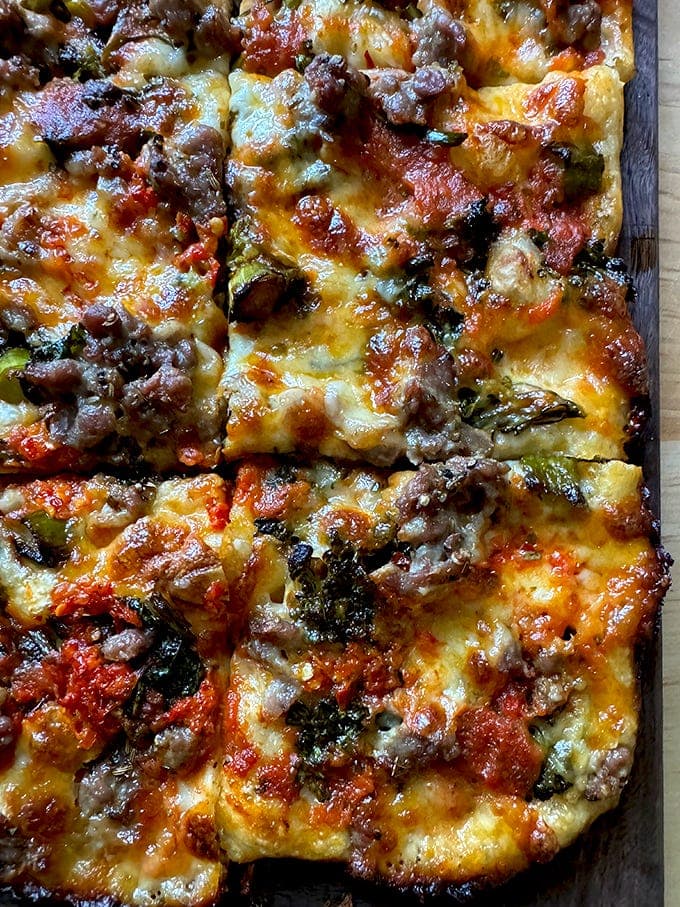
Grandma pizza is sheet pan pizza, similar to Sicilian-style pizza but thinner: you use the same size pan but half the amount of dough. Unlike Sicilian-style pizza, with grandma pizza, there’s no parbake, which makes the process simpler.
I love the various styles of pan pizzas for different reasons — Detroit-style for its irresistible frico crust, Sicilian for it’s pillowy airiness — but for me, grandma is the best: it’s the thinnest of the three styles, and I love the ratio of toppings to crust as well as its texture: light and airy, like focaccia, but with crisp edges, too.
As with Sicilian and Detroit-style pizza, grandma pizza is great for feeding a crowd. What’s more, so much of the process can be done ahead of time, from making the dough to stretching and topping it. A Lloyd steel pan makes for an especially crispy crust, but a standard half sheet pan works well, too. Find a how-to video and step-by-step instructions below.
How to Make Grandma-Style Pizza, Step by Step
First, make the dough. You’ll need bread flour, instant yeast ( SAF is my preference ), salt, and water:
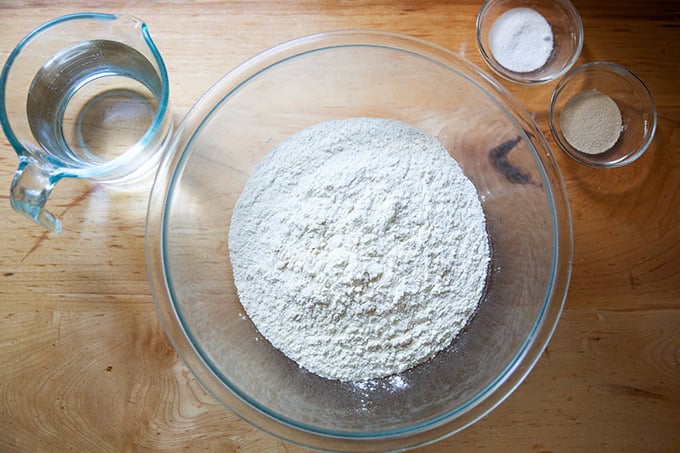
The process is the same as making focaccia: Combine the dry ingredients in a large bowl:
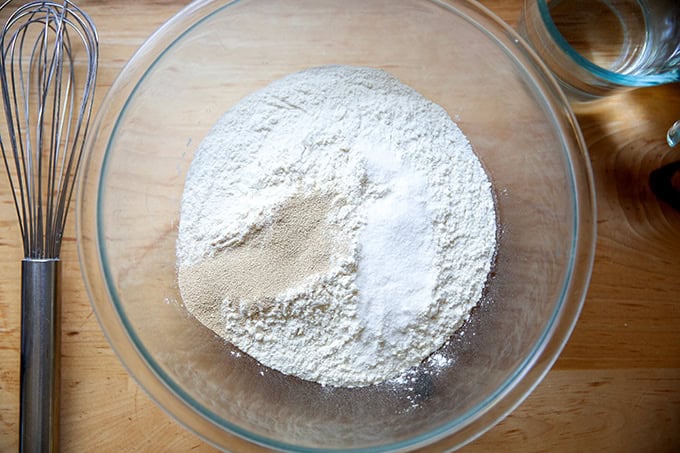
Whisk them together, then add the water:
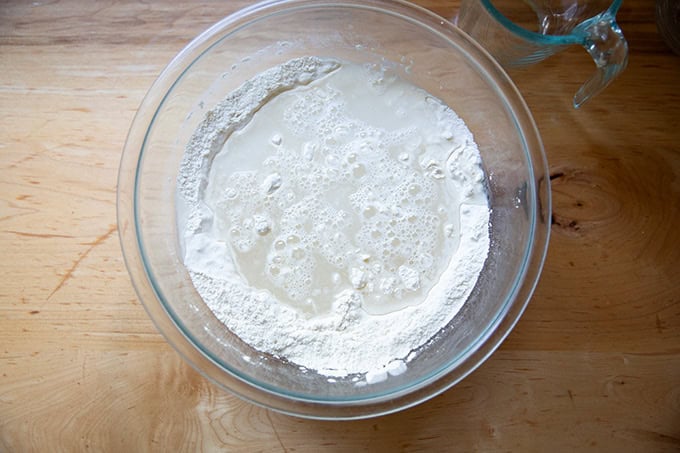
Mix until you have a sticky dough ball.
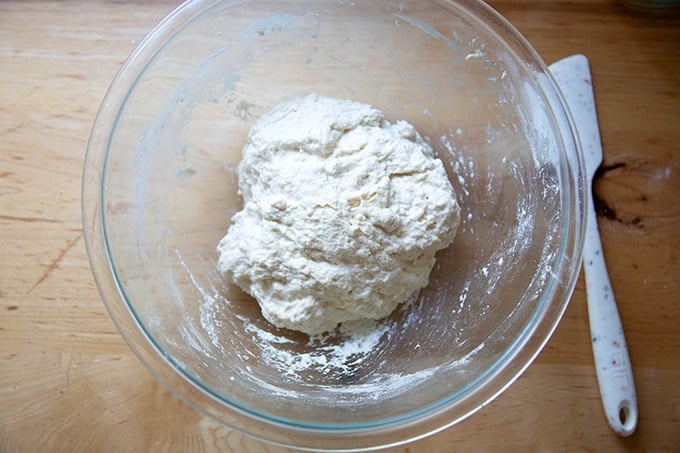
Let the dough rest for 30 minutes, then stretch and fold the dough. Video guidance is above (and in the recipe card.) After the stretches and folds, your dough will be a more cohesive ball. Slick it with olive oil, cover the bowl, and let it rest at room temperature for 6 to 10 hours.
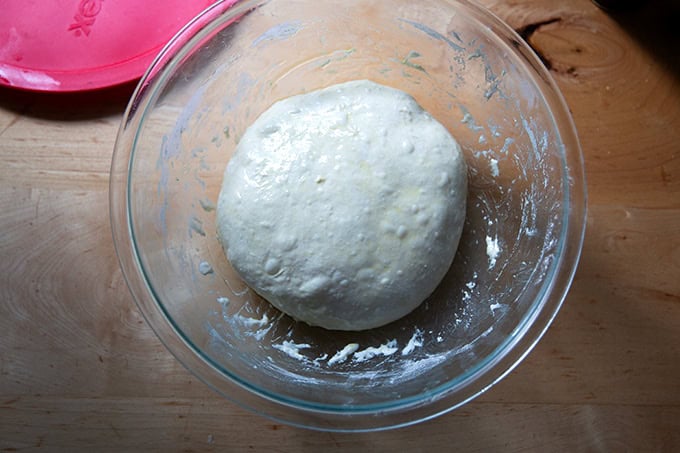
Uncover the bowl…
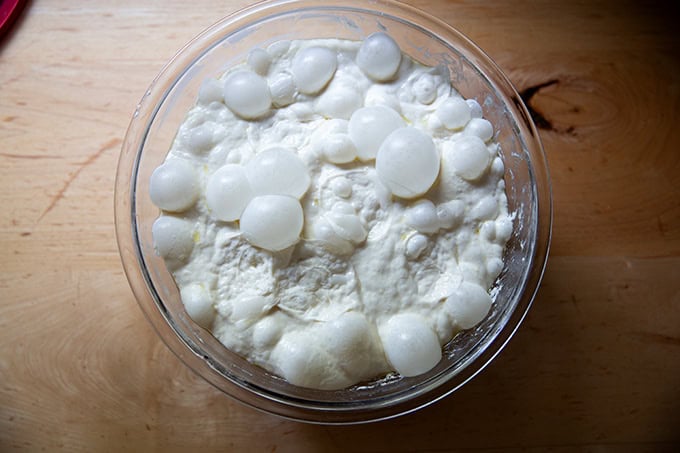
… deflate it …
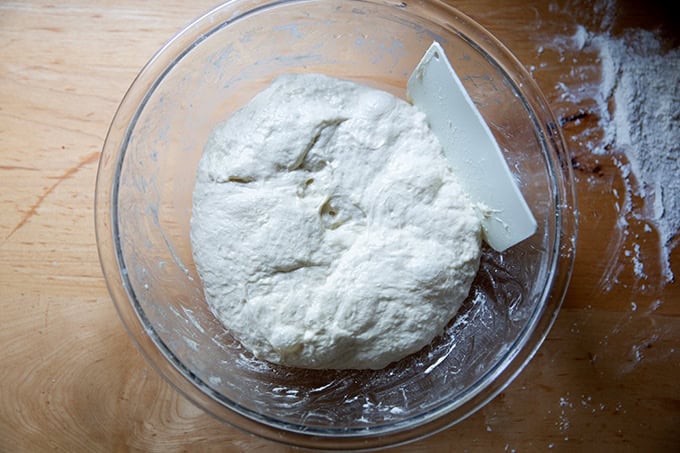
… and turn it out onto a floured work surface.
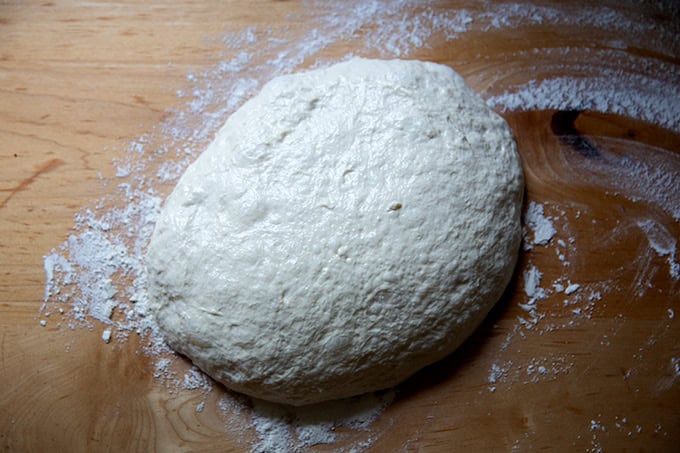
Divide the dough into two equal portions. Each portion should weigh roughly 525 grams.
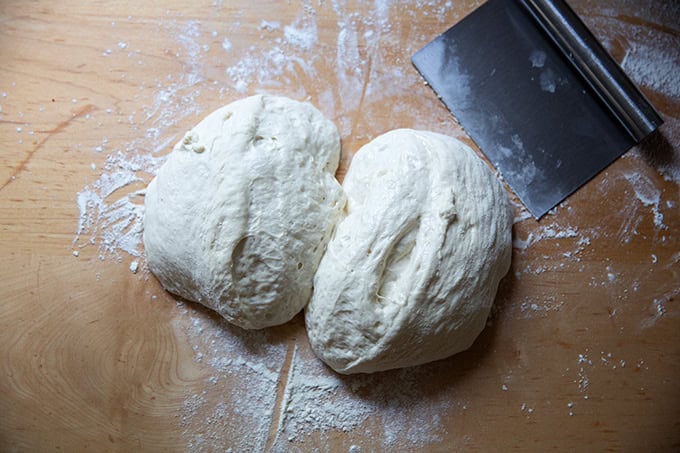
Ball up each portion. The dough will be very wet and sticky, so use flour as needed.
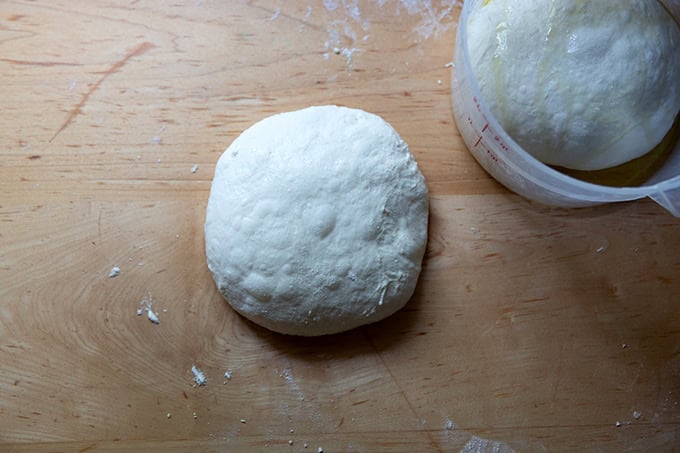
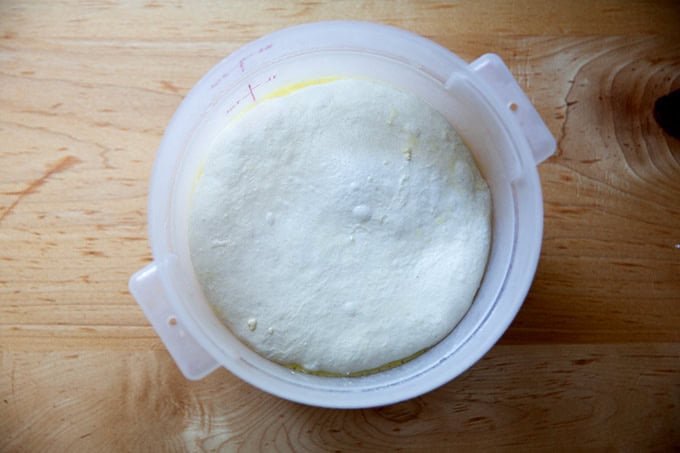
Transfer each portion to a lightly oiled vessel. I love this 2-quart vessel . (I have 4 of these! So handy for so many things.) Drizzle each ball lightly with oil and turn to coat. Cover the vessels and place them in the fridge for 1 to 3 days (or for as long as 5). See recipe box if you need to shorten this timeline.
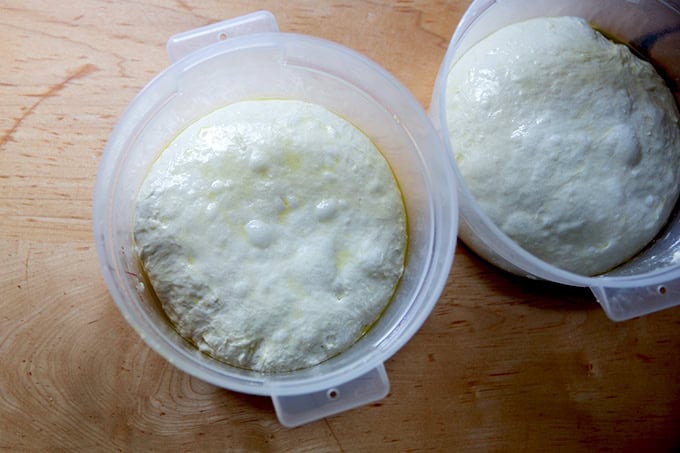
On baking day, remove one (or both if you are making two pizzas) of the vessels.
Prepare your pan. This is a Lloyd grandma-style pizza pan, and it makes an especially nice crust but you can use a standard sheet pan in its place. You want to butter the pan first — this provides flavor, promotes browning, and prevents sticking — before pouring in 1 tablespoon of olive oil.
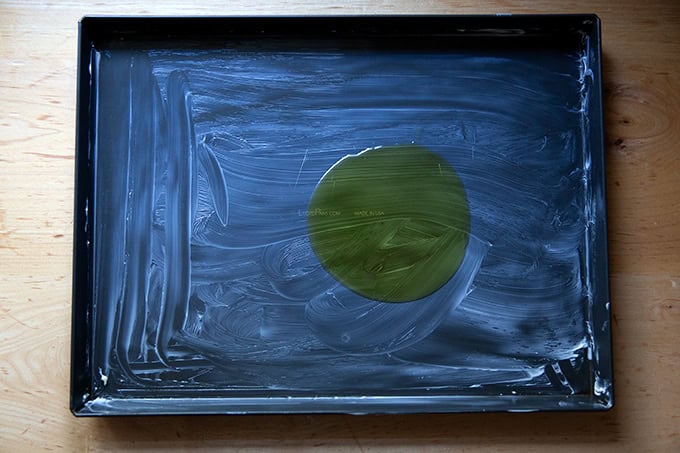
Turn the dough out into the pool of oil and turn it to coat.
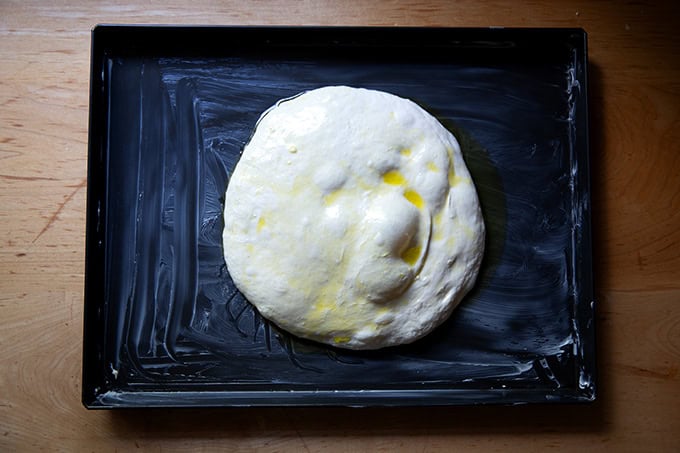
Let the dough rest at room temperature for 1 to 4 hours, depending on your timing needs.
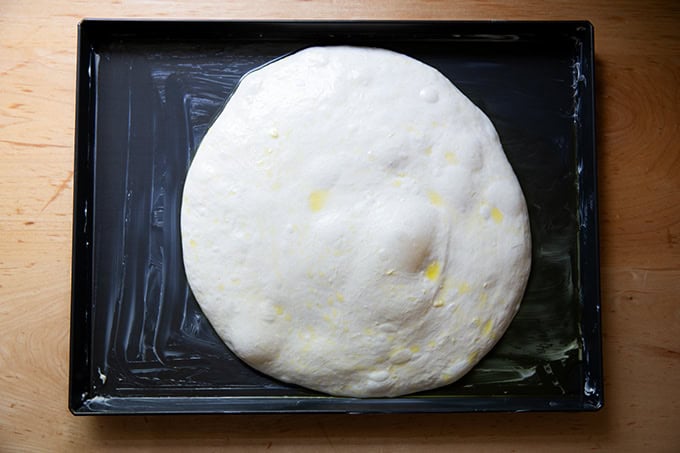
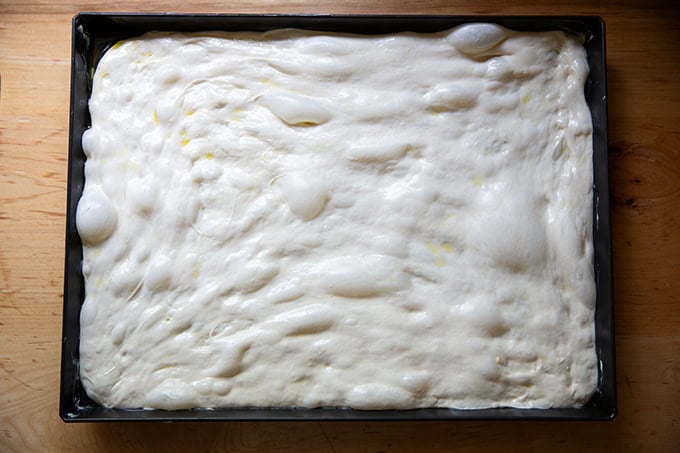
Using lightly oiled hands, stretch the dough to fit the pan.
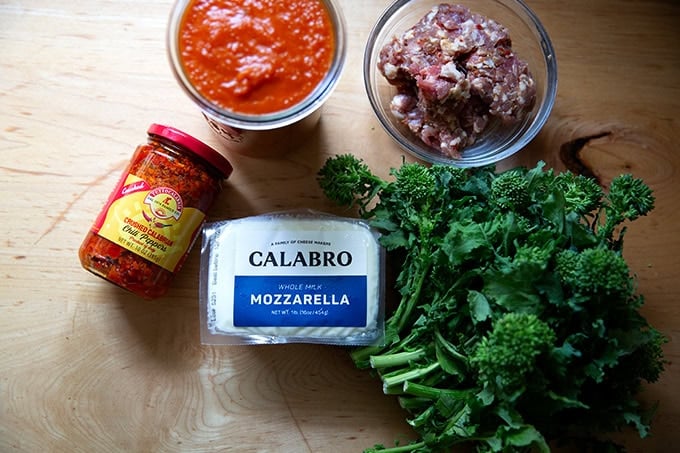
Meanwhile, gather your toppings. This is a favorite combination from Pizza Night : broccoli rabe, sausage, mozzarella, and spicy tomato sauce (sauce + Calabrian chili paste ).
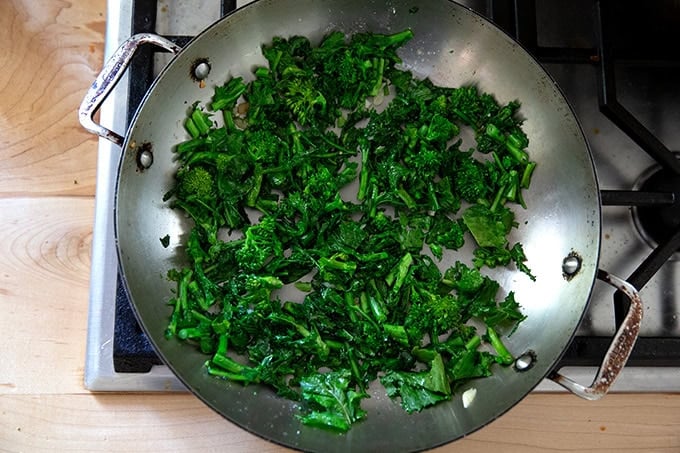
For this pizza, you’ll need to quickly sauté the broccoli rabe (or other green) with olive oil and garlic.
And you’ll need to stir 1 to 2 tablespoons of the Calabrian chili paste into the tomato sauce. Simply omit it if you don’t have it.
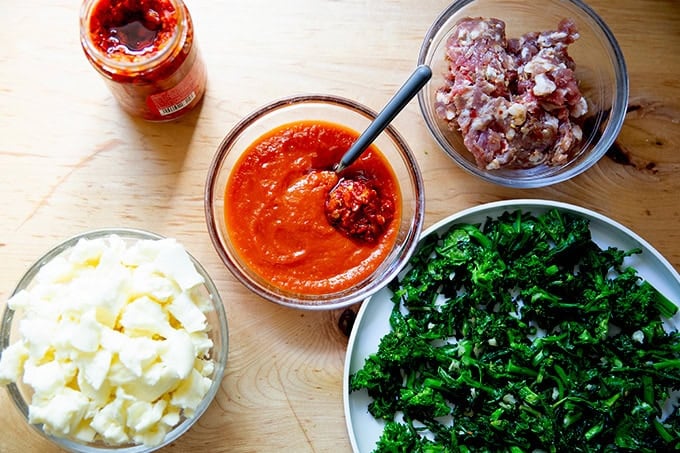
Top the pizza with the mozzarella first…
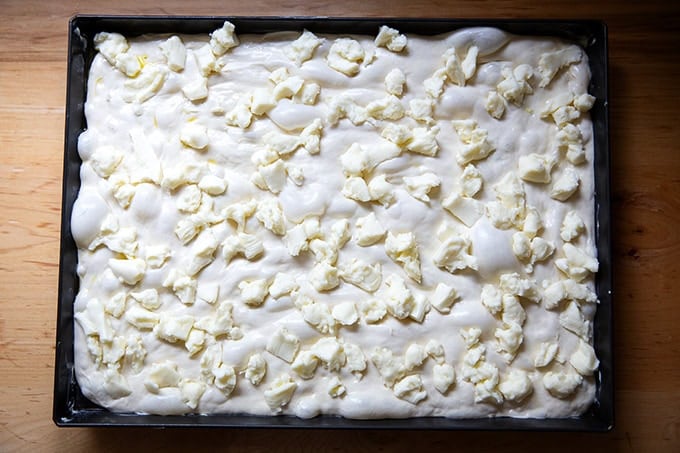
… followed by the broccoli rabe. I find placing the cheese and other toppings down before the sauce helps keep the crust crisper.
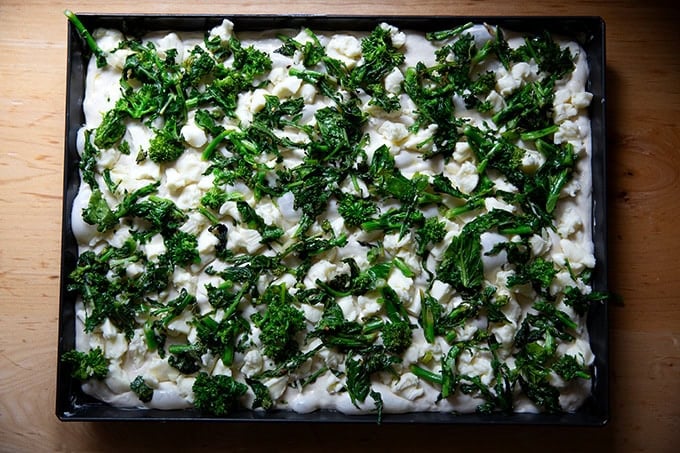
Drop spoonfuls of the sauce all around, then spread with the back of a spoon.
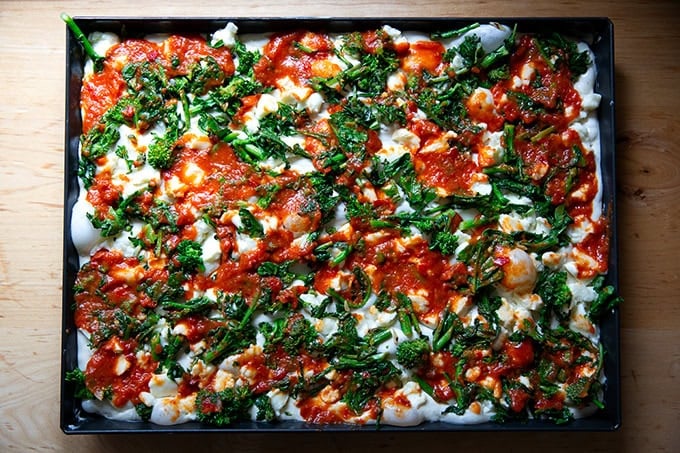
Top with the sausage, if using:
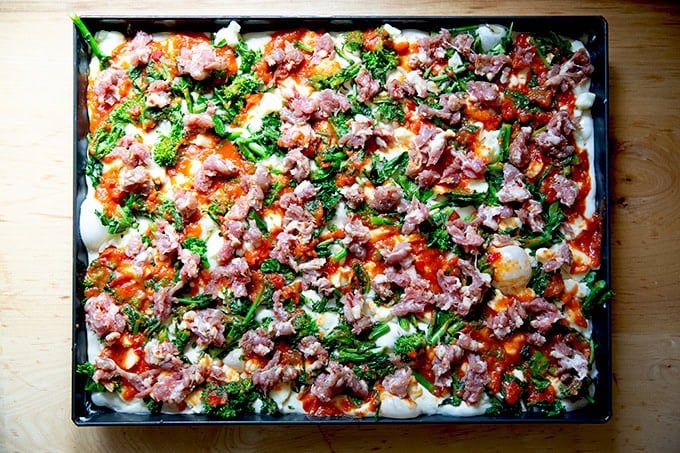
Bake @ 450ºF for 23-25 minutes on a preheated Baking Steel or pizza stone.
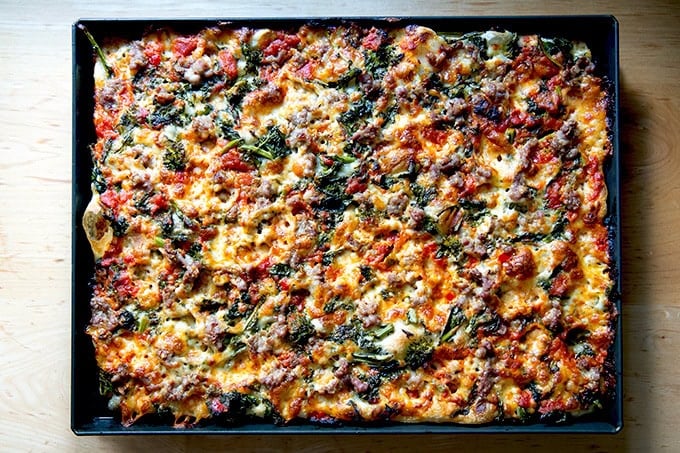
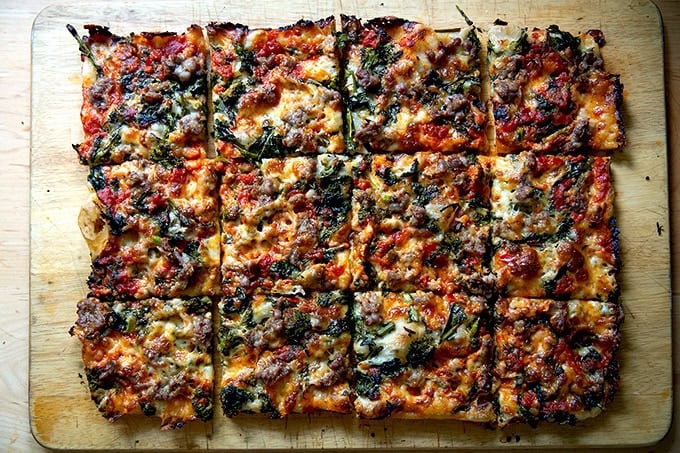
Transfer to a cutting board, and cut into squares:
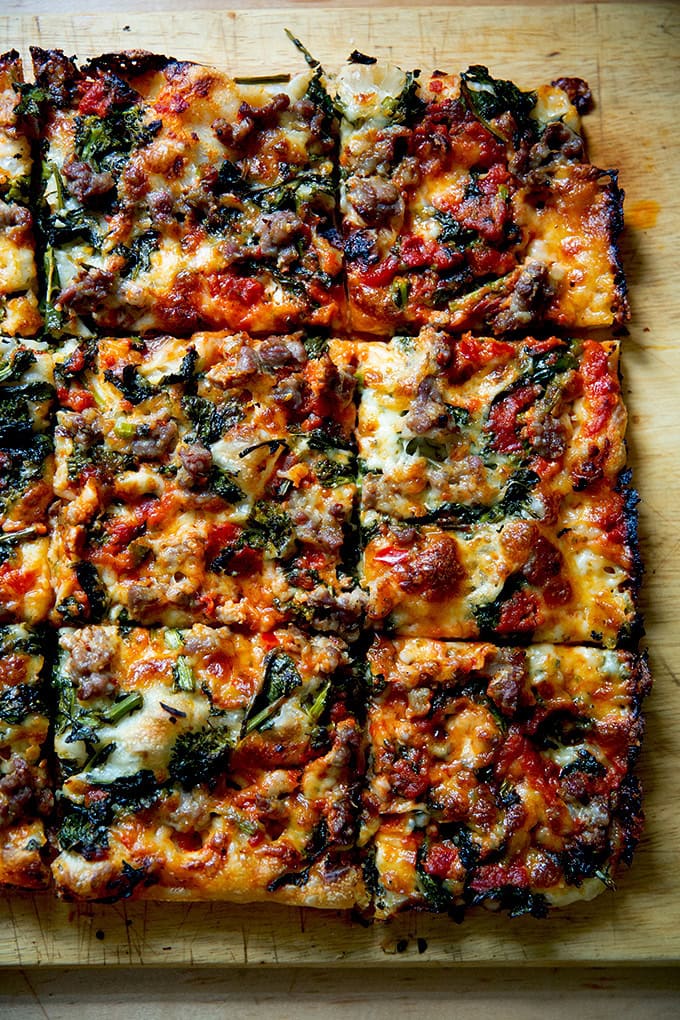
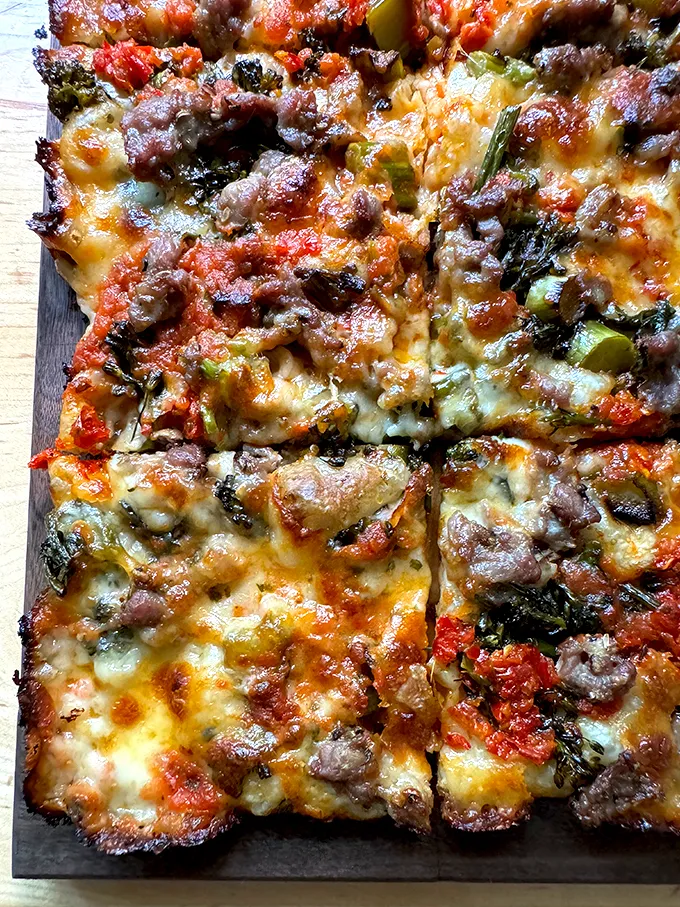
Description
Grandma-style pizza is pan pizza, similar to Sicilian-style in that it’s baked on a sheet pan, but it’s thinner and crisper. It’s perfect for feeding a crowd!
Recipe from my cookbook, Pizza Night.
Notes:
- As always, for best results, use a digital scale to measure the flour and water.
- Flour/water: If you live in a humid environment, I would suggest using bread flour. If you are in Canada or the UK, also consider using bread flour or consider holding back some of the water — reference the video for how the texture of the bread should look; then add water as needed. In my recent experiments, I used King Arthur bread flour and Central Milling bread flour — the dough made with Central Milling flour was stiffer and easier to work with because it absorbed more water. This example is simply to show that it may take some trial and error to get the ratio of water to flour right. And do keep in mind: it is supposed to be a wet and sticky dough, and it takes practice handling these sorts of doughs.
- Salt: The rule of thumb with bread dough is that the weight of the salt should be 2 to 3% the weight of the flour. For this recipe, that is 10 to 15 grams. If you are sensitive to salt, use 1o grams. If you are not, use 12 to 15 grams salt. I use Diamond Crystal kosher salt.
- Yeast: I love SAF instant yeast . I buy it in bulk, transfer it to a quart storage container , and store it in my fridge for months. You can store it in the freezer also. If you are using active-dry yeast , simply sprinkle the yeast over the lukewarm water and let it stand for 15 minutes or until it gets foamy; then proceed with the recipe.
- Plan Ahead: The first rise takes 6-10 hours, and ideally, the balled-up dough should spend a day or two in the fridge. That said, if you want to shorten the timeline, you can skip the fridge rise and simply proceed with the recipe after the first rise, i.e. proofing the dough at room temperature in the pan. And if you need to shorten the first rise, use as much as 2 teaspoons of instant yeast and lukewarm water. Let the rough rise at room temperature for 1 to 3 hours; then proceed with the recipe.
Equipment:
- A Lloyd grandma pan makes for an especially nice crust.
- A Baking Steel or pizza stone further promotes a crisp crust.
- Two 2-quart dough storage vessels are handy for storing the grandma-style dough balls in the fridge for a few days.
For the pan pizza dough (which yields enough for 2 Grandma pizzas):
- 550 grams (about 4¼ cups ) bread flour or all-purpose flour, plus more for dusting, see notes above
- 15 grams salt, see notes above
- 2 grams (about ½ teaspoon ) instant yeast
- 485 grams (a heaping 2 cups) cold (about 60 °F) water
- Extra-virgin olive oil
For one pizza:
- 2 tablespoons unsalted butter, at room temperature
- 2 tablespoons extra-virgin olive oil, divided, plus more as needed
- One 525 -gram ball of pan pizza dough (from above)
- 8 ounces broccoli rabe, ends trimmed
- 1 clove of garlic, minced
- squeeze of lemon
- 12 ounces (about 3 cups ) shredded low-moisture whole-milk mozzarella cheese, I love Calabro
- ¾ cup tomato sauce, such as this one or your favorite jarred sauce
- 1 to 2 tablespoons Calabrian chili paste , optional
- 8 ounces bulk hot or sweet Italian sausage
For the dough:
- Mix the dough: In a large bowl, whisk together the flour, salt, and yeast. Add the water and use a spatula to mix until the water is absorbed and the ingredients form a wet, sticky dough ball. Cover the bowl with a towel and let rest for at least 15 minutes and up to 30 minutes.
- Stretch and fold: Fill a small bowl with water. Dip one hand into the bowl of water, then use the dry hand to stabilize the bowl while you grab an edge of the dough with your wet hand, pull up, and fold the dough toward the center. Repeat this stretching and folding motion 8 to 10 times, turning the bowl 90 degrees after each set. By the end, the dough should be smoother and more cohesive, though still very wet. Do not worry if you do not execute this step perfectly — in addition to creating some strength in the dough, the purpose of this step is to ensure any dry patches of dough have been fully hydrated and incorporated into the dough.
- Let it rise: Pour about 1 teaspoon of olive oil over the dough and use your hands to rub it all over. Cover the bowl tightly and let the dough rise at room temperature until it has nearly doubled in volume, 6 to 10 hours. The time will vary depending on the time of year and the temperature of your kitchen.
- Portion the dough: Using lightly oiled hands, release the dough from the sides of the bowl. Turn the dough out onto a lightly floured work surface and use a bench scraper to divide the dough into 2 equal portions roughly 525 grams each.
- Ball up the dough: Using flour as needed, form each portion into a ball by grabbing the edges of the dough and pulling them toward the center to create a rough ball. Then flip the ball over, cup your hands around the dough, and drag it toward you, creating tension as you pull. Repeat this cupping and dragging until you have a tight ball. The dough will be wet and sticky! Do not worry if you do not create a perfect ball… it is forgiving.
- Store the dough: Place the dough balls in individual airtight containers and transfer to the fridge for 1 to 3 days.
For the pizza:
- Proof the dough: Grease a 12 × 16-inch grandma-style pan or a 13 × 18-inch sheet pan with the softened butter. Pour one tablespoon of the olive oil into the center of the pan. Place the dough ball in the oil and turn to coat. Let rest uncovered for 1 to 4 hours, depending on your time constraints.
- Stretch the dough: Lightly oil your hands and use your fingertips to dimple and stretch the dough to fit the pan. When the dough resists, let it rest for 30 minutes, then stretch it again using the same technique. Repeat this stretching and resting until the dough fits the pan.
- Prepare the oven: If you have a baking steel, place it on a rack in the middle or lower third of the oven and preheat the oven to 450ºF.
- Prepare the broccoli rabe: Cut the broccoli rabe into 1-inch segments. In a large skillet, heat the remaining tablespoon of oil and garlic over medium-high heat just until the garlic begins to shimmer and take on the slightest amount of color, 1 to 2 minutes. Add the broccoli rabe, season with a pinch of kosher salt, and cook, stirring and rearranging frequently with tongs until wilted, about 2 minutes. Add 2 tablespoons water, cover, and cook for 2 minutes more. Remove the cover, squeeze the lemon over the top, stir, taste, and adjust with salt or more lemon to taste.
- Season the tomato sauce: In a small bowl, stir together the tomato sauce and 1 to 2 tablespoons of Calabrian chili paste, depending on your heat tolerance.
- Assemble the pizza: Using lightly oiled hands, stretch the dough one final time to fit the pan. Sprinkle the mozzarella evenly over the pizza, spreading it all the way to the edges. Spread the broccoli rabe evenly over the top. Drop spoonfuls of the tomato sauce evenly over the top, then smooth with the back of a spoon to spread. Finally, pinch the sausage into small pieces and scatter them evenly over the top.
- Bake the pizza: Bake until the edges look very caramelized, 23 to 25 minutes.
- Remove the pan from the oven. Run a paring knife or spatula around the pan’s edges. Use an offset spatula to carefully transfer the pizza from the pan to a cutting board. Cut into 12 to 16 squares.
- Prep Time: 24 hours
- Cook Time: 25 minutes
- Category: Pizza
- Method: oven
- Cuisine: Amerian
Description
Grandma-style pizza is pan pizza, similar to Sicilian-style in that it’s baked on a sheet pan, but it’s thinner and crisper. It’s perfect for feeding a crowd!
Recipe from my cookbook, Pizza Night.
Notes:
- As always, for best results, use a digital scale to measure the flour and water.
- Flour/water: If you live in a humid environment, I would suggest using bread flour. If you are in Canada or the UK, also consider using bread flour or consider holding back some of the water — reference the video for how the texture of the bread should look; then add water as needed. In my recent experiments, I used King Arthur bread flour and Central Milling bread flour — the dough made with Central Milling flour was stiffer and easier to work with because it absorbed more water. This example is simply to show that it may take some trial and error to get the ratio of water to flour right. And do keep in mind: it is supposed to be a wet and sticky dough, and it takes practice handling these sorts of doughs.
- Salt: The rule of thumb with bread dough is that the weight of the salt should be 2 to 3% the weight of the flour. For this recipe, that is 10 to 15 grams. If you are sensitive to salt, use 1o grams. If you are not, use 12 to 15 grams salt. I use Diamond Crystal kosher salt.
- Yeast: I love SAF instant yeast . I buy it in bulk, transfer it to a quart storage container , and store it in my fridge for months. You can store it in the freezer also. If you are using active-dry yeast , simply sprinkle the yeast over the lukewarm water and let it stand for 15 minutes or until it gets foamy; then proceed with the recipe.
- Plan Ahead: The first rise takes 6-10 hours, and ideally, the balled-up dough should spend a day or two in the fridge. That said, if you want to shorten the timeline, you can skip the fridge rise and simply proceed with the recipe after the first rise, i.e. proofing the dough at room temperature in the pan. And if you need to shorten the first rise, use as much as 2 teaspoons of instant yeast and lukewarm water. Let the rough rise at room temperature for 1 to 3 hours; then proceed with the recipe.
Equipment:
- A Lloyd grandma pan makes for an especially nice crust.
- A Baking Steel or pizza stone further promotes a crisp crust.
- Two 2-quart dough storage vessels are handy for storing the grandma-style dough balls in the fridge for a few days.
For the pan pizza dough (which yields enough for 2 Grandma pizzas):
- 550 grams (about 4¼ cups ) bread flour or all-purpose flour, plus more for dusting, see notes above
- 15 grams salt, see notes above
- 2 grams (about ½ teaspoon ) instant yeast
- 485 grams (a heaping 2 cups) cold (about 60 °F) water
- Extra-virgin olive oil
For one pizza:
- 2 tablespoons unsalted butter, at room temperature
- 2 tablespoons extra-virgin olive oil, divided, plus more as needed
- One 525 -gram ball of pan pizza dough (from above)
- 8 ounces broccoli rabe, ends trimmed
- 1 clove of garlic, minced
- squeeze of lemon
- 12 ounces (about 3 cups ) shredded low-moisture whole-milk mozzarella cheese, I love Calabro
- ¾ cup tomato sauce, such as this one or your favorite jarred sauce
- 1 to 2 tablespoons Calabrian chili paste , optional
- 8 ounces bulk hot or sweet Italian sausage
For the dough:
- Mix the dough: In a large bowl, whisk together the flour, salt, and yeast. Add the water and use a spatula to mix until the water is absorbed and the ingredients form a wet, sticky dough ball. Cover the bowl with a towel and let rest for at least 15 minutes and up to 30 minutes.
- Stretch and fold: Fill a small bowl with water. Dip one hand into the bowl of water, then use the dry hand to stabilize the bowl while you grab an edge of the dough with your wet hand, pull up, and fold the dough toward the center. Repeat this stretching and folding motion 8 to 10 times, turning the bowl 90 degrees after each set. By the end, the dough should be smoother and more cohesive, though still very wet. Do not worry if you do not execute this step perfectly — in addition to creating some strength in the dough, the purpose of this step is to ensure any dry patches of dough have been fully hydrated and incorporated into the dough.
- Let it rise: Pour about 1 teaspoon of olive oil over the dough and use your hands to rub it all over. Cover the bowl tightly and let the dough rise at room temperature until it has nearly doubled in volume, 6 to 10 hours. The time will vary depending on the time of year and the temperature of your kitchen.
- Portion the dough: Using lightly oiled hands, release the dough from the sides of the bowl. Turn the dough out onto a lightly floured work surface and use a bench scraper to divide the dough into 2 equal portions roughly 525 grams each.
- Ball up the dough: Using flour as needed, form each portion into a ball by grabbing the edges of the dough and pulling them toward the center to create a rough ball. Then flip the ball over, cup your hands around the dough, and drag it toward you, creating tension as you pull. Repeat this cupping and dragging until you have a tight ball. The dough will be wet and sticky! Do not worry if you do not create a perfect ball… it is forgiving.
- Store the dough: Place the dough balls in individual airtight containers and transfer to the fridge for 1 to 3 days.
For the pizza:
- Proof the dough: Grease a 12 × 16-inch grandma-style pan or a 13 × 18-inch sheet pan with the softened butter. Pour one tablespoon of the olive oil into the center of the pan. Place the dough ball in the oil and turn to coat. Let rest uncovered for 1 to 4 hours, depending on your time constraints.
- Stretch the dough: Lightly oil your hands and use your fingertips to dimple and stretch the dough to fit the pan. When the dough resists, let it rest for 30 minutes, then stretch it again using the same technique. Repeat this stretching and resting until the dough fits the pan.
- Prepare the oven: If you have a baking steel, place it on a rack in the middle or lower third of the oven and preheat the oven to 450ºF.
- Prepare the broccoli rabe: Cut the broccoli rabe into 1-inch segments. In a large skillet, heat the remaining tablespoon of oil and garlic over medium-high heat just until the garlic begins to shimmer and take on the slightest amount of color, 1 to 2 minutes. Add the broccoli rabe, season with a pinch of kosher salt, and cook, stirring and rearranging frequently with tongs until wilted, about 2 minutes. Add 2 tablespoons water, cover, and cook for 2 minutes more. Remove the cover, squeeze the lemon over the top, stir, taste, and adjust with salt or more lemon to taste.
- Season the tomato sauce: In a small bowl, stir together the tomato sauce and 1 to 2 tablespoons of Calabrian chili paste, depending on your heat tolerance.
- Assemble the pizza: Using lightly oiled hands, stretch the dough one final time to fit the pan. Sprinkle the mozzarella evenly over the pizza, spreading it all the way to the edges. Spread the broccoli rabe evenly over the top. Drop spoonfuls of the tomato sauce evenly over the top, then smooth with the back of a spoon to spread. Finally, pinch the sausage into small pieces and scatter them evenly over the top.
- Bake the pizza: Bake until the edges look very caramelized, 23 to 25 minutes.
- Remove the pan from the oven. Run a paring knife or spatula around the pan’s edges. Use an offset spatula to carefully transfer the pizza from the pan to a cutting board. Cut into 12 to 16 squares.
- Prep Time: 24 hours
- Cook Time: 25 minutes
- Category: Pizza
- Method: oven
- Cuisine: Amerian
Find it online : https://alexandracooks.com/2025/09/27/homemade-grandma-style-pizza/
In this fall salad, cubes of chili-roasted sweet potatoes unite with greens, toasted nuts, cheese, and a sweet-sharp vinaigrette.
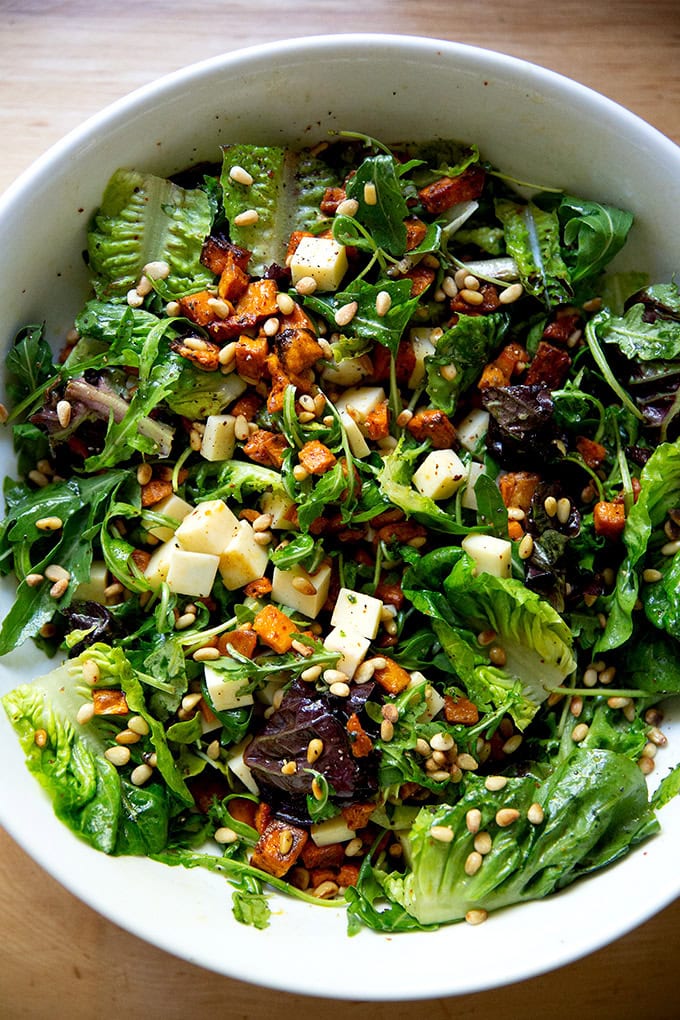
A few weeks ago, my daughter and I had lunch at GB Eats in Great Barrington, Massachusetts. I ordered the breakfast salad, a bowl of arugula, roasted sweet potatoes, crumbled bacon, and avocado dressed with a lemon vinaigrette and topped with two poached eggs.
It was heavenly — so fresh tasting — and made me wonder why breakfast salads aren’t more of a thing. With every completely satisfying bite, I found myself thinking: I could eat this every day.
The recipe below is inspired by that salad, the star being the chili-roasted sweet potato cubes. I’ve found a mix of sturdy greens (like Romaine) combined with delicate greens (like arugula) works best, and a light, bright dressing, like this apple cider vinaigrette or this lemon vinaigrette , is perfect, its sharpness so nicely balancing the sweetness of the roasted potatoes.
Finally, I’ve used all sorts of nuts, dried fruit, and cheese with success, so use what you have on hand.
Roasted Sweet Potato Salad, Step by Step
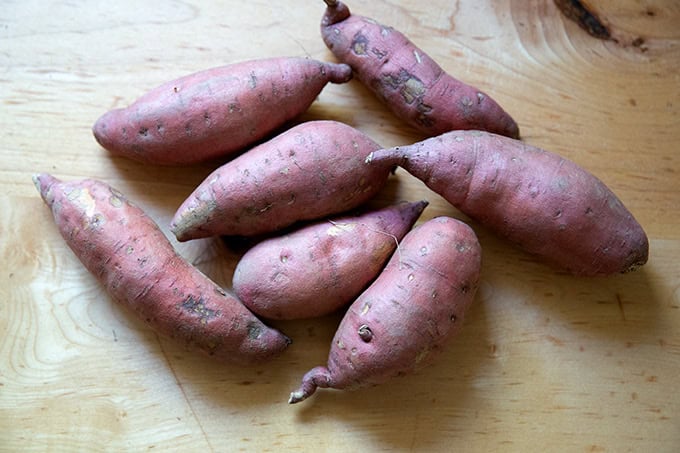
First, gather a couple of pounds of sweet potatoes.
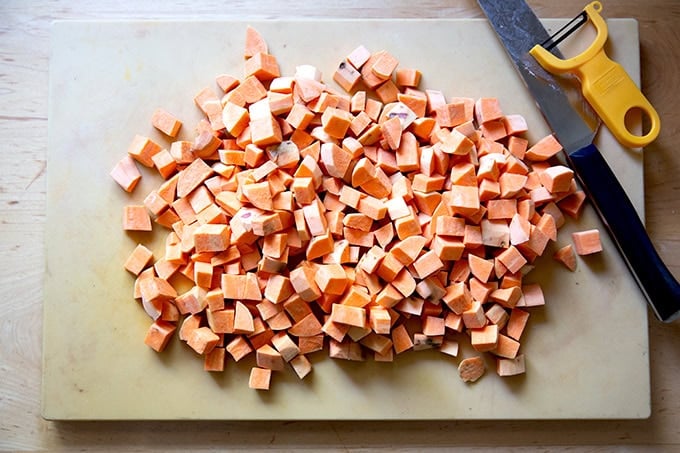
Peel and dice them.
Transfer them to a sheet pan and season with salt, Aleppo pepper (or Silk Chili), optional, and melted coconut oil or olive oil.
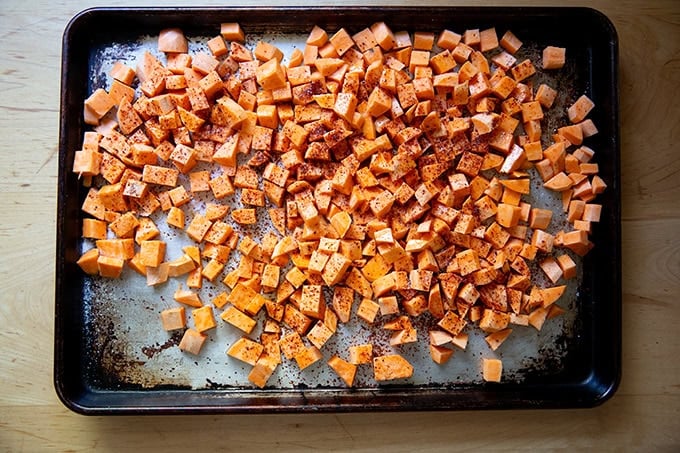
Toss to combine.
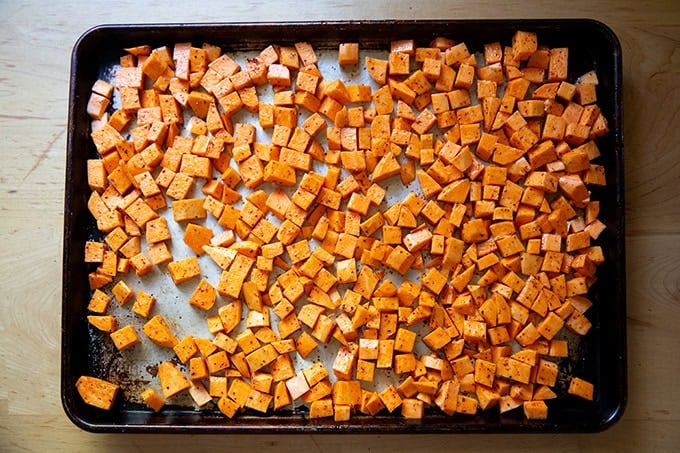
Then roast at 400ºF for roughly 45 minutes.
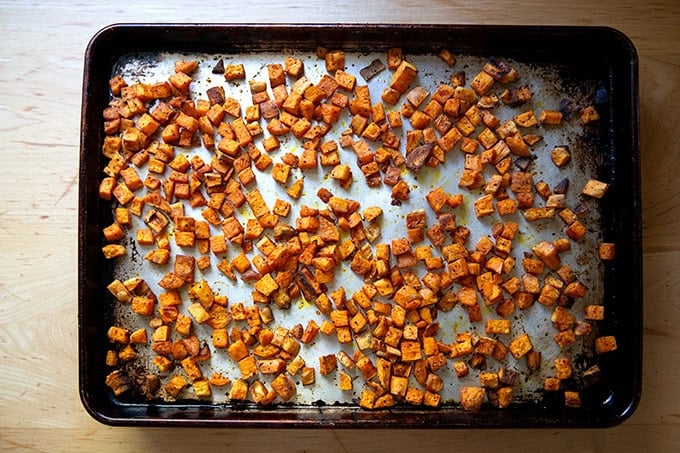
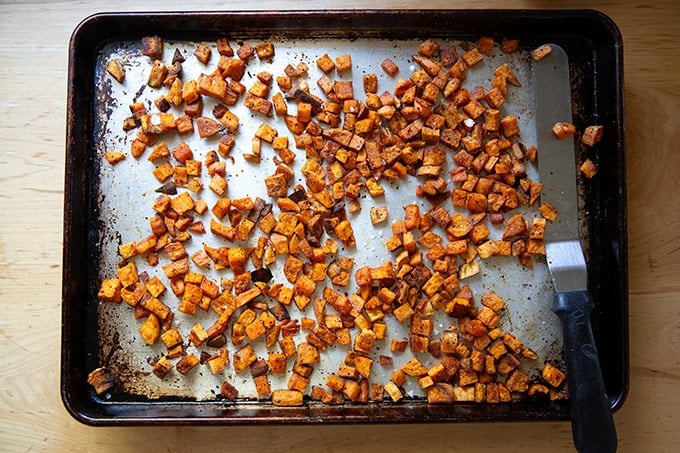
Let the potatoes cool for five minutes in the pan, then release them with a spatula.
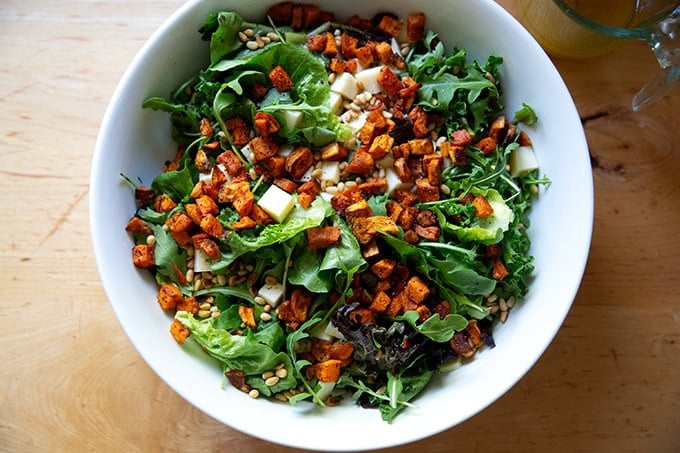
Toss with apple cider vinaigrette to taste:
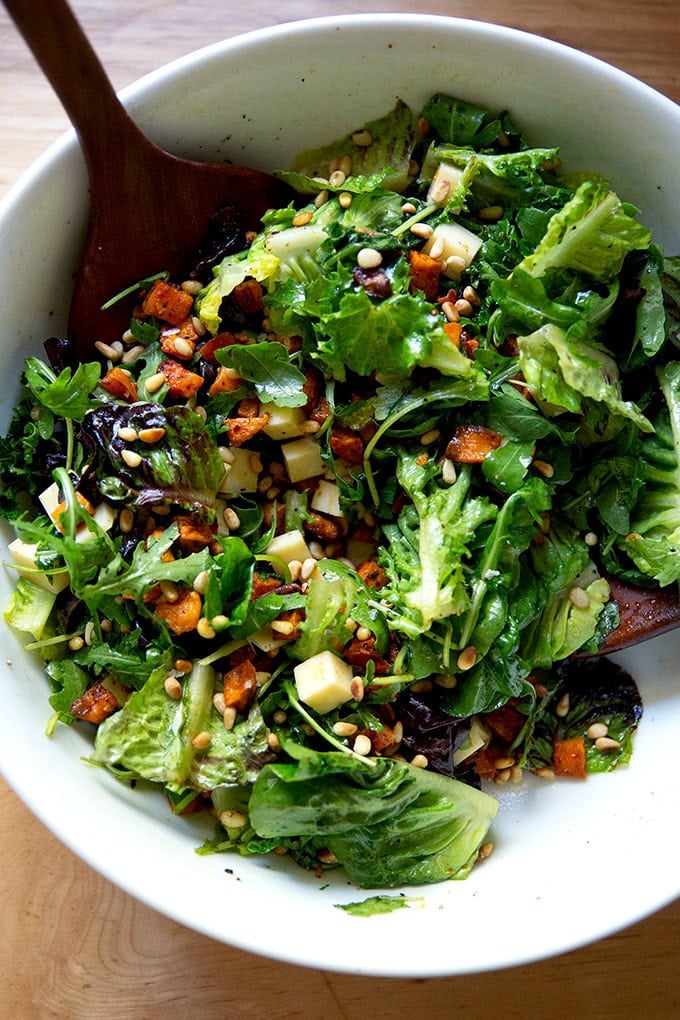
Season with pepper and serve.
Description
In this fall salad, cubes of chili-roasted sweet potatoes unite with greens, toasted nuts, cheese, and apple cider vinaigrette. It lends itself to improvisation, so don’t be afraid to use what cheese and nuts you have on hand.
Notes:
- Salt: If you are using Morton kosher salt or fine sea salt, use half as much.
- Aleppo pepper: I have been able to find this at two different local grocery stores, which has been a pleasant surprise as I’ve previously ordered it online. You can do an InstaCart search to see if any of your local stores carry it. Silk Chili is the Turkish variety of Aleppo pepper, and I buy large containers of it from Burlap and Barrel.
- Lemon Vinaigrette would be nice here, too.
For the sweet potatoes:
2 pounds sweet potatoes
3 tablespoons melted coconut oil or extra-virgin olive oil
1 to 1.5 teaspoons Diamond Crystal kosher salt, see notes above
1 to 2 teaspoons Aleppo pepper or Silk Chili, optional, see notes above
Fresh lime juice to taste, optional
⅓ cup pine nuts or other nut: almonds, walnuts, pecans, macadamia, etc.
5 ounces mixed greens, preferably a mix of mostly sturdy greens like Little Gems, Romaine, and Radicchio, with a smaller amount of Arugula or other tender greens
Flaky sea salt
Freshly cracked black pepper
4 ounces cubed cheese such as Gruyere, Gouda, or Cheddar or crumbled goat cheese, feta or really any cheese you like
⅓ cup Apple Cider Vinaigrette , plus more to taste, see notes above
- Roast the sweet potatoes : Preheat the oven to 400ºF. While the oven preheats, peel the potatoes, then dice them into ½-inch cubes, roughly. Place the diced cubes on a rimmed sheet pan. Toss them with the melted coconut oil or olive oil, salt (1.5 teaspoons unless you are sensitive to salt), and 1 to 2 teaspoons of Aleppo Pepper or Silk chili or to taste. Transfer to the oven and roast for 30 minutes. Check on the sweet potatoes to ensure they are browning evenly, stir them, then return the pan to the oven for another 15 minutes. Remove the pan from the oven and let the sweet potatoes cool for 5 minutes on the sheet pan. Using a spatula, release the sweet potatoes from the pan. Taste. Add more flaky sea salt to taste, and, if you wish, a squeeze of lime.
- Toast the nuts: Place the pine nuts in a small skillet set over low heat. Let the pine nuts toast slowly over this low heat while you prepare the rest of the salad.
- Assemble the salad: Place the greens in a large bowl. Season with a pinch of sea salt and toss gently to combine. Add the cheese. Add the roasted sweet potatoes to taste (1 to 1.5 cups), and the toasted pine nuts when they have fully toasted (I crank up the heat once everything is assembled). Season with pepper to taste.
- Drizzle the dressing over the salad and toss gently. Taste. The greens should be lightly dressed but should taste seasoned. Add salt, pepper, and more dressing to taste. Once the seasonings are right, serve immediately.
- Prep Time: 30 minutes
- Cook Time: 45 minutes
- Category: Salad
- Method: oven, stovetop
- Cuisine: Amerian
