This easy Thai chicken satay has become my family’s most requested meal. The 6-ingredient chicken marinade, which requires no chopping, comes together in a snap. The chicken can be sliced and marinated 48 hours or more in advance, so don’t be afraid to make it ahead of time. I always serve it with coconut rice, which my children devour.
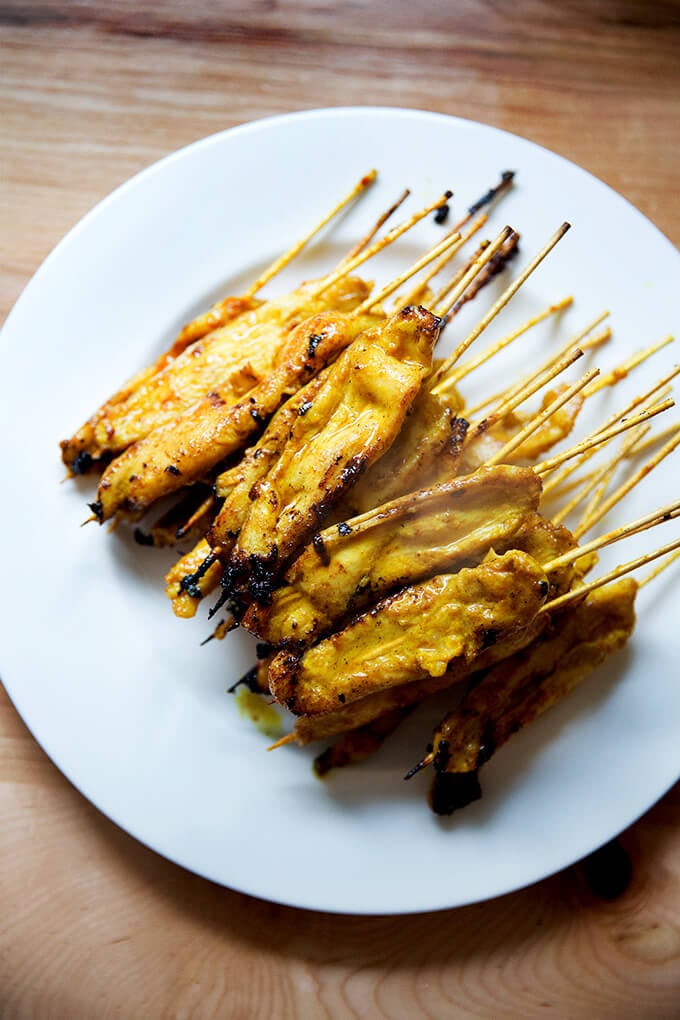
A few months ago, I discovered my children love Thai food. If you are wondering: How could children not love Thai food? Chicken on a stick ! Dumplings! Rice! Noodles! Peanut sauce! What’s not to love?
I hear you.
But if I know anything it’s that you never know with these fickle little beings, and this recent discovery is a welcomed one. Dining out with four little ones is about as much fun as it sounds, but knowing the food will not be a challenge — knowing I can relish a spicy green papaya salad while the children jump from one platter to the next — changes everything.
A night at Celadon , newly opened just down the road, leaves us all incredibly happy.
Celadon’s Thai chicken satay in particular is what my children devour about as quickly as it arrives on the table. After a few visits, I set out to recreate the satay at home, consulting a few recipes, which ran the gamut from including Thai red curry paste and coconut milk in the marinade to excluding both, opting for dried spices and aromatics instead.
The recipe below is the result of several experiments, and it has become one of my children’s most-requested meals. Here are the details:
Easy Thai Chicken Satay
Thought process:
- To keep the marinade simple, I omitted aromatics. There’s no garlic, ginger, lemongrass, etc. here . Mentally knowing I don’t need to chop anything for the marinade makes it feel doable any night of the week.
- To keep it geared toward children, I omitted spicy pastes and sauces .
What I included:
- Brown sugar, fish sauce, soy sauce, coconut milk, turmeric, and curry powder . It’s a little sweet, a little salty, and it’s got warm spice without heat. It comes together in a snap.
- Coconut rice goes nicely with satay, and I now always make the two together to make the most of that one can of unsweetened coconut milk: 3/4 cup of it goes into the rice; the remainder goes into the marinade.
A few tips:
- Thinly sliced chicken breasts. Celadon uses chicken breasts that are sliced thinly and threaded onto skewers (as opposed to using cubed meat), so I’ve done the same here. What I love about using the thinly sliced breasts is that they cook incredibly quickly on the stovetop. So while threading the breasts onto skewers may feel a bit too much like hard work on a Tuesday night, know that the chicken will cook in about 4 minutes total. (30-second slicing video included below.)
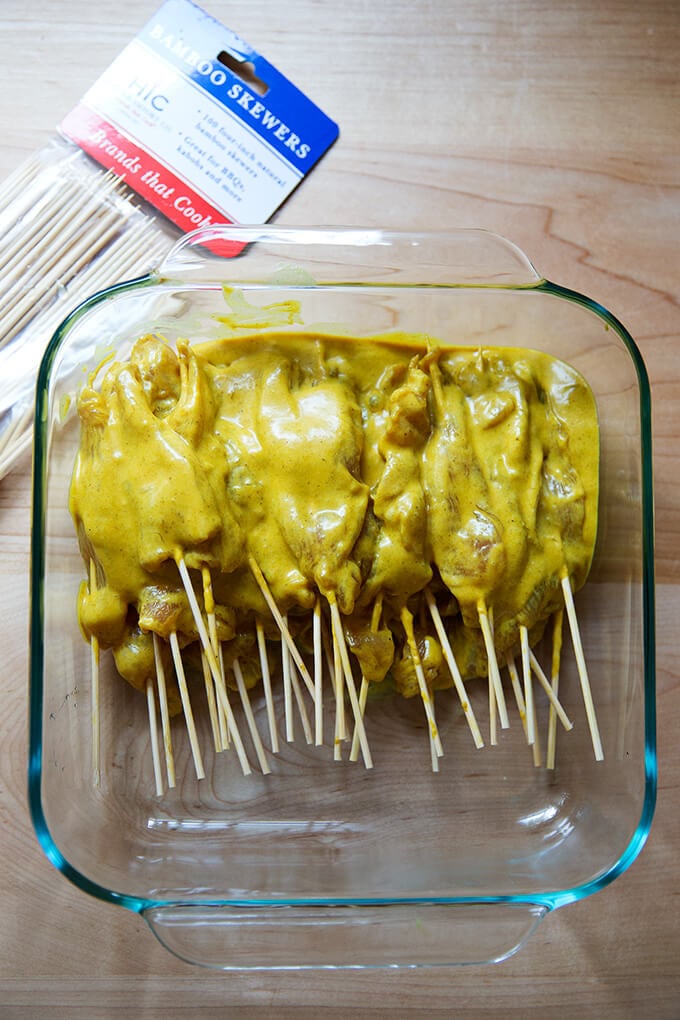
- Skewers . I have no doubt that part of the appeal of this chicken for children is that it arrives on a stick. Small 6-inch skewers are key for ensuring the stovetop cooking process is as painless as possible — larger ones won’t fit into the pan. If you only have large ones, break them.
- Medium-high heat . The first time I made the chicken, I made the mistake of using a screaming hot pan to get that char I love so much. But children (mine at least) don’t love char. There is no need to get your pans smoking hot here. Medium to medium-high heat should cook the chicken quickly without caramelizing it too much.
- Peanut sauce: Where is it? Shockingly, my kids don’t eat the peanut sauce with the satay. At first I found myself pushing it on them, and then I thought: what am I doing? If they eat the chicken without it, that’s one less thing to worry about. If you, however, are looking to serve this satay with a peanut sauce, this one is excellent: All-Purpose Thai Peanut Sauce.
Final note:
This recipe was designed with children in mind, but this is a meal the whole family can enjoy. You can always make it spicier by squirting some Sriracha or other prepared hot sauce over the cooked chicken or into the peanut sauce. I made this recently for a dear friend and her four children, and my friend took one bite and said: Al, you should put this on your blog. Music to my ears.
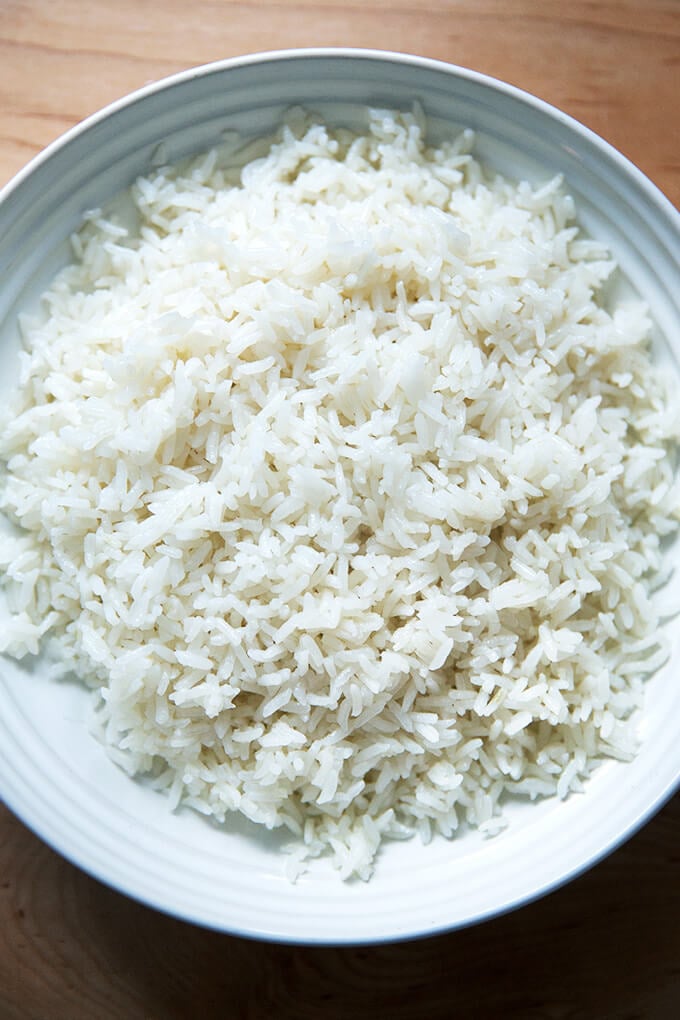
How to Make Perfect Coconut Rice
- Use white Basmati rice or Jasmine rice.
- Rinse the rice. Rinsing rice is one of my least favorite kitchen tasks, but more and more, I find it makes a difference. To rinse rice: place it in a large bowl, fill it with cold water, swoosh the rice around a little bit; then tip the bowl to dump out the cloudy water. Repeat this process 3 to 4 more times.
- Use a ratio of 1 part liquid to 1 part rice, and with the liquid use a ratio of 3 parts coconut milk to 1 part water . So, for this recipe, for 1 cup of rice, I use 3/4 cup coconut milk and 1/4 cup water. For 2 cups of rice, use 1 1/2 cups coconut milk and 1/2 cup water.
- Cook the rice covered over low heat for 15 minutes. Turn off the heat, and do not remove the lid for at least 10 minutes . Then, uncover, fluff with a fork and serve.
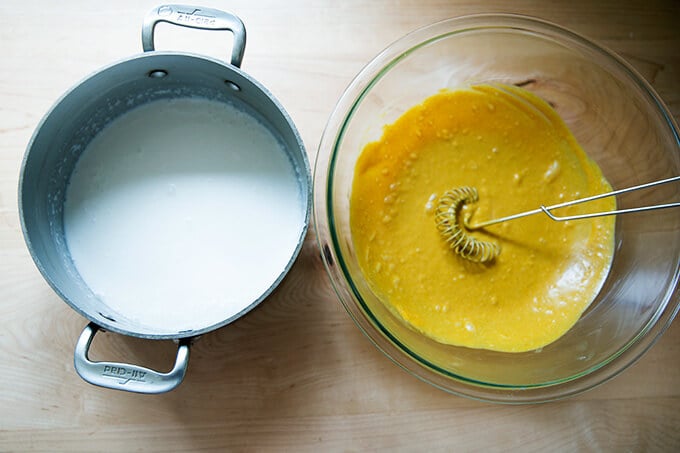
Here’s the play-by-play: Stir together the satay marinade.
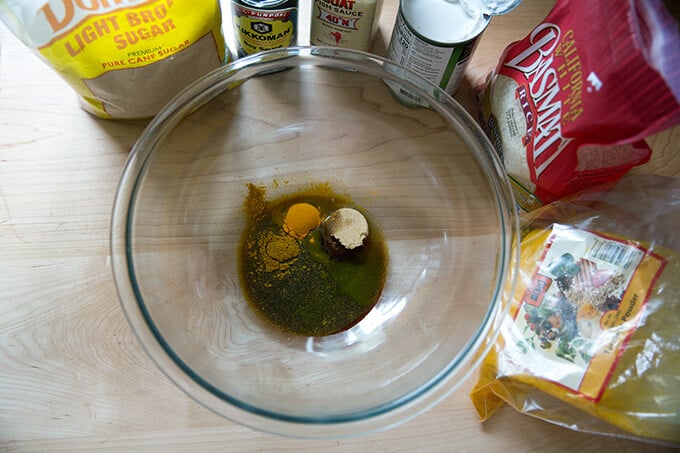
3/4 cup of the unsweetened coconut milk goes with the rice; the remainder goes into the marinade.
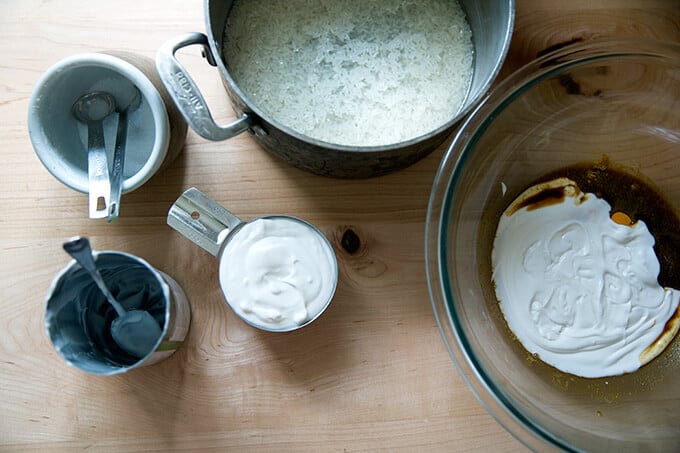
On the left: coconut rice ready to go. One the right: Thai satay marinade ready to go.
Thinly sliced chicken breasts.
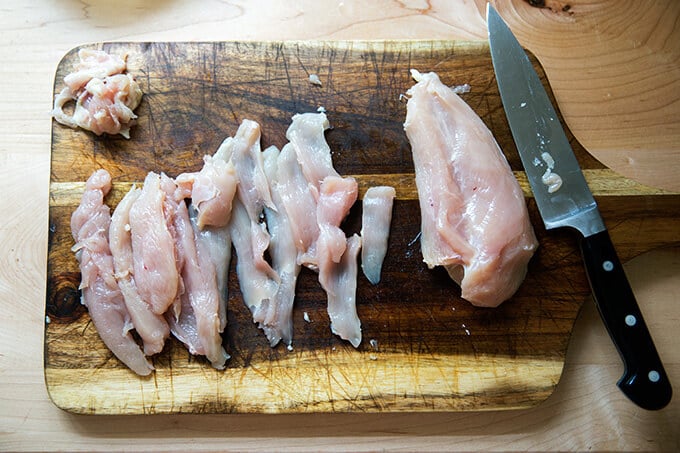
30-second slicing video:
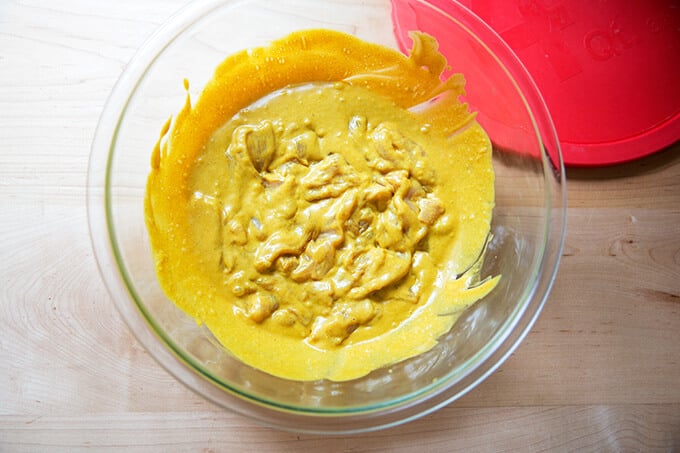
Marinating chicken breasts. (This 4-qt Pyrex bowl with lid is so handy for marinating.)
Skewered chicken breasts. These skewers are great .
Cooking the Thai chicken satay.
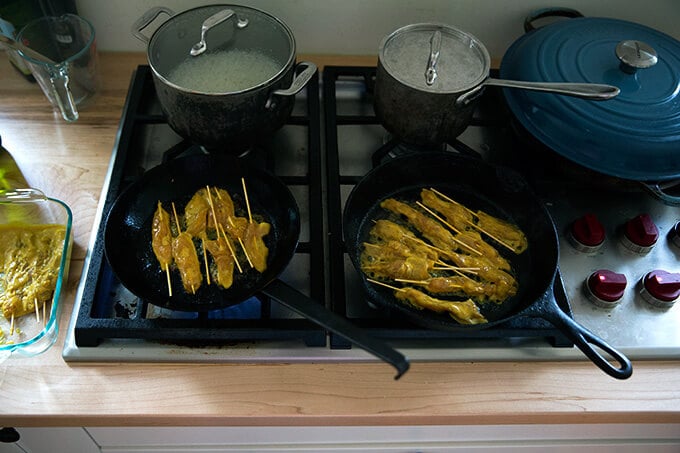
Cooked Thai chicken satay; cooked coconut rice.
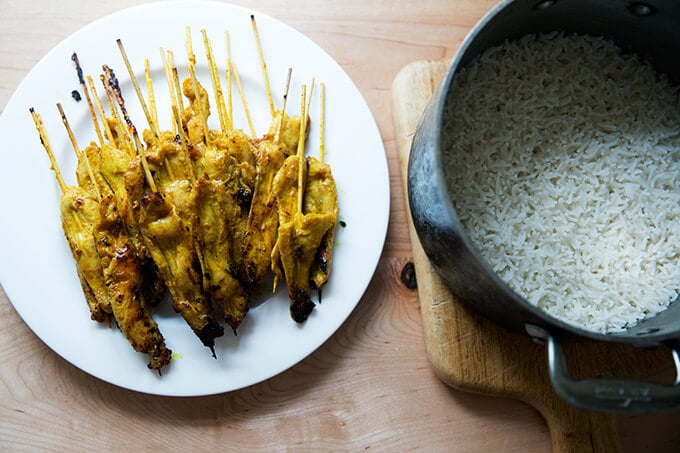
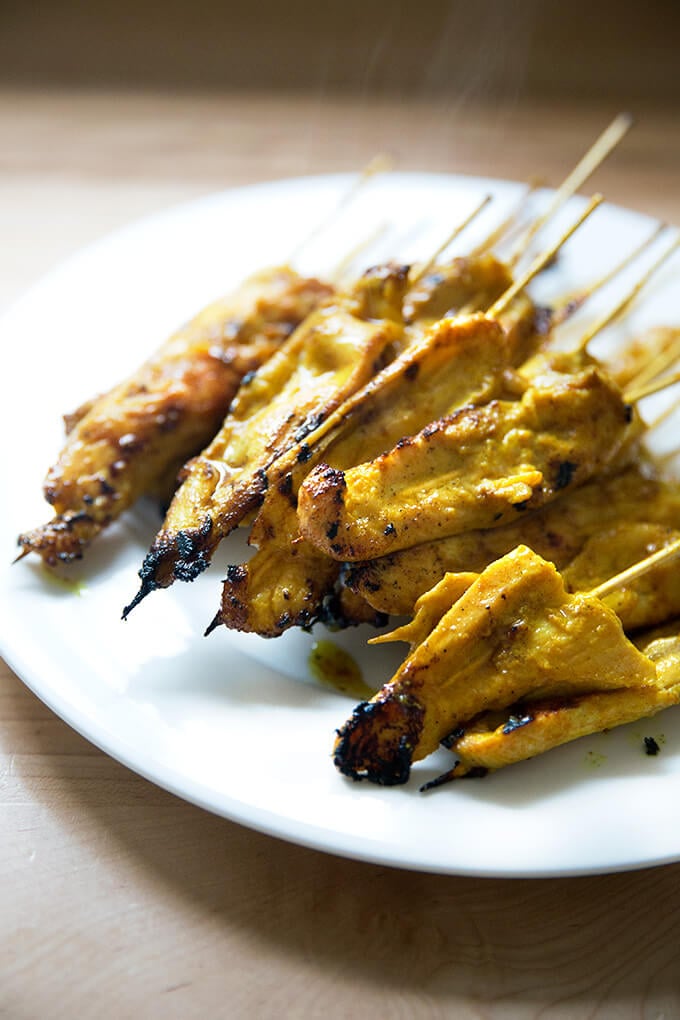
Thai chicken satay ready to be served.
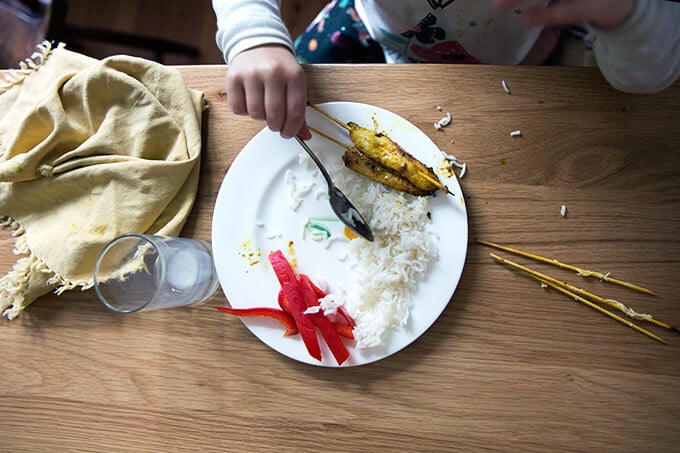
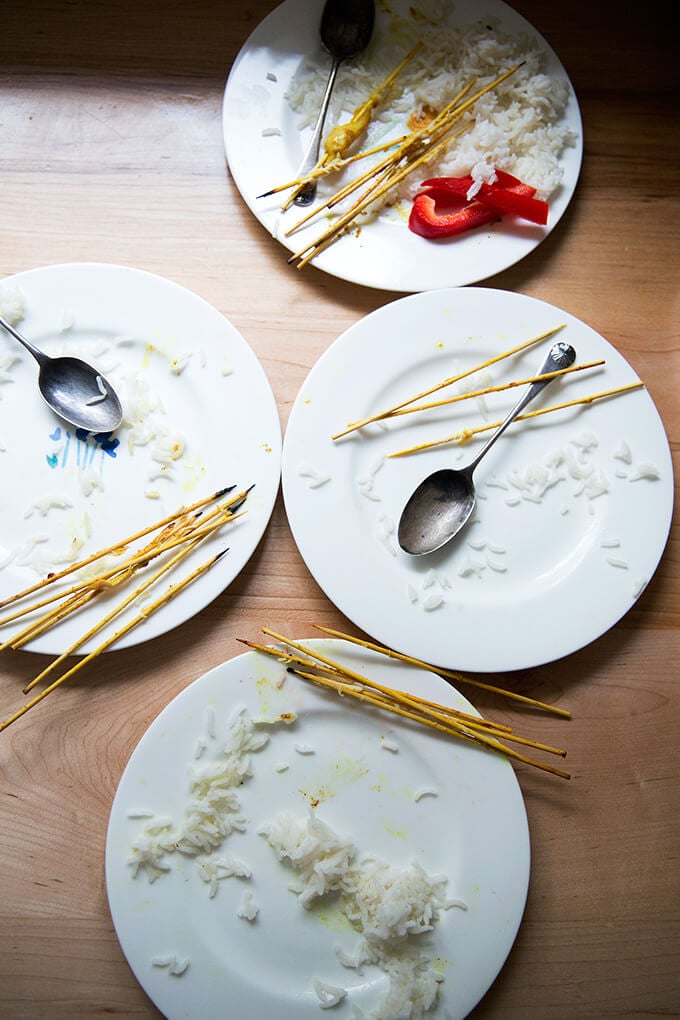
Happy eater.
Happy mother.
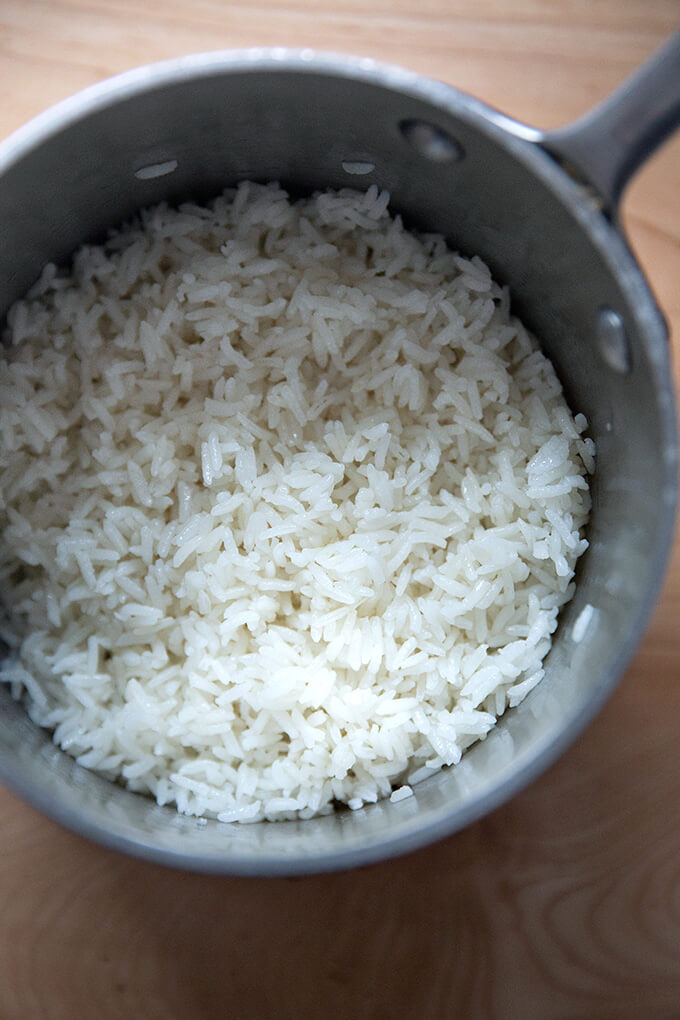
Perfect coconut rice: it’s a beautiful thing.
Description
A Few Notes:
- This marinade yields enough for 4 chicken breasts. I always use 2, but don’t be afraid to slice up 4.
- 6-inch skewers make the cooking process painless — large skewers won’t fit into the pan, and they’ll burn if propped against the edge of the pan for too long. If you only have large skewers, break them.
- To rinse rice: place it in a large bowl, fill it with cold water, swoosh the rice around a little bit; then tip the bowl to dump out the cloudy water. Repeat this process 3 to 4 more times. You don’t have to rinse it until the water runs clear, but rinsing 4 to 5 times will make a difference. Drain the rice by placing it in a fine-meshed colander, and letting it hang over a bowl for a few minutes to allow the excess water to drain out.
For the satay marinade:
- 1 can unsweetened coconut milk (you’ll use some for the rice — if you’re not making the rice, use about 3/4 cup )
- 2 tablespoons brown sugar
- 2 tablespoons fish sauce
- 1 tablespoon soy sauce
- 1 teaspoon turmeric
- 1 teaspoon curry powder, such as Madras
- 2 to 4 boneless, skinless chicken breasts, very thinly sliced, see video below
- grapeseed oil or other neutral oil for cooking the chicken
For the coconut rice:
- 1 cup white basmati rice, rinsed and drained, see notes above
- 3/4 cup well-stirred unsweetened coconut milk
- 1/4 cup water
- 1/4 teaspoon kosher salt
- Marinate the chicken. Open the can of coconut milk and stir it well. Measure 3/4 cup and set it aside for the rice. Dump the remaining coconut milk (it’s about 3/4 cup) into a large bowl. Stir in the brown sugar, fish sauce, soy sauce, turmeric, and curry powder. Add the chicken and toss to coat. Set aside to marinate for at least an hour and up to 24 hours (or longer).
- Get the rice ready: Combine the rinsed and drained rice, 3/4 cup coconut milk, 1/4 cup water, and salt in a medium saucepan. Stir. You can mix this several hours before cooking just to get it out of the way. When ready to cook: bring to a simmer over high heat. Turn heat to low. Cover. Cook 15 minutes. Remove pan from heat. Don’t uncover for at least 10 more minutes.
- Cook the chicken. Thread the chicken breasts onto small (6-inch) skewers. Heat one or two large skillets over medium-high heat. Add a tablespoon of oil (or so) into each skillet. Add the skewers, alternating them head to toe to fit as many as possible into the pan at one time. Cook for about a minute a side — if you cut them more thickly than I have here, you may need to cook them a little bit longer. Transfer skewers to a plate and repeat with the remaining chicken.
- Serve with rice on the side.
- Prep Time: 1 hour
- Cook Time: 20 minutes
- Category: Chicken
- Method: Stovetop
- Cuisine: Thai
Description
A Few Notes:
- This marinade yields enough for 4 chicken breasts. I always use 2, but don’t be afraid to slice up 4.
- 6-inch skewers make the cooking process painless — large skewers won’t fit into the pan, and they’ll burn if propped against the edge of the pan for too long. If you only have large skewers, break them.
- To rinse rice: place it in a large bowl, fill it with cold water, swoosh the rice around a little bit; then tip the bowl to dump out the cloudy water. Repeat this process 3 to 4 more times. You don’t have to rinse it until the water runs clear, but rinsing 4 to 5 times will make a difference. Drain the rice by placing it in a fine-meshed colander, and letting it hang over a bowl for a few minutes to allow the excess water to drain out.
For the satay marinade:
- 1 can unsweetened coconut milk (you’ll use some for the rice — if you’re not making the rice, use about 3/4 cup )
- 2 tablespoons brown sugar
- 2 tablespoons fish sauce
- 1 tablespoon soy sauce
- 1 teaspoon turmeric
- 1 teaspoon curry powder, such as Madras
- 2 to 4 boneless, skinless chicken breasts, very thinly sliced, see video below
- grapeseed oil or other neutral oil for cooking the chicken
For the coconut rice:
- 1 cup white basmati rice, rinsed and drained, see notes above
- 3/4 cup well-stirred unsweetened coconut milk
- 1/4 cup water
- 1/4 teaspoon kosher salt
- Marinate the chicken. Open the can of coconut milk and stir it well. Measure 3/4 cup and set it aside for the rice. Dump the remaining coconut milk (it’s about 3/4 cup) into a large bowl. Stir in the brown sugar, fish sauce, soy sauce, turmeric, and curry powder. Add the chicken and toss to coat. Set aside to marinate for at least an hour and up to 24 hours (or longer).
- Get the rice ready: Combine the rinsed and drained rice, 3/4 cup coconut milk, 1/4 cup water, and salt in a medium saucepan. Stir. You can mix this several hours before cooking just to get it out of the way. When ready to cook: bring to a simmer over high heat. Turn heat to low. Cover. Cook 15 minutes. Remove pan from heat. Don’t uncover for at least 10 more minutes.
- Cook the chicken. Thread the chicken breasts onto small (6-inch) skewers. Heat one or two large skillets over medium-high heat. Add a tablespoon of oil (or so) into each skillet. Add the skewers, alternating them head to toe to fit as many as possible into the pan at one time. Cook for about a minute a side — if you cut them more thickly than I have here, you may need to cook them a little bit longer. Transfer skewers to a plate and repeat with the remaining chicken.
- Serve with rice on the side.
- Prep Time: 1 hour
- Cook Time: 20 minutes
- Category: Chicken
- Method: Stovetop
- Cuisine: Thai
Find it online : https://alexandracooks.com/2019/10/15/easy-thai-chicken-satay-with-coconut-rice/
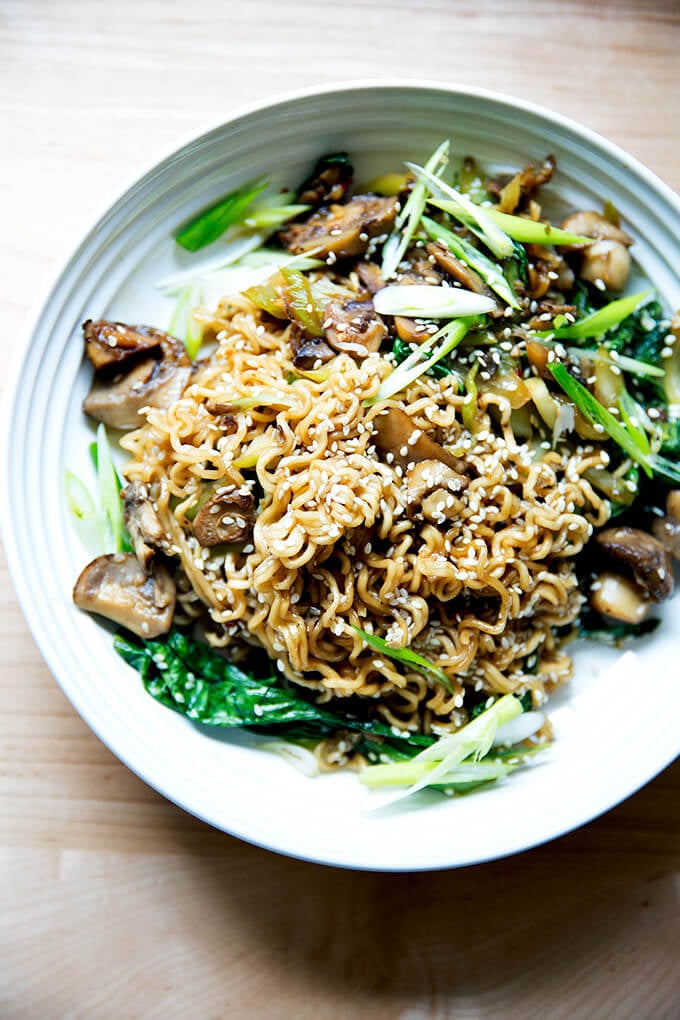
A few weeks ago I found, hiding in a stash of to-make recipes, a magazine clipping featuring “better-than-takeout” udon noodles.
It had been torn from a Bon Appetit, and a note before the recipe intrigued me. It said: “You can easily make this vegetarian—omit the pork and sub in 8 oz. shiitake or crimini mushrooms.”
I loved this idea, and I happened to have mushrooms on hand because I had been making large batches of vegetarian chili .
I made the noodles that evening, and perhaps reasoning a pass through the food processor might mimic the texture of ground meat, but more likely because time was escaping, I pulsed the mushrooms a few times in my Cuisinart. A knob of ginger followed.
With a knife, I shredded a head of Savoy cabbage and chopped up a few scallions. I scoured the pantry for the seasonings, all of which I had on hand — soy sauce, mirin, and sesame oil — and then for some sort of dried noodle. I found a bag of pad Thai rice noodles and went with it.
The entire dish came together incredibly quickly, and what’s more, it was delicious! And loaded with vegetables! And nicely spicy! And balanced! And completely satisfying!
Better than takeout indeed.
I’ve made the dish a number of times since with various noodles and modifications. It’s becoming a favorite for its ease, flavor, and adaptability. Hope you love it, too.
A Few Tips:
- Noodles: The original recipe calls for udon noodles, which I love for their chewiness, but which I can never find without making a trip to the Asian market. Ramen noodles, available everywhere, work beautifully, as do pad Thai noodles and likely many others. [ Note: I don’t love the waste factor when buying individual ramen packets … is there another way? ]
- Cabbage : If you can get your hands on Savoy or Napa, do it. They melt into the noodles in such a nice way. I also think you could substitute other greens such as Swiss chard, kale, or mustard greens. Most recently I made it with bok choy, thinly sliced, and I loved it.
- Mushrooms: I’ve been using cremini, because they are so low maintenance — no need to stem! — though I think shiitake would be delicious here. You could also add more than 10 oz. of mushrooms if you love them, and, of course, you can add other vegetables here, too.
- Sauce: The original recipe calls for 1/3 cup each mirin and soy sauce. I found it to be a touch sweet, so I’ve reduced the amount of mirin to 1/4 cup. That said, the dish may have been sweet because of the heap of cabbage. I encourage you to make it once, and adapt it to your liking.
How to Make One-Pot Ginger-Scallion Ramen Noodles
- Gather your ingredients.
- If you’re feeling lazy, pull out your food processor and pulse the mushrooms about 8 times. Don’t clean it. Then purée a knob of ginger till it’s finely minced. You definitely can chop by hand if you don’t have a food processor.
- Chop a head of cabbage — I like Savoy for its softness — and place it in a colander.
- Open up two packages of ramen noodles, any flavor, and discard the seasoning packet. Cook noodles for 1 minute.
- Drain over the cabbage.
- Sauté the mushrooms in a little bit of olive oil.
- Add ginger, crushed red pepper flakes, and the cabbage and noodles.
- Add mirin, soy sauce, sesame oil, scallions, and sesame seeds. Toss and serve!
Description
Adapted from this Bon Appetit recipe.
Notes:
Mushrooms: If you love mushrooms, I think you could get away with using even more here because they, like cabbage, shrink down so much.
Other vegetables: This recipe can be adapted to what you like or have on hand. I love draining noodles over things like cabbage and dark leafy greens to soften them just slightly. If you want to add carrots, sweet potato, or other harder vegetables, you could shred them in the food processor to ensure they cook quickly.
- 1 small head cabbage, preferably Savoy or Napa (for their softness)
- 2 packages (3-0z each) Ramen noodles, any variety, seasoning packet discarded
- 10 ounces Cremini (or other) mushrooms, see notes above
- 1 small knob ginger, about an inch long, peeled
- 1 tablespoon olive oil
- kosher salt
- pinch crushed red pepper flakes or more to taste
- 1/4 cup mirin
- 1/3 cup soy sauce
- 3 scallions, white and green parts, finely sliced
- 1 tablespoon sesame seeds
- 2 teaspoons sesame oil
- hot sauce, such as Sriracha, for serving
- Fill a large, wide sauté pan or Dutch oven with water and bring to a simmer. (I use a wide sauté pan to make this a one-pot endeavor, but you could also simply use a small saucepan to boil the noodles and then a separate large sauté pan to sauté everything together. Cleanup will still be minimal.)
- Cut the cabbage in half through the core and then again through the core to make quarters. Cut out the core and discard. Shred the remaining leaves finely. Depending on the size of your cabbage, you may chose to use all or part of the cabbage. Keep in mind cabbage shrinks considerably — I’ve been using 3/4 to a whole head every time . It’s about 8 cups. Place the cabbage in a colander, and place in the sink.
- Add the ramen noodles to the simmering water and cook for 30 seconds. They won’t be fully cooked. Drain over the cabbage, being careful the noodles don’t slip over the sides. Keep colander in sink. Reserve your pan.
- Meanwhile: chop the mushrooms. I’ve been using my food processor: 8 to 10 quick pulses. Transfer to a bowl —don’t wash the processor. Add the knob of ginger to the processor and purée until fine, scraping down once and processing once more.
- Heat the 1 tablespoon of olive oil in your reserved sauté pan over high heat. Add the mushrooms, season with a pinch of kosher salt, stir. Let cook undisturbed for 1 minute, then stir and continue to cook at medium-high heat until the mushrooms begin to brown, 3 to 5 minutes.
- Add the ginger and a pinch of crushed red pepper flakes to the pan, and stir to combine. Add the reserved noodles and cabbage. Add the mirin and soy sauce. Use tongs to stir and combine.
- Add the scallions, sesame seeds, and sesame oil, and using tongs again, stir to combine.
- Serve immediately, passing hot sauce of choice on the side.
- Prep Time: 15 minutes
- Cook Time: 10 minutes
- Category: Noodles
- Method: Stovetop
- Cuisine: Asian
