Made with a small portion of stone-milled whole wheat flour, this sourdough bread is so flavorful, aromatic, and tasty. Using a mix of both bread flour and whole wheat flour keeps the texture light while providing a nutritional boost and lovely flavor. 🍞🍞🍞🍞
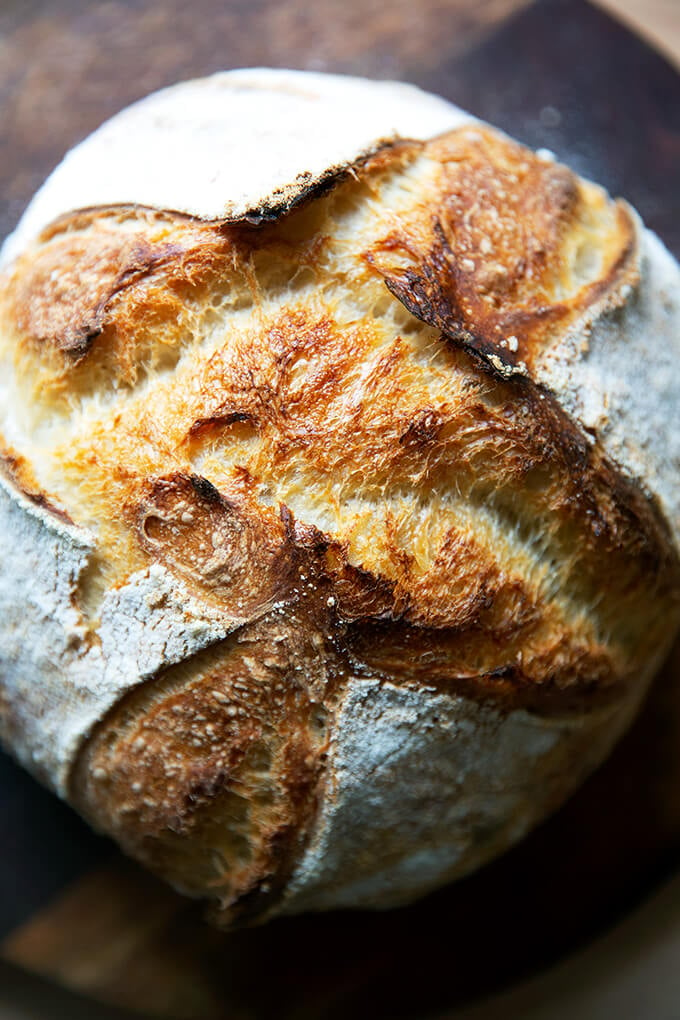
If you are looking to add more nutrition to your bread, a logical first step is to replace some of the white flour with whole wheat flour. The trouble with this idea is that not all whole-wheat flours are created equal.
Let’s get straight to it. Most commercial flour (both white and whole wheat) is made from roller-milled wheat, meaning a roller mill has separated the wheat kernel into three parts: the endosperm, germ, and bran. White flour is made from the endosperm. Whole wheat flour is made from a combination of the endosperm, germ, and bran. Much research shows that as soon as the wheat kernel is separated into the various parts, much of the nutritional value is lost — even when the bran and germ are added in after the fact.
So what’s the solution? Seek out stone-milled flour, which is flour made from wheat that passes through a stone mill, the process of which keeps the endosperm, bran, and germ together. Much research shows that keeping the components together preserves the nutritional value.
What’s more, the bran and germ present in stone-milled flours lend so much by way of flavor, texture, aroma and hue:
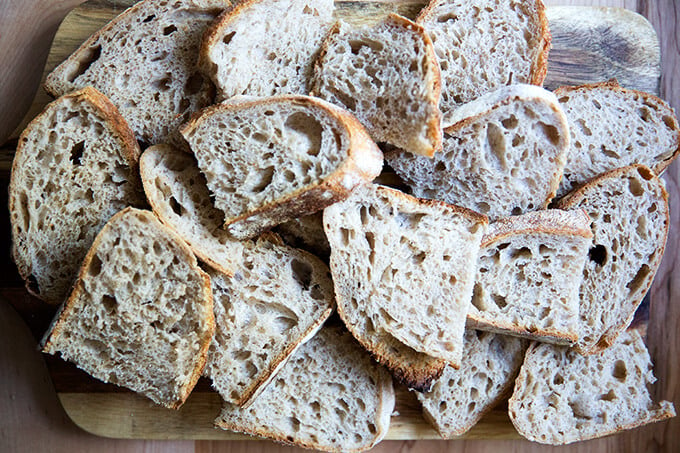
The recipe below calls for a mix of both bread flour and stone-milled flour. Using a small amount of stone-milled flour gives your bread a boost of nutrition while preserving its light texture. Once you’ve made the recipe once, if you like what the whole wheat flour is contributing to your loaf, you can increase the proportion of stone-milled flour next time around.
How to Make Whole Wheat-ish Sourdough Bread, Step by Step
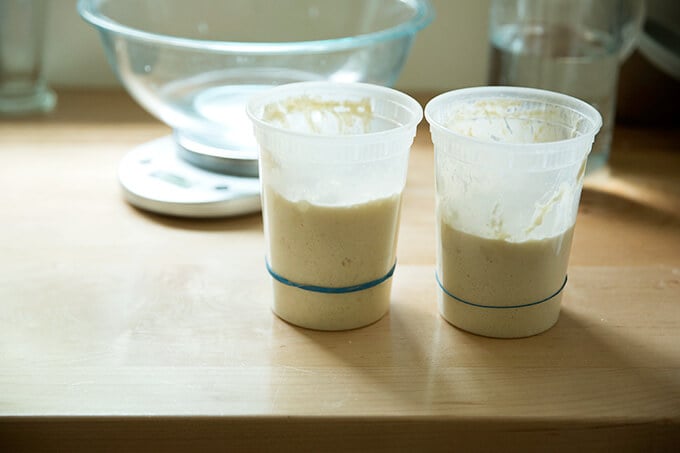
First, gather your ingredients: you need an active/fed sourdough starter:
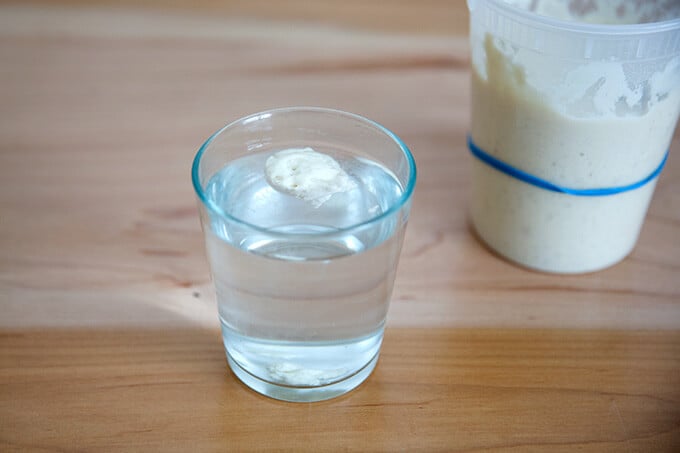
To ensure it is ready, drop a spoonful into a glass of water. If it floats, it’s ready:
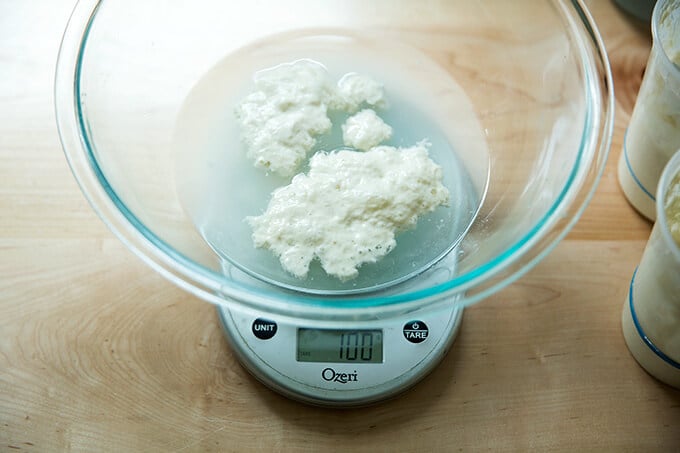
Place 300 g of water, 100 g of starter, and 10 g of salt into a bowl.
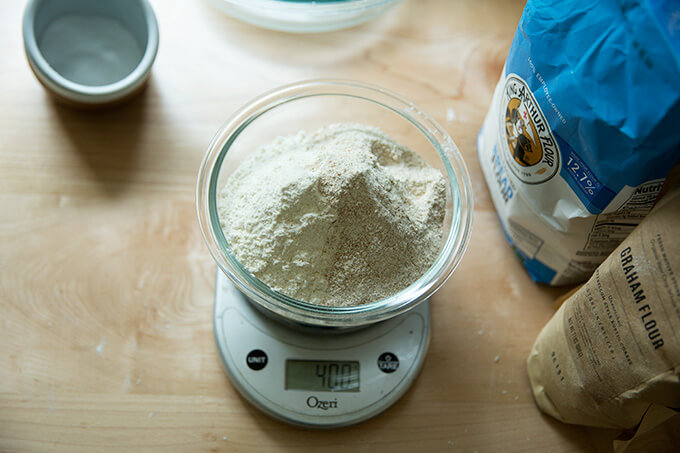
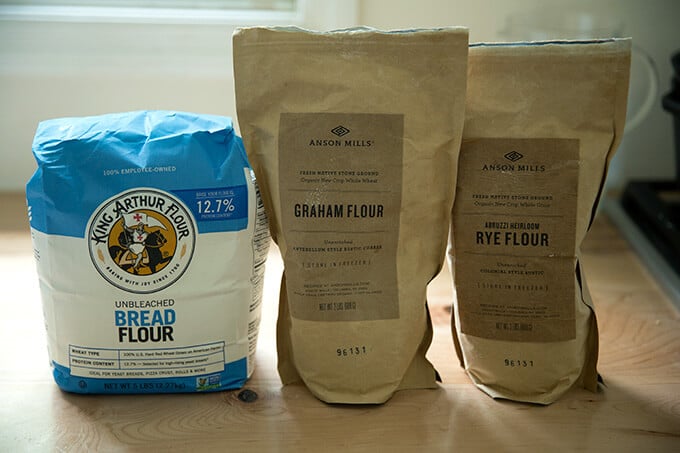
Next, weigh your flour: you need 400 grams of flour. For this whole-wheat-ish loaf, my preference is 350 grams of bread flour (King Arthur Flour) and 50 grams of stone-milled, freshly milled flour (I use a mix of Anson Mills rye and graham).
Mix until a sticky dough forms.
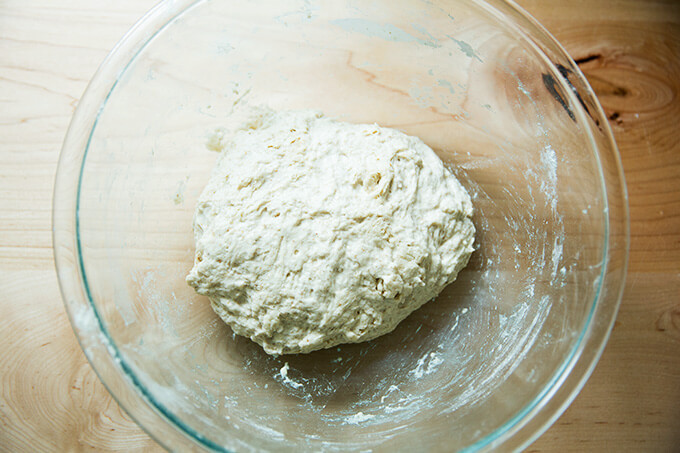
Then transfer to a straight-sided vessel for the bulk fermentation (the first rise).
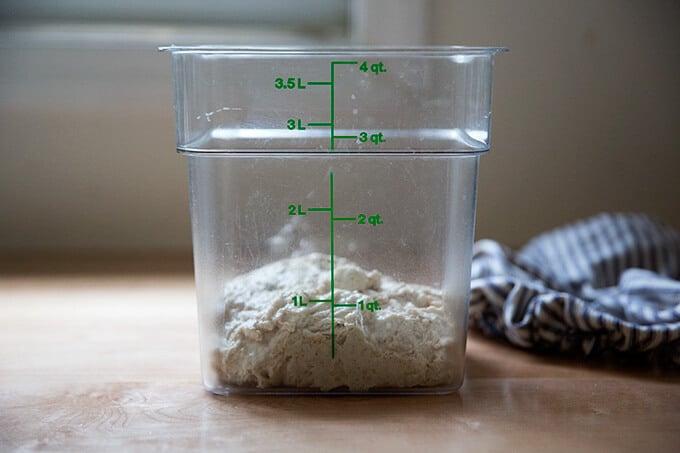
After 30 minutes, stretch and fold the dough:
You’ll repeat this stretching and folding 3x at 30-minute intervals…
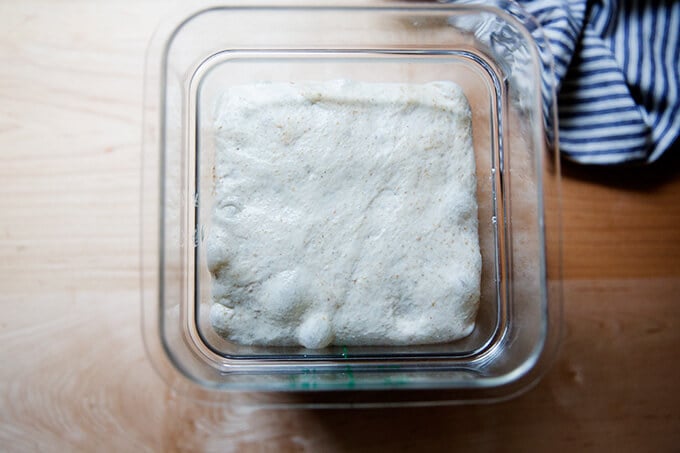
… then you’ll leave the dough to rise until it increases in volume by 50-75%:
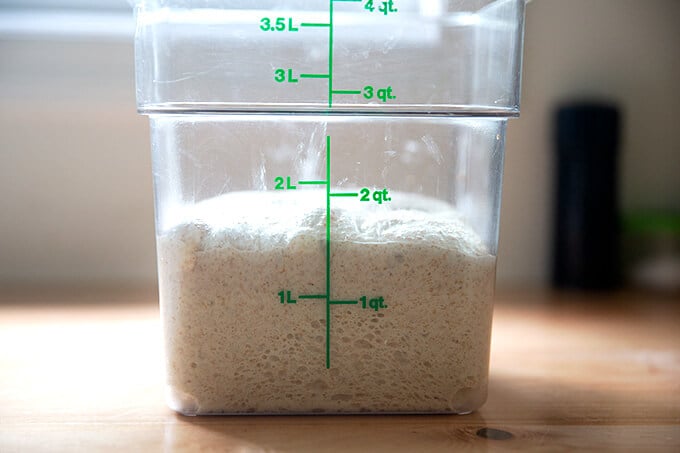
Transfer dough to a clean work surface. I prefer to use no flour and minimal handling to shape it into a ball.
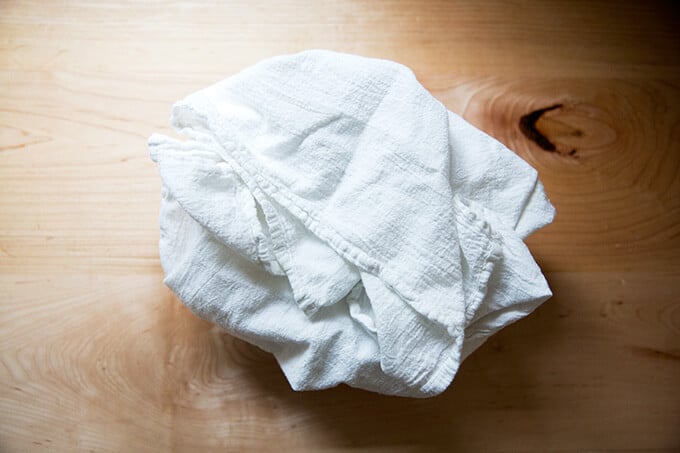
After the initial shape, let the dough rest for 20-40 minutes; then shape again and transfer to a flour sack-lined bowl.
Transfer bowl to fridge to proof (second rise) for 18 to 24 hours
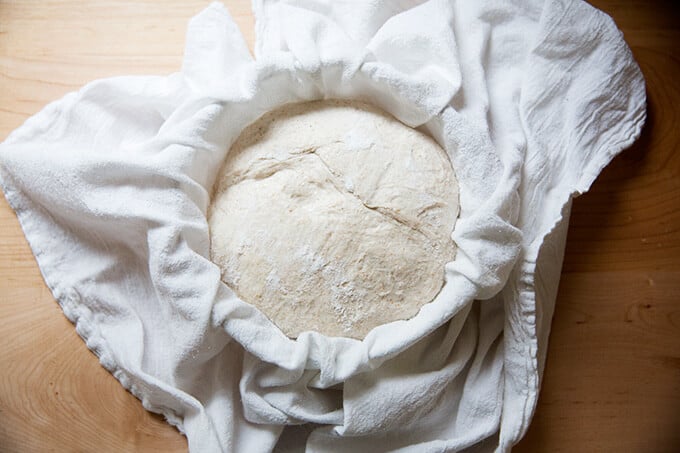
After 18 to 24 hours, transfer dough to a sheet of parchment paper. This video shows how:
Score as you wish; simple is fine.
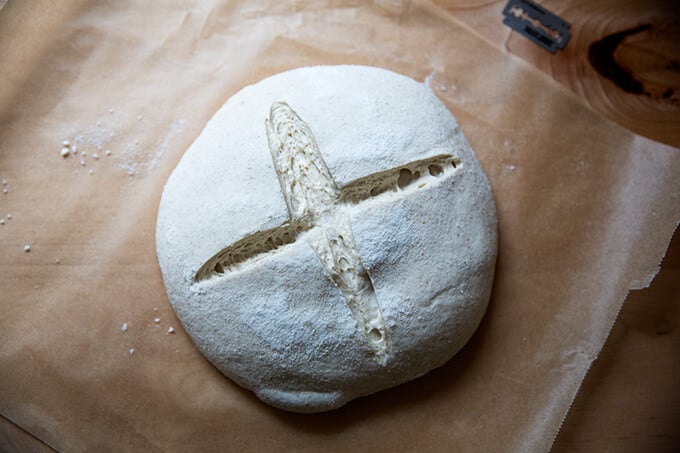
Transfer to a Dutch oven and bake, covered, at 450ºF for 30 minutes, then uncover and bake at 400ºF for 10 minutes.
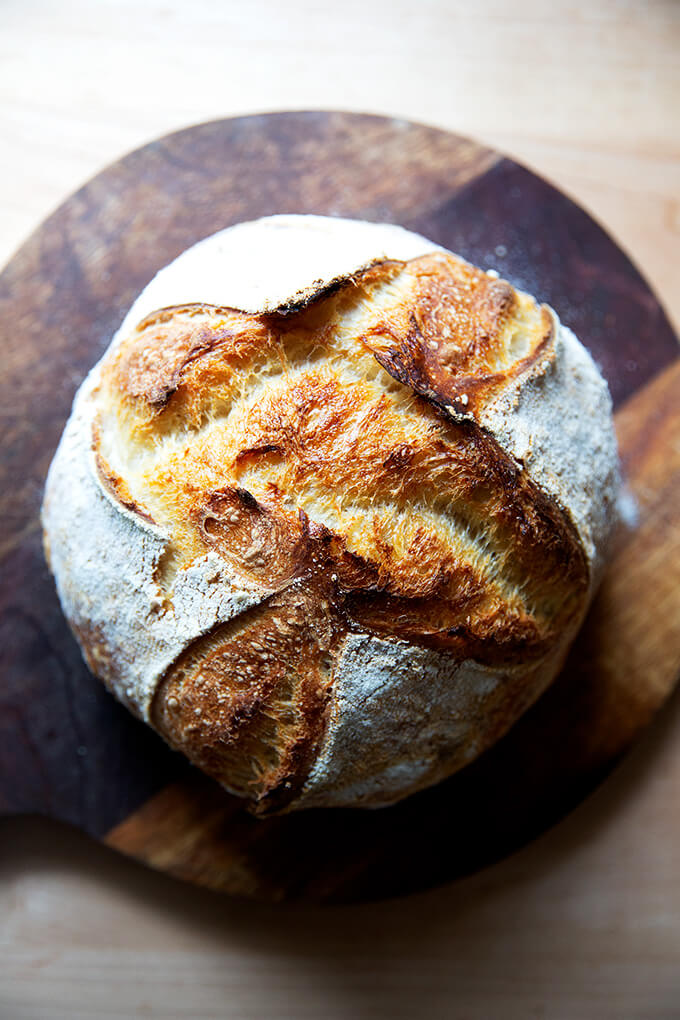
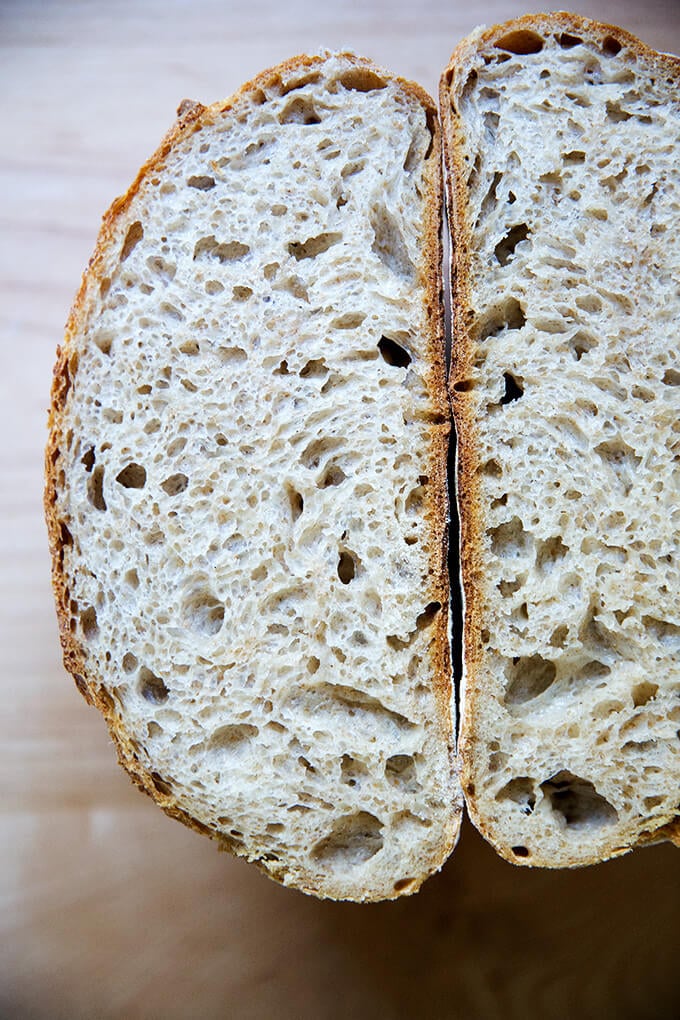
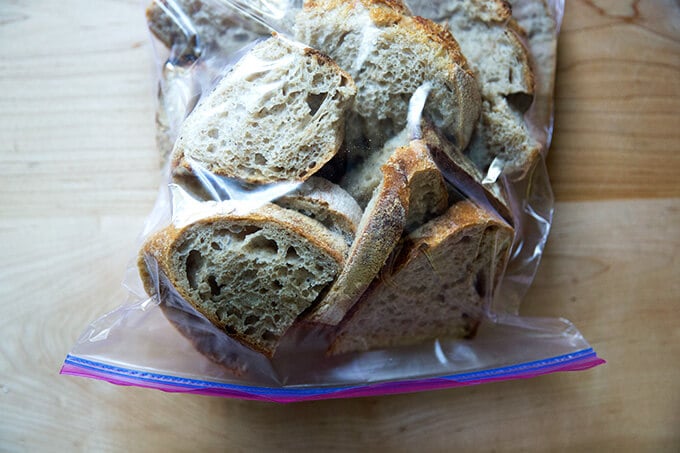
Store the bread at room temperature in a ziptop bag for 3 to 4 days or in the freezer for up to 3 months:
Description
Made with a small portion of stone-milled whole wheat flour, this sourdough bread is so flavorful, aromatic, and tasty. Using a mix of both bread flour and whole wheat flour keeps the texture light while providing a nutritional boost and more flavor.
Notes:
Special equipment: Straight-sided vessel for the bulk fermentation, Dutch oven , flour-sack towel
Digital Scale: Do not attempt this recipe without a scale. This one costs $10 . Troubleshooting what goes wrong with sourdough bread is impossible if you’ve measured with cups. They’re simply not accurate.
Troubleshooting: If you have issues with your dough being too sticky, please read this post: Why is my sourdough so sticky? The 4 common mistakes.
Flour:
- I prefer making this bread with 350g bread flour and 50g of freshly milled, stone-milled flour, which provides both flavor and color. I love using a mix of Anson Mills graham flour and rye flour, but there are many great stone-milled flours out there, and you may have a local source, which is even better. Where to buy stone-milled flour? In the past few years, it has become easier to find stone-milled flour, and if you are up for it, you should seek out locally, stone-milled flour. Why? Because if you’re buying locally milled flour, you likely can find out how recently it was milled. Because stone-milled flour perishes more quickly than roller-milled flour, it’s best if you can find a local source, which will ensure it will be fresh. Note: Store stone-milled flour in the freezer if you don’t bake regularly. I find locally milled stone-milled flours at a local co-op, Honest Weight Food Co-op, and I also order online from various sources. Here are a few I love: Cairnspring Mills, Anson Mills, and Community Grains 50g may seem like a tiny amount of stone-milled flour for this recipe, but I am constantly amazed by how much flavor this small amount of freshly milled flour adds.
Please read notes above before proceeding. Watching the video is helpful, too.
- 300 g water
- 100 g active sourdough starter
- 10 g kosher salt or sea salt
- 350 g bread flour, see notes above
- 50 g whole wheat flour, preferably stone-milled, see notes above
- rice flour, for dusting
- Mix the dough. In a large bowl, combine the water, starter, and salt. Stir with a rubber spatula to loosely combine. Add the flours, and stir with a spatula to combine — it will be a wet, sticky dough ball. Transfer to a straight-sided vessel and cover with a tea towel or bowl cover for 30 minutes.
- Stretch and fold . After 30 minutes, grab a corner of the dough and pull it up and into the center. Repeat until you’ve performed this series of folds 4 to 5 times with the dough. Let the dough rest for another 30 minutes and repeat the stretching and folding action. If you have the time, do this twice more for a total of 4 times in 2 hours. [ Video guidance here. ] Note: Even if you can only perform one series of stretches and folds, your dough will benefit. So don’t worry if you have to run off shortly after you mix the dough.
- Bulk fermentation: Cover the vessel with a tea towel or bowl cover and let rise at room temperature (70ºF/21ºC) for 4 to 18 hours (times will vary based on the time of year, the humidity, and the temperature of your kitchen). The bulk fermentation will end when the dough has nearly doubled in volume, and you can see bubbles throughout the dough and on the surface. (Note: Do not use your oven with the light on for the bulk fermentation — it is too warm for the dough. To determine when the bulk fermentation is done, it is best to rely on visual cues (doubling in volume) as opposed to time. A straight-sided vessel makes monitoring the bulk fermentation especially easy because it allows you to see when your dough has truly doubled.)
- Shape: Gently transfer the dough to a clean work surface. I prefer to use no flour and a bench scraper at this step, but if you find an unfloured work surface to be difficult, feel free to lightly flour it. [ Video guidance is especially helpful for this step .] Fold the dough, envelope style: top third over to the center; bottom third up and over to the center. Then repeat from right to left. Turn the dough over and use your bench scraper to push the dough up, then back towards you to create a tight ball. Repeat this pushing and pulling till you feel you have some tension in your ball. Place the dough ball top side down and let rest 30 to 40 minutes. ( FYI: This is called the bench rest. )
- Proof. Line a shallow 2-qt bowl (or something similar) with a tea towel or flour sack towel . Flour sack towels are amazing because the dough doesn’t stick to them, and therefore, you need very little rice flour, but if you only have a tea towel, you will be fine. If you are using a tea towel, sprinkle it generously with rice flour. If you are using a flour sack towel, you can use a lighter hand with the rice flour. After the 30-to 40-minute bench rest, repeat the envelope-style folding and the bench scraper pushing and pulling till you have a tight ball. [ Video guidance here .] Place the ball top side down in your prepared towel-lined bowl. Cover bowl with overhanging towel. Transfer bowl to the fridge for 12 to 24 hours. (Note: When you remove your dough from the fridge, visually it will likely look unchanged. This is OK. You do not need to let it then proof at room temperature before baking.)
- Bake. Heat oven to 500ºF. Remove your sourdough from the fridge. Open the towel. Place a sheet of parchment over the bowl. Place a plate over the parchment. With a hand firmly on the plate and one on the bowl, turn the dough out onto the parchment-paper-lined plate. [ Video guidance here. ] Carefully remove the bowl and towel. Carefully remove the plate. Brush off any excess rice flour. Use a razor blade to score the dough as you wish. I always do a simple X. Grab the ends of the parchment paper and transfer to the Dutch oven. [ Video guidance here .] Cover it. Lower oven temperature to 450ºF, bake covered for 30 minutes. Uncover. Lower the temperature to 400ºF. Bake for 10 minutes more or until the loaf has darkened to your liking. Transfer the loaf to a cooling rack.
- Cool. Let the loaf cool for at least 30 minutes before cutting.
- Prep Time: 48 hours
- Cook Time: 45 minutes
- Category: Bread
- Method: Sourdough
- Cuisine: Global
Made with a small portion of stone-milled whole wheat flour, this sourdough bread is so flavorful, aromatic, and tasty. Using a mix of both bread flour and whole wheat flour keeps the texture light while providing a nutritional boost and lovely flavor. 🍞🍞🍞🍞
If you are looking to add more nutrition to your bread, a logical first step is to replace some of the white flour with whole wheat flour. The trouble with this idea is that not all whole-wheat flours are created equal.
Let’s get straight to it. Most commercial flour (both white and whole wheat) is made from roller-milled wheat, meaning a roller mill has separated the wheat kernel into three parts: the endosperm, germ, and bran. White flour is made from the endosperm. Whole wheat flour is made from a combination of the endosperm, germ, and bran. Much research shows that as soon as the wheat kernel is separated into the various parts, much of the nutritional value is lost — even when the bran and germ are added in after the fact.
So what’s the solution? Seek out stone-milled flour, which is flour made from wheat that passes through a stone mill, the process of which keeps the endosperm, bran, and germ together. Much research shows that keeping the components together preserves the nutritional value.
What’s more, the bran and germ present in stone-milled flours lend so much by way of flavor, texture, aroma and hue:
The recipe below calls for a mix of both bread flour and stone-milled flour. Using a small amount of stone-milled flour gives your bread a boost of nutrition while preserving its light texture. Once you’ve made the recipe once, if you like what the whole wheat flour is contributing to your loaf, you can increase the proportion of stone-milled flour next time around.
How to Make Whole Wheat-ish Sourdough Bread, Step by Step
First, gather your ingredients: you need an active/fed sourdough starter:
To ensure it is ready, drop a spoonful into a glass of water. If it floats, it’s ready:
Place 300 g of water, 100 g of starter, and 10 g of salt into a bowl.
Next, weigh your flour: you need 400 grams of flour. For this whole-wheat-ish loaf, my preference is 350 grams of bread flour (King Arthur Flour) and 50 grams of stone-milled, freshly milled flour (I use a mix of Anson Mills rye and graham).
Mix until a sticky dough forms.
Then transfer to a straight-sided vessel for the bulk fermentation (the first rise).
After 30 minutes, stretch and fold the dough:
You’ll repeat this stretching and folding 3x at 30-minute intervals…
… then you’ll leave the dough to rise until it increases in volume by 50-75%:
Transfer dough to a clean work surface. I prefer to use no flour and minimal handling to shape it into a ball.
After the initial shape, let the dough rest for 20-40 minutes; then shape again and transfer to a flour sack-lined bowl.
Transfer bowl to fridge to proof (second rise) for 18 to 24 hours
After 18 to 24 hours, transfer dough to a sheet of parchment paper. This video shows how:
Score as you wish; simple is fine.
Transfer to a Dutch oven and bake, covered, at 450ºF for 30 minutes, then uncover and bake at 400ºF for 10 minutes.
Store the bread at room temperature in a ziptop bag for 3 to 4 days or in the freezer for up to 3 months:
Description
Made with a small portion of stone-milled whole wheat flour, this sourdough bread is so flavorful, aromatic, and tasty. Using a mix of both bread flour and whole wheat flour keeps the texture light while providing a nutritional boost and more flavor.
Notes:
Special equipment: Straight-sided vessel for the bulk fermentation, Dutch oven , flour-sack towel
Digital Scale: Do not attempt this recipe without a scale. This one costs $10 . Troubleshooting what goes wrong with sourdough bread is impossible if you’ve measured with cups. They’re simply not accurate.
Troubleshooting: If you have issues with your dough being too sticky, please read this post: Why is my sourdough so sticky? The 4 common mistakes.
Flour:
- I prefer making this bread with 350g bread flour and 50g of freshly milled, stone-milled flour, which provides both flavor and color. I love using a mix of Anson Mills graham flour and rye flour, but there are many great stone-milled flours out there, and you may have a local source, which is even better. Where to buy stone-milled flour? In the past few years, it has become easier to find stone-milled flour, and if you are up for it, you should seek out locally, stone-milled flour. Why? Because if you’re buying locally milled flour, you likely can find out how recently it was milled. Because stone-milled flour perishes more quickly than roller-milled flour, it’s best if you can find a local source, which will ensure it will be fresh. Note: Store stone-milled flour in the freezer if you don’t bake regularly. I find locally milled stone-milled flours at a local co-op, Honest Weight Food Co-op, and I also order online from various sources. Here are a few I love: Cairnspring Mills, Anson Mills, and Community Grains 50g may seem like a tiny amount of stone-milled flour for this recipe, but I am constantly amazed by how much flavor this small amount of freshly milled flour adds.
Please read notes above before proceeding. Watching the video is helpful, too.
- 300 g water
- 100 g active sourdough starter
- 10 g kosher salt or sea salt
- 350 g bread flour, see notes above
- 50 g whole wheat flour, preferably stone-milled, see notes above
- rice flour, for dusting
- Mix the dough. In a large bowl, combine the water, starter, and salt. Stir with a rubber spatula to loosely combine. Add the flours, and stir with a spatula to combine — it will be a wet, sticky dough ball. Transfer to a straight-sided vessel and cover with a tea towel or bowl cover for 30 minutes.
- Stretch and fold . After 30 minutes, grab a corner of the dough and pull it up and into the center. Repeat until you’ve performed this series of folds 4 to 5 times with the dough. Let the dough rest for another 30 minutes and repeat the stretching and folding action. If you have the time, do this twice more for a total of 4 times in 2 hours. [ Video guidance here. ] Note: Even if you can only perform one series of stretches and folds, your dough will benefit. So don’t worry if you have to run off shortly after you mix the dough.
- Bulk fermentation: Cover the vessel with a tea towel or bowl cover and let rise at room temperature (70ºF/21ºC) for 4 to 18 hours (times will vary based on the time of year, the humidity, and the temperature of your kitchen). The bulk fermentation will end when the dough has nearly doubled in volume, and you can see bubbles throughout the dough and on the surface. (Note: Do not use your oven with the light on for the bulk fermentation — it is too warm for the dough. To determine when the bulk fermentation is done, it is best to rely on visual cues (doubling in volume) as opposed to time. A straight-sided vessel makes monitoring the bulk fermentation especially easy because it allows you to see when your dough has truly doubled.)
- Shape: Gently transfer the dough to a clean work surface. I prefer to use no flour and a bench scraper at this step, but if you find an unfloured work surface to be difficult, feel free to lightly flour it. [ Video guidance is especially helpful for this step .] Fold the dough, envelope style: top third over to the center; bottom third up and over to the center. Then repeat from right to left. Turn the dough over and use your bench scraper to push the dough up, then back towards you to create a tight ball. Repeat this pushing and pulling till you feel you have some tension in your ball. Place the dough ball top side down and let rest 30 to 40 minutes. ( FYI: This is called the bench rest. )
- Proof. Line a shallow 2-qt bowl (or something similar) with a tea towel or flour sack towel . Flour sack towels are amazing because the dough doesn’t stick to them, and therefore, you need very little rice flour, but if you only have a tea towel, you will be fine. If you are using a tea towel, sprinkle it generously with rice flour. If you are using a flour sack towel, you can use a lighter hand with the rice flour. After the 30-to 40-minute bench rest, repeat the envelope-style folding and the bench scraper pushing and pulling till you have a tight ball. [ Video guidance here .] Place the ball top side down in your prepared towel-lined bowl. Cover bowl with overhanging towel. Transfer bowl to the fridge for 12 to 24 hours. (Note: When you remove your dough from the fridge, visually it will likely look unchanged. This is OK. You do not need to let it then proof at room temperature before baking.)
- Bake. Heat oven to 500ºF. Remove your sourdough from the fridge. Open the towel. Place a sheet of parchment over the bowl. Place a plate over the parchment. With a hand firmly on the plate and one on the bowl, turn the dough out onto the parchment-paper-lined plate. [ Video guidance here. ] Carefully remove the bowl and towel. Carefully remove the plate. Brush off any excess rice flour. Use a razor blade to score the dough as you wish. I always do a simple X. Grab the ends of the parchment paper and transfer to the Dutch oven. [ Video guidance here .] Cover it. Lower oven temperature to 450ºF, bake covered for 30 minutes. Uncover. Lower the temperature to 400ºF. Bake for 10 minutes more or until the loaf has darkened to your liking. Transfer the loaf to a cooling rack.
- Cool. Let the loaf cool for at least 30 minutes before cutting.
- Prep Time: 48 hours
- Cook Time: 45 minutes
- Category: Bread
- Method: Sourdough
- Cuisine: Global
Made with a small portion of stone-milled whole wheat flour, this sourdough bread is so flavorful, aromatic, and tasty. Using a mix of both bread flour and whole wheat flour keeps the texture light while providing a nutritional boost and lovely flavor. 🍞🍞🍞🍞
If you are looking to add more nutrition to your bread, a logical first step is to replace some of the white flour with whole wheat flour. The trouble with this idea is that not all whole-wheat flours are created equal.
Let’s get straight to it. Most commercial flour (both white and whole wheat) is made from roller-milled wheat, meaning a roller mill has separated the wheat kernel into three parts: the endosperm, germ, and bran. White flour is made from the endosperm. Whole wheat flour is made from a combination of the endosperm, germ, and bran. Much research shows that as soon as the wheat kernel is separated into the various parts, much of the nutritional value is lost — even when the bran and germ are added in after the fact.
So what’s the solution? Seek out stone-milled flour, which is flour made from wheat that passes through a stone mill, the process of which keeps the endosperm, bran, and germ together. Much research shows that keeping the components together preserves the nutritional value.
What’s more, the bran and germ present in stone-milled flours lend so much by way of flavor, texture, aroma and hue:
The recipe below calls for a mix of both bread flour and stone-milled flour. Using a small amount of stone-milled flour gives your bread a boost of nutrition while preserving its light texture. Once you’ve made the recipe once, if you like what the whole wheat flour is contributing to your loaf, you can increase the proportion of stone-milled flour next time around.
How to Make Whole Wheat-ish Sourdough Bread, Step by Step
First, gather your ingredients: you need an active/fed sourdough starter:
To ensure it is ready, drop a spoonful into a glass of water. If it floats, it’s ready:
Place 300 g of water, 100 g of starter, and 10 g of salt into a bowl.
Next, weigh your flour: you need 400 grams of flour. For this whole-wheat-ish loaf, my preference is 350 grams of bread flour (King Arthur Flour) and 50 grams of stone-milled, freshly milled flour (I use a mix of Anson Mills rye and graham).
Mix until a sticky dough forms.
Then transfer to a straight-sided vessel for the bulk fermentation (the first rise).
After 30 minutes, stretch and fold the dough:
You’ll repeat this stretching and folding 3x at 30-minute intervals…
… then you’ll leave the dough to rise until it increases in volume by 50-75%:
Transfer dough to a clean work surface. I prefer to use no flour and minimal handling to shape it into a ball.
After the initial shape, let the dough rest for 20-40 minutes; then shape again and transfer to a flour sack-lined bowl.
Transfer bowl to fridge to proof (second rise) for 18 to 24 hours
After 18 to 24 hours, transfer dough to a sheet of parchment paper. This video shows how:
Score as you wish; simple is fine.
Transfer to a Dutch oven and bake, covered, at 450ºF for 30 minutes, then uncover and bake at 400ºF for 10 minutes.
Store the bread at room temperature in a ziptop bag for 3 to 4 days or in the freezer for up to 3 months:
Description
Made with a small portion of stone-milled whole wheat flour, this sourdough bread is so flavorful, aromatic, and tasty. Using a mix of both bread flour and whole wheat flour keeps the texture light while providing a nutritional boost and more flavor.
Notes:
Special equipment: Straight-sided vessel for the bulk fermentation, Dutch oven , flour-sack towel
Digital Scale: Do not attempt this recipe without a scale. This one costs $10 . Troubleshooting what goes wrong with sourdough bread is impossible if you’ve measured with cups. They’re simply not accurate.
Troubleshooting: If you have issues with your dough being too sticky, please read this post: Why is my sourdough so sticky? The 4 common mistakes.
Flour:
- I prefer making this bread with 350g bread flour and 50g of freshly milled, stone-milled flour, which provides both flavor and color. I love using a mix of Anson Mills graham flour and rye flour, but there are many great stone-milled flours out there, and you may have a local source, which is even better. Where to buy stone-milled flour? In the past few years, it has become easier to find stone-milled flour, and if you are up for it, you should seek out locally, stone-milled flour. Why? Because if you’re buying locally milled flour, you likely can find out how recently it was milled. Because stone-milled flour perishes more quickly than roller-milled flour, it’s best if you can find a local source, which will ensure it will be fresh. Note: Store stone-milled flour in the freezer if you don’t bake regularly. I find locally milled stone-milled flours at a local co-op, Honest Weight Food Co-op, and I also order online from various sources. Here are a few I love: Cairnspring Mills, Anson Mills, and Community Grains 50g may seem like a tiny amount of stone-milled flour for this recipe, but I am constantly amazed by how much flavor this small amount of freshly milled flour adds.
Please read notes above before proceeding. Watching the video is helpful, too.
- 300 g water
- 100 g active sourdough starter
- 10 g kosher salt or sea salt
- 350 g bread flour, see notes above
- 50 g whole wheat flour, preferably stone-milled, see notes above
- rice flour, for dusting
- Mix the dough. In a large bowl, combine the water, starter, and salt. Stir with a rubber spatula to loosely combine. Add the flours, and stir with a spatula to combine — it will be a wet, sticky dough ball. Transfer to a straight-sided vessel and cover with a tea towel or bowl cover for 30 minutes.
- Stretch and fold . After 30 minutes, grab a corner of the dough and pull it up and into the center. Repeat until you’ve performed this series of folds 4 to 5 times with the dough. Let the dough rest for another 30 minutes and repeat the stretching and folding action. If you have the time, do this twice more for a total of 4 times in 2 hours. [ Video guidance here. ] Note: Even if you can only perform one series of stretches and folds, your dough will benefit. So don’t worry if you have to run off shortly after you mix the dough.
- Bulk fermentation: Cover the vessel with a tea towel or bowl cover and let rise at room temperature (70ºF/21ºC) for 4 to 18 hours (times will vary based on the time of year, the humidity, and the temperature of your kitchen). The bulk fermentation will end when the dough has nearly doubled in volume, and you can see bubbles throughout the dough and on the surface. (Note: Do not use your oven with the light on for the bulk fermentation — it is too warm for the dough. To determine when the bulk fermentation is done, it is best to rely on visual cues (doubling in volume) as opposed to time. A straight-sided vessel makes monitoring the bulk fermentation especially easy because it allows you to see when your dough has truly doubled.)
- Shape: Gently transfer the dough to a clean work surface. I prefer to use no flour and a bench scraper at this step, but if you find an unfloured work surface to be difficult, feel free to lightly flour it. [ Video guidance is especially helpful for this step .] Fold the dough, envelope style: top third over to the center; bottom third up and over to the center. Then repeat from right to left. Turn the dough over and use your bench scraper to push the dough up, then back towards you to create a tight ball. Repeat this pushing and pulling till you feel you have some tension in your ball. Place the dough ball top side down and let rest 30 to 40 minutes. ( FYI: This is called the bench rest. )
- Proof. Line a shallow 2-qt bowl (or something similar) with a tea towel or flour sack towel . Flour sack towels are amazing because the dough doesn’t stick to them, and therefore, you need very little rice flour, but if you only have a tea towel, you will be fine. If you are using a tea towel, sprinkle it generously with rice flour. If you are using a flour sack towel, you can use a lighter hand with the rice flour. After the 30-to 40-minute bench rest, repeat the envelope-style folding and the bench scraper pushing and pulling till you have a tight ball. [ Video guidance here .] Place the ball top side down in your prepared towel-lined bowl. Cover bowl with overhanging towel. Transfer bowl to the fridge for 12 to 24 hours. (Note: When you remove your dough from the fridge, visually it will likely look unchanged. This is OK. You do not need to let it then proof at room temperature before baking.)
- Bake. Heat oven to 500ºF. Remove your sourdough from the fridge. Open the towel. Place a sheet of parchment over the bowl. Place a plate over the parchment. With a hand firmly on the plate and one on the bowl, turn the dough out onto the parchment-paper-lined plate. [ Video guidance here. ] Carefully remove the bowl and towel. Carefully remove the plate. Brush off any excess rice flour. Use a razor blade to score the dough as you wish. I always do a simple X. Grab the ends of the parchment paper and transfer to the Dutch oven. [ Video guidance here .] Cover it. Lower oven temperature to 450ºF, bake covered for 30 minutes. Uncover. Lower the temperature to 400ºF. Bake for 10 minutes more or until the loaf has darkened to your liking. Transfer the loaf to a cooling rack.
- Cool. Let the loaf cool for at least 30 minutes before cutting.
- Prep Time: 48 hours
- Cook Time: 45 minutes
- Category: Bread
- Method: Sourdough
- Cuisine: Global
Made with a small portion of stone-milled whole wheat flour, this sourdough bread is so flavorful, aromatic, and tasty. Using a mix of both bread flour and whole wheat flour keeps the texture light while providing a nutritional boost and lovely flavor. 🍞🍞🍞🍞
If you are looking to add more nutrition to your bread, a logical first step is to replace some of the white flour with whole wheat flour. The trouble with this idea is that not all whole-wheat flours are created equal.
Let’s get straight to it. Most commercial flour (both white and whole wheat) is made from roller-milled wheat, meaning a roller mill has separated the wheat kernel into three parts: the endosperm, germ, and bran. White flour is made from the endosperm. Whole wheat flour is made from a combination of the endosperm, germ, and bran. Much research shows that as soon as the wheat kernel is separated into the various parts, much of the nutritional value is lost — even when the bran and germ are added in after the fact.
So what’s the solution? Seek out stone-milled flour, which is flour made from wheat that passes through a stone mill, the process of which keeps the endosperm, bran, and germ together. Much research shows that keeping the components together preserves the nutritional value.
What’s more, the bran and germ present in stone-milled flours lend so much by way of flavor, texture, aroma and hue:
The recipe below calls for a mix of both bread flour and stone-milled flour. Using a small amount of stone-milled flour gives your bread a boost of nutrition while preserving its light texture. Once you’ve made the recipe once, if you like what the whole wheat flour is contributing to your loaf, you can increase the proportion of stone-milled flour next time around.
How to Make Whole Wheat-ish Sourdough Bread, Step by Step
First, gather your ingredients: you need an active/fed sourdough starter:
To ensure it is ready, drop a spoonful into a glass of water. If it floats, it’s ready:
Place 300 g of water, 100 g of starter, and 10 g of salt into a bowl.
Next, weigh your flour: you need 400 grams of flour. For this whole-wheat-ish loaf, my preference is 350 grams of bread flour (King Arthur Flour) and 50 grams of stone-milled, freshly milled flour (I use a mix of Anson Mills rye and graham).
Mix until a sticky dough forms.
Then transfer to a straight-sided vessel for the bulk fermentation (the first rise).
After 30 minutes, stretch and fold the dough:
You’ll repeat this stretching and folding 3x at 30-minute intervals…
… then you’ll leave the dough to rise until it increases in volume by 50-75%:
Transfer dough to a clean work surface. I prefer to use no flour and minimal handling to shape it into a ball.
After the initial shape, let the dough rest for 20-40 minutes; then shape again and transfer to a flour sack-lined bowl.
Transfer bowl to fridge to proof (second rise) for 18 to 24 hours
After 18 to 24 hours, transfer dough to a sheet of parchment paper. This video shows how:
Score as you wish; simple is fine.
Transfer to a Dutch oven and bake, covered, at 450ºF for 30 minutes, then uncover and bake at 400ºF for 10 minutes.
Store the bread at room temperature in a ziptop bag for 3 to 4 days or in the freezer for up to 3 months:
Description
Made with a small portion of stone-milled whole wheat flour, this sourdough bread is so flavorful, aromatic, and tasty. Using a mix of both bread flour and whole wheat flour keeps the texture light while providing a nutritional boost and more flavor.
Notes:
Special equipment: Straight-sided vessel for the bulk fermentation, Dutch oven , flour-sack towel
Digital Scale: Do not attempt this recipe without a scale. This one costs $10 . Troubleshooting what goes wrong with sourdough bread is impossible if you’ve measured with cups. They’re simply not accurate.
Troubleshooting: If you have issues with your dough being too sticky, please read this post: Why is my sourdough so sticky? The 4 common mistakes.
Flour:
- I prefer making this bread with 350g bread flour and 50g of freshly milled, stone-milled flour, which provides both flavor and color. I love using a mix of Anson Mills graham flour and rye flour, but there are many great stone-milled flours out there, and you may have a local source, which is even better. Where to buy stone-milled flour? In the past few years, it has become easier to find stone-milled flour, and if you are up for it, you should seek out locally, stone-milled flour. Why? Because if you’re buying locally milled flour, you likely can find out how recently it was milled. Because stone-milled flour perishes more quickly than roller-milled flour, it’s best if you can find a local source, which will ensure it will be fresh. Note: Store stone-milled flour in the freezer if you don’t bake regularly. I find locally milled stone-milled flours at a local co-op, Honest Weight Food Co-op, and I also order online from various sources. Here are a few I love: Cairnspring Mills, Anson Mills, and Community Grains 50g may seem like a tiny amount of stone-milled flour for this recipe, but I am constantly amazed by how much flavor this small amount of freshly milled flour adds.
Please read notes above before proceeding. Watching the video is helpful, too.
- 300 g water
- 100 g active sourdough starter
- 10 g kosher salt or sea salt
- 350 g bread flour, see notes above
- 50 g whole wheat flour, preferably stone-milled, see notes above
- rice flour, for dusting
- Mix the dough. In a large bowl, combine the water, starter, and salt. Stir with a rubber spatula to loosely combine. Add the flours, and stir with a spatula to combine — it will be a wet, sticky dough ball. Transfer to a straight-sided vessel and cover with a tea towel or bowl cover for 30 minutes.
- Stretch and fold . After 30 minutes, grab a corner of the dough and pull it up and into the center. Repeat until you’ve performed this series of folds 4 to 5 times with the dough. Let the dough rest for another 30 minutes and repeat the stretching and folding action. If you have the time, do this twice more for a total of 4 times in 2 hours. [ Video guidance here. ] Note: Even if you can only perform one series of stretches and folds, your dough will benefit. So don’t worry if you have to run off shortly after you mix the dough.
- Bulk fermentation: Cover the vessel with a tea towel or bowl cover and let rise at room temperature (70ºF/21ºC) for 4 to 18 hours (times will vary based on the time of year, the humidity, and the temperature of your kitchen). The bulk fermentation will end when the dough has nearly doubled in volume, and you can see bubbles throughout the dough and on the surface. (Note: Do not use your oven with the light on for the bulk fermentation — it is too warm for the dough. To determine when the bulk fermentation is done, it is best to rely on visual cues (doubling in volume) as opposed to time. A straight-sided vessel makes monitoring the bulk fermentation especially easy because it allows you to see when your dough has truly doubled.)
- Shape: Gently transfer the dough to a clean work surface. I prefer to use no flour and a bench scraper at this step, but if you find an unfloured work surface to be difficult, feel free to lightly flour it. [ Video guidance is especially helpful for this step .] Fold the dough, envelope style: top third over to the center; bottom third up and over to the center. Then repeat from right to left. Turn the dough over and use your bench scraper to push the dough up, then back towards you to create a tight ball. Repeat this pushing and pulling till you feel you have some tension in your ball. Place the dough ball top side down and let rest 30 to 40 minutes. ( FYI: This is called the bench rest. )
- Proof. Line a shallow 2-qt bowl (or something similar) with a tea towel or flour sack towel . Flour sack towels are amazing because the dough doesn’t stick to them, and therefore, you need very little rice flour, but if you only have a tea towel, you will be fine. If you are using a tea towel, sprinkle it generously with rice flour. If you are using a flour sack towel, you can use a lighter hand with the rice flour. After the 30-to 40-minute bench rest, repeat the envelope-style folding and the bench scraper pushing and pulling till you have a tight ball. [ Video guidance here .] Place the ball top side down in your prepared towel-lined bowl. Cover bowl with overhanging towel. Transfer bowl to the fridge for 12 to 24 hours. (Note: When you remove your dough from the fridge, visually it will likely look unchanged. This is OK. You do not need to let it then proof at room temperature before baking.)
- Bake. Heat oven to 500ºF. Remove your sourdough from the fridge. Open the towel. Place a sheet of parchment over the bowl. Place a plate over the parchment. With a hand firmly on the plate and one on the bowl, turn the dough out onto the parchment-paper-lined plate. [ Video guidance here. ] Carefully remove the bowl and towel. Carefully remove the plate. Brush off any excess rice flour. Use a razor blade to score the dough as you wish. I always do a simple X. Grab the ends of the parchment paper and transfer to the Dutch oven. [ Video guidance here .] Cover it. Lower oven temperature to 450ºF, bake covered for 30 minutes. Uncover. Lower the temperature to 400ºF. Bake for 10 minutes more or until the loaf has darkened to your liking. Transfer the loaf to a cooling rack.
- Cool. Let the loaf cool for at least 30 minutes before cutting.
- Prep Time: 48 hours
- Cook Time: 45 minutes
- Category: Bread
- Method: Sourdough
- Cuisine: Global
Description
Made with a small portion of stone-milled whole wheat flour, this sourdough bread is so flavorful, aromatic, and tasty. Using a mix of both bread flour and whole wheat flour keeps the texture light while providing a nutritional boost and more flavor.
Notes:
Special equipment: Straight-sided vessel for the bulk fermentation, Dutch oven , flour-sack towel
Digital Scale: Do not attempt this recipe without a scale. This one costs $10 . Troubleshooting what goes wrong with sourdough bread is impossible if you’ve measured with cups. They’re simply not accurate.
Troubleshooting: If you have issues with your dough being too sticky, please read this post: Why is my sourdough so sticky? The 4 common mistakes.
Flour:
- I prefer making this bread with 350g bread flour and 50g of freshly milled, stone-milled flour, which provides both flavor and color. I love using a mix of Anson Mills graham flour and rye flour, but there are many great stone-milled flours out there, and you may have a local source, which is even better. Where to buy stone-milled flour? In the past few years, it has become easier to find stone-milled flour, and if you are up for it, you should seek out locally, stone-milled flour. Why? Because if you’re buying locally milled flour, you likely can find out how recently it was milled. Because stone-milled flour perishes more quickly than roller-milled flour, it’s best if you can find a local source, which will ensure it will be fresh. Note: Store stone-milled flour in the freezer if you don’t bake regularly. I find locally milled stone-milled flours at a local co-op, Honest Weight Food Co-op, and I also order online from various sources. Here are a few I love: Cairnspring Mills, Anson Mills, and Community Grains 50g may seem like a tiny amount of stone-milled flour for this recipe, but I am constantly amazed by how much flavor this small amount of freshly milled flour adds.
Please read notes above before proceeding. Watching the video is helpful, too.
- 300 g water
- 100 g active sourdough starter
- 10 g kosher salt or sea salt
- 350 g bread flour, see notes above
- 50 g whole wheat flour, preferably stone-milled, see notes above
- rice flour, for dusting
- Mix the dough. In a large bowl, combine the water, starter, and salt. Stir with a rubber spatula to loosely combine. Add the flours, and stir with a spatula to combine — it will be a wet, sticky dough ball. Transfer to a straight-sided vessel and cover with a tea towel or bowl cover for 30 minutes.
- Stretch and fold . After 30 minutes, grab a corner of the dough and pull it up and into the center. Repeat until you’ve performed this series of folds 4 to 5 times with the dough. Let the dough rest for another 30 minutes and repeat the stretching and folding action. If you have the time, do this twice more for a total of 4 times in 2 hours. [ Video guidance here. ] Note: Even if you can only perform one series of stretches and folds, your dough will benefit. So don’t worry if you have to run off shortly after you mix the dough.
- Bulk fermentation: Cover the vessel with a tea towel or bowl cover and let rise at room temperature (70ºF/21ºC) for 4 to 18 hours (times will vary based on the time of year, the humidity, and the temperature of your kitchen). The bulk fermentation will end when the dough has nearly doubled in volume, and you can see bubbles throughout the dough and on the surface. (Note: Do not use your oven with the light on for the bulk fermentation — it is too warm for the dough. To determine when the bulk fermentation is done, it is best to rely on visual cues (doubling in volume) as opposed to time. A straight-sided vessel makes monitoring the bulk fermentation especially easy because it allows you to see when your dough has truly doubled.)
- Shape: Gently transfer the dough to a clean work surface. I prefer to use no flour and a bench scraper at this step, but if you find an unfloured work surface to be difficult, feel free to lightly flour it. [ Video guidance is especially helpful for this step .] Fold the dough, envelope style: top third over to the center; bottom third up and over to the center. Then repeat from right to left. Turn the dough over and use your bench scraper to push the dough up, then back towards you to create a tight ball. Repeat this pushing and pulling till you feel you have some tension in your ball. Place the dough ball top side down and let rest 30 to 40 minutes. ( FYI: This is called the bench rest. )
- Proof. Line a shallow 2-qt bowl (or something similar) with a tea towel or flour sack towel . Flour sack towels are amazing because the dough doesn’t stick to them, and therefore, you need very little rice flour, but if you only have a tea towel, you will be fine. If you are using a tea towel, sprinkle it generously with rice flour. If you are using a flour sack towel, you can use a lighter hand with the rice flour. After the 30-to 40-minute bench rest, repeat the envelope-style folding and the bench scraper pushing and pulling till you have a tight ball. [ Video guidance here .] Place the ball top side down in your prepared towel-lined bowl. Cover bowl with overhanging towel. Transfer bowl to the fridge for 12 to 24 hours. (Note: When you remove your dough from the fridge, visually it will likely look unchanged. This is OK. You do not need to let it then proof at room temperature before baking.)
- Bake. Heat oven to 500ºF. Remove your sourdough from the fridge. Open the towel. Place a sheet of parchment over the bowl. Place a plate over the parchment. With a hand firmly on the plate and one on the bowl, turn the dough out onto the parchment-paper-lined plate. [ Video guidance here. ] Carefully remove the bowl and towel. Carefully remove the plate. Brush off any excess rice flour. Use a razor blade to score the dough as you wish. I always do a simple X. Grab the ends of the parchment paper and transfer to the Dutch oven. [ Video guidance here .] Cover it. Lower oven temperature to 450ºF, bake covered for 30 minutes. Uncover. Lower the temperature to 400ºF. Bake for 10 minutes more or until the loaf has darkened to your liking. Transfer the loaf to a cooling rack.
- Cool. Let the loaf cool for at least 30 minutes before cutting.
- Prep Time: 48 hours
- Cook Time: 45 minutes
- Category: Bread
- Method: Sourdough
- Cuisine: Global
Find it online : https://alexandracooks.com/2019/11/07/easy-whole-wheat-ish-sourdough-bread/

In this guide, I share everything you need to know about buying, feeding, maintaining, and storing a healthy sourdough starter. Below you will find video guidance and step-by-step instructions. Let’s go!
If you are interested in dipping your toe into sourdough bread baking, for starters you need a starter (😂). In this sourdough starter guide I share my tips for:
- Buying a sourdough starter online
- Activating a sourdough starter
- Feeding a sourdough starter
- Maintaining a sourdough starter
- Storing a sourdough starter
- Knowing when a sourdough starter is bad
- How to use your discard in delicious recipes
Although building a sourdough starter from scratch is very gratifying, I am a huge proponent of purchasing a starter. I outline why in more detail here — Sourdough Focaccia: A Beginner’s Guide — but in short, it’s because:
- If you’re curious about sourdough, get to it! Making a starter from scratch can take weeks.
- They’re relatively cheap (or free if you get one from a friend or baker).
- A purchased starter potentially will be stronger/more active than a young, homemade starter.
- Before you spend weeks making a starter, find out if you like the process — again, a purchased starter allows you to get straight to it.
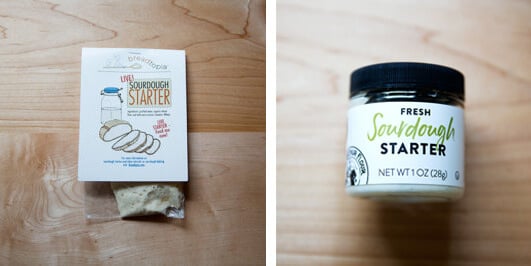
Where to Purchase a Sourdough Starter
I have had success purchasing and activating sourdough starters from three places:
- Breadtopia ($9)
- King Arthur Flour ($9)
- Cultures for Health ($11)
Each place offers guidance for “activating” the starter. Breadtopia’s instructions live on its website. King Arthur Flour sends along a booklet with details, but also provides online help. Cultures For Health offers video guidance here.
In short, to “activate” each, you simply add flour and water, stir, and wait — that’s all there is to feeding a sourdough starter.
How to Activate a Sourdough Starter
A purchased starter generally arrives in a small bag or container. I’ve created a short video for activating a King Arthur Flour sourdough starter . You can use this same process for activating a Breadtopia starter as well:
Follow these steps to activate it:
- Place starter in a vessel. I love these deli quart containers for this purpose.
- Add 45 g each of all-purpose flour (organic if possible) and room-temperature water . ( Note: The consistency should look like a thick batter. )
- Wait. You may see bubbles and action (rising!) in as few as 6 hours; it may take more like 18 to 24 hours. Variables include the time of year, the temperature of your kitchen, the temperature of your water, how much water and flour you used, etc.
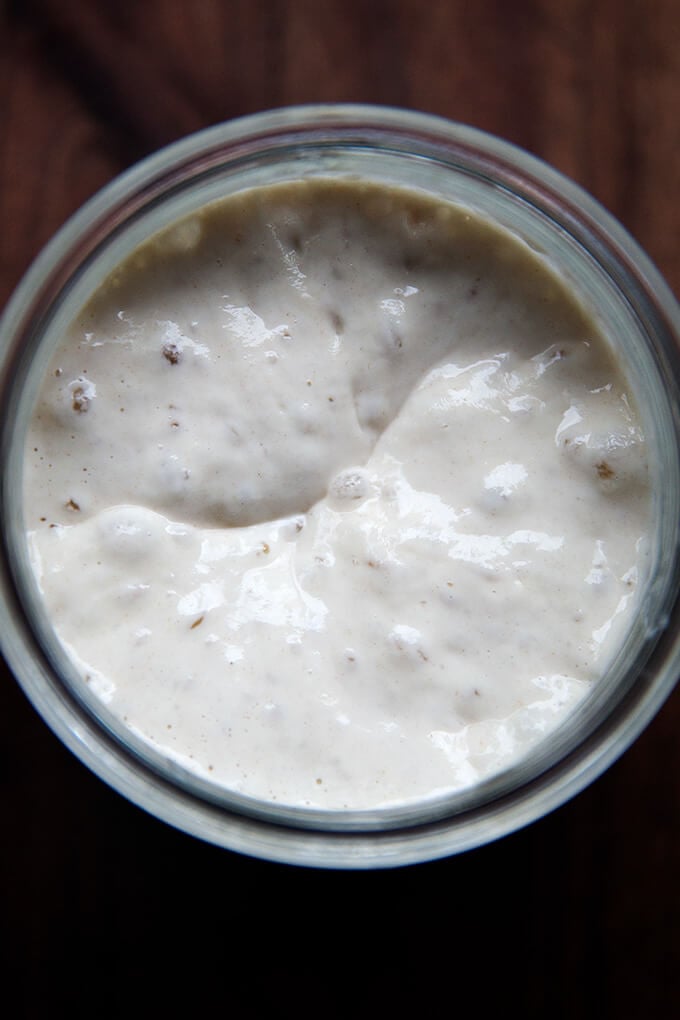
- When the starter has roughly doubled in volume, it’s likely ready to go. Drop a spoonful of it in a glass of water. If it floats, you’re ready!
- If it doesn’t float after 24 hours, add more flour and water (equal parts), stir again, and wait.
- If you aren’t seeing any action after another 12 hours, discard most of it, and add more flour and water (equal parts), stir, and wait. Just be patient. Before you know it, your starter will be rising and bubbling and ready to go.
How to Feed A Sourdough Starter
If your starter floats, and you’re ready to start baking, measure the required amount into a bowl and proceed with the recipe. Here are four great beginner’s sourdough recipes:
- Simple Sourdough Focaccia: A Beginner’s Guide
- Simple Sourdough Bread: A Step-by-Step Guide
- Favorite, Easy Sourdough Bread (Whole Wheat-ish)
- Simple Sourdough Ciabatta Bread
If you’re not ready to bake, discard most of it, add an equal amount of flour and water (45 g each or so), stir it together, cover it, and stash in your fridge.
My preferred storage vessel is a deli quart container . When I store my starter in the fridge, I use the lid that comes with the quart container. When I feed my starter and let it sit at room temperature, I use a breathable lid.
From here on out, you’ll need to feed it roughly once every two weeks — I’ve left it for as long as three-four weeks without a feeding, and it has been fine, but I don’t recommend waiting that long in between feedings.
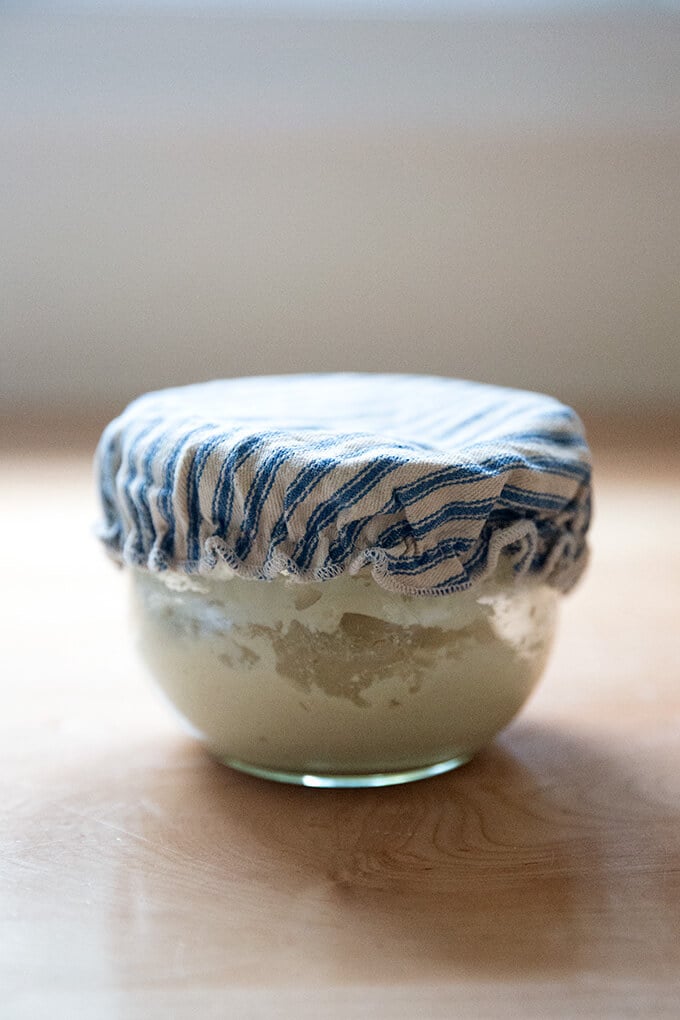
Here’s the play-by-play:
- Place the vessel holding your starter on a scale, and add 45 g flour:
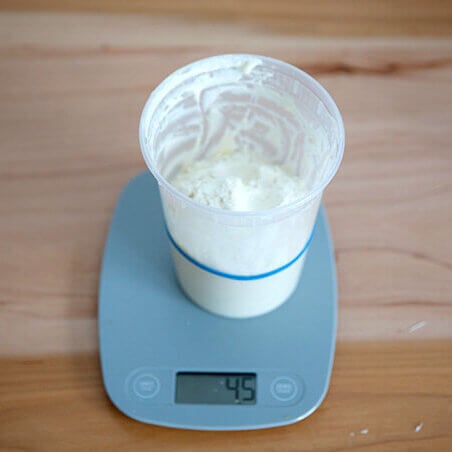
- Add 45 g water:

- Stir together and mark the top of the mixture with a rubber band:

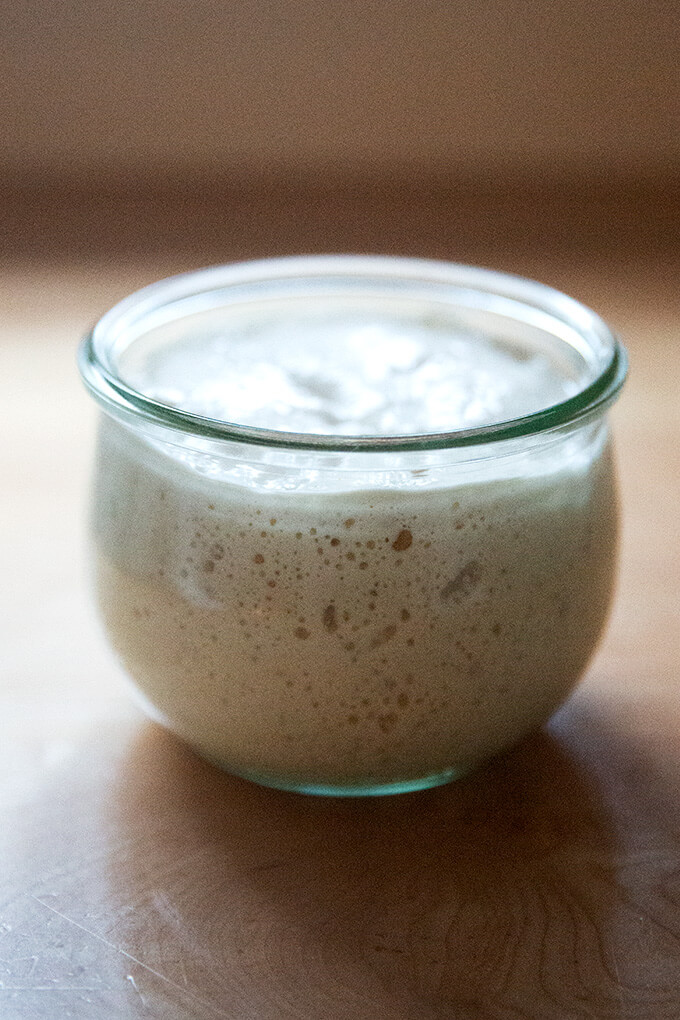
- Wait until the starter doubles or nearly doubles:

- Test it! If it floats, you’re good to go!

Before long, you’ll get the hang of your starter’s rhythm: how it rises and falls, how it behaves when you feed it more regularly, how it behaves when you neglect it, how it smells at various stages, etc.
When you’re ready to bake, the goal is to “catch” the starter at its peak (i.e. at its doubling point, when you see lots of bubbles covering the surface) — this is when it is the strongest/most alive. If you miss the opportunity, and the starter collapses, don’t despair: simply discard some of it (or don’t), and feed it again with equal parts flour and water by weight, stir, and set it aside to rise again.
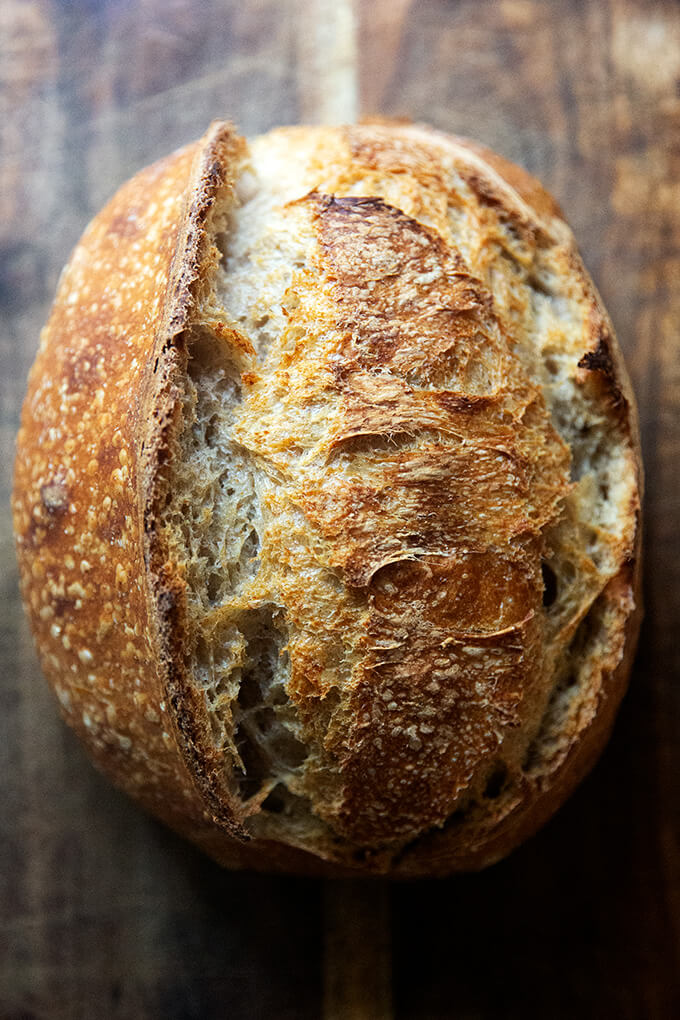
Maintaining a Sourdough Starter
- Something that deterred me from sourdough for a long time is the waste element: I hated discarding so much and “feeding” so much. I’ve learned over time that there are ways to keep your starter on the lean side to reduce the waste factor. Here’s how:
- After I use my starter for a bread recipe, I do one of two things: If there is a fair amount of starter left (a half cup or 100 g), I simply stir it up, cover it, and stash it in the fridge. If there are only a few tablespoons of starter left, I like to replenish it with a very small amount of flour and water (45 g of each). Once I add the flour and water and stir it all together, I cover the vessel, and stash it in the fridge.
- Every time I use it or feed it, I discard most of it, and feed it with equal amounts by weight water and flour.
- When life gets in the way, and I can’t find time for sourdough, I tend to it every 2-3 weeks by discarding most of it, and feeding it with 45 g each flour and water.
Storing a Sourdough Starter
If you are not baking regularly, store your starter in the fridge.
As noted above, my preferred storage vessel is a deli quart container . When I store my starter in the fridge, I use the lid that comes with the quart container. When I feed my starter and let it sit at room temperature, I use a breathable lid.
Ideally, strive to feed your starter roughly once a week or every two weeks if you are not finding time to bake regularly. If you are baking regularly, feeding your starter once a week will be a natural part of your baking rhythm. If you are looking for ideas for what to do with the discard, try these sourdough flour tortillas , this Irish soda bread , these pancakes or make peasant bread as outlined in this troubleshooting post .
As noted above, I’ve left my starter for as long as three to four weeks in the fridge without feeding it, and it has “awakened” beautifully, though I don’t recommend, if you can help it, waiting that long in between feedings.
How to Tell if Your Starter is Healthy
If you are just getting started with sourdough, it may be hard to “read” the various smells of your starter. Depending on what “phase” a starter is in — i.e. freshly fed or neglected for weeks in the fridge — it can smell anywhere from stinky and acidic to fresh and sweet.
Don’t be alarmed if your starter, upon pulling it from the fridge, smells a little funky. It might smell like alcohol or, as one commenter noted: dirty socks. As soon as you discard most of this sharp-smelling starter and feed it with equal parts flour and water, the aroma will instantly change. As your starter rises and approaches a doubling point, it should smell fresh and sweet.
You know you have a healthy starter when it …
- … doubles in volume within 4 to 6 hours (roughly) of feeding it.
- … floats when you drop a spoonful of it in water.
So how do you know if your starter is bad? When …
- … you see mold.
- … it doesn’t rise or is slow to rise after a feeding.
Unfortunately, if you see mold in your starter, you probably should toss it, and start over. Alternatively, you could scrape off the moldy bits, transfer a few tablespoons of what looks healthy (not moldy) to a clean jar, and feed it with equal parts flour and water.
If your starter is not doubling in volume within 4 to 6 hours of a feeding you should spend a few days strengthening it. This is what I always recommend:
- Be aggressive with how much of it you are discarding: throw away most of it, leaving behind just 2 tablespoons or so. Feed it with equal parts by weight flour and water. Start with 40 g of each or so.
- Use water that you’ve left out overnight to ensure any chlorine has evaporated. (This isn’t always necessary, but it might make a difference.)
- Buy spring or distilled water. In some places, letting water sit out overnight will not be effective, and your tap water may kill your starter.
- Feed your starter with organic flour or a small amount of rye flour or stone-milled flour (fresh or locally milled if possible). My store sells 2-lb. bags of King Arthur Flour organic all-purpose flour for $3.49 — I use it exclusively for feeding my starter.
- Once you feed your starter, cover the vessel with a breathable lid, and leave it alone at room temperature. After 6 hours (more or less), repeat the process: discard most of it and feed it with 40 g each flour and water.
Once you have a strong starter on hand — one that is doubling in volume within 4 to 6 hours — you can bake with it (using it at its peak doubling point) or stash it in the fridge. When you feed your starter, place a rubber band around the vessel to mark the starter’s height, which helps gauge when it has doubled
Sourdough Discard Recipes
Though I generally keep a small starter (as outlined above), inevitably I end up with sourdough discard on my hands due to the nature of the sourdough starter feeding process. And when I am organized, I put that discard to delicious use. Here are four simple recipes calling for sourdough discard:
- Simple Sourdough Discard Crackers (Pictured above.)
- Sourdough Tortillas
- Favorite Pancakes
- Irish Soda Bread
Questions? Thoughts? Shoot!
Description
Where to Buy a Sourdough Starter
I have had success purchasing and activating sourdough starters from three places:
- Breadtopia ($9)
- King Arthur Flour ($9)
- Cultures for Health ($11)
As with all sourdough bread baking (and all baking in general), you will have the best results if you measure with a digital scale . The amount of starter you start with is not really important here. What is important is that you feed your starter with equal parts by weight flour and water — this is called a 100% hydration starter, and it is what many sourdough bread recipes, including all of the ones on this site , call for.
Flour
If you can find King Arthur Flour organic all-purpose flour at your local supermarket, buy that. Organic flour or a little bit of freshly milled flour will help your starter thrive.
Water
I always use tap water that I’ve left to sit out overnight, which ensures any chlorine has evaporated. In some places, letting water sit out overnight will not be effective, and your tap water may kill your starter. If you are unsure about your water, consider buying a gallon of spring water to use exclusively for feeding your starter until you get the hang of the process.
- 45 grams (or more or less) sourdough starter, see notes above
- 45 grams flour, see notes above
- 45 grams water, see notes above
To Activate Your Sourdough Starter:
- Place starter in a vessel. I love these deli quart containers for this purpose.
- Add 45 g each of all-purpose flour and room-temperature water . ( Note: The consistency should look like a thick batter. )
- Wait. You may see bubbles and action (rising!) in as few as 6 hours; it may take more like 18 to 24 hours. Variables include the time of year, the temperature of your kitchen, the temperature of your water, the type of flour you are using, etc.
- When the starter has roughly doubled in volume, it’s likely ready to go. Drop a spoonful of it in a glass of water. If it floats, you’re ready!
- If it doesn’t float after 24 hours, add more flour and water (equal parts), stir again, and wait.
- If you aren’t seeing any action after another 12 hours, discard most of it, and add more flour and water (equal parts), stir, and wait. Just be patient. Before you know it, your starter will be rising and bubbling and ready to go.
To Feed Your Sourdough Starter:
- Place the vessel holding your starter on a scale, and add 45 g flour: 2. Add 45 g water: 3. Stir together and mark the top of the mixture with a rubber band: 4. Wait until the starter doubles or nearly doubles: 5. Test it! If it floats, you’re good to go!
How to Maintain Your Sourdough Starter:
- After I use my starter for a bread recipe, I do one of two things: If there is a fair amount of starter left (a half cup or 100 g), I simply stir it up, cover it, and stash it in the fridge. But if there are only a few tablespoons of starter left, I like to replenish it with a very small amount of flour and water (45 g of each). Once I add the flour and water and stir it all together, I let it rise until it doubles. Then I cover the vessel and stash it in the fridge.
- Every time I use it or feed it, I discard most of it and feed it with equal amounts by weight water and flour.
- When life gets in the way, and I can’t find time for sourdough, I tend to it every 2-3 weeks by discarding most of it and feeding it with 45 g each flour and water.
To Store Your Sourdough Starter
If you are not baking regularly, store your starter in the fridge.
My preferred storage vessel is a deli quart container . When I store my starter in the fridge, I use the lid that comes with the quart container. When I feed my starter and let it sit at room temperature, I use a breathable lid.
Ideally, strive to feed your starter roughly once a week or every two weeks if you are not finding time to bake regularly. If you are baking regularly, feeding your starter once a week will be a natural part of your baking rhythm. If you are looking for ideas for what to do with the discard, try these sourdough flour tortillas or make peasant bread as outlined in this troubleshooting post .
Note: I’ve left my starter for as long as three to four weeks in the fridge without feeding it, and it has “awakened” beautifully, though I don’t recommend, if you can help it, waiting that long in between feedings.
- Prep Time: 24 hours
- Category: Bread
- Method: Sourdough
