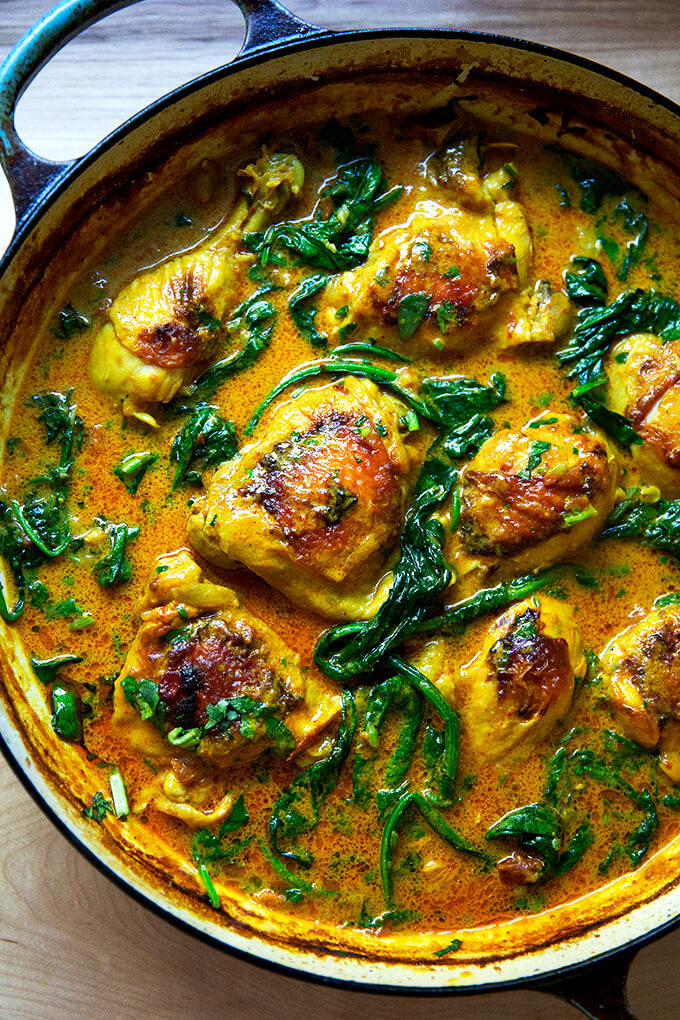
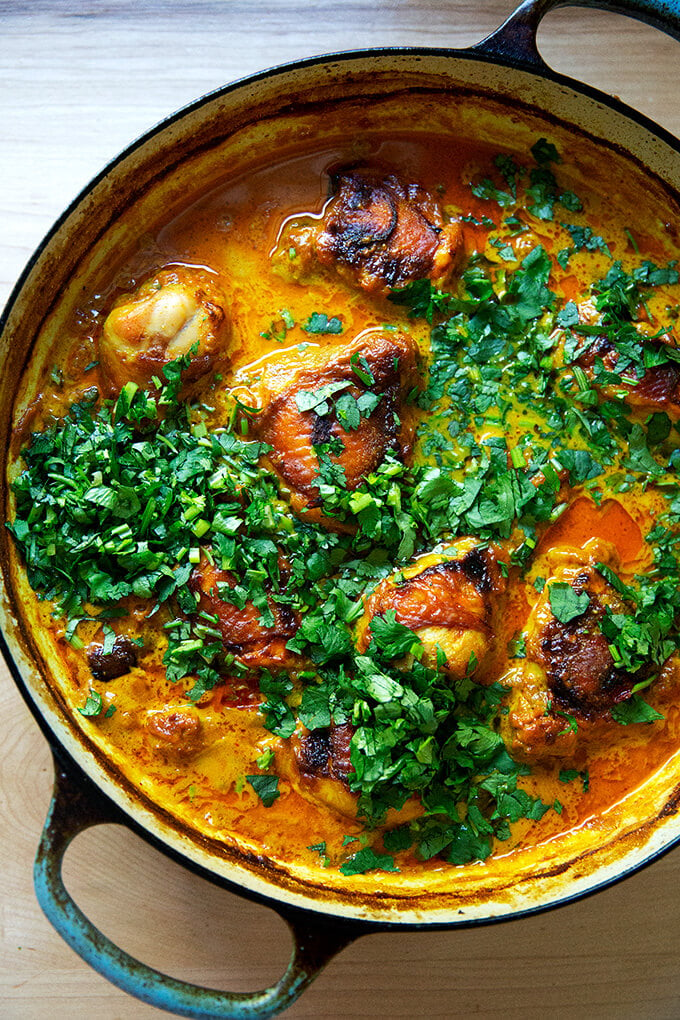
This one-pot coconut Thai chicken curry is incredibly flavorful and easy to prepare thanks to delicious time-saving tip: not browning the chicken. After sautéing an onion and making a simple sauce with spices, curry pastes, tomatoes, and coconut milk, you add the chicken to the pot and transfer it to the oven. In just about an hour, it will be done! The sauce is plentiful, so making rice or some sort of flatbread essential.
Are you still browning chicken?
When I was first learning to cook, browning meat prior to braising it, is what all of my favorite cookbooks taught. It’s also what I learned from the chef, Thien Ngo, I worked for at Fork . Before Thien braised anything — chicken, brisket, short ribs — he always began by browning the meat first.
But browning, as far as I can tell, serves only one good purpose: to remove excess fat, thereby ensuring the sauce, in the end, won’t taste unpleasantly fatty. For a braise, browning is not a step that produces crispy skin. And while it creates an appealing color and, in turn, flavor, these two outcomes can be achieved without actually going through the tedious process of browning.
How? In the oven.
Two years ago I made Diana Henry’s Moroccan Chicken and Rice with Harissa and Dates , a recipe that calls for essentially chucking everything into a pan at once and throwing it in the oven. There’s no preliminary browning, and it works: the end product being crispy skin and fall-off-the-bone meat.
I’ve stopped browning chicken ever since, and I’ve been revisiting my favorite braises in the meantime, giving them the chuck-in-the-oven treatment. This one-pan chicken with sherry vinegar sauce is a favorite, and here’s another one: one-pan Thai chicken curry with spinach.
It uses all of the same flavorings as Thien’s Thai chicken curry, but the method is different, simpler.
One-Pan Thai Chicken Curry How-To
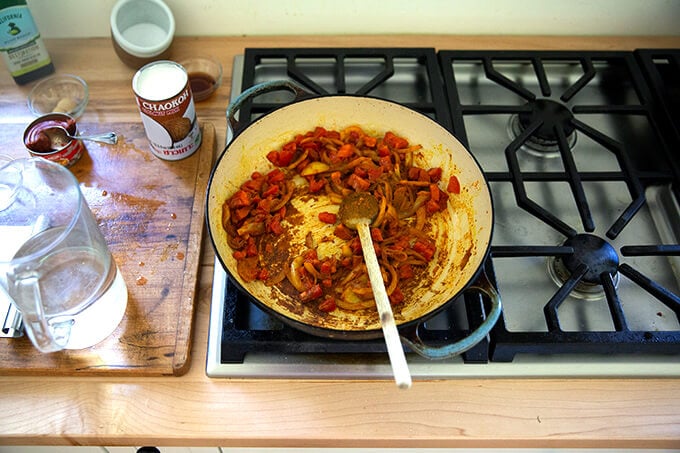
- Sauté an onion.
- Add turmeric, curry powder, and Thai red curry paste.
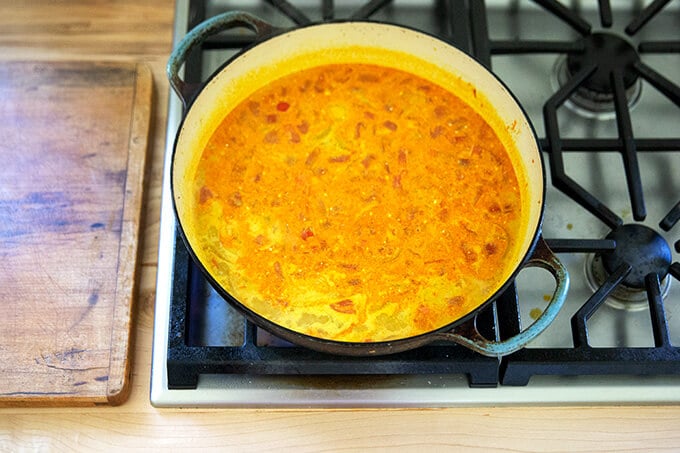
- Add tomatoes, coconut milk, brown sugar, fish sauce, and water.
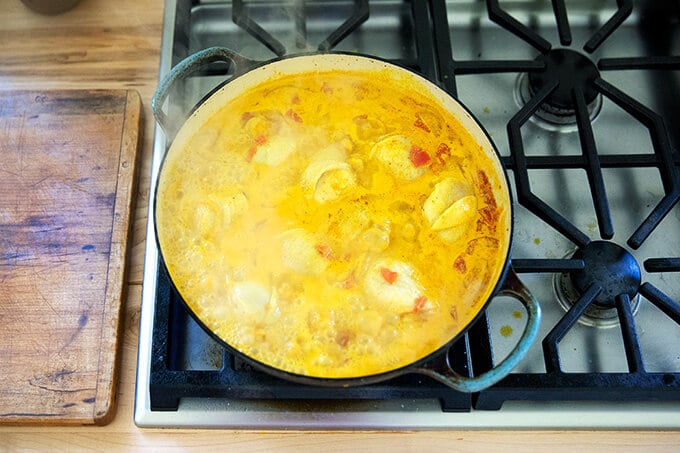
- Add chicken, transfer to the oven and cook for 1 hour.
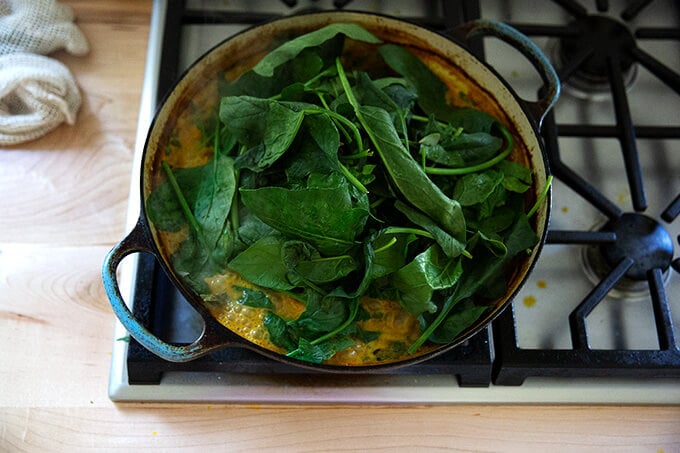
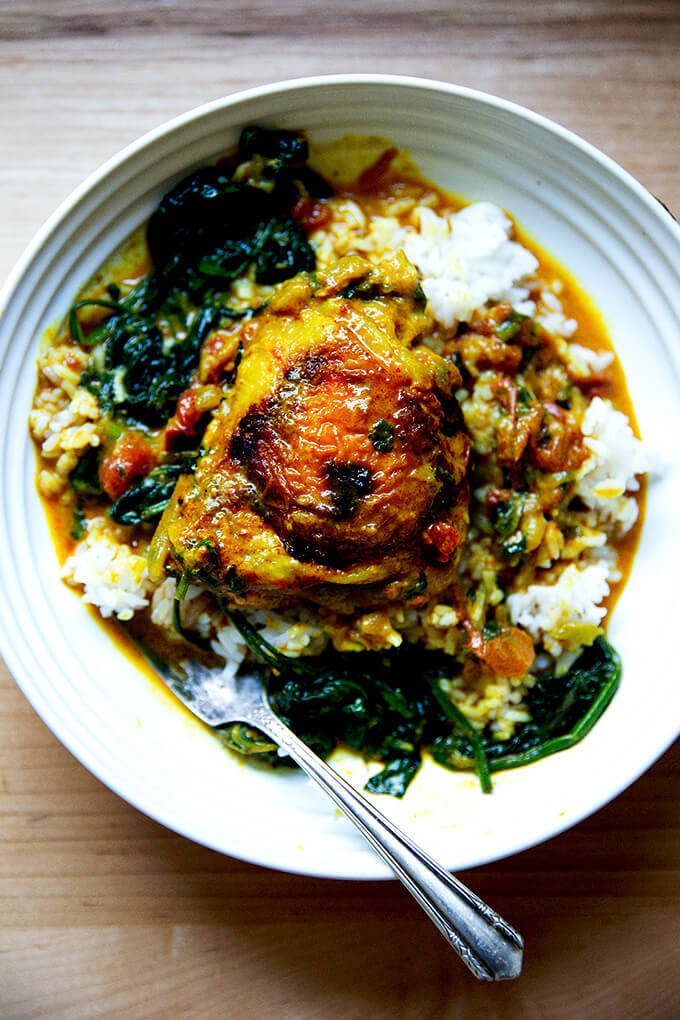
- Out of the oven, add a heap of spinach, stir, and serve over rice.
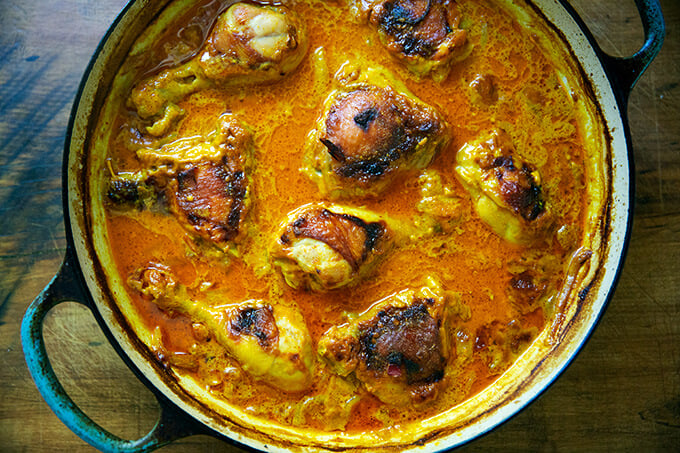
After an hour in the oven, the chicken skins are browned, and the meat has absorbed all the flavors of the sauce. The sauce is plentiful, making rice or some sort of flatbread essential.
A final note regarding not browning:
As noted above, browning meat does remove excess fat. If, prior to cooking, you notice your chicken thighs or drumsticks are particularly fatty, trim the excess fat/overhanging skin. This step usually is enough to ensure the final sauce doesn’t taste too fatty, but if, in the end, you still find the sauce tasting too rich, you can skim excess fat, which will pool to the surface.
5 Favorite No-Browning Chicken Recipes
- One-Pan Chicken and Shallots
- One-Pan Chicken with Sherry Vinegar Sauce
- Chicken legs with white wine, parmigiano, and olive oil
- Moroccan Chicken and Rice
- Spatchcocked Chicken with Za’atar and Lemon
PS: Curried Lentils with Kale & Coconut Milk
PPS: Chopped Thai Satay Salad with Peanut-Ginger Dressing
PPS: Easy Thai Chicken Satay with Coconut Rice
Description
I learned to make this chicken curry while working at Fork in Philadelphia many years ago, now. The chef, Thien Ngo, prepared it somewhat differently — he browned the meat first in one pot; browned a ton of vegetables (carrots, parsnips, onions) in another pan; additionally, he deep-fried potatoes; and he cooked everything stove top.
I’ve converted this to a one-pan number, and in place of the carrots, parsnips, and potatoes, I stir in a heap of spinach at the end.
A few notes:
If your chicken thighs or drumsticks are particularly fatty, trim the excess fat. This will prevent your sauce from being too fatty in the end.
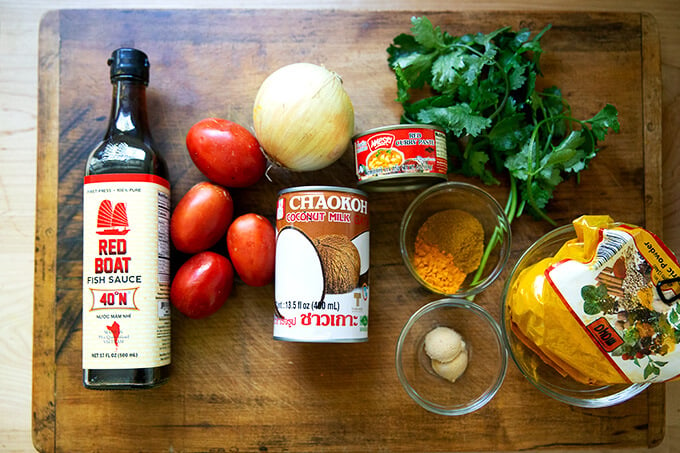
Thai red curry paste. Maesri is the brand I buy at the Asian market. You can find it online, too . I use half a tin for this recipe (which is about 3 tablespoons), which makes it quite spicy but not outrageous. If you are sensitive to heat, start with a tablespoon and adjust the sauce with more at the end.
1 tablespoon olive oil
1 onion, sliced
kosher salt
8 bone-in, skin on chicken thighs or drumsticks or a combination of both
2 teaspoons turmeric
2 teaspoons curry powder
1 to 3 tablespoons Thai red curry paste (see notes above)
3 to 4 plum tomatoes, chopped
1 can (13.5 oz) unsweetened coconut milk
1 tablespoon fish sauce
2 teaspoons brown sugar
1/2 cup cilantro, roughly chopped, or more or less to taste
3 to 5 ounces spinach, optional
For serving:
- cooked Jasmine or Basmati rice (or any rice you like)
- Heat oven to 400ºF.
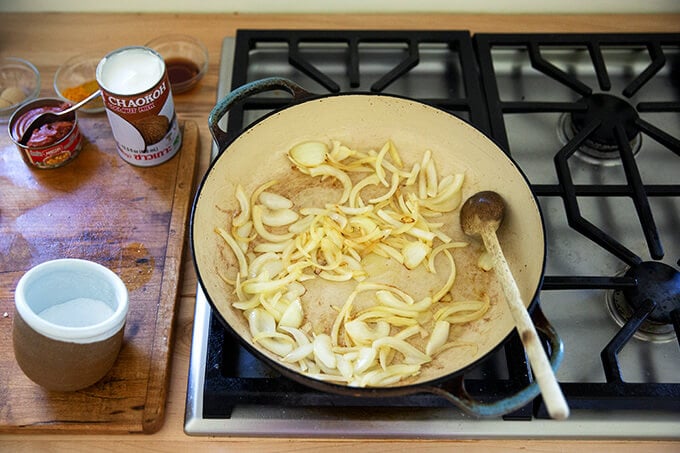
- In a large sauté pan over hight heat, heat 1 tablespoon of olive oil. Add the onions and a pinch of salt, and immediately turn the heat to medium-low. Stir every so often, and cook until the onions soften and begin browning at the edges, about 5 minutes.
- Meanwhile, place the chicken in a large bowl and season all over with kosher salt. Use 1 teaspoon per pound.
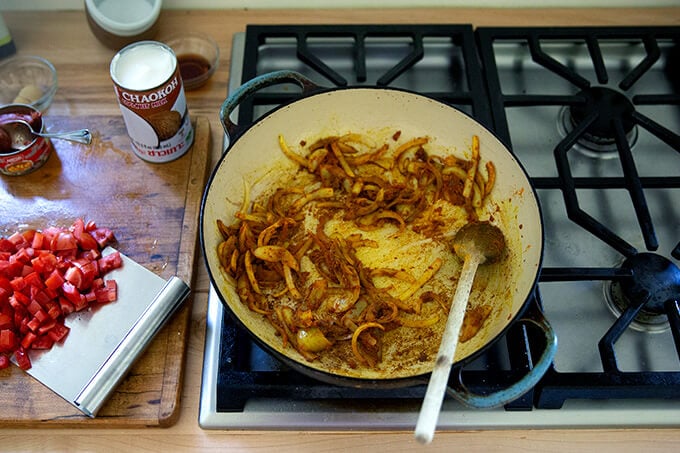
- Add the curry powder, turmeric, and Thai red curry paste to the onions, and stir until onions are coated in the spices, about a minute. Add the tomatoes, and stir until they just begin to soften, about a minute. Add the can of coconut milk. Fill up the empty can of coconut milk with water and add to the pan. Add the fish sauce and brown sugar and bring to a simmer. ( Note: A number of people have had issues with this being too liquidy, so I’ve reduced the amount of water from 2 empty cans to one… hope this solves the issues.).
- Add the chicken pieces and turn to coat. Transfer pan to the oven uncovered and cook for 1 hour or until the liquid has reduced considerably, the chicken skin is brown, and the meat is falling off the bone. If the liquid has reduced too much, add more by the quarter cup. Note: If you make this ahead, you may need to add more water upon reheating.
- Add cilantro and stir. Add spinach, if using, and stir. Spoon rice into bowls. Top with chicken and sauce, and serve immediately.
- Prep Time: 10 minutes
- Cook Time: 1 hour
- Category: Dinner
- Method: Stovetop/Oven
- Cuisine: Thai
This one-pot coconut Thai chicken curry is incredibly flavorful and easy to prepare thanks to delicious time-saving tip: not browning the chicken. After sautéing an onion and making a simple sauce with spices, curry pastes, tomatoes, and coconut milk, you add the chicken to the pot and transfer it to the oven. In just about an hour, it will be done! The sauce is plentiful, so making rice or some sort of flatbread essential.
Are you still browning chicken?
When I was first learning to cook, browning meat prior to braising it, is what all of my favorite cookbooks taught. It’s also what I learned from the chef, Thien Ngo, I worked for at Fork . Before Thien braised anything — chicken, brisket, short ribs — he always began by browning the meat first.
But browning, as far as I can tell, serves only one good purpose: to remove excess fat, thereby ensuring the sauce, in the end, won’t taste unpleasantly fatty. For a braise, browning is not a step that produces crispy skin. And while it creates an appealing color and, in turn, flavor, these two outcomes can be achieved without actually going through the tedious process of browning.
How? In the oven.
Two years ago I made Diana Henry’s Moroccan Chicken and Rice with Harissa and Dates , a recipe that calls for essentially chucking everything into a pan at once and throwing it in the oven. There’s no preliminary browning, and it works: the end product being crispy skin and fall-off-the-bone meat.
I’ve stopped browning chicken ever since, and I’ve been revisiting my favorite braises in the meantime, giving them the chuck-in-the-oven treatment. This one-pan chicken with sherry vinegar sauce is a favorite, and here’s another one: one-pan Thai chicken curry with spinach.
It uses all of the same flavorings as Thien’s Thai chicken curry, but the method is different, simpler.
One-Pan Thai Chicken Curry How-To
- Sauté an onion.
- Add turmeric, curry powder, and Thai red curry paste.
- Add tomatoes, coconut milk, brown sugar, fish sauce, and water.
- Add chicken, transfer to the oven and cook for 1 hour.
- Out of the oven, add a heap of spinach, stir, and serve over rice.
After an hour in the oven, the chicken skins are browned, and the meat has absorbed all the flavors of the sauce. The sauce is plentiful, making rice or some sort of flatbread essential.
A final note regarding not browning:
As noted above, browning meat does remove excess fat. If, prior to cooking, you notice your chicken thighs or drumsticks are particularly fatty, trim the excess fat/overhanging skin. This step usually is enough to ensure the final sauce doesn’t taste too fatty, but if, in the end, you still find the sauce tasting too rich, you can skim excess fat, which will pool to the surface.
5 Favorite No-Browning Chicken Recipes
- One-Pan Chicken and Shallots
- One-Pan Chicken with Sherry Vinegar Sauce
- Chicken legs with white wine, parmigiano, and olive oil
- Moroccan Chicken and Rice
- Spatchcocked Chicken with Za’atar and Lemon
PS: Curried Lentils with Kale & Coconut Milk
PPS: Chopped Thai Satay Salad with Peanut-Ginger Dressing
PPS: Easy Thai Chicken Satay with Coconut Rice
Description
I learned to make this chicken curry while working at Fork in Philadelphia many years ago, now. The chef, Thien Ngo, prepared it somewhat differently — he browned the meat first in one pot; browned a ton of vegetables (carrots, parsnips, onions) in another pan; additionally, he deep-fried potatoes; and he cooked everything stove top.
I’ve converted this to a one-pan number, and in place of the carrots, parsnips, and potatoes, I stir in a heap of spinach at the end.
A few notes:
If your chicken thighs or drumsticks are particularly fatty, trim the excess fat. This will prevent your sauce from being too fatty in the end.
Thai red curry paste. Maesri is the brand I buy at the Asian market. You can find it online, too . I use half a tin for this recipe (which is about 3 tablespoons), which makes it quite spicy but not outrageous. If you are sensitive to heat, start with a tablespoon and adjust the sauce with more at the end.
1 tablespoon olive oil
1 onion, sliced
kosher salt
8 bone-in, skin on chicken thighs or drumsticks or a combination of both
2 teaspoons turmeric
2 teaspoons curry powder
1 to 3 tablespoons Thai red curry paste (see notes above)
3 to 4 plum tomatoes, chopped
1 can (13.5 oz) unsweetened coconut milk
1 tablespoon fish sauce
2 teaspoons brown sugar
1/2 cup cilantro, roughly chopped, or more or less to taste
3 to 5 ounces spinach, optional
For serving:
- cooked Jasmine or Basmati rice (or any rice you like)
- Heat oven to 400ºF.
- In a large sauté pan over hight heat, heat 1 tablespoon of olive oil. Add the onions and a pinch of salt, and immediately turn the heat to medium-low. Stir every so often, and cook until the onions soften and begin browning at the edges, about 5 minutes.
- Meanwhile, place the chicken in a large bowl and season all over with kosher salt. Use 1 teaspoon per pound.
- Add the curry powder, turmeric, and Thai red curry paste to the onions, and stir until onions are coated in the spices, about a minute. Add the tomatoes, and stir until they just begin to soften, about a minute. Add the can of coconut milk. Fill up the empty can of coconut milk with water and add to the pan. Add the fish sauce and brown sugar and bring to a simmer. ( Note: A number of people have had issues with this being too liquidy, so I’ve reduced the amount of water from 2 empty cans to one… hope this solves the issues.).
- Add the chicken pieces and turn to coat. Transfer pan to the oven uncovered and cook for 1 hour or until the liquid has reduced considerably, the chicken skin is brown, and the meat is falling off the bone. If the liquid has reduced too much, add more by the quarter cup. Note: If you make this ahead, you may need to add more water upon reheating.
- Add cilantro and stir. Add spinach, if using, and stir. Spoon rice into bowls. Top with chicken and sauce, and serve immediately.
- Prep Time: 10 minutes
- Cook Time: 1 hour
- Category: Dinner
- Method: Stovetop/Oven
- Cuisine: Thai
This one-pot coconut Thai chicken curry is incredibly flavorful and easy to prepare thanks to delicious time-saving tip: not browning the chicken. After sautéing an onion and making a simple sauce with spices, curry pastes, tomatoes, and coconut milk, you add the chicken to the pot and transfer it to the oven. In just about an hour, it will be done! The sauce is plentiful, so making rice or some sort of flatbread essential.
Are you still browning chicken?
When I was first learning to cook, browning meat prior to braising it, is what all of my favorite cookbooks taught. It’s also what I learned from the chef, Thien Ngo, I worked for at Fork . Before Thien braised anything — chicken, brisket, short ribs — he always began by browning the meat first.
But browning, as far as I can tell, serves only one good purpose: to remove excess fat, thereby ensuring the sauce, in the end, won’t taste unpleasantly fatty. For a braise, browning is not a step that produces crispy skin. And while it creates an appealing color and, in turn, flavor, these two outcomes can be achieved without actually going through the tedious process of browning.
How? In the oven.
Two years ago I made Diana Henry’s Moroccan Chicken and Rice with Harissa and Dates , a recipe that calls for essentially chucking everything into a pan at once and throwing it in the oven. There’s no preliminary browning, and it works: the end product being crispy skin and fall-off-the-bone meat.
I’ve stopped browning chicken ever since, and I’ve been revisiting my favorite braises in the meantime, giving them the chuck-in-the-oven treatment. This one-pan chicken with sherry vinegar sauce is a favorite, and here’s another one: one-pan Thai chicken curry with spinach.
It uses all of the same flavorings as Thien’s Thai chicken curry, but the method is different, simpler.
One-Pan Thai Chicken Curry How-To
- Sauté an onion.
- Add turmeric, curry powder, and Thai red curry paste.
- Add tomatoes, coconut milk, brown sugar, fish sauce, and water.
- Add chicken, transfer to the oven and cook for 1 hour.
- Out of the oven, add a heap of spinach, stir, and serve over rice.
After an hour in the oven, the chicken skins are browned, and the meat has absorbed all the flavors of the sauce. The sauce is plentiful, making rice or some sort of flatbread essential.
A final note regarding not browning:
As noted above, browning meat does remove excess fat. If, prior to cooking, you notice your chicken thighs or drumsticks are particularly fatty, trim the excess fat/overhanging skin. This step usually is enough to ensure the final sauce doesn’t taste too fatty, but if, in the end, you still find the sauce tasting too rich, you can skim excess fat, which will pool to the surface.
5 Favorite No-Browning Chicken Recipes
- One-Pan Chicken and Shallots
- One-Pan Chicken with Sherry Vinegar Sauce
- Chicken legs with white wine, parmigiano, and olive oil
- Moroccan Chicken and Rice
- Spatchcocked Chicken with Za’atar and Lemon
PS: Curried Lentils with Kale & Coconut Milk
PPS: Chopped Thai Satay Salad with Peanut-Ginger Dressing
PPS: Easy Thai Chicken Satay with Coconut Rice
Description
I learned to make this chicken curry while working at Fork in Philadelphia many years ago, now. The chef, Thien Ngo, prepared it somewhat differently — he browned the meat first in one pot; browned a ton of vegetables (carrots, parsnips, onions) in another pan; additionally, he deep-fried potatoes; and he cooked everything stove top.
I’ve converted this to a one-pan number, and in place of the carrots, parsnips, and potatoes, I stir in a heap of spinach at the end.
A few notes:
If your chicken thighs or drumsticks are particularly fatty, trim the excess fat. This will prevent your sauce from being too fatty in the end.
Thai red curry paste. Maesri is the brand I buy at the Asian market. You can find it online, too . I use half a tin for this recipe (which is about 3 tablespoons), which makes it quite spicy but not outrageous. If you are sensitive to heat, start with a tablespoon and adjust the sauce with more at the end.
1 tablespoon olive oil
1 onion, sliced
kosher salt
8 bone-in, skin on chicken thighs or drumsticks or a combination of both
2 teaspoons turmeric
2 teaspoons curry powder
1 to 3 tablespoons Thai red curry paste (see notes above)
3 to 4 plum tomatoes, chopped
1 can (13.5 oz) unsweetened coconut milk
1 tablespoon fish sauce
2 teaspoons brown sugar
1/2 cup cilantro, roughly chopped, or more or less to taste
3 to 5 ounces spinach, optional
For serving:
- cooked Jasmine or Basmati rice (or any rice you like)
- Heat oven to 400ºF.
- In a large sauté pan over hight heat, heat 1 tablespoon of olive oil. Add the onions and a pinch of salt, and immediately turn the heat to medium-low. Stir every so often, and cook until the onions soften and begin browning at the edges, about 5 minutes.
- Meanwhile, place the chicken in a large bowl and season all over with kosher salt. Use 1 teaspoon per pound.
- Add the curry powder, turmeric, and Thai red curry paste to the onions, and stir until onions are coated in the spices, about a minute. Add the tomatoes, and stir until they just begin to soften, about a minute. Add the can of coconut milk. Fill up the empty can of coconut milk with water and add to the pan. Add the fish sauce and brown sugar and bring to a simmer. ( Note: A number of people have had issues with this being too liquidy, so I’ve reduced the amount of water from 2 empty cans to one… hope this solves the issues.).
- Add the chicken pieces and turn to coat. Transfer pan to the oven uncovered and cook for 1 hour or until the liquid has reduced considerably, the chicken skin is brown, and the meat is falling off the bone. If the liquid has reduced too much, add more by the quarter cup. Note: If you make this ahead, you may need to add more water upon reheating.
- Add cilantro and stir. Add spinach, if using, and stir. Spoon rice into bowls. Top with chicken and sauce, and serve immediately.
- Prep Time: 10 minutes
- Cook Time: 1 hour
- Category: Dinner
- Method: Stovetop/Oven
- Cuisine: Thai
This one-pot coconut Thai chicken curry is incredibly flavorful and easy to prepare thanks to delicious time-saving tip: not browning the chicken. After sautéing an onion and making a simple sauce with spices, curry pastes, tomatoes, and coconut milk, you add the chicken to the pot and transfer it to the oven. In just about an hour, it will be done! The sauce is plentiful, so making rice or some sort of flatbread essential.
Are you still browning chicken?
When I was first learning to cook, browning meat prior to braising it, is what all of my favorite cookbooks taught. It’s also what I learned from the chef, Thien Ngo, I worked for at Fork . Before Thien braised anything — chicken, brisket, short ribs — he always began by browning the meat first.
But browning, as far as I can tell, serves only one good purpose: to remove excess fat, thereby ensuring the sauce, in the end, won’t taste unpleasantly fatty. For a braise, browning is not a step that produces crispy skin. And while it creates an appealing color and, in turn, flavor, these two outcomes can be achieved without actually going through the tedious process of browning.
How? In the oven.
Two years ago I made Diana Henry’s Moroccan Chicken and Rice with Harissa and Dates , a recipe that calls for essentially chucking everything into a pan at once and throwing it in the oven. There’s no preliminary browning, and it works: the end product being crispy skin and fall-off-the-bone meat.
I’ve stopped browning chicken ever since, and I’ve been revisiting my favorite braises in the meantime, giving them the chuck-in-the-oven treatment. This one-pan chicken with sherry vinegar sauce is a favorite, and here’s another one: one-pan Thai chicken curry with spinach.
It uses all of the same flavorings as Thien’s Thai chicken curry, but the method is different, simpler.
One-Pan Thai Chicken Curry How-To
- Sauté an onion.
- Add turmeric, curry powder, and Thai red curry paste.
- Add tomatoes, coconut milk, brown sugar, fish sauce, and water.
- Add chicken, transfer to the oven and cook for 1 hour.
- Out of the oven, add a heap of spinach, stir, and serve over rice.
After an hour in the oven, the chicken skins are browned, and the meat has absorbed all the flavors of the sauce. The sauce is plentiful, making rice or some sort of flatbread essential.
A final note regarding not browning:
As noted above, browning meat does remove excess fat. If, prior to cooking, you notice your chicken thighs or drumsticks are particularly fatty, trim the excess fat/overhanging skin. This step usually is enough to ensure the final sauce doesn’t taste too fatty, but if, in the end, you still find the sauce tasting too rich, you can skim excess fat, which will pool to the surface.
5 Favorite No-Browning Chicken Recipes
- One-Pan Chicken and Shallots
- One-Pan Chicken with Sherry Vinegar Sauce
- Chicken legs with white wine, parmigiano, and olive oil
- Moroccan Chicken and Rice
- Spatchcocked Chicken with Za’atar and Lemon
PS: Curried Lentils with Kale & Coconut Milk
PPS: Chopped Thai Satay Salad with Peanut-Ginger Dressing
PPS: Easy Thai Chicken Satay with Coconut Rice
Description
I learned to make this chicken curry while working at Fork in Philadelphia many years ago, now. The chef, Thien Ngo, prepared it somewhat differently — he browned the meat first in one pot; browned a ton of vegetables (carrots, parsnips, onions) in another pan; additionally, he deep-fried potatoes; and he cooked everything stove top.
I’ve converted this to a one-pan number, and in place of the carrots, parsnips, and potatoes, I stir in a heap of spinach at the end.
A few notes:
If your chicken thighs or drumsticks are particularly fatty, trim the excess fat. This will prevent your sauce from being too fatty in the end.
Thai red curry paste. Maesri is the brand I buy at the Asian market. You can find it online, too . I use half a tin for this recipe (which is about 3 tablespoons), which makes it quite spicy but not outrageous. If you are sensitive to heat, start with a tablespoon and adjust the sauce with more at the end.
1 tablespoon olive oil
1 onion, sliced
kosher salt
8 bone-in, skin on chicken thighs or drumsticks or a combination of both
2 teaspoons turmeric
2 teaspoons curry powder
1 to 3 tablespoons Thai red curry paste (see notes above)
3 to 4 plum tomatoes, chopped
1 can (13.5 oz) unsweetened coconut milk
1 tablespoon fish sauce
2 teaspoons brown sugar
1/2 cup cilantro, roughly chopped, or more or less to taste
3 to 5 ounces spinach, optional
For serving:
- cooked Jasmine or Basmati rice (or any rice you like)
- Heat oven to 400ºF.
- In a large sauté pan over hight heat, heat 1 tablespoon of olive oil. Add the onions and a pinch of salt, and immediately turn the heat to medium-low. Stir every so often, and cook until the onions soften and begin browning at the edges, about 5 minutes.
- Meanwhile, place the chicken in a large bowl and season all over with kosher salt. Use 1 teaspoon per pound.
- Add the curry powder, turmeric, and Thai red curry paste to the onions, and stir until onions are coated in the spices, about a minute. Add the tomatoes, and stir until they just begin to soften, about a minute. Add the can of coconut milk. Fill up the empty can of coconut milk with water and add to the pan. Add the fish sauce and brown sugar and bring to a simmer. ( Note: A number of people have had issues with this being too liquidy, so I’ve reduced the amount of water from 2 empty cans to one… hope this solves the issues.).
- Add the chicken pieces and turn to coat. Transfer pan to the oven uncovered and cook for 1 hour or until the liquid has reduced considerably, the chicken skin is brown, and the meat is falling off the bone. If the liquid has reduced too much, add more by the quarter cup. Note: If you make this ahead, you may need to add more water upon reheating.
- Add cilantro and stir. Add spinach, if using, and stir. Spoon rice into bowls. Top with chicken and sauce, and serve immediately.
- Prep Time: 10 minutes
- Cook Time: 1 hour
- Category: Dinner
- Method: Stovetop/Oven
- Cuisine: Thai
Description
I learned to make this chicken curry while working at Fork in Philadelphia many years ago, now. The chef, Thien Ngo, prepared it somewhat differently — he browned the meat first in one pot; browned a ton of vegetables (carrots, parsnips, onions) in another pan; additionally, he deep-fried potatoes; and he cooked everything stove top.
I’ve converted this to a one-pan number, and in place of the carrots, parsnips, and potatoes, I stir in a heap of spinach at the end.
A few notes:
If your chicken thighs or drumsticks are particularly fatty, trim the excess fat. This will prevent your sauce from being too fatty in the end.
Thai red curry paste. Maesri is the brand I buy at the Asian market. You can find it online, too . I use half a tin for this recipe (which is about 3 tablespoons), which makes it quite spicy but not outrageous. If you are sensitive to heat, start with a tablespoon and adjust the sauce with more at the end.
1 tablespoon olive oil
1 onion, sliced
kosher salt
8 bone-in, skin on chicken thighs or drumsticks or a combination of both
2 teaspoons turmeric
2 teaspoons curry powder
1 to 3 tablespoons Thai red curry paste (see notes above)
3 to 4 plum tomatoes, chopped
1 can (13.5 oz) unsweetened coconut milk
1 tablespoon fish sauce
2 teaspoons brown sugar
1/2 cup cilantro, roughly chopped, or more or less to taste
3 to 5 ounces spinach, optional
For serving:
- cooked Jasmine or Basmati rice (or any rice you like)
- Heat oven to 400ºF.
- In a large sauté pan over hight heat, heat 1 tablespoon of olive oil. Add the onions and a pinch of salt, and immediately turn the heat to medium-low. Stir every so often, and cook until the onions soften and begin browning at the edges, about 5 minutes.
- Meanwhile, place the chicken in a large bowl and season all over with kosher salt. Use 1 teaspoon per pound.
- Add the curry powder, turmeric, and Thai red curry paste to the onions, and stir until onions are coated in the spices, about a minute. Add the tomatoes, and stir until they just begin to soften, about a minute. Add the can of coconut milk. Fill up the empty can of coconut milk with water and add to the pan. Add the fish sauce and brown sugar and bring to a simmer. ( Note: A number of people have had issues with this being too liquidy, so I’ve reduced the amount of water from 2 empty cans to one… hope this solves the issues.).
- Add the chicken pieces and turn to coat. Transfer pan to the oven uncovered and cook for 1 hour or until the liquid has reduced considerably, the chicken skin is brown, and the meat is falling off the bone. If the liquid has reduced too much, add more by the quarter cup. Note: If you make this ahead, you may need to add more water upon reheating.
- Add cilantro and stir. Add spinach, if using, and stir. Spoon rice into bowls. Top with chicken and sauce, and serve immediately.
- Prep Time: 10 minutes
- Cook Time: 1 hour
- Category: Dinner
- Method: Stovetop/Oven
- Cuisine: Thai
Find it online : https://alexandracooks.com/2019/09/22/one-pot-thai-chicken-curry/
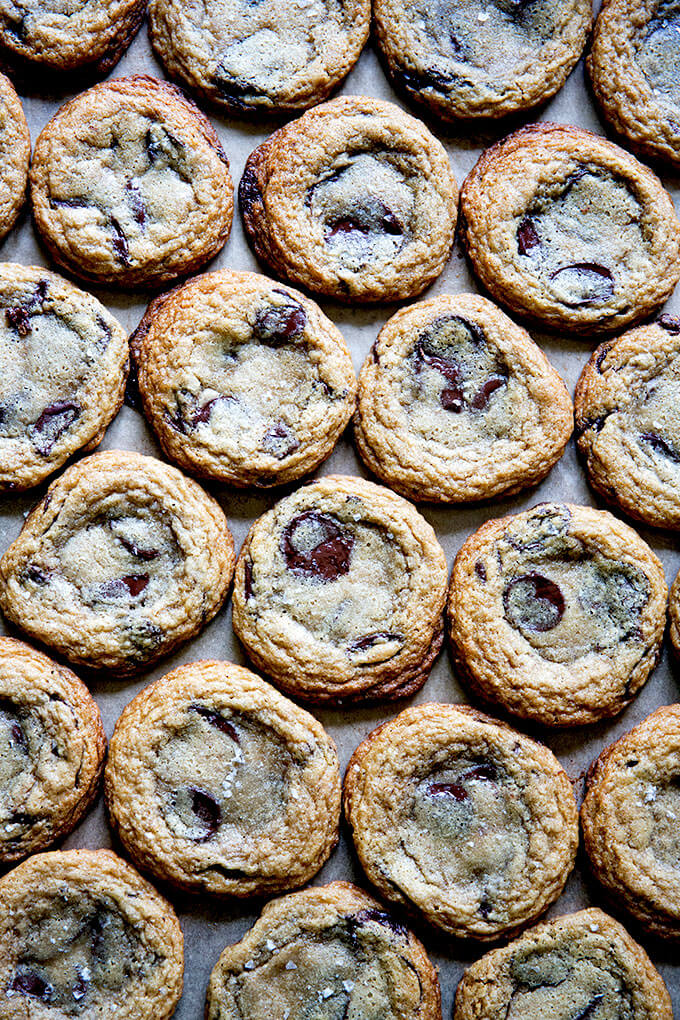
This recipe for gluten-free chocolate chip cookies is perfect both in taste and texture. Good ingredients, plus time in the fridge before baking is the BIG secret! This recipe, from JeffreyLarsen’s Gluten Free Baking at Home, includes three very specific tips for making chewy, exceptionally tasty cookies. Dive into the tips, or skip to the recipe—either way, this recipe is a winner!
Yesterday, Jeffrey Larsen’s Gluten-Free Baking at Home made its way into the world. It’s filled with 100+ recipes for gluten-free cakes, cookies, scones, breads, biscuits and more. And while it is a goldmine for anyone on a gluten-free diet who loves baking (and/or eating treats!), the many tips and tricks peppered throughout — the culmination of 18 years of testing and retesting — make it a treasure for any baker.
Let’s dive right in with three tips I picked up from Jeffrey’s gluten-free chocolate chip cookie, which are soft and chewy and exceptionally tasty. Jeffrey revised the recipe 14 times (!!) before giving it the green light.
3 Tips For Making The Best Gluten-Free Chocolate Chip Cookies
Tip 1: Refrigerate your cookie dough.
Jeffrey says: “Cookie dough should always be set aside to chill in the refrigerator before it is baked. This allows the fat to solidify, which keeps the cookies from spreading as they bake.” Moreover, by allowing the flours to fully hydrate during their time in the fridge, you’ll avoid baking off a “gritty, flat cookie.”
I do this with my favorite soft and chewy chocolate chip cookie dough balls, and it makes a world of difference: cookies baked from refrigerated dough (preferably 2 to 3 days refrigerated) compared to freshly mixed dough are hands-down superior both in texture and flavor. Now I know why.
Tip 2: Take it one step further: Portion the cookie dough, and freeze it. Bake straight from the freezer.
Jeffrey says: “Freezing cookies, scones, and biscuits before baking allows for a more gradual bake and thus less spread and a higher rise. If the butter in each of these items is frozen, it takes longer for the butter to melt.”
Makes sense. Note: The timing with cookies baked straight from the freezer does not change.
Tip 3: Use clarified butter.
Part of Jeffrey’s interest in using clarified butter stems from having personal trouble with lactose — clarified butter is both lactose- and casein-free, the two allergens that make dairy troubling for many people.
But there’s another reason to use it in baking and in cookies in particular. Jeffrey describes clarified butter as “miraculous” because it keeps cookies from spreading as they bake. Butter has a lot of water in it — clarifying it removes both the water and the milk solids, leaving the butter fat behind.
Interesting, right?
Friends, I’m only just scratching the surface here. Here’s a bit more:
Highlights From Gluten-Free Baking at Home
- Weight measurements. Measuring by weight is important for consistent and accurate results in all baking but most especially in gluten-free baking: if you’ve every scooped potato starch or tapioca starch, you’ll know why — it’s as light as dust, which makes the chances of measuring it inaccurately by volume very high.
- Unique formula for each recipe : Jeffrey does not use a one-mix-fits-all approach to gluten-free baking. The ingredients — the various flours, starches, leaveners, etc. — for each recipe have been thoughtfully chosen based on the item being baked: a flaky biscuit, a buttery scones, a tender cake, etc.
- Care for nutrition and flavor: Jeffrey does not settle on using rice flour, a great ingredient for gluten-free baking not only for its neutral flavor but also for its performance. Because many rice flours on the market contain high amounts of pesticides and heavy metals, Jeffrey uses them sparingly.
- Whole grain and nut flours: Jeffrey’s recipes include almond, oat, sorghum, millet, teff, and buckwheat flours to name a few.
- Dairy-free and vegan substitutions: It is rare to find treats that are both gluten-free and vegan, and Jeffrey offers alternatives to milk, butter, and eggs in nearly every recipe.
- Vegetable and fruit purees: Inspired by an old cake recipe that used whole poached oranges, Jeffrey used the technique to create a variety of purées to add to his breads and baked goods, which not only add flavor but also nutrition. (He also has a tip on using high-quality baby food if you don’t feel like making your own purée.)
There’s so much more, too: from the tutorials preceding each chapter to Jeffrey’s food styling tips inserted throughout. For instance, for a better presentation of your chocolate chip cookies, don’t mix in all of the chocolate chips — set some aside for adding on top of the cookies just before baking. So smart.
Final Note: Jeffrey , if you are unfamiliar, is not only a food stylist but also a recipe developer, pastry chef, and instructor living in the Bay Area. He was the food stylist for the Bread Toast Crumbs photoshoot, which was hilarious because he couldn’t eat any of the food we churned out day after day for two weeks. He is a perfectionist and an artist, not to mention one of the kindest, best people I have ever met.
My 5 Tips for Exceptional Chocolate Chip Cookies
- Weigh your ingredients. I know I say this all the time (sorry!) but a digital scale ($9) will transform your baking.
- Use good chocolate. Two of my favorites are pictured below. Local friends, you can find the Guayaquil Pistoles (64% cacao) at Honest Weight Food Co-op in Albany. Below, the Guittard chocolate wafers (74% cacao) are more readily available. I love these two chips not only for their flavor, but also for their shape — there is something about the flatness of the wafer and how it settles into the dough that I find so nice. Personal preference.
- Weigh the dough balls. [Optional!] For me, there is something deeply reassuring knowing that each cookie dough ball weighs exactly the same before entering the oven, which helps ensure each will bake nearly identically. I know, it’s a weird habit, but I can’t shake it. (Help me.) Jeffrey uses a scoop, so use a scoop if you wish.
- Refrigerate the dough balls for at least 3 hours and up to 5 days. Better, freeze them.
- Bake a tester cookie to get it right. I found 12 minutes to be perfect for me, but every oven is different as is every pan. Also, experiment with removing cookies from the oven before they look done. At 12 minutes, for instance, the cookies don’t necessarily look done, but as they settle and cool completely on the sheet pan, they set up perfectly. Another weird preference of mine: I prefer completely cool cookies, preferably day old. To me, warm, freshly baked cookies are overrated. (Help me.)
- Bonus! This likely sounds a little passé, but a sprinkling of Maldon sea salt (or other flaky sea salt) on top just makes them all the more irresistible.
Gluten-Free Chocolate Chip Cookie How-To:
- Gather your ingredients:
- Cream together the clarified butter and brown sugar.
- Add the eggs one at a time, mixing after each addition (oops!).
- Mix until light and fluffy.
- Add the dry ingredients.
- Add the chocolate chip cookies and mix slowly to incorporate.
- Refrigerate dough before portioning. Once portioned, freeze the balls.
- Bake cookie balls straight from the freezer. No need to adjust the timing.
- Remove cookies from the oven before they look done; let cookies cool completely on sheet pan.
- Share with everyone you know!
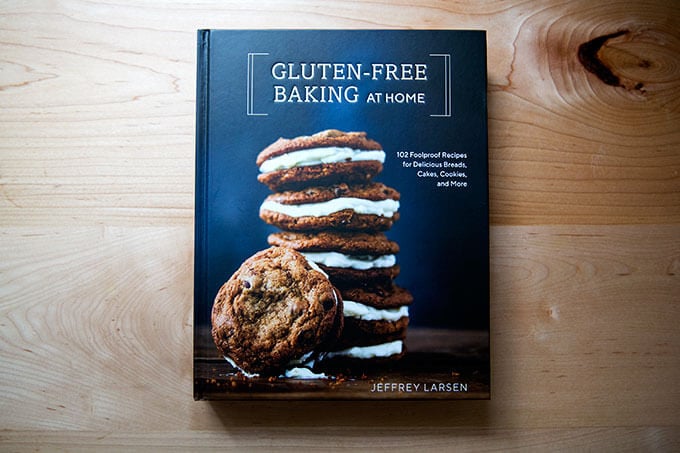
Jeffrey Larsen’s Gluten-Free Baking at Home :
Description
From Jeffrey Larsen’s Gluten-Free Baking at Home
Notes:
For best results: Use a scale .
For best results: Make the batter at least a day in advance. Better: make the batter in advance, portion the batter into balls, and freeze the balls. These cookies bake best straight from the freezer.
In place of almond meal, you can use: pecan meal, sunflower meal, hazelnut meal or 45 g (1/2 cup) oat flour.
Clarified butter. Jeffrey describes clarified butter as “miraculous” because it keeps cookies from spreading as they bake. Butter has a lot of water in it — clarifying it removes both the water and the milk solids, leaving the butter fat behind. You’ll want to clarify a little bit more than 3/4 cup — I clarified a cup to ensure I had 3/4 cup to use in the recipe.
In place of the eggs, you could use 1/2 cup unsweetened applesauce.
I prefer chocolate wafers to chocolate chips. Local friends, you can find the Guayaquil Pistoles (64% cacao) at Honest Weight Food Co-op in Albany or online . Guittard chocolate wafers are more readily available.
108 g ( 3/4 cup ) potato starch
90 g ( 1 cup ) gluten-free oat flour
90 g ( 3/4 cup ) sorghum flour
45 g ( 1/2 cup ) almond meal, see notes above
1 1/2 teaspoons baking soda
1 teaspoon xanthan gum
1 teaspoon fine sea salt
285 g ( 1 1/2 cups ) firmly packed brown sugar
3/4 cup melted and slightly cooled clarified butter or coconut oil, see notes above
2 eggs room temperature, see notes above
1 tablespoon vanilla extract
10 to 12 ounces ( 2 to 2.25 cups) chocolate chips, see notes above
flaky sea salt, optional
- In a large bowl, whisk together the potato starch, oat flour, sorghum flour, almond meal, baking soda, xanthan gum, and salt.
- In the bowl of a stand mixer fitted with the paddle attachment, mix together the brown sugar and clarified butter on medium speed. Add the eggs one at a time, mixing after each addition. Add the vanilla, and mix until fluffy and light in color, 1 to 2 minutes.
- Add the dry ingredients to the bowl and mix on low speed until well incorporated. On very low speed, mix in the chocolate chips.
- Cover the bowl and refrigerate the dough for at least 3 hours and up to 5 days . This step is important, so the dry ingredients have a chance to absorb all the moisture, which keeps the cookies from spreading too much when baked. Optional: I like to refrigerate the dough until it is firm enough to scoop, an hour or two. Then I portion the dough into 48 g balls using my scale. Then I freeze the dough balls on a tray before transferring them to an airtight container or ziplock bag. Jeffrey says these cookies bake best straight from the freezer, and I agree.
- When you’re ready to bake the cookies, heat the oven to 350ºF. Lightly spray a cooking sheet with gluten-free nonstick spray or line with parchment paper.
- If you haven’t portioned the dough balls out already, use a 1-ounce scoop or a tablespoon measure, portion out the dough and roll into balls. Arrange the balls on the prepared baking sheet 2 inches apart. Sprinkle with sea salt if you wish.
- Bake for 12 to 14 minutes , until the cookies are light golden brown. Remove the pan from the oven and let the cookies cool completely on the sheet pan. Once the cookies are completely cool, test one. If you like the texture/consistency, transfer cookies to a rack and repeat. If the cookies are overcooked, reduce the cooking time with the next batch. If the cookies are undercooked, increase the cooking time. I find 12 minutes for my 48g dough balls to be perfect.
- Prep Time: 24 hours
- Cook Time: 12 minutes
- Category: Dessert/Cookie
- Method: Oven
- Cuisine: American
