This 4-ingredient homemade ricotta tastes vastly better than anything you could buy at the store and can be ready in just about 30 minutes!
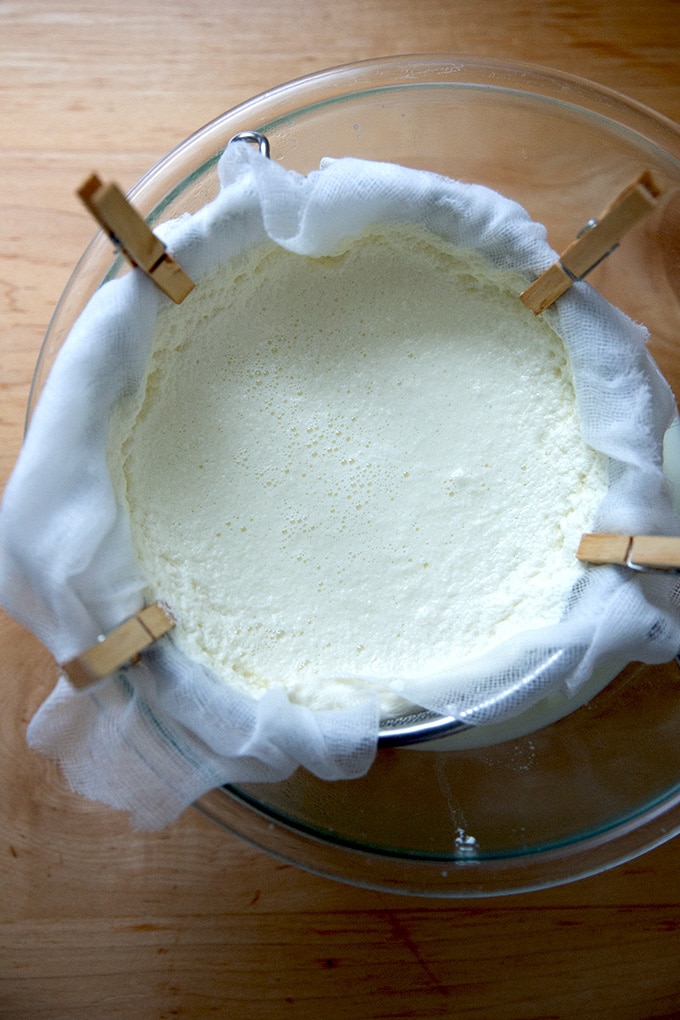
I never thought I liked ricotta until I made it from scratch. The difference in taste and texture between homemade ricotta and store-bought is dramatic. If you, too, think you don’t like ricotta, I have no doubt this recipe will change your mind.
Homemade Ricotta: Tips
- Get Organized. You’ll need to line a fine-meshed sieve with a few layers of cheesecloth. It’s helpful to have some kitchen clips or clothespins on hand to fasten the cheesecloth to the sieve.
- Stay focused. Every cook at some point in his/her life has made the mistake of walking away from a pot of near-boiling milk or cream only to return to find the pot boiling over. In this recipe, you’ll bring 4 cups of milk and 2 cups of heavy cream with a teaspoon of kosher salt to a simmer over medium heat. Do not walk away. As soon as the milk-cream mixture comes to a boil remove it from the heat. Add 3 tablespoons vinegar and let it sit for 1 minute, until the mixture begins to curdle.
- Be Patient . It takes 20 to 30 minutes for the curds to separate from the whey. If you line your sieve especially well, it will take longer. Once the ricotta (the curds) has reached a consistency you like, spoon it into a serving vessel or storage jar and use as you wish. A few ideas follow. Save the whey! You can use it to make bread ; you can use it to thin out the ricotta to the consistency you like on subsequent days.
How To Make Ricotta, Step by Step
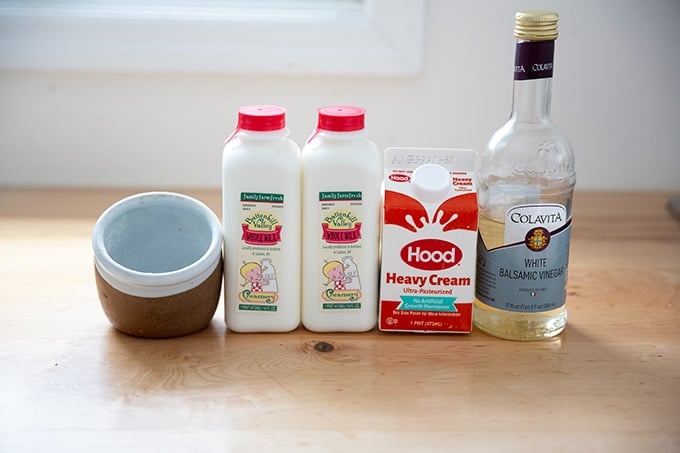
First, gather your ingredients: whole milk, heavy cream, salt, and vinegar.
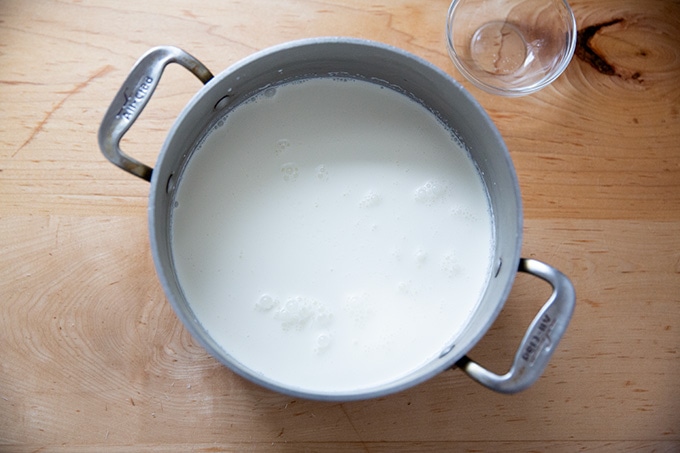
Combine the milk, cream, and salt in a pot:
Bring to a simmer over medium heat. Monitor closely and stir occasionally.
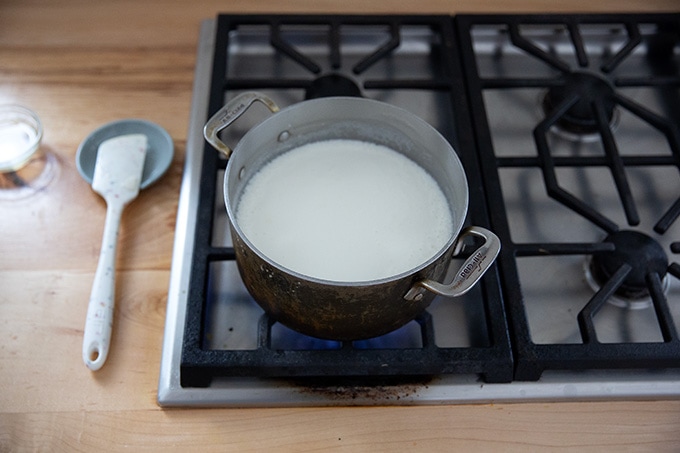
Once it comes to a simmer, turn off the heat, and add the vinegar:
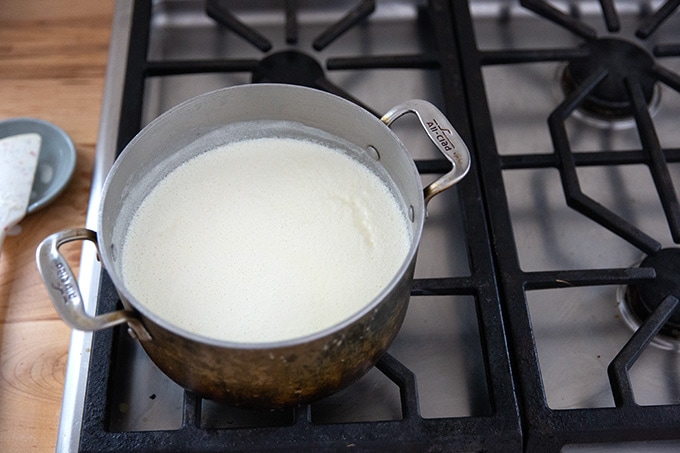
Let it stand for a minute or until it curdles:
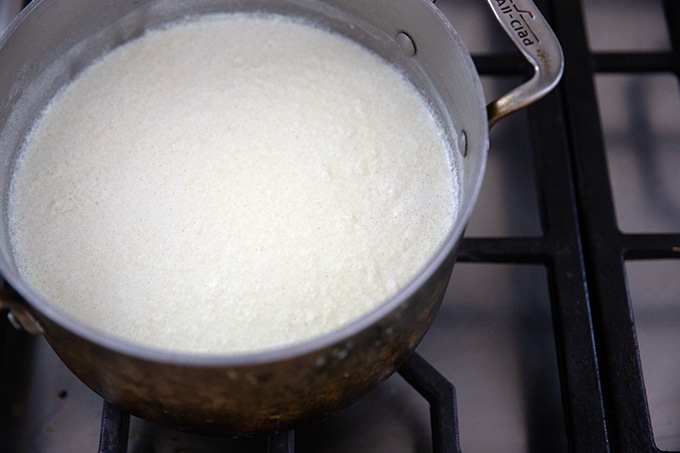
Strain it through a few layers of cheese cloth in a sieve set over a bowl:
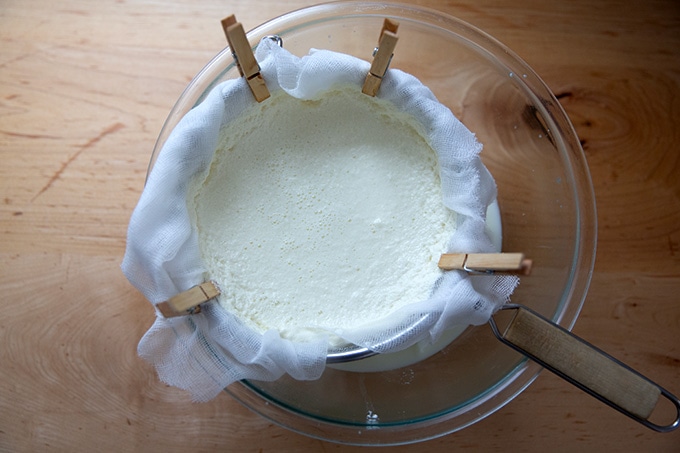
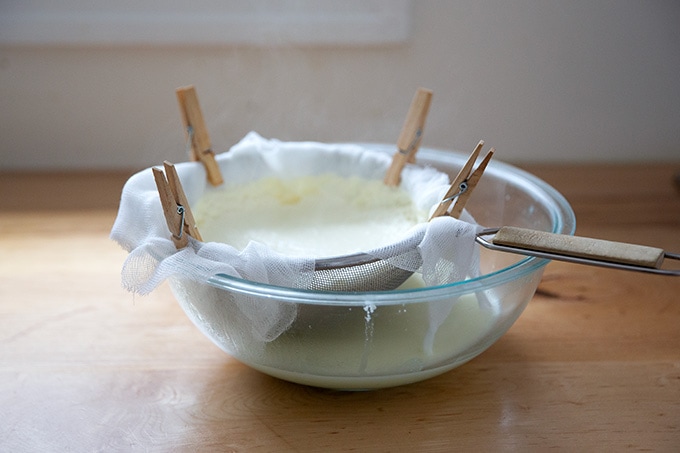
In just about 20 minutes, it will be done:
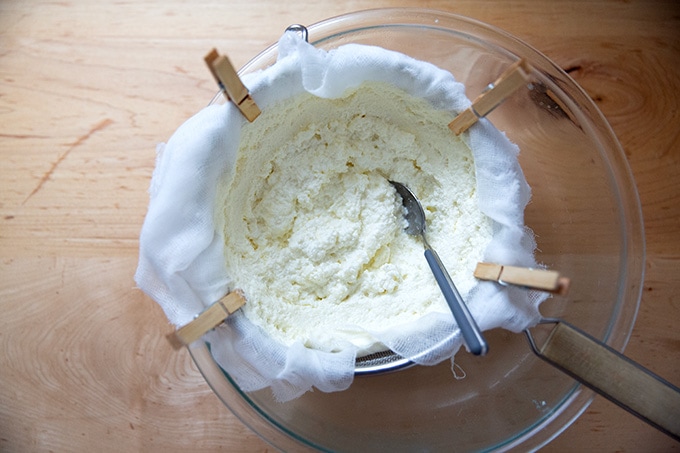
By the end, you will have two cups of ricotta and 4 cups of whey:
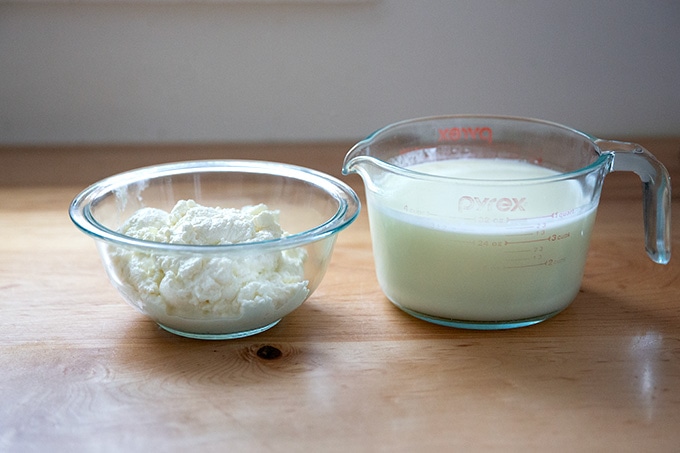
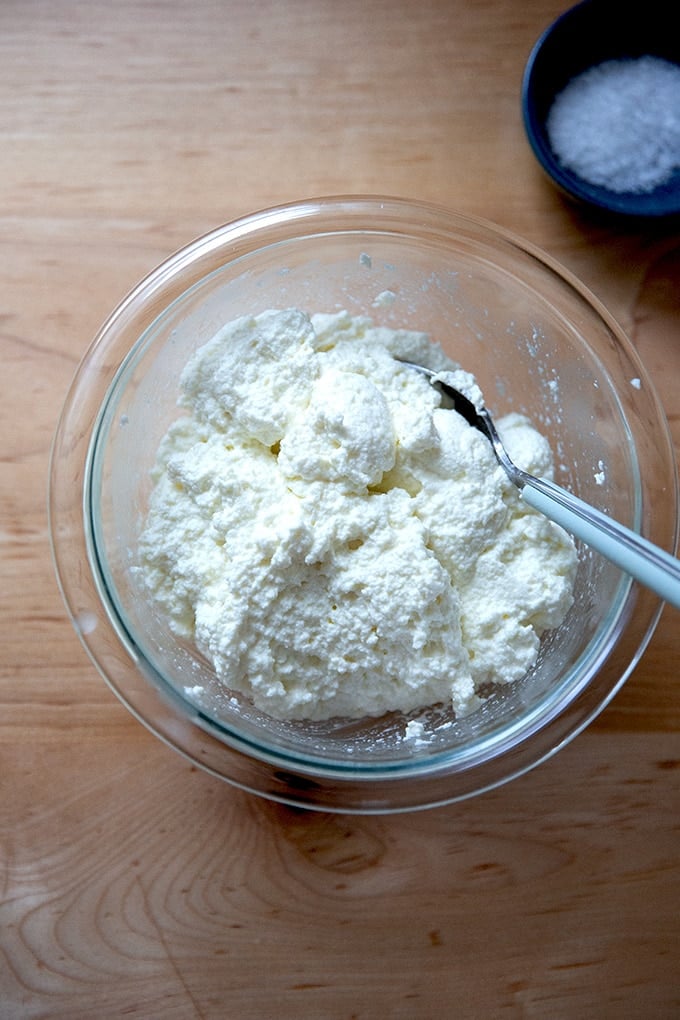
Taste the ricotta: you may want to season it with more salt.
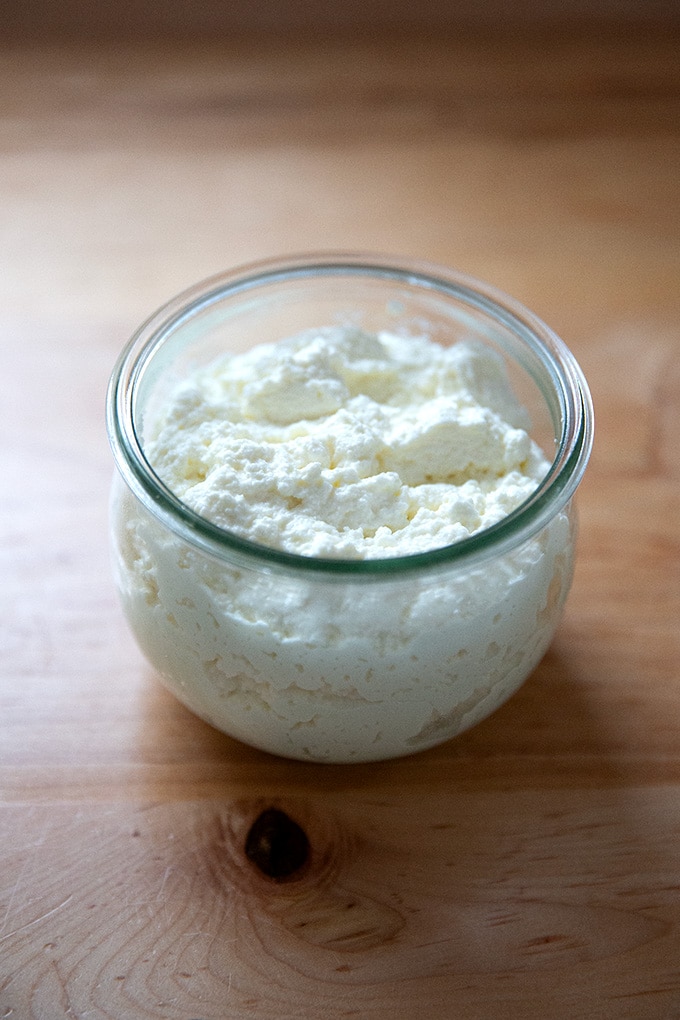
Store in the fridge for at least 1 week.
How to Use Your Homemade Ricotta

Bruschetta with Thyme-Roasted Grapes

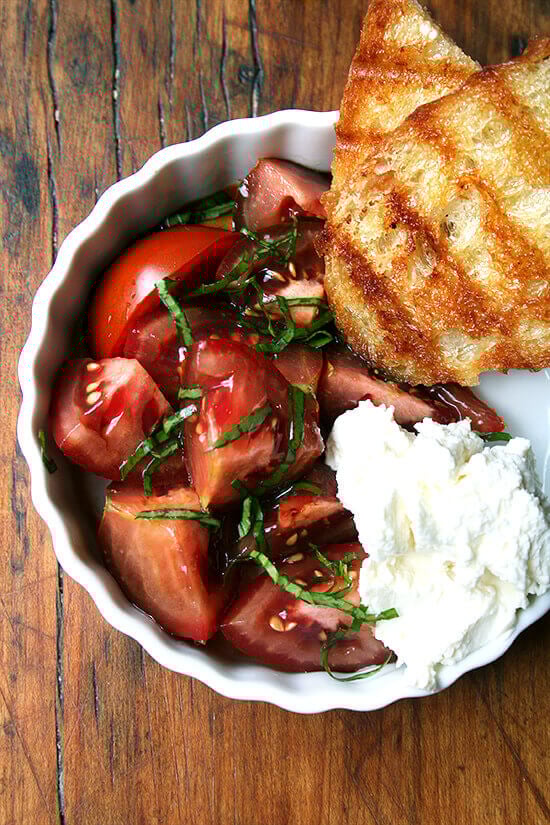
A Summer Lunch: Tomatoes, Basil, Grilled Bread, Homemade Ricotta
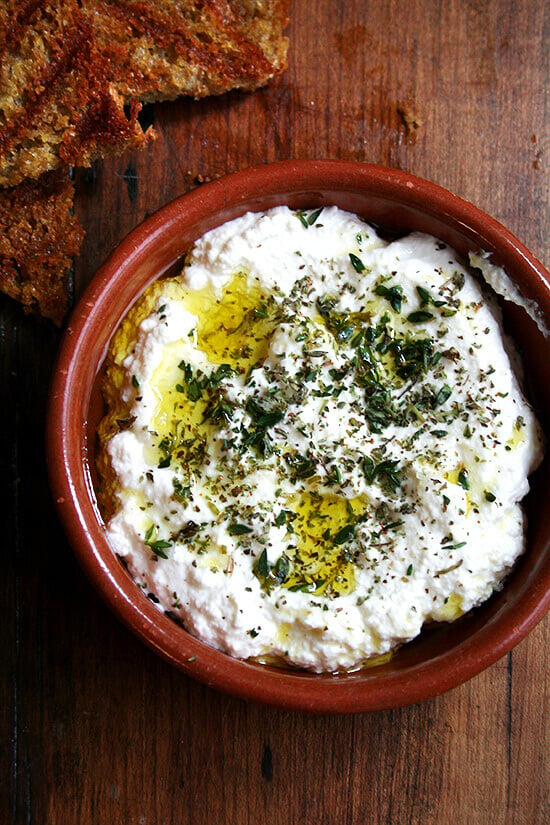
An Irresistible Appetizer: Whipped Ricotta with Olive Oil and Herbs
Endive and Fava Tartines with Herbed Ricotta

Description
Salt: If you are using Morton Kosher salt or sea salt, use 3/4 teaspoon.
Milk and Cream: If you can find milk and cream that is not “ultra-pasteurized”, buy them. I never can find non “ultra-pasteurized” heavy cream but it doesn’t seem to matter.
- 4 cups whole milk, see notes above
- 2 cups heavy cream
- 1.5 teaspoons Diamond Crystal kosher salt, see notes above
- 3 tablespoons white balsamic vinegar or other white vinegar you like
- Set a large fine-mesh sieve over a deep bowl. Line the sieve with two layers of folded cheesecloth (so roughly 4 single layers).
- Pour the milk and cream into a stainless steel or enameled pot. Stir in the salt. Bring to a full boil over medium heat, stirring occasionally — do not walk away. Turn off the heat and stir in the vinegar. Allow the mixture to stand for 1 minute or until it curdles. It will separate into thick parts (the curds) and milky parts (the whey).
- Pour the mixture into a cheesecloth-lined sieve and allow it to drain into the bowl at room temperature for 20 to 25 minutes, occasionally transferring the liquid that collects in the bowl to another storage vessel. In the end you will have 2 cups of ricotta and 4 cups of whey. Transfer the ricotta to a bowl, discarding the cheesecloth. Save the whey — you can make bread with it.
- Taste the ricotta. Season with more salt if you wish. Use the ricotta immediately or transfer it to a storage vessel, and refrigerate. The ricotta will keep refrigerated for 4 to 5 days. It will thicken considerably once chilled for 24 hours.
- Prep Time: 2 minutes
- Cook Time: 25 minutes
- Category: Cheese
- Method: Stovetop
- Cuisine: American/Italian
Description
Salt: If you are using Morton Kosher salt or sea salt, use 3/4 teaspoon.
Milk and Cream: If you can find milk and cream that is not “ultra-pasteurized”, buy them. I never can find non “ultra-pasteurized” heavy cream but it doesn’t seem to matter.
- 4 cups whole milk, see notes above
- 2 cups heavy cream
- 1.5 teaspoons Diamond Crystal kosher salt, see notes above
- 3 tablespoons white balsamic vinegar or other white vinegar you like
- Set a large fine-mesh sieve over a deep bowl. Line the sieve with two layers of folded cheesecloth (so roughly 4 single layers).
- Pour the milk and cream into a stainless steel or enameled pot. Stir in the salt. Bring to a full boil over medium heat, stirring occasionally — do not walk away. Turn off the heat and stir in the vinegar. Allow the mixture to stand for 1 minute or until it curdles. It will separate into thick parts (the curds) and milky parts (the whey).
- Pour the mixture into a cheesecloth-lined sieve and allow it to drain into the bowl at room temperature for 20 to 25 minutes, occasionally transferring the liquid that collects in the bowl to another storage vessel. In the end you will have 2 cups of ricotta and 4 cups of whey. Transfer the ricotta to a bowl, discarding the cheesecloth. Save the whey — you can make bread with it.
- Taste the ricotta. Season with more salt if you wish. Use the ricotta immediately or transfer it to a storage vessel, and refrigerate. The ricotta will keep refrigerated for 4 to 5 days. It will thicken considerably once chilled for 24 hours.
- Prep Time: 2 minutes
- Cook Time: 25 minutes
- Category: Cheese
- Method: Stovetop
- Cuisine: American/Italian
Find it online : https://alexandracooks.com/2019/01/13/how-to-make-ricotta-from-scratch/
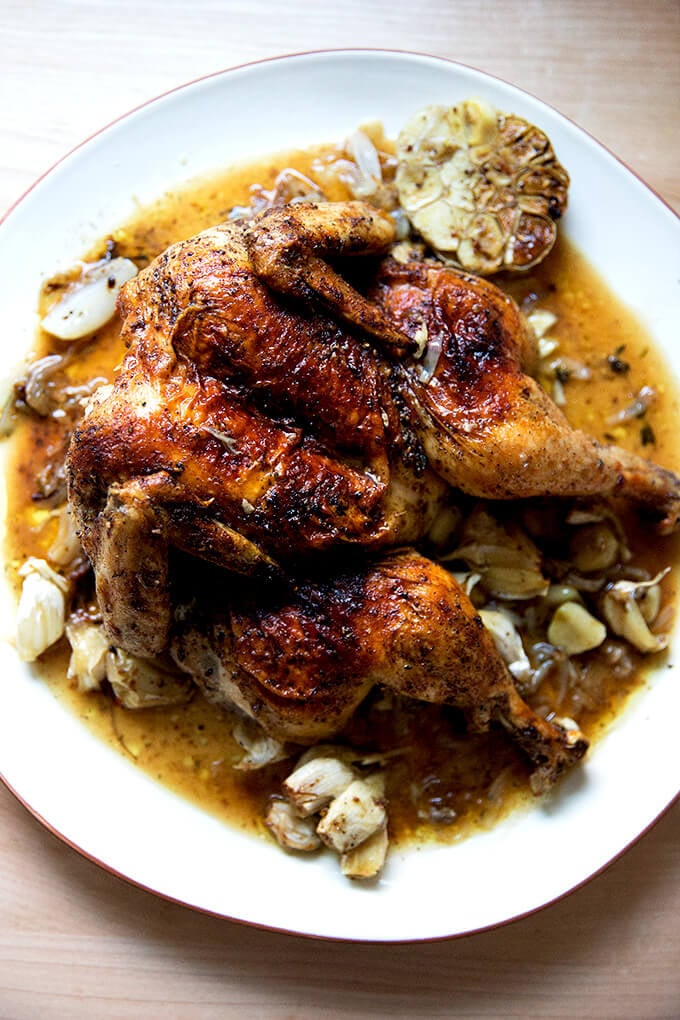
In early December in preparation for a chat with Margaret Roach , I cooked furiously through as many new cookbooks as I could. I discovered some gems in the process, namely this spatchcocked chicken recipe with lemon and za’atar from Dorie Greenspan’s latest book, Everyday Dorie .
It came together effortlessly, cooked quickly, and looked stunning, yielding an abundant and flavorful sauce, perfect for dunking crusty bread into. I served it as Dorie suggested, right out of the skillet, “for a very casual grab, dip, and dunk dinner.” With bread in hand, not a buttery clove of garlic, a melting sliver of shallot or a drip of sauce was spared.
The beauty of this dish as Dorie notes is its adaptability: “If you fall in love with the technique,” she says, “you can put it in the rotation and fiddle with the flavors each time.”
I’ve been enjoying the suggested combination of za’atar, cumin, coriander, and lemon, but I’m looking forward to trying her French variation with fresh tarragon replacing the spices entirely.
Everything in Everyday Dorie looks and sounds so inviting: roasted squash hummus, black bean chipotle dip, chicken Milanese with celery salad, slow-roasted tomatoes for everything, so-good Miso corn, oven-charred tomato-stuffed peppers.
PS: What to do with Leftover Roast Chicken? Make a Salad
PPS: How to Roast A Chicken and Make the Most of it
How to Spatchcock a Chicken
- Remove the backbone. A pair of sharp kitchen shears makes this an easy task. Tip: If you find your scissors getting stuck, try cutting even closer to the backbone.
- Place chicken in cooking vessel. I love using my Le Creuset braiser for cooking spatchcocked birds but you could use a rimmed sheet pan or 9 x 13-inch pan — something on the shallow side is ideal.
- Use the heel of your hand to press down hard on the breast to flatten the bird. It’s OK if you break the breast bone when you flatten it. (See video above.)
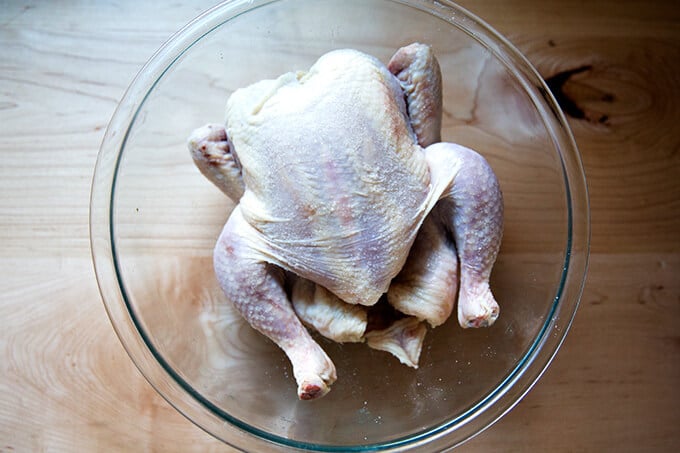
Here’s a play-by-play. If you remember, salt your chicken ahead of time—it helps keep the breasts from drying out, and generally helps keeping the chicken juicy.
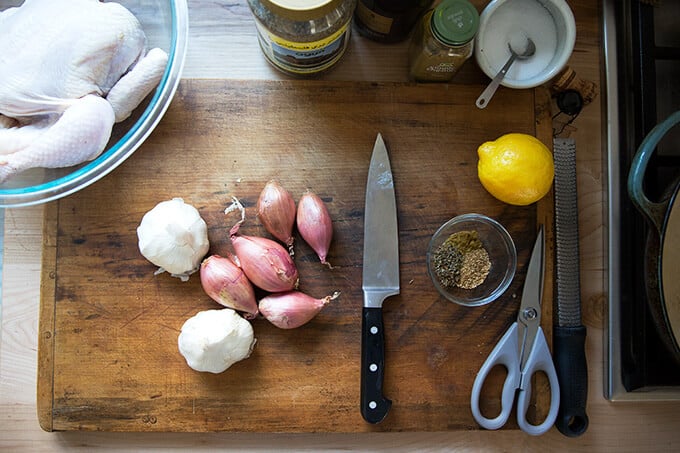
Gather your ingredients.
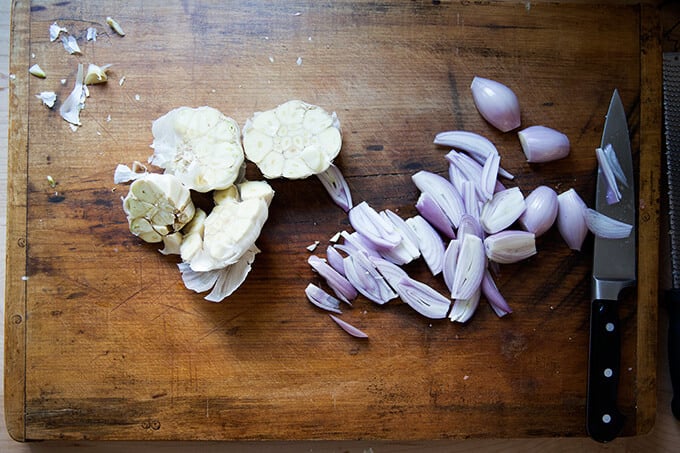
Halve the heads of garlic. Slice the shallots.
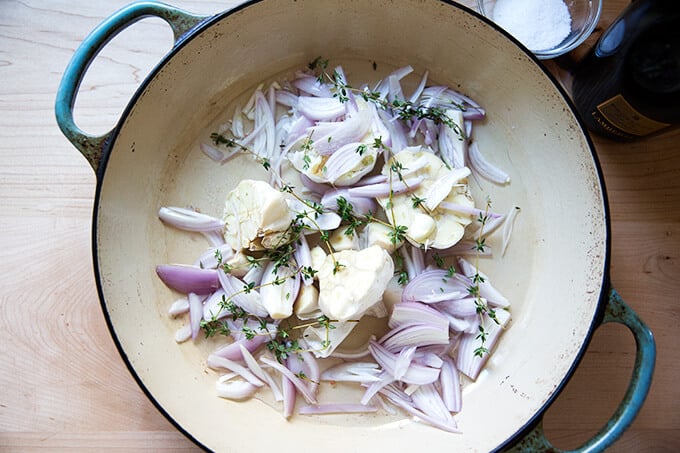
Place them in a skillet with thyme or other herbs. Add white wine and stock (or water).
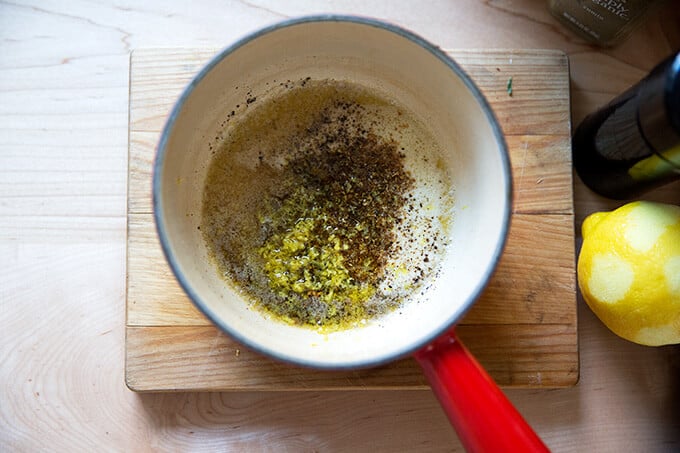
Make a seasoned butter. You can do this with softened or melted butter. I prefer to melt.
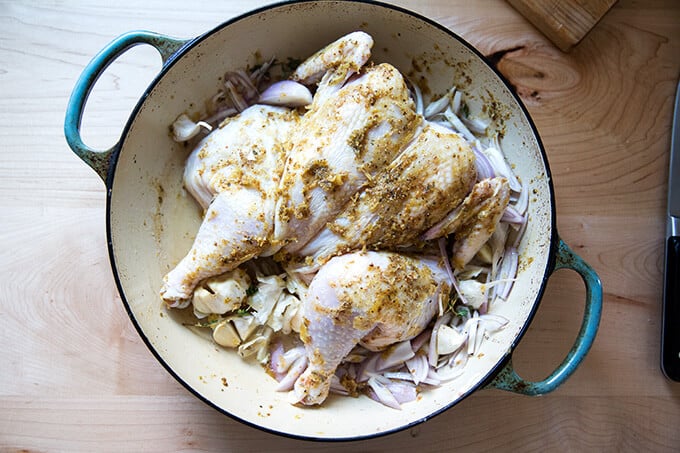
Brush it all over the chicken, then chuck the whole thing in the oven for 45 minutes.
Let it rest briefly, then serve with lots of crusty bread .
Description
Adapted from Everyday Dorie
Salting in Advance: Salting the morning you plan to cook chicken or other meat is sufficient, but it’s best if you can do it the day before or even two or three days ahead of time. I find this makes a big difference especially when I’m cooking a whole chicken — it helps keep the breast juicy — and less as important, when I’m roasting a spatchcocked bird, which generally cooks more evenly.
Spices: If you don’t have sumac or za’atar or any of the others, don’t worry — lemon zest, salt, and pepper would suffice as would any combination of the spices listed. Dorie’s French variation calls for omitting the spices and using fresh tarragon and lemon zest in their place.
One change: Dorie calls for using softened butter, which she mixes with the spices and rubs all over the chicken including under the skin and over the breast and other parts. I use melted butter instead, which I stir the spices into and brush over top.
- 1 chicken, 3 to 4 pounds
- kosher salt
- 1 to 2 heads of garlic, cut in half horizontally
- 1 small onion or 5 to 6 shallots, sliced
- a few sprigs of thyme
- ¾ cups water or chicken stock
- ¼ cup white wine or Prosecco
- freshly cracked black pepper
- 4 tablespoons unsalted butter
- 1 teaspoon za’atar or dried oregano crumbled between your fingers after measuring
- ¾ teaspoon ground cumin
- ¾ teaspoon ground sumac or finely grated zest of one lemon (I use lemon)
- ½ teaspoon ground coriander
- Crusty bread for serving (optional)
- If you remember, salt the chicken in advance. Place chicken in a large bowl, sprinkle all over and inside with kosher salt — 1 teaspoon per pound is a good rule — cover bowl, and place it in the fridge until ready to cook.
- Center a rack in the oven and preheat it to 425ºF. Choose a large cast-iron skillet, a 9×13-inch roasting pan or a small baking sheet. (I use this braiser .)
- Place the garlic, shallots, and thyme in the center of your pan. Season with salt and pepper to taste. Pour the water and wine over top.
- To spatchcock the chicken, use kitchen shears to cut alongside the backbone. If your shears are sharp, this should be easy. If you get tripped up, try cutting closer to the backbone. Alternatively, use a chef’s knife on a cutting board. Remove the bone (save for stock making if you wish), and turn the chicken over so the breast is facing up.
- Place chicken in your pan over the garlic and shallots. Use the heel of your hands to press down on the breast and flatten it as much as you can. It’s OK if you break the breastbone. Pat the chicken very dry with paper towels. Season with pepper to taste.
- Melt the butter in a small skillet. Stir in the za’atar, cumin, sumac or lemon zest, and coriander. Brush this seasoned butter all over the chicken.
- Transfer pan to the oven and cook for 45 minutes or until done—the time will depend on your bird. The chicken should be golden brown and the juices should run clear when the thigh is pricked. An i nstant read thermometer should register 165ºF. Transfer the bird to a carving board to rest for at least 10 minutes for cutting and serving.
- Dorie’s Notes: “If you’ve roasted the bird in a skillet, it’s nice to return the pieces to the pan and bring the whole thing to the table for a very casual grab, dip, and dunk dinner. Otherwise, put the chicken on a platter and pour the cooking juices into a serving pitcher. Either mash the garlic cloves and serve them as a spread instead of the butter for the bread, if you’re serving it, or place the garlic halves alongside the chicken and encourage everyone to squeeze the roasted garlic onto the bread or chicken.”
- Prep Time: 15 minutes
- Cook Time: 45 minutes
- Category: Dinner
- Method: Roast
- Cuisine: Middle Eastern
