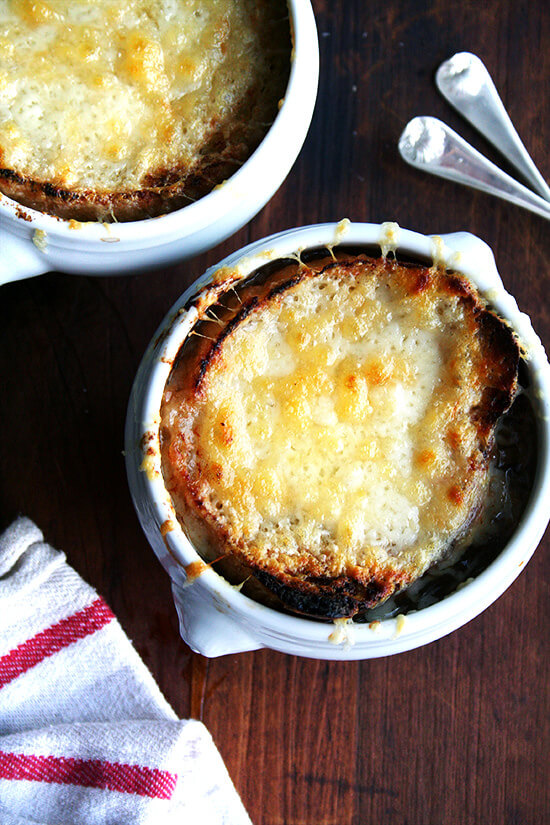
I have read over the years that good, classic French onion soup can be made with little more than water, onions, bread and cheese.
But before last week, I had never read that good French onion soup should be made with little more than water, onions, bread and cheese, and that using chicken or beef stock in such a peasant dish not only betrays the soup’s economical roots but also muddles the soup’s pure onion flavor.
In his post on making traditional French onion soup, Michael Ruhlman describes the bistros of Lyon, France, also known as bouchons , which serve country-style fare and whose owners, often a husband and wife team, wouldn’t dare make onion soup with a costly and time-consuming stock. A “fine soup with a pure caramelized onion flavor,” he insists, requires nothing more than water, onions and a splash of wine for seasoning.
Skeptical? I was, too. But yesterday, I gave it a go. After slicing six pounds of onions and caramelizing them for four hours, I poured six cups of water into the pot and seasoned the broth with a few cracks of pepper.
I gave it a stir and took a taste. I could have stopped right there. I could have served the soup without taking a single taste more, without adding a pinch more of this or a splash more of that. I could have forgone the broiled bread-and-Gruyère topping altogether.
The broth, unadulterated by any chicken or beef flavor, tasted of pure, sweet onions. Because Ruhlman suggests adding a splash of vinegar to temper the sweetness and a little sherry and wine for more depth of flavor, I did, and the broth may have been the best I have ever made.
Making this soup will test your patience, challenge your instincts, and might leave you with blistered fingers. But I think you’ll find the process rewarding:
During the first half hour, six pounds of onions cook with a single tablespoon of butter in a covered pot. In this period, the onions release pools of juices and shrink by half in volume. Only after the juices cook off do the onions begin their long, slow caramelization ultimately shrinking to a fraction of their initial volume.
When the onions turn amber in color, you’ll have to resist all temptations to thaw the stock in your freezer and trust that water will reconstitute those super-concentrated swirls melting into the bottom of your pot into perhaps the best soup, French onion or otherwise, you ever make. I hope you all find time sometime soon to give it a try.
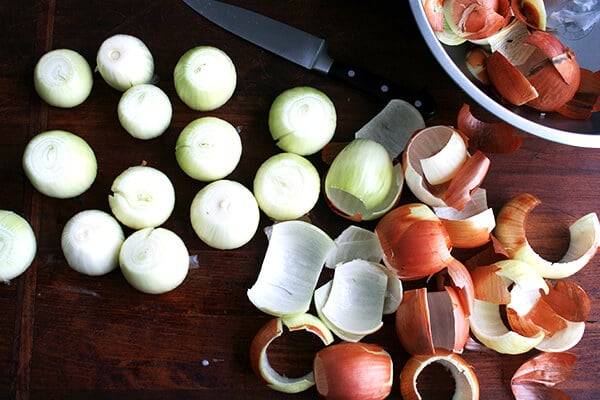
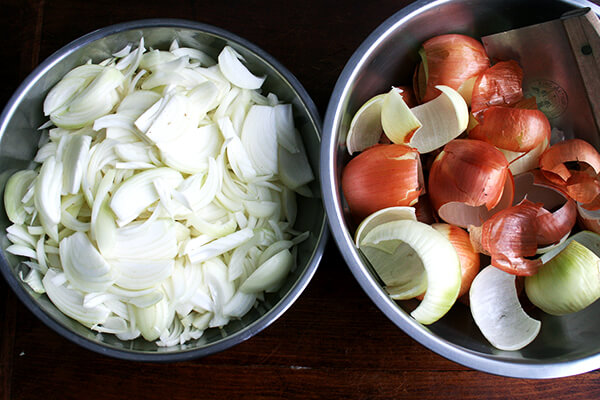
Since you will be chopping a lot of onions, you need a game plan: 1. Gather two large bowls — one for the onion scraps and one for the onions. A bench scraper is nice to have close by, too. Start by trimming off the ends of each onion, collecting scraps in one of the bowls as you go.
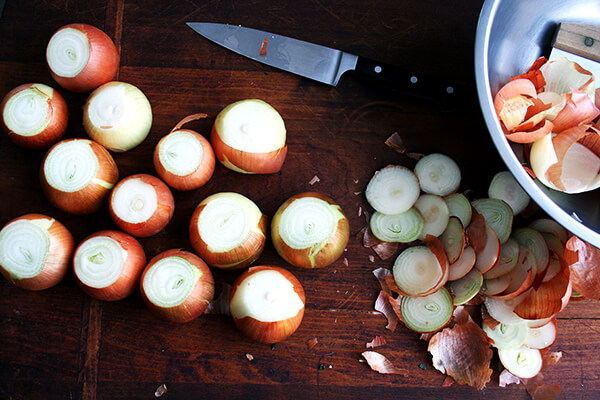
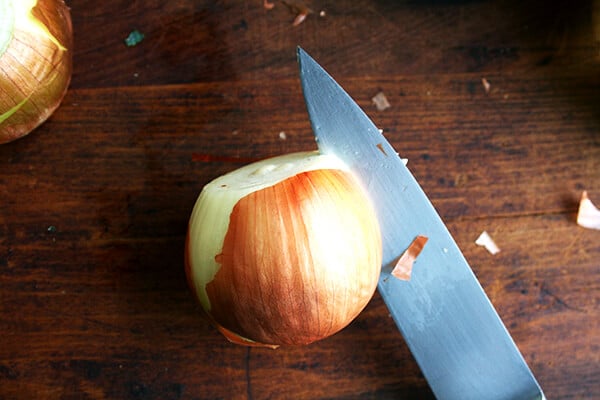
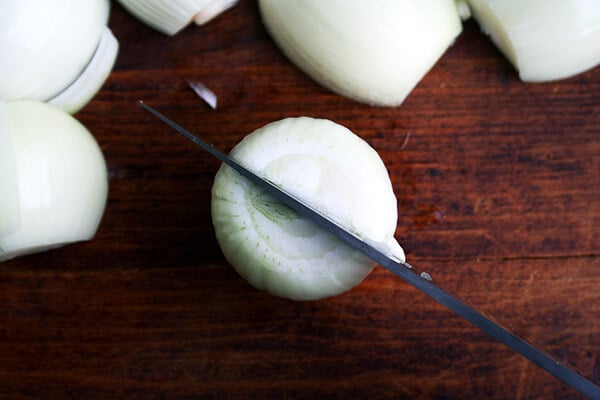
- Next, score the outside layer of each onion…
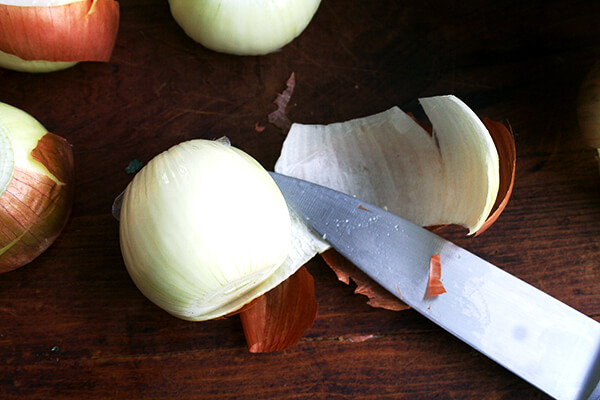
…and use your knife to peel away the skin.
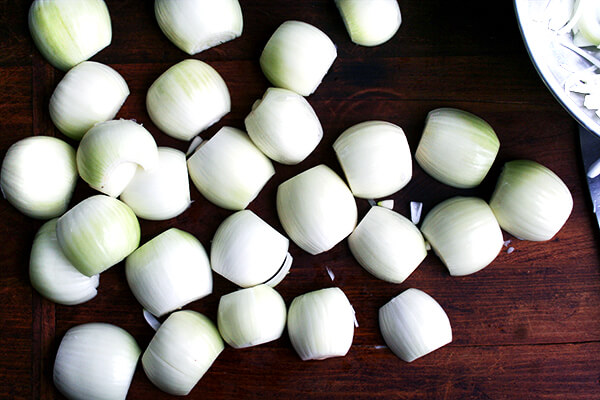
- Cut each onion in half next.
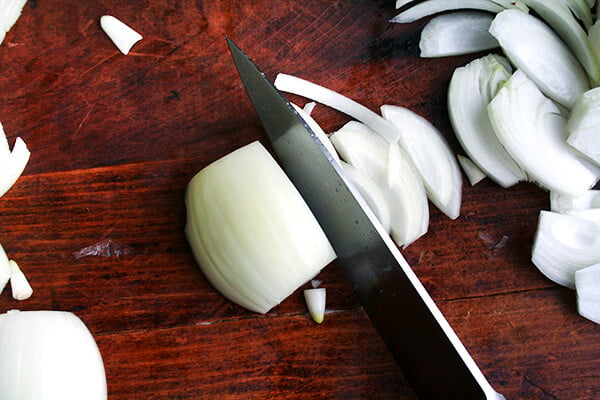
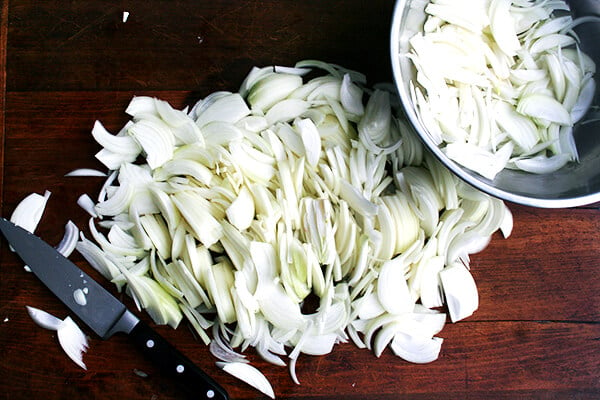
- Slice the onion thinly making cuts perpendicular to the rings.
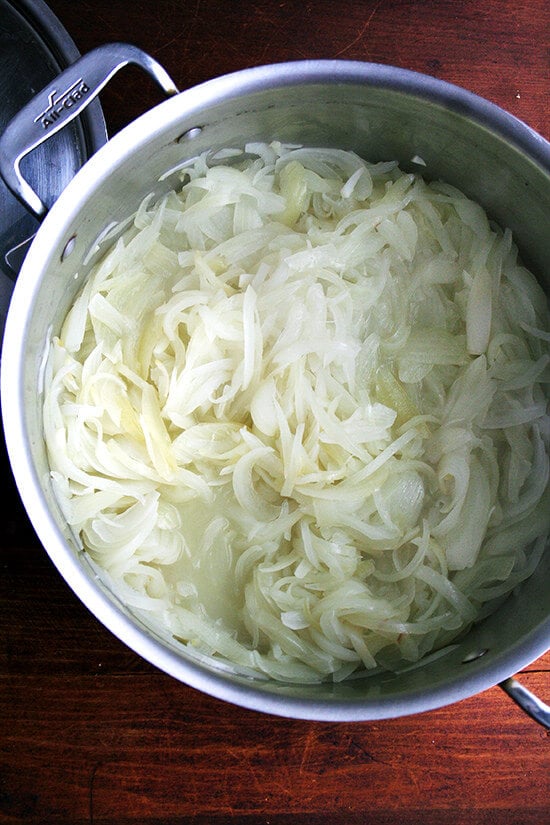
Onions after 30 minutes of cooking covered over low heat:
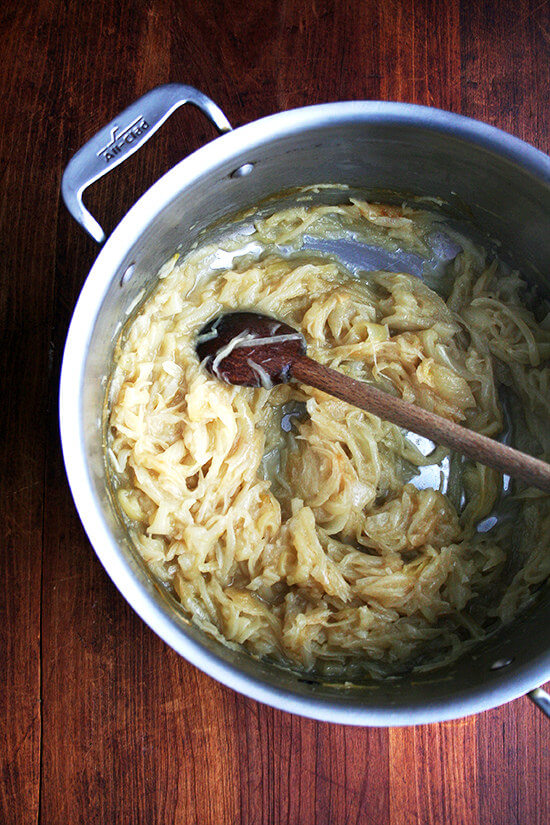
After two hours of stewing uncovered:
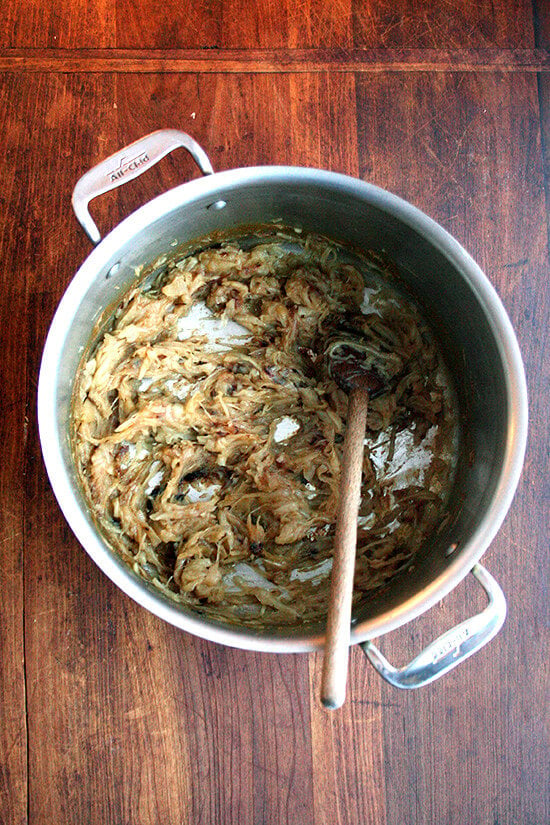
After three and a half hours total:
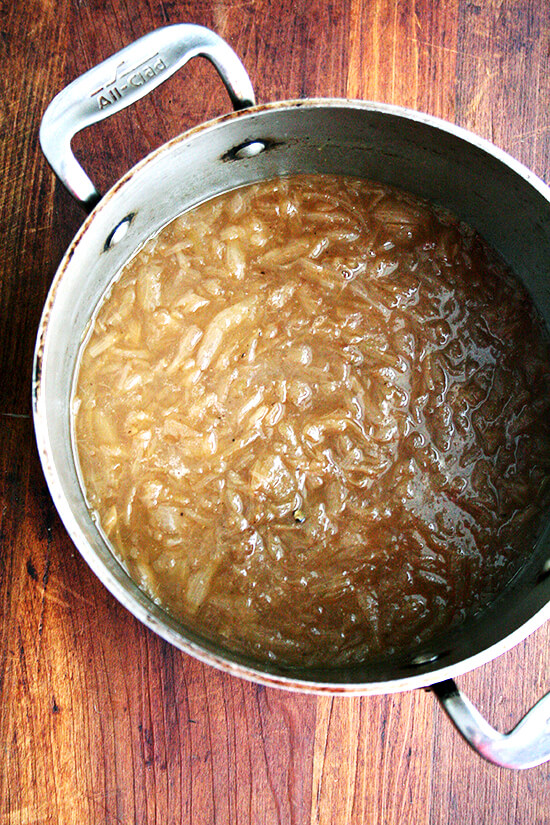
When the onions look amber in color, add 6 cups of water, 1/3 cup Sherry, a splash of red wine and a splash of vinegar:
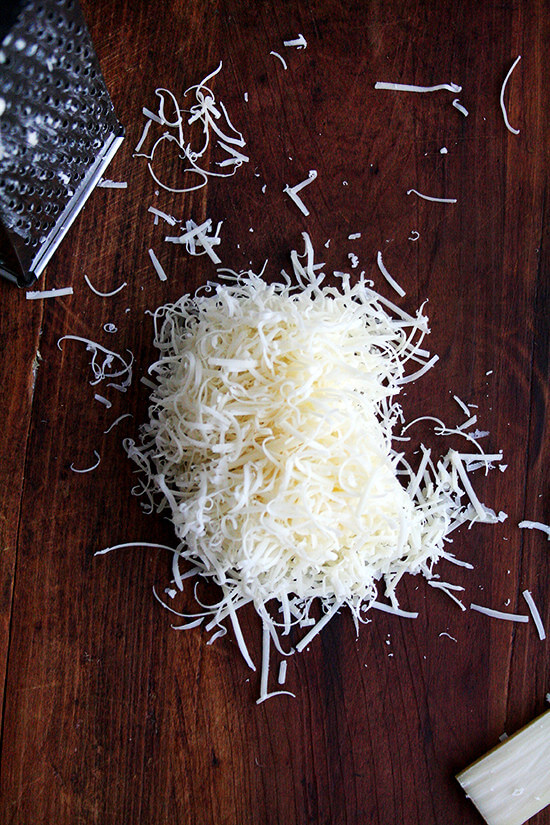
Grated Gruyère:
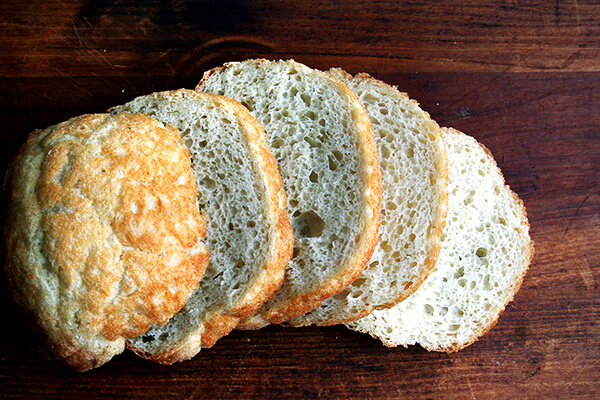
Day-old bread , sliced and ready to be toasted:
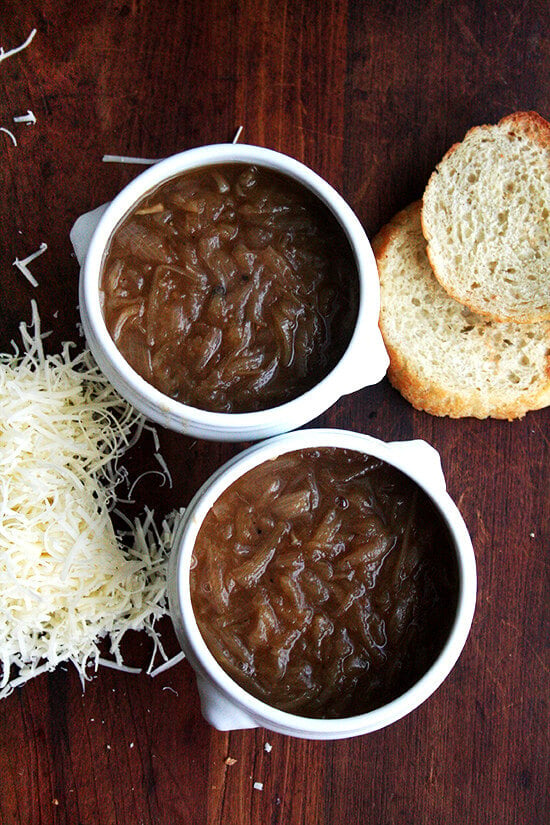
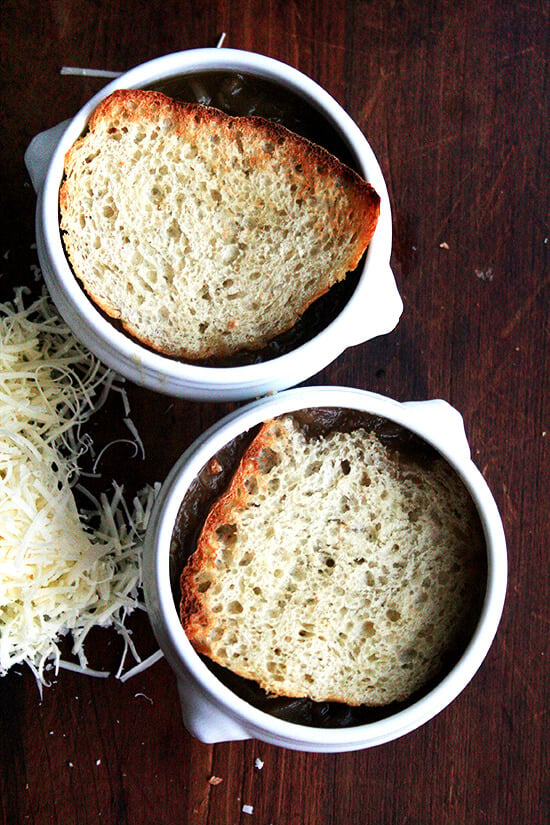
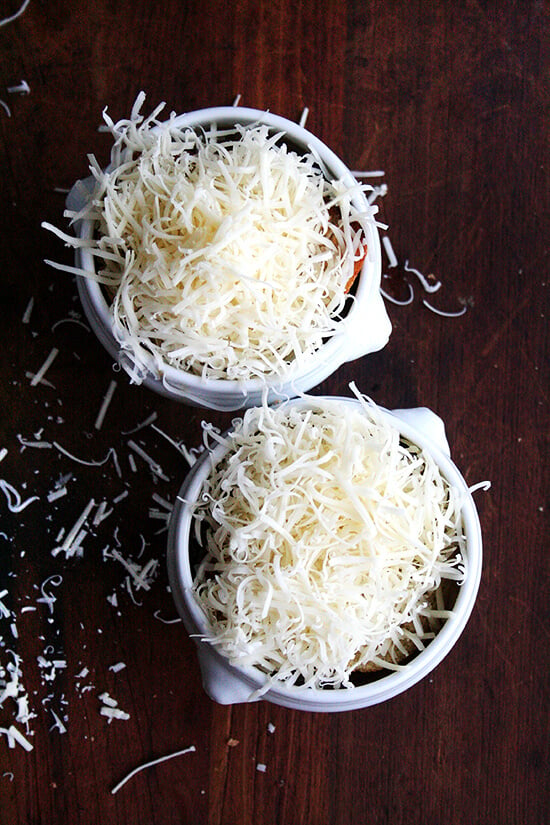
Ready for the broiler:
Description
Adapted just barely from Michael Ruhlman’s Traditional French Onion Soup
Note: Plan ahead. Slicing the onions takes time, and cooking the onions takes time, too — 3 to 4 hours.
- 1 tablespoon butter
- 6 to 8 pounds onions, thinly sliced (see notes below)
- kosher salt
- freshly ground black pepper
- 6 slices of country-style bread — I use peasant bread
- ⅓ cup sherry
- 1 tablespoon white balsamic vinegar or white/red wine vinegar (optional)
- 1 tablespoon red wine (optional)
- ½ to ¾ pound | 225 to 340 grams Gruyère or Comté cheese, grated
- Use a large pot (7 to 8 quarts) that will hold all the onions. Place the pot over medium and melt the butter. Add the onions, sprinkle with 2 teaspoons salt, cover, and cook until the onions have heated through and started to steam, about 30 minutes.
- Uncover, reduce the heat to low, and cook, stirring occasionally (you should be able to leave the onions alone for an hour at a stretch once they’ve released their water). Cook for about 3 hours at low to medium-low heat. Season with several grinds of pepper.
- Meanwhile, preheat the oven to 200°F. Place the bread slices in the oven and let dry completely (you can leave the slices in the oven for a few hours, as the heat is not high enough to burn them).
- When the onions have completely cooked down, the water has cooked off, and the onions have turned amber (3-4 hours total), add 6 cups of water. Raise the heat to high and bring the soup to a simmer, then reduce the heat to low. Add the sherry. Taste and season with salt and pepper as needed. If the soup is too sweet, add the vinegar. If you would like a little more depth, add a splash of red wine.
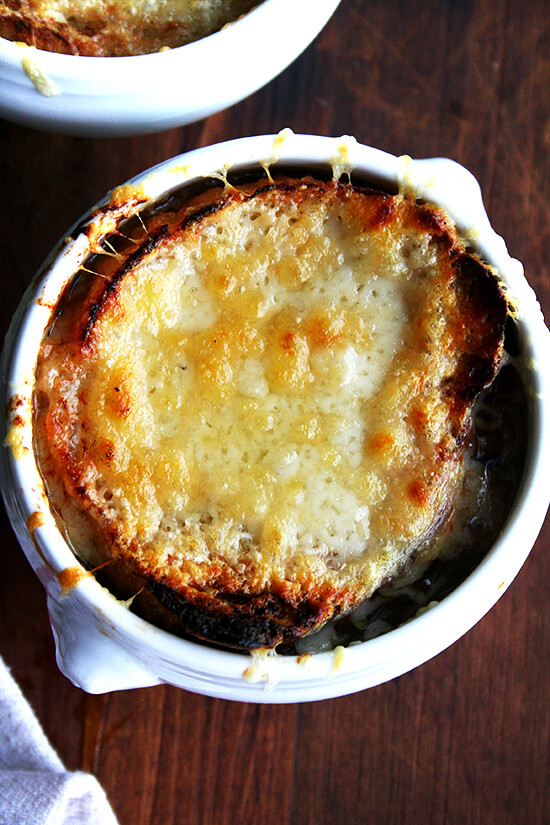
- Preheat the broiler. Portion the soup into bowls, top with bread, cover with cheese, and broil until the cheese is melted and nicely browned. Serve immediately.
Notes
A game plan for chopping all of those onions:
- Gather two large bowls — one for the onion scraps and one for the onions. A bench scraper is nice to have close by, too. Start by trimming off the ends of each onion, collecting scraps in one of the bowls as you go.
- Next, score the outside layer of each onion, and use your knife to peel away the skin.
- Cut each onion in half next.
- Slice the onion thinly making cuts perpendicular to the rings.
- Prep Time: 30 minutes
- Cook Time: 4 hours
- Category: Soup
- Method: Stovetop, Broiler
- Cuisine: French
I have read over the years that good, classic French onion soup can be made with little more than water, onions, bread and cheese.
But before last week, I had never read that good French onion soup should be made with little more than water, onions, bread and cheese, and that using chicken or beef stock in such a peasant dish not only betrays the soup’s economical roots but also muddles the soup’s pure onion flavor.
In his post on making traditional French onion soup, Michael Ruhlman describes the bistros of Lyon, France, also known as bouchons , which serve country-style fare and whose owners, often a husband and wife team, wouldn’t dare make onion soup with a costly and time-consuming stock. A “fine soup with a pure caramelized onion flavor,” he insists, requires nothing more than water, onions and a splash of wine for seasoning.
Skeptical? I was, too. But yesterday, I gave it a go. After slicing six pounds of onions and caramelizing them for four hours, I poured six cups of water into the pot and seasoned the broth with a few cracks of pepper.
I gave it a stir and took a taste. I could have stopped right there. I could have served the soup without taking a single taste more, without adding a pinch more of this or a splash more of that. I could have forgone the broiled bread-and-Gruyère topping altogether.
The broth, unadulterated by any chicken or beef flavor, tasted of pure, sweet onions. Because Ruhlman suggests adding a splash of vinegar to temper the sweetness and a little sherry and wine for more depth of flavor, I did, and the broth may have been the best I have ever made.
Making this soup will test your patience, challenge your instincts, and might leave you with blistered fingers. But I think you’ll find the process rewarding:
During the first half hour, six pounds of onions cook with a single tablespoon of butter in a covered pot. In this period, the onions release pools of juices and shrink by half in volume. Only after the juices cook off do the onions begin their long, slow caramelization ultimately shrinking to a fraction of their initial volume.
When the onions turn amber in color, you’ll have to resist all temptations to thaw the stock in your freezer and trust that water will reconstitute those super-concentrated swirls melting into the bottom of your pot into perhaps the best soup, French onion or otherwise, you ever make. I hope you all find time sometime soon to give it a try.
Since you will be chopping a lot of onions, you need a game plan: 1. Gather two large bowls — one for the onion scraps and one for the onions. A bench scraper is nice to have close by, too. Start by trimming off the ends of each onion, collecting scraps in one of the bowls as you go.
- Next, score the outside layer of each onion…
…and use your knife to peel away the skin.
- Cut each onion in half next.
- Slice the onion thinly making cuts perpendicular to the rings.
Onions after 30 minutes of cooking covered over low heat:
After two hours of stewing uncovered:
After three and a half hours total:
When the onions look amber in color, add 6 cups of water, 1/3 cup Sherry, a splash of red wine and a splash of vinegar:
Grated Gruyère:
Day-old bread , sliced and ready to be toasted:
Ready for the broiler:
Description
Adapted just barely from Michael Ruhlman’s Traditional French Onion Soup
Note: Plan ahead. Slicing the onions takes time, and cooking the onions takes time, too — 3 to 4 hours.
- 1 tablespoon butter
- 6 to 8 pounds onions, thinly sliced (see notes below)
- kosher salt
- freshly ground black pepper
- 6 slices of country-style bread — I use peasant bread
- ⅓ cup sherry
- 1 tablespoon white balsamic vinegar or white/red wine vinegar (optional)
- 1 tablespoon red wine (optional)
- ½ to ¾ pound | 225 to 340 grams Gruyère or Comté cheese, grated
- Use a large pot (7 to 8 quarts) that will hold all the onions. Place the pot over medium and melt the butter. Add the onions, sprinkle with 2 teaspoons salt, cover, and cook until the onions have heated through and started to steam, about 30 minutes.
- Uncover, reduce the heat to low, and cook, stirring occasionally (you should be able to leave the onions alone for an hour at a stretch once they’ve released their water). Cook for about 3 hours at low to medium-low heat. Season with several grinds of pepper.
- Meanwhile, preheat the oven to 200°F. Place the bread slices in the oven and let dry completely (you can leave the slices in the oven for a few hours, as the heat is not high enough to burn them).
- When the onions have completely cooked down, the water has cooked off, and the onions have turned amber (3-4 hours total), add 6 cups of water. Raise the heat to high and bring the soup to a simmer, then reduce the heat to low. Add the sherry. Taste and season with salt and pepper as needed. If the soup is too sweet, add the vinegar. If you would like a little more depth, add a splash of red wine.
- Preheat the broiler. Portion the soup into bowls, top with bread, cover with cheese, and broil until the cheese is melted and nicely browned. Serve immediately.
Notes
A game plan for chopping all of those onions:
- Gather two large bowls — one for the onion scraps and one for the onions. A bench scraper is nice to have close by, too. Start by trimming off the ends of each onion, collecting scraps in one of the bowls as you go.
- Next, score the outside layer of each onion, and use your knife to peel away the skin.
- Cut each onion in half next.
- Slice the onion thinly making cuts perpendicular to the rings.
- Prep Time: 30 minutes
- Cook Time: 4 hours
- Category: Soup
- Method: Stovetop, Broiler
- Cuisine: French
Description
Adapted just barely from Michael Ruhlman’s Traditional French Onion Soup
Note: Plan ahead. Slicing the onions takes time, and cooking the onions takes time, too — 3 to 4 hours.
- 1 tablespoon butter
- 6 to 8 pounds onions, thinly sliced (see notes below)
- kosher salt
- freshly ground black pepper
- 6 slices of country-style bread — I use peasant bread
- ⅓ cup sherry
- 1 tablespoon white balsamic vinegar or white/red wine vinegar (optional)
- 1 tablespoon red wine (optional)
- ½ to ¾ pound | 225 to 340 grams Gruyère or Comté cheese, grated
- Use a large pot (7 to 8 quarts) that will hold all the onions. Place the pot over medium and melt the butter. Add the onions, sprinkle with 2 teaspoons salt, cover, and cook until the onions have heated through and started to steam, about 30 minutes.
- Uncover, reduce the heat to low, and cook, stirring occasionally (you should be able to leave the onions alone for an hour at a stretch once they’ve released their water). Cook for about 3 hours at low to medium-low heat. Season with several grinds of pepper.
- Meanwhile, preheat the oven to 200°F. Place the bread slices in the oven and let dry completely (you can leave the slices in the oven for a few hours, as the heat is not high enough to burn them).
- When the onions have completely cooked down, the water has cooked off, and the onions have turned amber (3-4 hours total), add 6 cups of water. Raise the heat to high and bring the soup to a simmer, then reduce the heat to low. Add the sherry. Taste and season with salt and pepper as needed. If the soup is too sweet, add the vinegar. If you would like a little more depth, add a splash of red wine.
- Preheat the broiler. Portion the soup into bowls, top with bread, cover with cheese, and broil until the cheese is melted and nicely browned. Serve immediately.
Notes
A game plan for chopping all of those onions:
- Gather two large bowls — one for the onion scraps and one for the onions. A bench scraper is nice to have close by, too. Start by trimming off the ends of each onion, collecting scraps in one of the bowls as you go.
- Next, score the outside layer of each onion, and use your knife to peel away the skin.
- Cut each onion in half next.
- Slice the onion thinly making cuts perpendicular to the rings.
- Prep Time: 30 minutes
- Cook Time: 4 hours
- Category: Soup
- Method: Stovetop, Broiler
- Cuisine: French
Find it online : https://alexandracooks.com/2014/01/20/no-stock-french-onion-soup/

Skip to Recipe

This is the post I meant to write back on January 7th, when I was eating croque monsieur and thought you should, too. I still feel bad about that one.
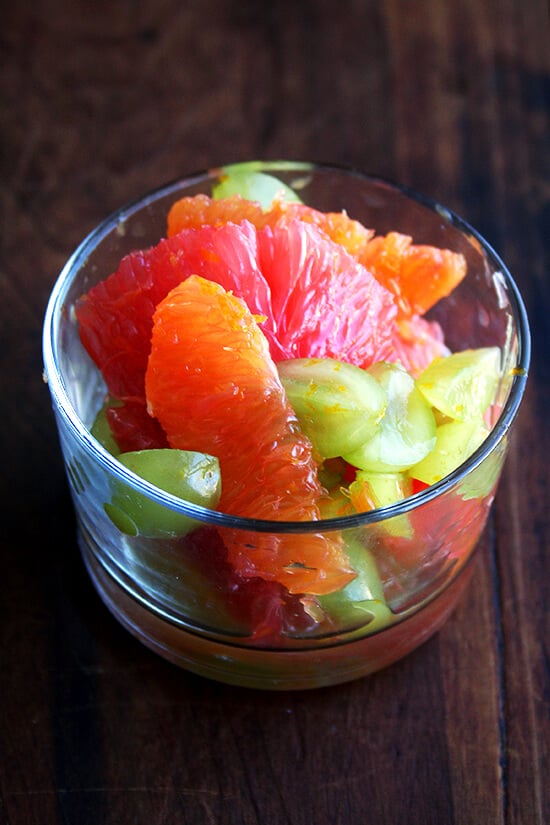
Is it too late to make things right? I hope not. Because this little mixture of orange, grapefruit and slivered grapes tossed together with citrus sugar and freshly squeezed juice couldn’t taste more right than right now. My aunt, the one who makes pies and Vermont Cheddar Cheese soup and baked fontina , discovered it 10 years ago, and we’ve been making it every winter since.
It’s fresh and light and makes an elegant dessert or a nice addition to any breakfast or brunch. And while it’s simple in theory to throw together — fruit and sugar are tossed with fresh juice — somehow it takes more time to assemble than you might anticipate. But don’t let that deter you. All of the zesting and supreming and slivering are worth every effort. One bite of this compote* will send those winter blues packin’!
Have a great weekend, Everyone.
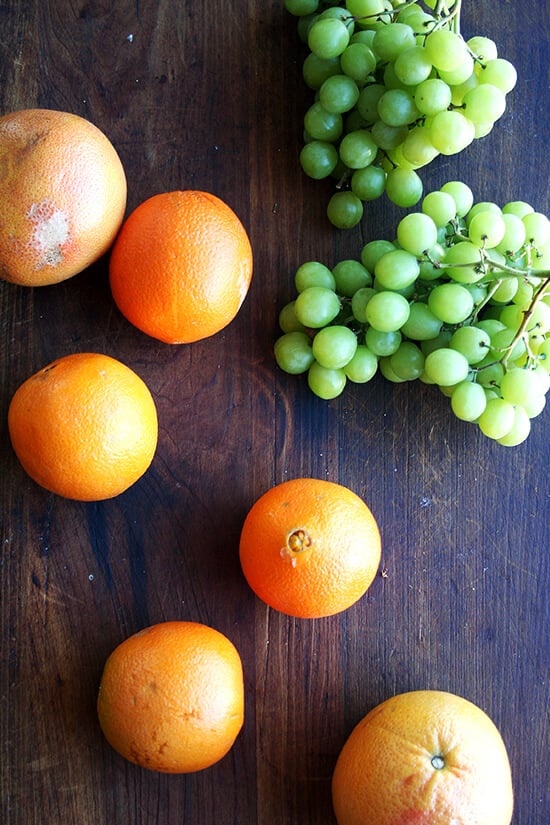
*Probably not technically a compote since it’s not cooked, but that was the title Gourmet gave to it back in 2003, so I’m sticking with it.

Description
- 6 navel oranges
- 2 large grapefruit
- 6 tablespoons sugar
- 1/2 lb. seedless green grapes ( 1 1/3 cups ), quartered lengthwise
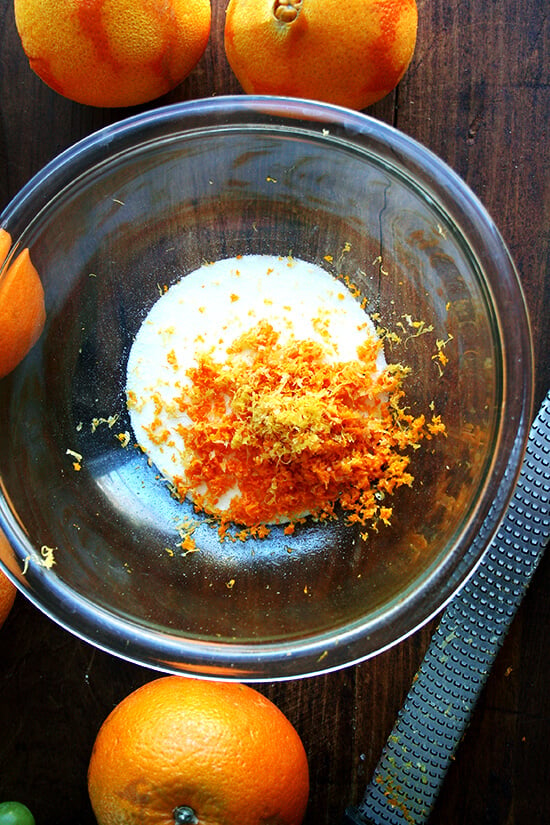
- Finely grate zest from 2 oranges and 1 grapefruit into a small bowl and stir in sugar. Massage with fingers to incorporate the zest and sugar together. Set aside.
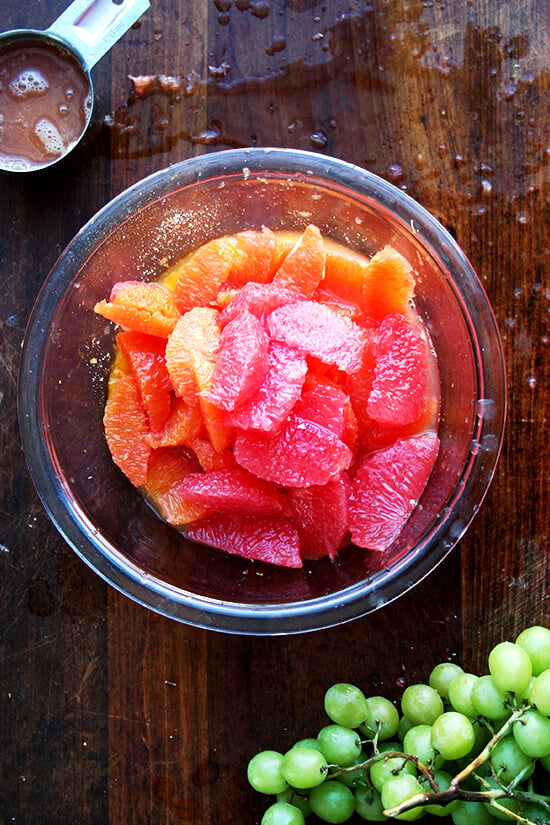
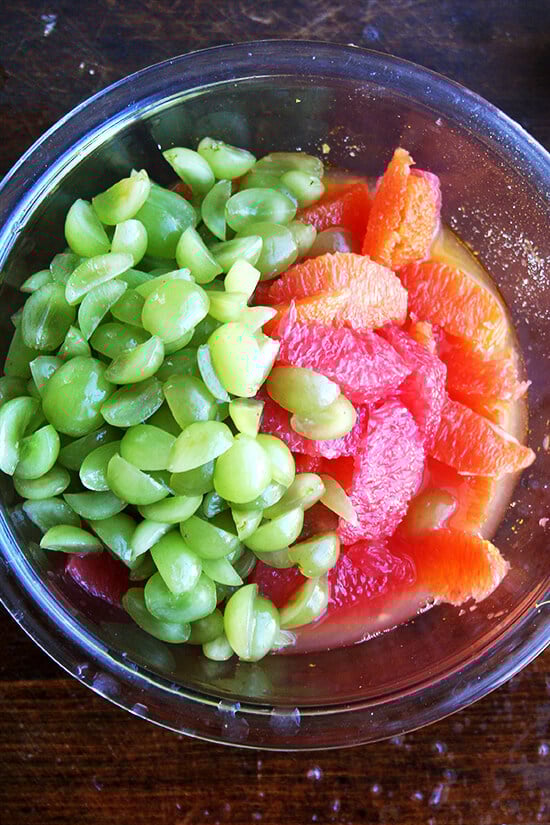
- Cut peel, including all white pith, from oranges and grapefruit with a sharp knife, then, working over a large bowl, cut segments free from membranes, letting segments fall into bowl. Squeeze enough juice from membranes to measure 1/2 cup, then add to citrus segments with grapes and 3 tablespoons of the citrus sugar. Very gently toss the fruit — some of the pieces inevitably will fall apart, which is OK — with a large spoon, and serve with remaining sugar on the side.
