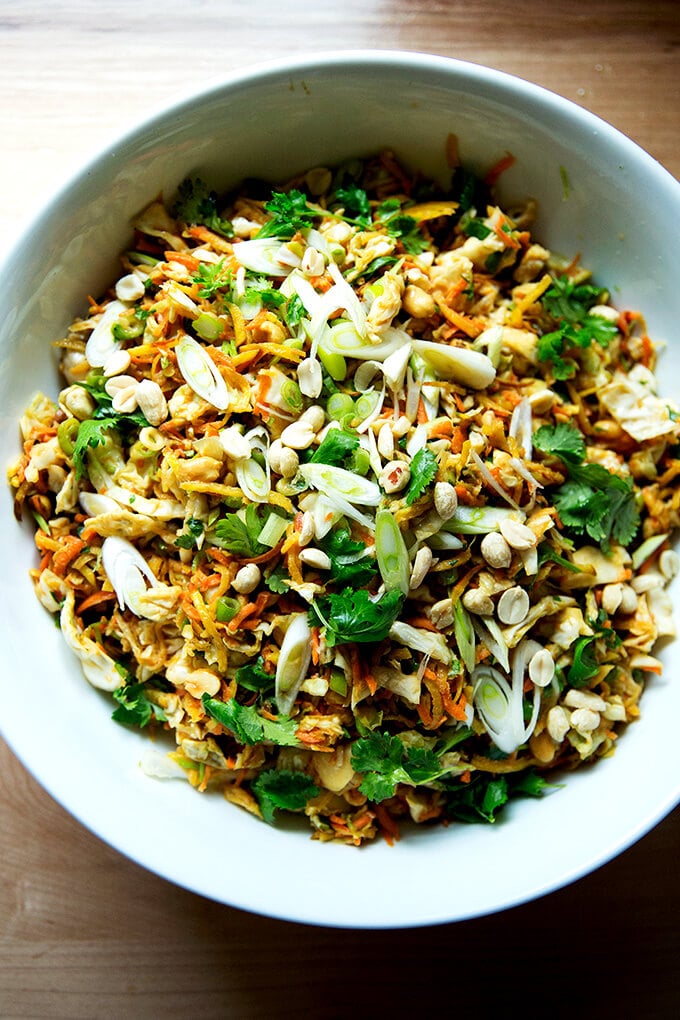
If you love Thai chicken satay or the peanut sauce that accompanies it, you will love this “chopped satay salad.” It’s essentially chopped vegetables + flavorful dressing + herbs + toasted nuts. It comes together relatively quickly (especially if you have a food processor) and is infinitely customizable given the produce you have access to at the moment as well as to your tastes and preferences.
I’ve been using cabbage, carrots, and raw beets*, but as the year moves on, I look forward to swapping in bell peppers, cucumbers, snap peas and other seasonal produce. I also could see bulking this up with noodles or leftover roast ( or poached ) chicken or crispy tofu, as here .
This salad comes from Liz Moody’s recently released cookbook, Healthier Together , which is all about, as the title suggests, cooking healthy meals together. But it’s not about cooking for a crowd or gathering the masses around the dinner table. Each recipes serves two: you and your cooking pal.
Why cooking for two?
Let’s back up. As a wellness blogger and editor, Liz often receives questions about what she eats. And while she is always happy to share the tips and tricks that have helped her on her wellness journey, she also always emphasizes the most important thing she has learned over the years: food is only one piece of the wellness puzzle.
She writes: “Oftentimes those who struggle on their wellness journey have failed to consider the missing piece: the people with whom they choose to journey. Once this piece slides into place, a healthy, satisfying picture emerges.”
From her own experience and through her observations, she has seen time and again that someone is more likely to set goals and stick to them when paired with someone else — a spouse, friend, partner, co-worker, or anybody else you love and trust. Makes sense, right?
So who is this book for?
- Anyone interested in plant-based cooking . This book does contain meat, but very little, and the recipes that do contain meat are easily adaptable to vegetarian cooking. It is filled with bright, fresh plant-based recipes.
- Anyone interested in making healthier choices in a holistic way — this is not a trendy diet book; it’s not about sacrifice. The book has already inspired me to add a few handfuls of spinach and a tablespoon of chia seeds to my favorite morning smoothie .
- Anyone in need of gluten-free and dairy-free recipes — every recipe in the book falls into each of these categories.
- Anyone in need of recipes for two .
All of this said, I would recommend this book to anyone who likes to cook in general but especially for someone interested in plant-based cooking. I didn’t know the recipes were gluten-free and dairy-free till I read the back cover, and all of the recipes are easily scalable for those looking to make larger quantities. I have my eye on a number of other recipes: Moroccan-ish Sunset Salad, General Tso’s Cauliflower, and Mexican Street Corn and Quinoa Bowl. As always, I’ll keep you posted.
How to Make Any Cabbage Salad Better
Salt + massage. Unless you are using a really soft cabbage, such as Napa and sometimes Savoy, cabbage can be very tough and stubborn, and as a result it will not absorb the dressing. If you salt it, briefly massage it, and set it aside for 10 minutes, it will be primed to receive any dressing you wish to toss it with. Here, for half a head of cabbage (roughly 1.5 pounds), I’m using 1/2 teaspoon kosher salt.
*Raw beets are a newish discovery for me, and I love them. They must be thinly sliced, either with a mandoline, as here , or with a box grater or food processor.
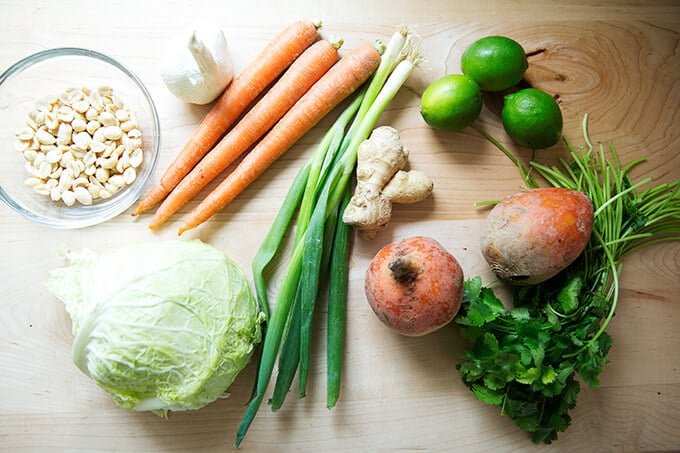
Here’s the play by play: Gather your ingredients.
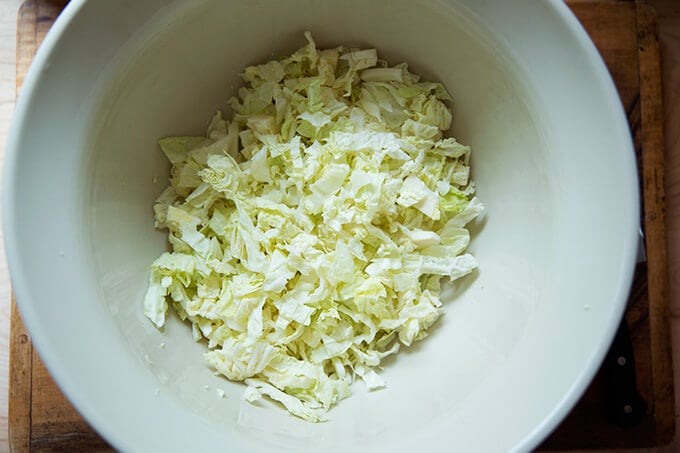
If your cabbage is tough, sprinkle it with salt, gently massage it, and set it aside for 10 minutes or so.
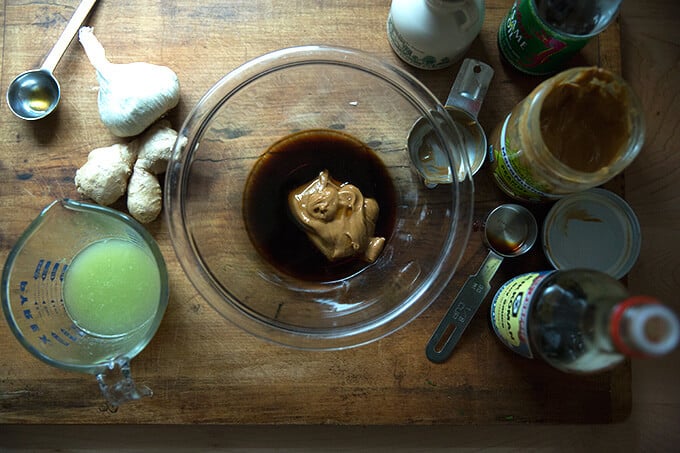
Whisk up the peanut dressing, a mix of fresh lime juice, soy sauce, peanut butter, sesame oil, maple syrup, ginger, and garlic.
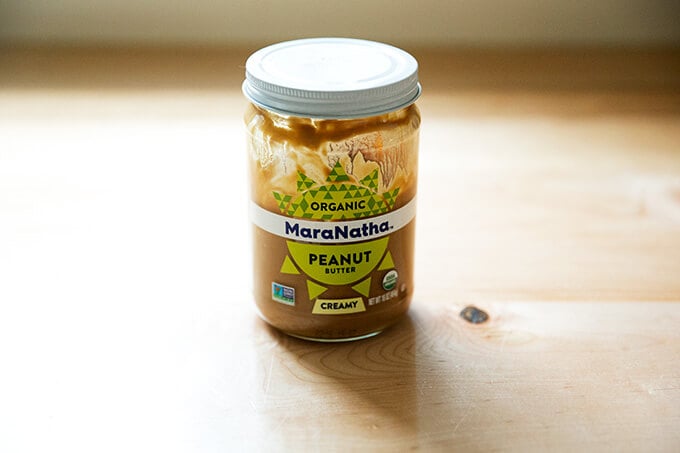
I’ve been loving this peanut butter. I also really love all of the Maranatha almond butters.
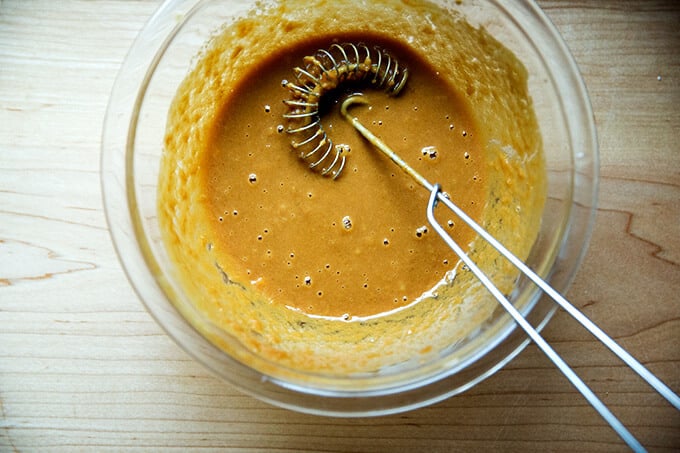
Thai peanut dressing. I get asked about this whisk a lot. It was a gift. This large whipper is similar.
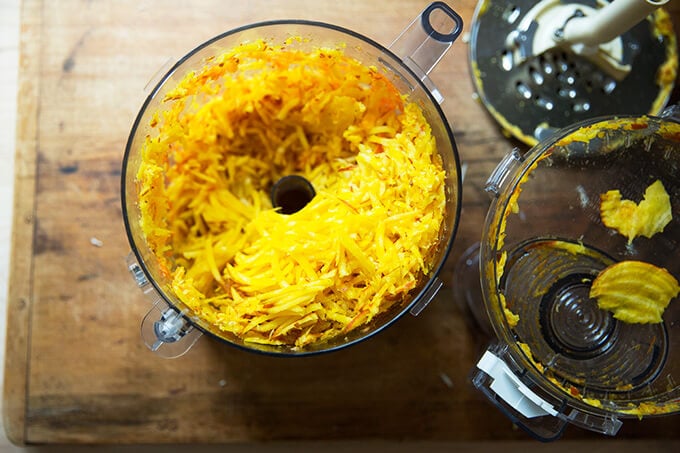
Shred the carrots and beets and any other tougher vegetable in the food processor fitted with the shredder attachment. I love my 14-cup Cuisinart .
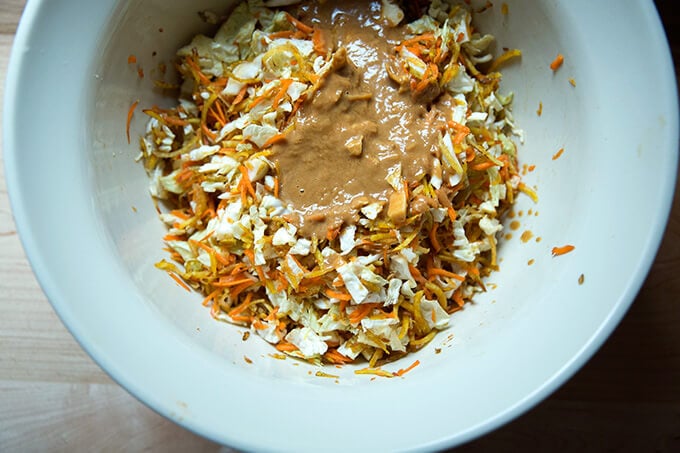
Toss with the dressing.
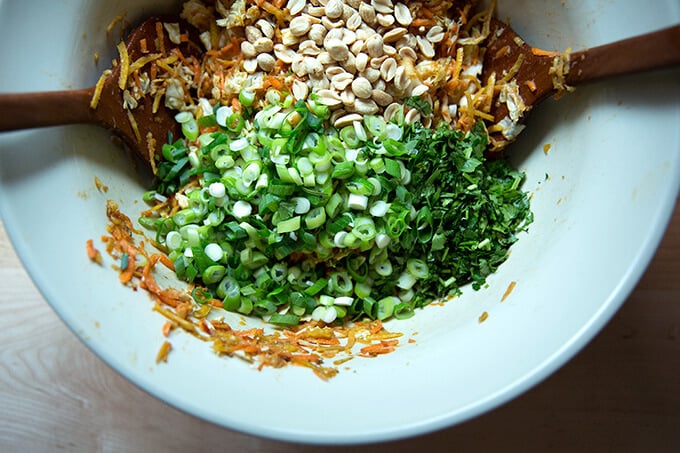
Add toasted peanuts, scallions, and cilantro.
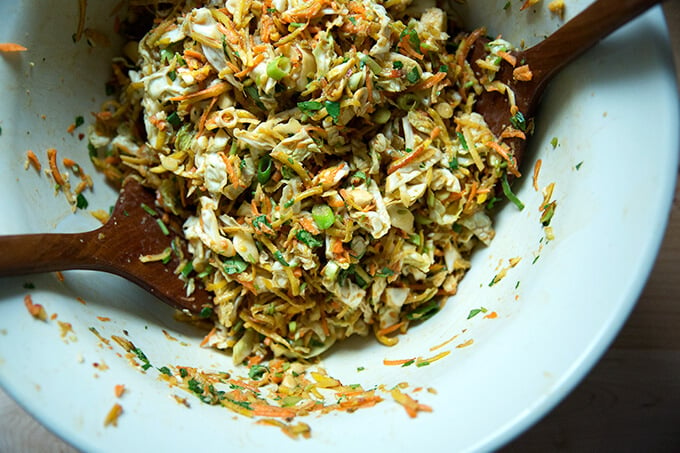
Toss again.
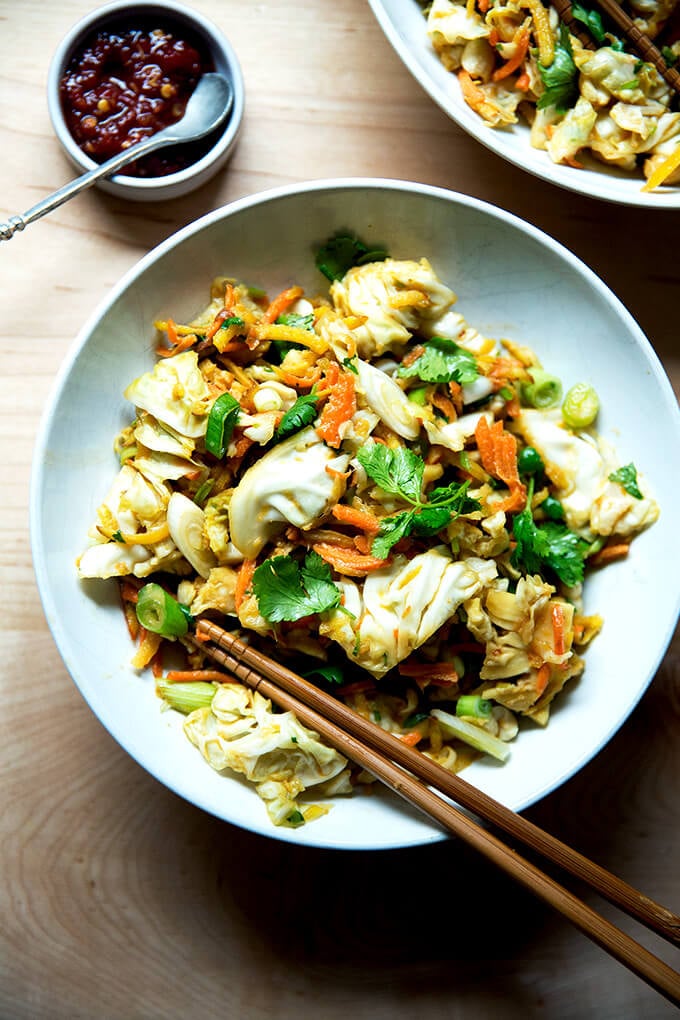
Serve with hot sauce on the side, if you wish.
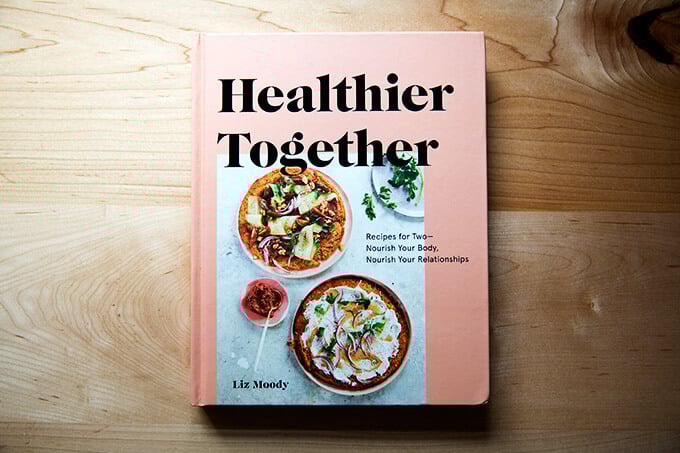
Liz Moody’s Healthier Together .
Description
Adapted from Healthier Together
A few notes:
Original recipe calls for red bell pepper, which I will absolutely use come summer time. I’ve used 2 raw golden beets here instead. I made this once with a couple of small red beets as well, and they work just as well as the golden beets, but if you use them, just know that the entire salad will be stained red.
Use the salad ingredient list as a guide — the dressing is so tasty and would complement so many different vegetables. If you don’t like cilantro, you can use parsley instead.
This salad could be bulked up with noodles or a shredded, cooked chicken breast, but you may need to double the dressing.
I love the Maranatha brand of peanut butter, and though I haven’t tried, I imagine the dressing would be just as good with almond butter or other nut butter. On that note, if you can’t eat peanuts, almonds or cashews would work well in their place.
1/2 cup raw, unsalted peanuts (or other nut)
1/2 head ( about 1.5 lbs.) green or red cabbage
1/2 teaspoon kosher salt, optional
2 – 3 carrots (about 1/2 lb.), unpeeled, ends trimmed
2 small beets (about 1 lb.), unpeeled, ends trimmed, see notes above
3 to 6 scallions, thinly sliced
1 cup fresh cilantro, roughly chopped
For the dressing:
- 1/4 cup peanut butter or other nut butter
- 3 tablespoons fresh lime juice
- 2 garlic cloves, finely minced or grated
- 2 teaspoons grated (or finely minced) fresh ginger
- 2 tablespoons soy sauce or tamari
- 1 tablespoon sesame oil
- 1 tablespoon maple syrup
- pinch cayenne, optional
- Flaky sea salt such as Maldon
- Make the salad: Heat the oven to 350ºF. Spread the peanuts out in a single layer on a small baking dish. Transfer pan to oven and toast till lightly golden, about 10 minutes.
- Shred the cabbage finely and transfer to a large bowl. If your cabbage is a little tough, sprinkle it with the 1/2 teaspoon salt. Toss. Briefly massage. Set aside.
- Fix your food processor with the shredder attachment. Send the carrots down the food chute and shred. Transfer to bowl with cabbage. Repeat with beets, transferring beets to the bowl as well.
- Make the dressing. In a medium bowl, stir together the peanut butter, lime juice, ginger, garlic, soy sauce, sesame oil, and maple syrup. Season with a pinch of sea salt. Stir until smooth. If necessary, thin with water a tablespoon at a time. Consistently, I’ve been adding 2 tablespoons of water.
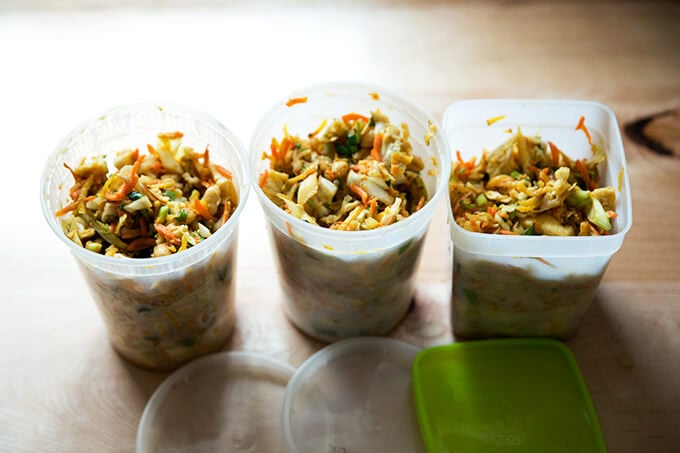
- Add dressing to the bowl with the cabbage, carrots and beets. Toss to coat. Add the scallions, cilantro, and peanuts, and toss again. Serve or transfer to storage containers and store in fridge.
- Prep Time: 25 minutes
- Category: Salad
- Method: Chopped
- Cuisine: Asian
If you love Thai chicken satay or the peanut sauce that accompanies it, you will love this “chopped satay salad.” It’s essentially chopped vegetables + flavorful dressing + herbs + toasted nuts. It comes together relatively quickly (especially if you have a food processor) and is infinitely customizable given the produce you have access to at the moment as well as to your tastes and preferences.
I’ve been using cabbage, carrots, and raw beets*, but as the year moves on, I look forward to swapping in bell peppers, cucumbers, snap peas and other seasonal produce. I also could see bulking this up with noodles or leftover roast ( or poached ) chicken or crispy tofu, as here .
This salad comes from Liz Moody’s recently released cookbook, Healthier Together , which is all about, as the title suggests, cooking healthy meals together. But it’s not about cooking for a crowd or gathering the masses around the dinner table. Each recipes serves two: you and your cooking pal.
Why cooking for two?
Let’s back up. As a wellness blogger and editor, Liz often receives questions about what she eats. And while she is always happy to share the tips and tricks that have helped her on her wellness journey, she also always emphasizes the most important thing she has learned over the years: food is only one piece of the wellness puzzle.
She writes: “Oftentimes those who struggle on their wellness journey have failed to consider the missing piece: the people with whom they choose to journey. Once this piece slides into place, a healthy, satisfying picture emerges.”
From her own experience and through her observations, she has seen time and again that someone is more likely to set goals and stick to them when paired with someone else — a spouse, friend, partner, co-worker, or anybody else you love and trust. Makes sense, right?
So who is this book for?
- Anyone interested in plant-based cooking . This book does contain meat, but very little, and the recipes that do contain meat are easily adaptable to vegetarian cooking. It is filled with bright, fresh plant-based recipes.
- Anyone interested in making healthier choices in a holistic way — this is not a trendy diet book; it’s not about sacrifice. The book has already inspired me to add a few handfuls of spinach and a tablespoon of chia seeds to my favorite morning smoothie .
- Anyone in need of gluten-free and dairy-free recipes — every recipe in the book falls into each of these categories.
- Anyone in need of recipes for two .
All of this said, I would recommend this book to anyone who likes to cook in general but especially for someone interested in plant-based cooking. I didn’t know the recipes were gluten-free and dairy-free till I read the back cover, and all of the recipes are easily scalable for those looking to make larger quantities. I have my eye on a number of other recipes: Moroccan-ish Sunset Salad, General Tso’s Cauliflower, and Mexican Street Corn and Quinoa Bowl. As always, I’ll keep you posted.
How to Make Any Cabbage Salad Better
Salt + massage. Unless you are using a really soft cabbage, such as Napa and sometimes Savoy, cabbage can be very tough and stubborn, and as a result it will not absorb the dressing. If you salt it, briefly massage it, and set it aside for 10 minutes, it will be primed to receive any dressing you wish to toss it with. Here, for half a head of cabbage (roughly 1.5 pounds), I’m using 1/2 teaspoon kosher salt.
*Raw beets are a newish discovery for me, and I love them. They must be thinly sliced, either with a mandoline, as here , or with a box grater or food processor.
Here’s the play by play: Gather your ingredients.
If your cabbage is tough, sprinkle it with salt, gently massage it, and set it aside for 10 minutes or so.
Whisk up the peanut dressing, a mix of fresh lime juice, soy sauce, peanut butter, sesame oil, maple syrup, ginger, and garlic.
I’ve been loving this peanut butter. I also really love all of the Maranatha almond butters.
Thai peanut dressing. I get asked about this whisk a lot. It was a gift. This large whipper is similar.
Shred the carrots and beets and any other tougher vegetable in the food processor fitted with the shredder attachment. I love my 14-cup Cuisinart .
Toss with the dressing.
Add toasted peanuts, scallions, and cilantro.
Toss again.
Serve with hot sauce on the side, if you wish.
Liz Moody’s Healthier Together .
Description
Adapted from Healthier Together
A few notes:
Original recipe calls for red bell pepper, which I will absolutely use come summer time. I’ve used 2 raw golden beets here instead. I made this once with a couple of small red beets as well, and they work just as well as the golden beets, but if you use them, just know that the entire salad will be stained red.
Use the salad ingredient list as a guide — the dressing is so tasty and would complement so many different vegetables. If you don’t like cilantro, you can use parsley instead.
This salad could be bulked up with noodles or a shredded, cooked chicken breast, but you may need to double the dressing.
I love the Maranatha brand of peanut butter, and though I haven’t tried, I imagine the dressing would be just as good with almond butter or other nut butter. On that note, if you can’t eat peanuts, almonds or cashews would work well in their place.
1/2 cup raw, unsalted peanuts (or other nut)
1/2 head ( about 1.5 lbs.) green or red cabbage
1/2 teaspoon kosher salt, optional
2 – 3 carrots (about 1/2 lb.), unpeeled, ends trimmed
2 small beets (about 1 lb.), unpeeled, ends trimmed, see notes above
3 to 6 scallions, thinly sliced
1 cup fresh cilantro, roughly chopped
For the dressing:
- 1/4 cup peanut butter or other nut butter
- 3 tablespoons fresh lime juice
- 2 garlic cloves, finely minced or grated
- 2 teaspoons grated (or finely minced) fresh ginger
- 2 tablespoons soy sauce or tamari
- 1 tablespoon sesame oil
- 1 tablespoon maple syrup
- pinch cayenne, optional
- Flaky sea salt such as Maldon
- Make the salad: Heat the oven to 350ºF. Spread the peanuts out in a single layer on a small baking dish. Transfer pan to oven and toast till lightly golden, about 10 minutes.
- Shred the cabbage finely and transfer to a large bowl. If your cabbage is a little tough, sprinkle it with the 1/2 teaspoon salt. Toss. Briefly massage. Set aside.
- Fix your food processor with the shredder attachment. Send the carrots down the food chute and shred. Transfer to bowl with cabbage. Repeat with beets, transferring beets to the bowl as well.
- Make the dressing. In a medium bowl, stir together the peanut butter, lime juice, ginger, garlic, soy sauce, sesame oil, and maple syrup. Season with a pinch of sea salt. Stir until smooth. If necessary, thin with water a tablespoon at a time. Consistently, I’ve been adding 2 tablespoons of water.
- Add dressing to the bowl with the cabbage, carrots and beets. Toss to coat. Add the scallions, cilantro, and peanuts, and toss again. Serve or transfer to storage containers and store in fridge.
- Prep Time: 25 minutes
- Category: Salad
- Method: Chopped
- Cuisine: Asian
Description
Adapted from Healthier Together
A few notes:
Original recipe calls for red bell pepper, which I will absolutely use come summer time. I’ve used 2 raw golden beets here instead. I made this once with a couple of small red beets as well, and they work just as well as the golden beets, but if you use them, just know that the entire salad will be stained red.
Use the salad ingredient list as a guide — the dressing is so tasty and would complement so many different vegetables. If you don’t like cilantro, you can use parsley instead.
This salad could be bulked up with noodles or a shredded, cooked chicken breast, but you may need to double the dressing.
I love the Maranatha brand of peanut butter, and though I haven’t tried, I imagine the dressing would be just as good with almond butter or other nut butter. On that note, if you can’t eat peanuts, almonds or cashews would work well in their place.
1/2 cup raw, unsalted peanuts (or other nut)
1/2 head ( about 1.5 lbs.) green or red cabbage
1/2 teaspoon kosher salt, optional
2 – 3 carrots (about 1/2 lb.), unpeeled, ends trimmed
2 small beets (about 1 lb.), unpeeled, ends trimmed, see notes above
3 to 6 scallions, thinly sliced
1 cup fresh cilantro, roughly chopped
For the dressing:
- 1/4 cup peanut butter or other nut butter
- 3 tablespoons fresh lime juice
- 2 garlic cloves, finely minced or grated
- 2 teaspoons grated (or finely minced) fresh ginger
- 2 tablespoons soy sauce or tamari
- 1 tablespoon sesame oil
- 1 tablespoon maple syrup
- pinch cayenne, optional
- Flaky sea salt such as Maldon
- Make the salad: Heat the oven to 350ºF. Spread the peanuts out in a single layer on a small baking dish. Transfer pan to oven and toast till lightly golden, about 10 minutes.
- Shred the cabbage finely and transfer to a large bowl. If your cabbage is a little tough, sprinkle it with the 1/2 teaspoon salt. Toss. Briefly massage. Set aside.
- Fix your food processor with the shredder attachment. Send the carrots down the food chute and shred. Transfer to bowl with cabbage. Repeat with beets, transferring beets to the bowl as well.
- Make the dressing. In a medium bowl, stir together the peanut butter, lime juice, ginger, garlic, soy sauce, sesame oil, and maple syrup. Season with a pinch of sea salt. Stir until smooth. If necessary, thin with water a tablespoon at a time. Consistently, I’ve been adding 2 tablespoons of water.
- Add dressing to the bowl with the cabbage, carrots and beets. Toss to coat. Add the scallions, cilantro, and peanuts, and toss again. Serve or transfer to storage containers and store in fridge.
- Prep Time: 25 minutes
- Category: Salad
- Method: Chopped
- Cuisine: Asian
Find it online : https://alexandracooks.com/2019/04/11/chopped-thai-satay-salad-with-peanut-ginger-dressing/
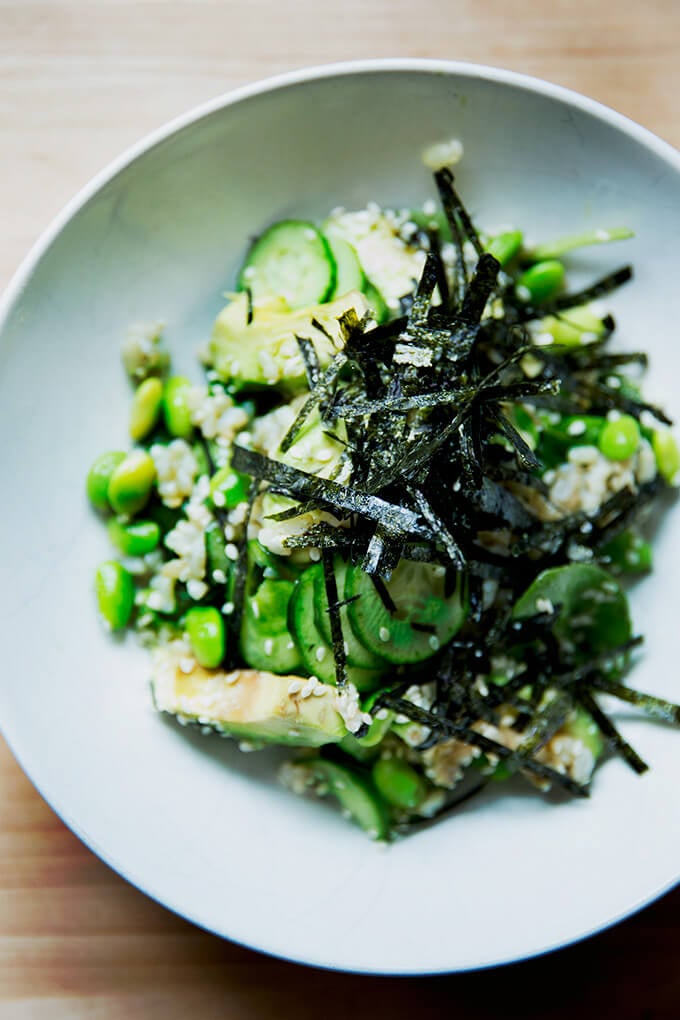
Once — just once — I made sushi. Twice — just last week — I made this sushi salad, and I foresee making it a lot because it’s so easy and good.
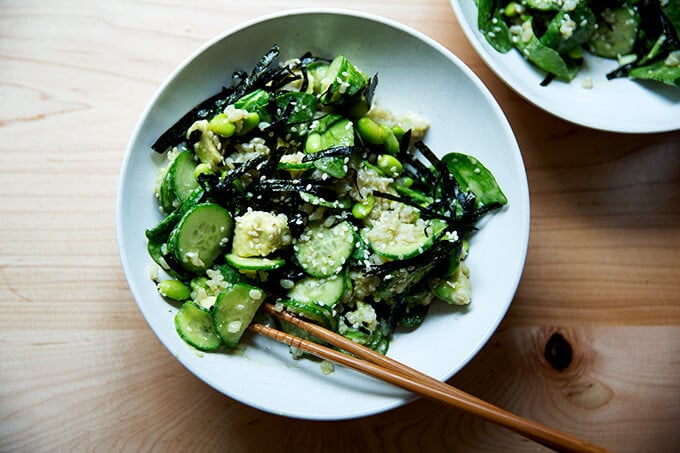
It’s a mix of brown rice, edamame, spinach, avocado, and cucumbers all tossed with a miso dressing, then finished with slivered nori and sesame seeds. It satisfies all of my cravings for sushi without the hassle of making it.
The recipe comes from Hetty McKinnon’s new book, Family , and I first tasted it a week ago at Cherry Bombe Jubilee, where Hetty herself prepared the salad for the many attendees. It was a beautiful site: a sea of green mounds, each artfully plated, each glistening with nori and sparkling with sesame seeds.
I returned home and made it immediately, and then on Friday evening, I had a few friends over for dinner and made it again. What I love about this salad is that you can prep nearly every component of the dish ahead of time: the brown rice, the miso dressing, the edamame, the sliced cucumbers, the slivered nori. All you have to do when your guests (or family) arrive is cut the avocado.
You can assemble this salad as you would any by tossing everything together with the dressing, but on Friday, I let my friends assemble their own bowls. It was easy and fun, and everyone loved how fresh, satisfying, and delicious the composition tasted as a whole. One tip: don’t skimp on the nori. When you get a bite without it, you miss it.
Hetty McKinnon, if you are unfamiliar, is the author of two best-selling cookbooks and the founder of Arthur Street Kitchen . She also writes The Community Kitchen column on The Guardian. Family , like her previous two books, challenges the idea that vegetables cannot be a full-sized meal; it’s filled with vegetarian main course meals.
I love what she says in the introduction:
“As a child, I don’t remember my mum ever telling us to “eat your vegetables.” We ate our greens with the same enthusiasm as we ate our noodles, rice, or meat. In Asian cooking, as in many other cultures, vegetables are an integral part of the dish, not a sideshow.”
The recipes in Family are not all Asian, though there is a chapter, “Asian Roots”, dedicated to the food closest to her heart. There are so many recipes in this book I want to make from the Turkish menemen (egg dish) to the one-pan sweet potato mac n cheese to the coconut soup with Asian greens and rice noodles. Each recipe is accompanied by a big beautiful photograph, making the book equally good for curling up on the couch to as pulling out for some instant dinner inspiration.
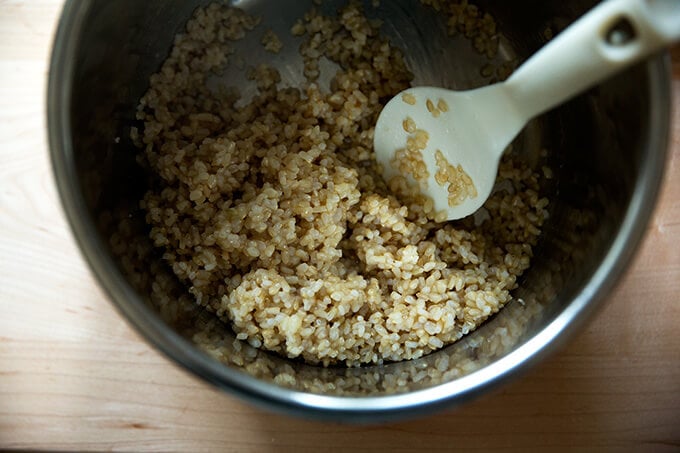
Here’s the play by play: You need about 3 cups cooked rice for this. I’m using my Instant pot brown rice recipe here.
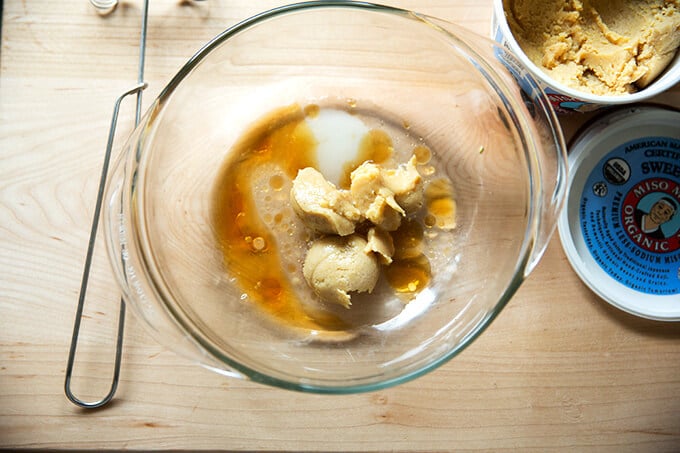
Making the dressing: miso, mirin, sesame oil, sugar, water, and sesame seeds.
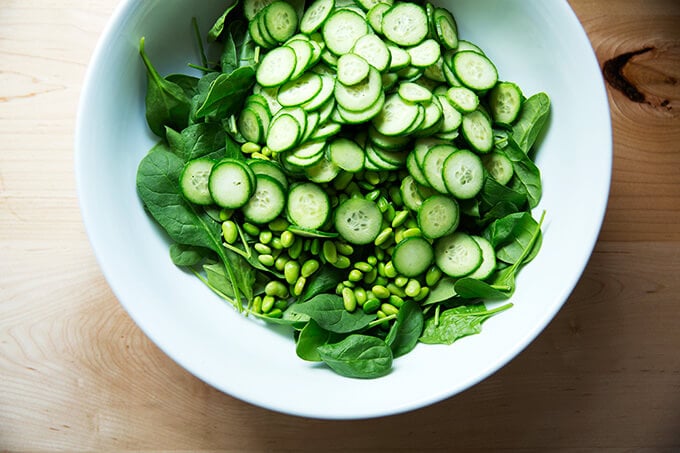
Some of the components: spinach, edamame, sliced cucumber.
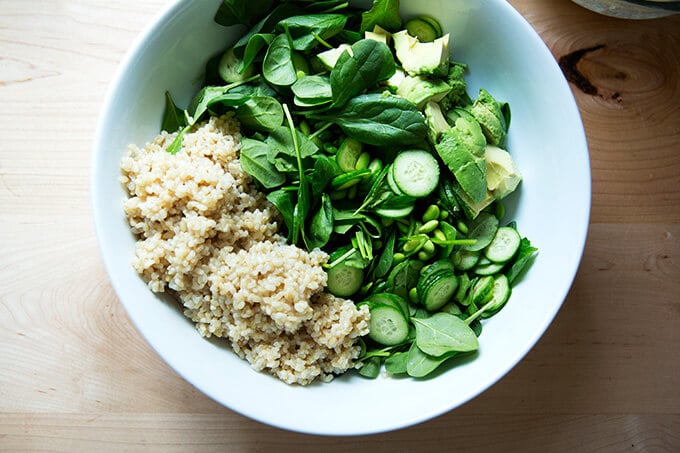
Brown rice and avocado added to the mix:
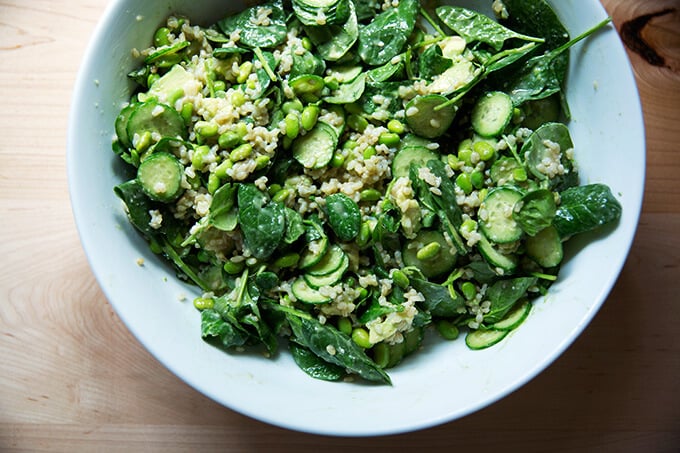
All tossed together with the miso dressing.
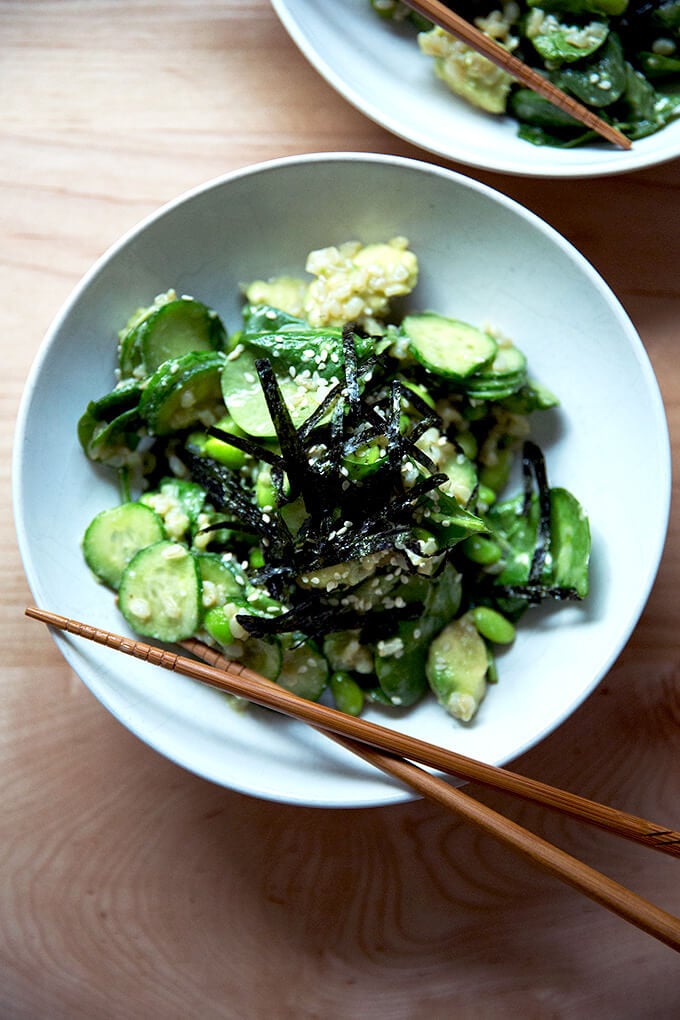
Finished with nori and sesame seeds.
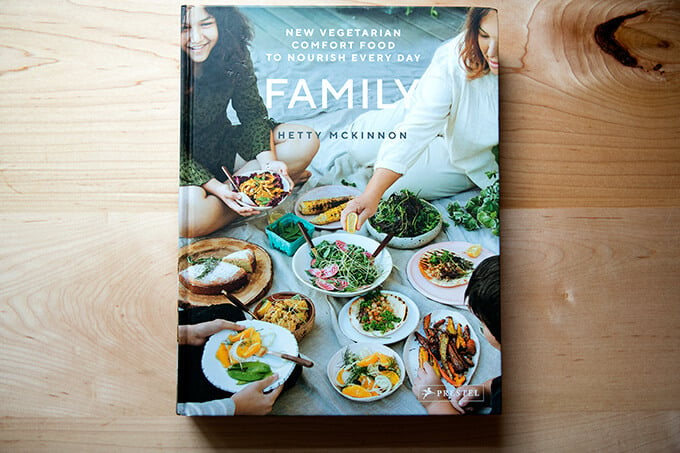
Family by Hetty McKinnon.
Description
From Hetty McKinnon’s Family
You need about 3 cups of cooked rice for this salad. I make mine in the Instant Pot . Instructions are included in the recipe below as well. You can make the rice a day in advance.
The beauty of this salad is that you can prep everything ahead of time with the exception of cutting the avocado. You may want to double the dressing. I’ve been doing this, and it has been so nice to have on hand, especially when you have leftover rice, edamame, lettuce, etc. on hand — makes for such a satisfying and fast lunch. On subsequent days, you may need to thin the dressing with more water.
- 1 cup short grain brown rice (or 3 cups cooked rice), see notes above
- 1 – 2 cups frozen, shelled edamame
- 4 Persian or small cucumbers, thinly sliced into rounds
- 2 avocados, peeled and sliced
- a few handfuls baby spinach or other tender greens
- olive oil, optional
- 1 tablespoon sesame seeds
- 4 toasted nori seaweed sheets, cut into thin slices
- sea salt, such as Maldon
For the dressing:
- 3 tablespoons miso paste (I’ve been using sweet white miso)
- 1 tablespoon toasted sesame oil
- 1 tablespoon mirin
- 1 teaspoon sugar
- 1 teaspoon sesame seeds
- 1 – 2 tablespoons water or more as needed
- To make the rice in an Instant Pot : Place the rice, 1.5 cups water, and 3/4 teaspoon kosher salt in the inner pot of your Instant Pot. Secure lid in place. Turn valve to Sealing. Select manual, high pressure, and adjust the time to 23 minutes. When the time has lapsed, allow the pressure to release naturally, which is when the silver button on the lid drops. Remove the lid, and allow the rice to cool. This can be done far in advance (including the day before).
- Cook the edamame. Bring a medium pot of salted water to a boil and add the edamame. Cook for 1 minute or until they are tender yet still crunchy. Drain and run under cold water.
- Make the dressing . Whisk together the miso paste, sesame oil, mirin, sugar, and 1 to 2 tablespoons water until smooth. Add more water by the tablespoon until the dressing is the consistency of cream — it should be pourable. (I’ve consistently been adding 2 more tablespoons of water.) Stir in the sesame seeds. Taste. Add a sprinkling of sea salt if necessary.
- Assemble the salad . You can assemble this salad in various ways. Most recently when I served it to friends, I set out all of the components in bowls and let people assemble their own bowl. But you can also combine everything in one large bowl. Here’s how: In a large bowl, combine the rice, edamame, cucumber, avocado, and baby spinach. Toss together gently. To serve, transfer salad to bowls or plates, drizzle over the dressing, a little olive oil (if you wish), and a sprinkling of sea salt. Top with the nori strips and sesame seeds.
- Prep Time: 20 minutes
- Cook Time: 23 minutes
- Category: Dinner
- Method: Salad
- Cuisine: Japanese
